

GCSE Business Results Day Wrong Grade: What to Do
GCSE business results day wrong grade? Learn what to check in the first hour, how script access and marking reviews work, and what to ask at school today.
A results sheet can change the atmosphere of a room in seconds. You expected one grade in GCSE Business and received another. Perhaps it is below your mock result, below your predicted grade or just inconsistent with how the papers felt.
If you are searching for gcse business results day wrong grade advice, the immediate answer is simple: do not assume the result is incorrect, but do not ignore your concern either. Check the details, speak to your Business teacher or exams officer, record the deadlines and ask whether your marked scripts should be accessed before a review is requested.
A surprising grade is a reason to investigate calmly. It is not, by itself, proof of a marking error.
Your first-hour results day checklist
During the first hour, focus on preserving information and finding the person who can act. You do not need to decide everything immediately.
- Check that the qualification and result belong to you.
- Confirm the exam board, such as Edexcel, AQA, OCR or Eduqas.
- Ask for your component or paper marks if they are available.
- Find out how far your overall mark is from the relevant grade boundary.
- Speak to your Business teacher, head of department or exams officer.
- Ask whether the school recommends accessing your marked scripts.
- Record the school's internal deadline for post-results requests.
- Explain immediately if the result affects a sixth-form, college or apprenticeship offer.
- Do not sign a review request until you understand that the mark can rise, stay unchanged or fall.
Take a photograph or secure digital copy of every results document you receive. Write down names, instructions and dates while they are fresh. Results day is emotionally loud; memory is not always reliable under pressure.
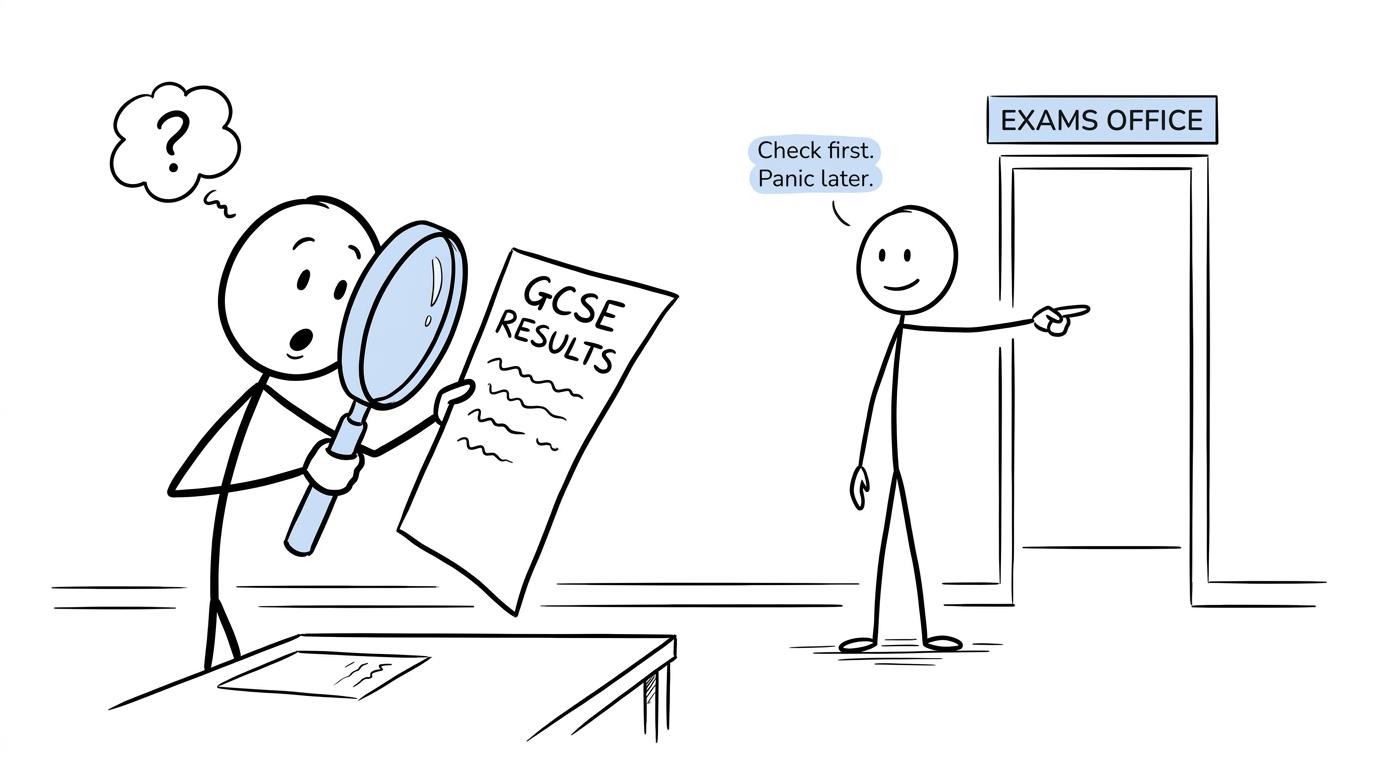 A student calmly investigates a surprising GCSE grade with help from a teacher
First, check whether the result is actually unexpected
Predicted and mock grades are useful estimates, not promises. Mock papers may use different boundaries, cover less content or be marked under different conditions. Predicted grades also reflect teacher judgement rather than a guaranteed exam outcome.
That means a difference between a prediction and the final result does not automatically show that something has gone wrong. The better question is whether there is evidence of a possible administrative or marking error.
Useful warning signs include:
- a paper or component appearing to have no mark when you completed it;
- an unusually low mark compared with your other Business components;
- a total that does not appear to match the component information;
- a teacher identifying responses that may not have been credited correctly;
- approved special consideration or access arrangements apparently not being reflected as expected;
- your result being very close to the next grade boundary.
Being close to a boundary does not prove that marks should change. It simply helps you and your teacher judge the possible benefit and risk of reviewing a particular paper.
Check the entry details
Make sure you are looking at the correct qualification. Schools may offer GCSE Business or another business-related qualification with different assessment arrangements. Confirm the exact title, exam board, specification and candidate details before comparing your result with published boundaries.
Grade boundaries are set for a particular exam series and specification. A boundary from an old paper, another board or an online estimate is not the right comparison. The boundary itself cannot be appealed merely because it feels high.
Speak to the school before contacting the exam board
For most GCSE candidates, post-results requests are made through the school or college. Exam boards generally do not accept review requests directly from students. Private candidates are an exception and may be able to approach the awarding organisation themselves or work through the centre where they sat the examination.
Ask your exams officer these questions:
- What was my mark on each examined component?
- How many marks am I from the next grade boundary?
- Can my Business teacher inspect an accessible copy of the script?
- Which post-results service would be appropriate?
- What is the school's internal deadline?
- Is there a fee, and who pays it?
- What happens to my sixth-form or college place while we wait?
- How can I appeal if the school decides not to request a review?
Schools must give students a route to appeal an internal decision not to request a marking review. Follow the school's published procedure and act promptly rather than relying on an informal conversation.
Understand the post-results options
The phrase “remark” is commonly used, but the official services are more precise. Choosing the right one depends on what may have gone wrong.
Access to scripts
Your school can request access to a marked examination script with your permission. A Business teacher can then compare the responses with the mark scheme and look for missed answers, unreasonable marking or places where the mark scheme may not have been applied correctly.
This is often the most informative first step. A disappointing total creates suspicion; a script provides evidence.
Accessing a script does not itself change the result. It helps the school decide whether a formal review is justified. Availability and deadlines depend on the board and the way the script was marked, so ask the exams officer what can be obtained and how quickly.
Administrative error review
This service, also commonly described as a clerical re-check, checks administrative processes. It can establish whether every question was marked and whether marks were totalled and recorded correctly.
It does not reconsider academic judgement in the same way as a review of marking. It may be suitable when the concern is an omitted page, an incorrect total or a mark that was not transferred properly.
Review of marking
A review of marking asks an independent reviewer to inspect the original marking and correct identified errors. It is not an opportunity to award extra marks simply because a student was close to the boundary. The reviewer considers whether the agreed mark scheme was applied correctly and whether the original academic judgement was reasonable.
Your written consent is required because the mark and grade can go down, remain the same or go up. Discuss the script and the size of any potential change with your teacher before agreeing.
For summer 2026, official guidance says non-priority reviews generally have deadlines in late September, but each board publishes its own dates and schools usually set earlier internal deadlines. Do not wait for the final national date. Ask your exams officer on results day.
Priority GCSE reviews are not universally offered by every board. Current Ofqual guidance states that Pearson offers a priority review for GCSEs, while priority arrangements differ elsewhere. Tell your school immediately if progression depends on the result so that it can check the correct service for your qualification.
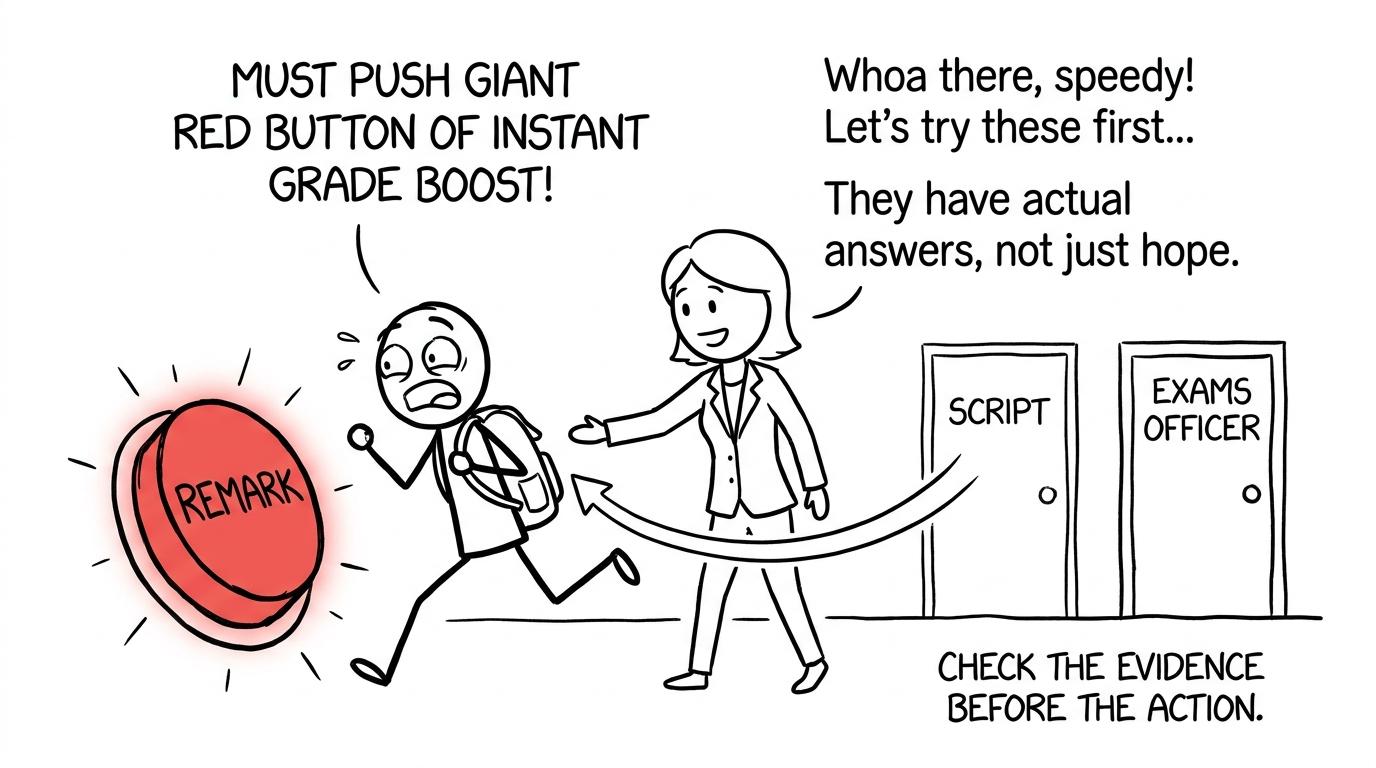 A teacher redirects a student from a giant remark button towards evidence and the exams office
If the grade affects your next step
A result matters most when it changes what happens next. If your sixth form, college or apprenticeship expected a particular Business grade, contact the provider on results day. Explain that you are speaking to your school about a possible post-results review and ask whether your place can be held or whether an alternative offer is available.
Do not wait for a review outcome before making contact. A provider cannot consider information it has not received.
Keep evidence of emails and note the time and substance of telephone calls. Your school may also be willing to contact the provider or supply confirmation that a review request is being considered.
If Business is disappointing but your maths grade also affects progression, deal with each result separately. MathsGenie's GCSE maths resit results day plan explains how to confirm your future exam arrangements and turn a result into a practical revision route.
What happens after a review?
There are three possible outcomes: your mark is raised, confirmed or lowered. A changed mark does not necessarily produce a changed grade because it may remain within the same grade boundary range.
If the review does not resolve a well-founded concern, your school may be able to appeal to the exam board. Appeals concern possible marking, moderation or procedural errors; they are not a second chance simply because the result is disappointing. After the awarding organisation's final appeal stage, an eligible case may be taken to Ofqual's Exam Procedures Review Service. Ofqual checks whether the correct procedures and regulatory rules were followed; it does not re-mark the paper or directly award a new grade.
Ask your school for the outcome in writing and for the deadline governing any next stage.
Common mistakes when a GCSE Business grade looks wrong
Treating the predicted grade as proof
A prediction is evidence of prior performance, but it does not establish that the final marking was incorrect. Component marks and the script are more useful.
Requesting a review without teacher input
A review carries downside as well as upside. Where possible, ask an experienced Business teacher to inspect the script and identify specific concerns first.
Comparing the result with the wrong boundary
Use the boundary for the correct board, specification and exam series. Do not rely on boundaries from a mock, predicted paper or previous year.
Missing the school's deadline
The exam board's published closing date may not be your practical deadline. Schools need time to collect consent, payment and evidence, so their internal date can be earlier.
Assuming a review cannot lower the grade
There is no general grade protection for a marking review. You must give informed written consent because the final mark may move in either direction.
Ignoring progression while waiting
Contact the sixth form, college or apprenticeship provider immediately. A post-results process and a progression conversation should happen alongside each other.
Use the result as information, not identity
Once the urgent decisions are handled, results day becomes less about judgement and more about direction. If maths remains part of your next step, use the free MathsGenie GCSE maths revision hub to move from uncertainty to a repeatable plan.
Start with one diagnostic paper, then follow the process in how to use GCSE past papers properly. Mark it carefully, identify weak topics and repair them with revision lessons and practice questions. Edexcel GCSE maths mini tests offer shorter timed checks, while GCSE predicted papers provide additional exam-style practice alongside official past papers.
If time is limited, the twenty-minute GCSE maths revision routine creates a manageable cycle of recall, practice, marking and correction. If you are unsure whether repeating a paper will help, read the guide to redoing GCSE maths past papers before choosing your next task.
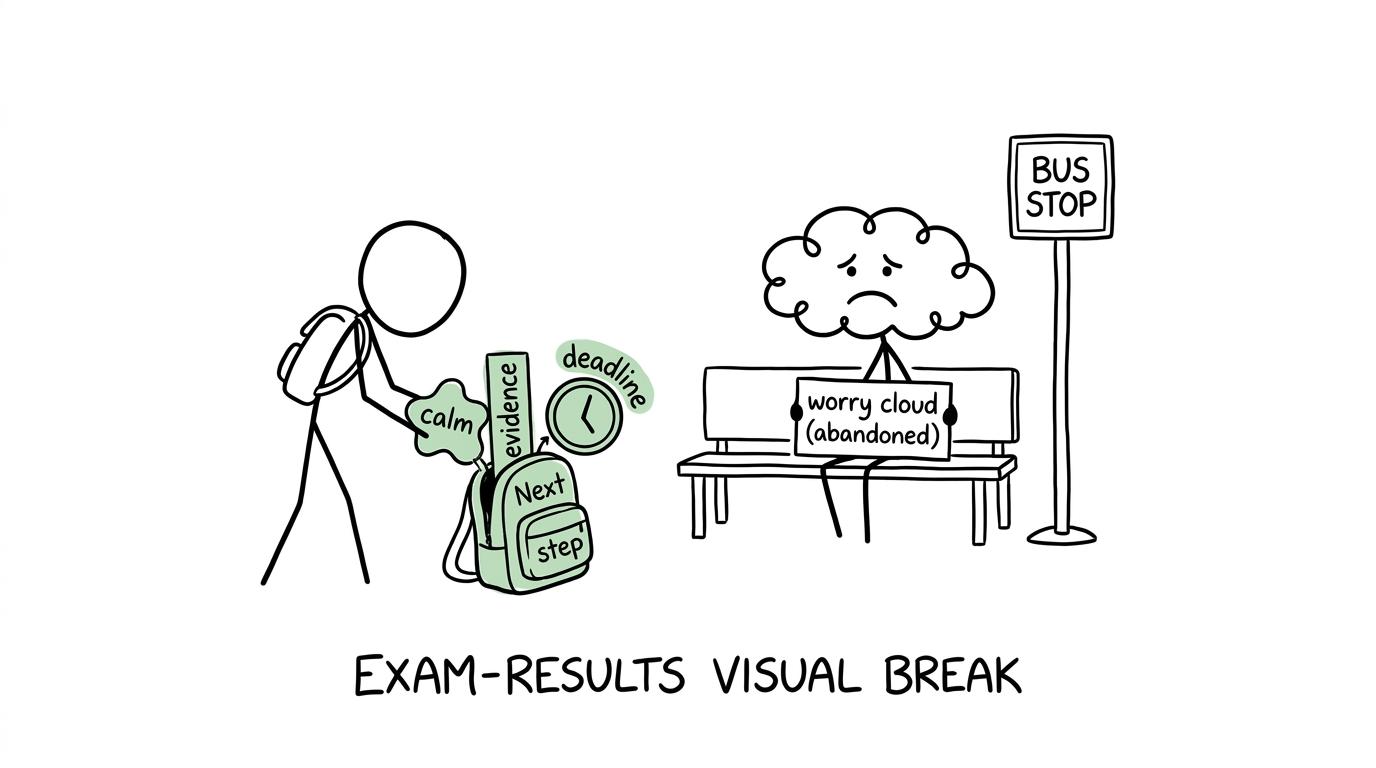 A student packs calm, evidence and deadlines for the next step after results day
Make the next calm decision
A surprising GCSE Business grade deserves attention, not instant certainty. In the first hour, verify the result, collect the marks, speak to your teacher and exams officer, note the deadlines and explain any effect on your next destination. Then use the marked script and professional advice to decide whether an administrative check or review of marking is proportionate.
After that, turn towards what you can control. MathsGenie gives you free revision lessons, practice questions, mini tests, past papers, predicted papers, mark schemes and video solutions to prepare for the next exam, course or resit. One grade may shape today's conversation. Your next informed action shapes what happens after it.











