GCSE Business Remark: When to Request One
GCSE business remark guide: understand reviews of marking, grade boundaries, risks, deadlines and appeals before asking your school to apply after results day.

Results day can turn a handful of marks into a very large decision. If your result is lower than expected, a GCSE Business remark may be worth considering, especially when you are close to the next grade boundary and a teacher can identify a possible marking error.
But a remark is not a request for generosity. Officially, it is a review of marking: an independent reviewer checks whether the original mark scheme was applied correctly. Your mark can rise, remain unchanged or fall. The right response is therefore not to rush. It is to gather evidence quickly and make a measured decision with your teacher and exams officer.
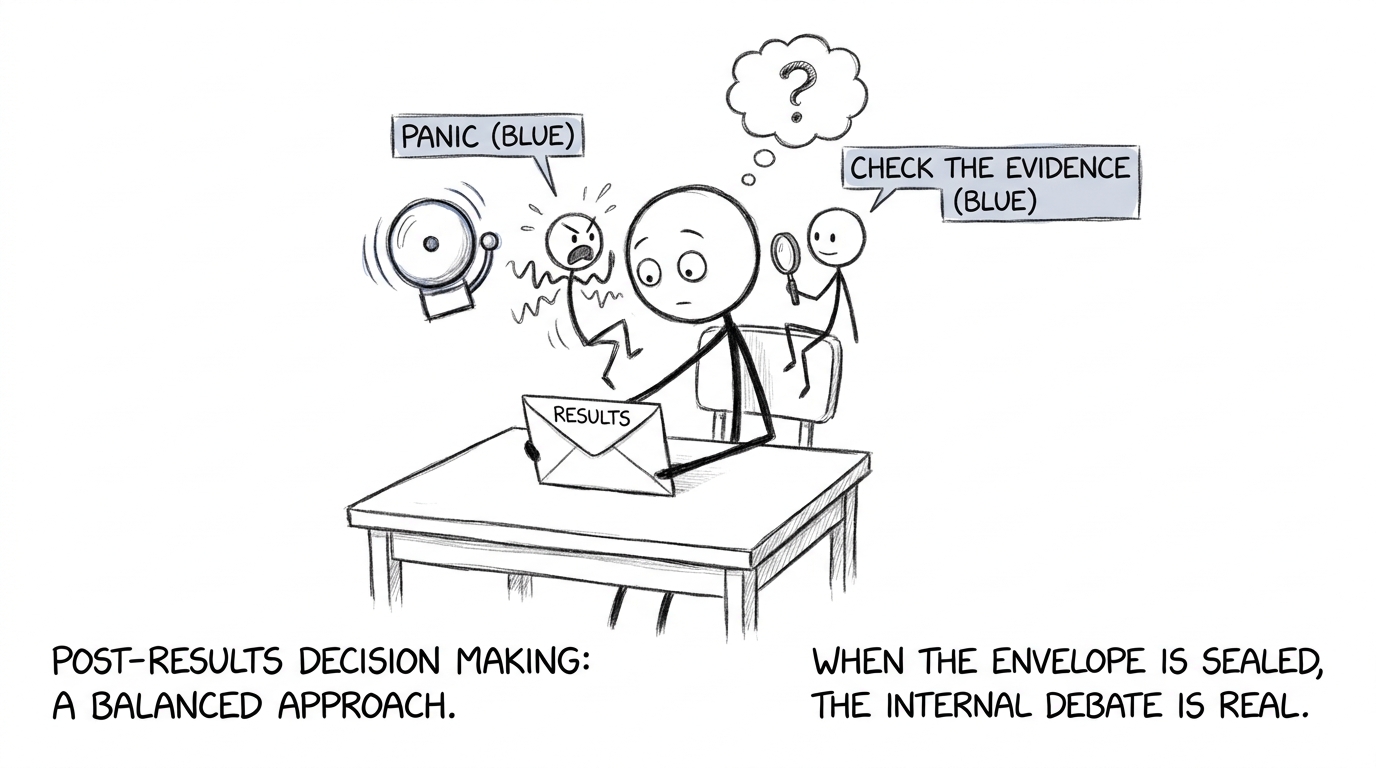 A student choosing evidence over results-day panic
Your GCSE Business remark checklist
Before requesting a review, ask:
- Have you checked the correct boundary for your exam board and exam series?
- How many marks are you below the next overall grade?
- Can your teacher inspect your marked script?
- Is there a specific answer where the mark scheme may have been applied incorrectly?
- Would the higher grade change your sixth-form, college or apprenticeship options?
- Do you accept that your mark and grade could fall?
- Have you checked your school's internal deadline and any fee?
A small gap is not proof of an error. It simply makes an evidence-based review more consequential.
How the GCSE Business re-mark process works
Check your mark against the grade boundary
Begin with the result for the correct board and year. Grade boundaries change between exam series, so last year's figures cannot decide this year's grade.
MathsGenie provides current and historical pages for Edexcel GCSE Business grade boundaries, AQA GCSE grade boundaries and Eduqas GCSE Business grade boundaries. You can also start from the complete GCSE and A Level grade boundaries hub.
For Edexcel, the GCSE Business predicted grade calculator can help you combine the paper marks and compare the total with previous boundaries. Always use the official result for your exam series when making the final decision.
Ask for the component marks and marked script
Speak to your Business teacher or exams officer as soon as possible. Ask for:
- your mark on each paper;
- the total mark and next grade boundary;
- access to your marked scripts where available;
- the relevant question papers and mark schemes;
- your school's fee, consent process and internal deadline.
Access to the script is particularly useful in Business because extended responses are often marked using levels. A teacher can look for missing credit, an answer placed in an unreasonable level, or a question that appears not to have been marked.
This is different from saying, “I wrote a lot, so I deserved more.” Length alone does not earn marks. Application to the case study, developed analysis, evaluation and a supported judgement are often what separate levels.
Choose the correct post-results service
A clerical re-check checks administrative matters such as whether every question was marked and whether marks were totalled and recorded correctly.
A review of marking checks the original marking for errors. The reviewer considers whether the mark scheme was applied correctly and whether judgements on less objective answers were reasonable. It is not a completely fresh re-mark designed to find extra credit.
A review of moderation concerns centre-assessed work that has been moderated. It is normally requested for a centre's sample rather than for one student's examination paper.
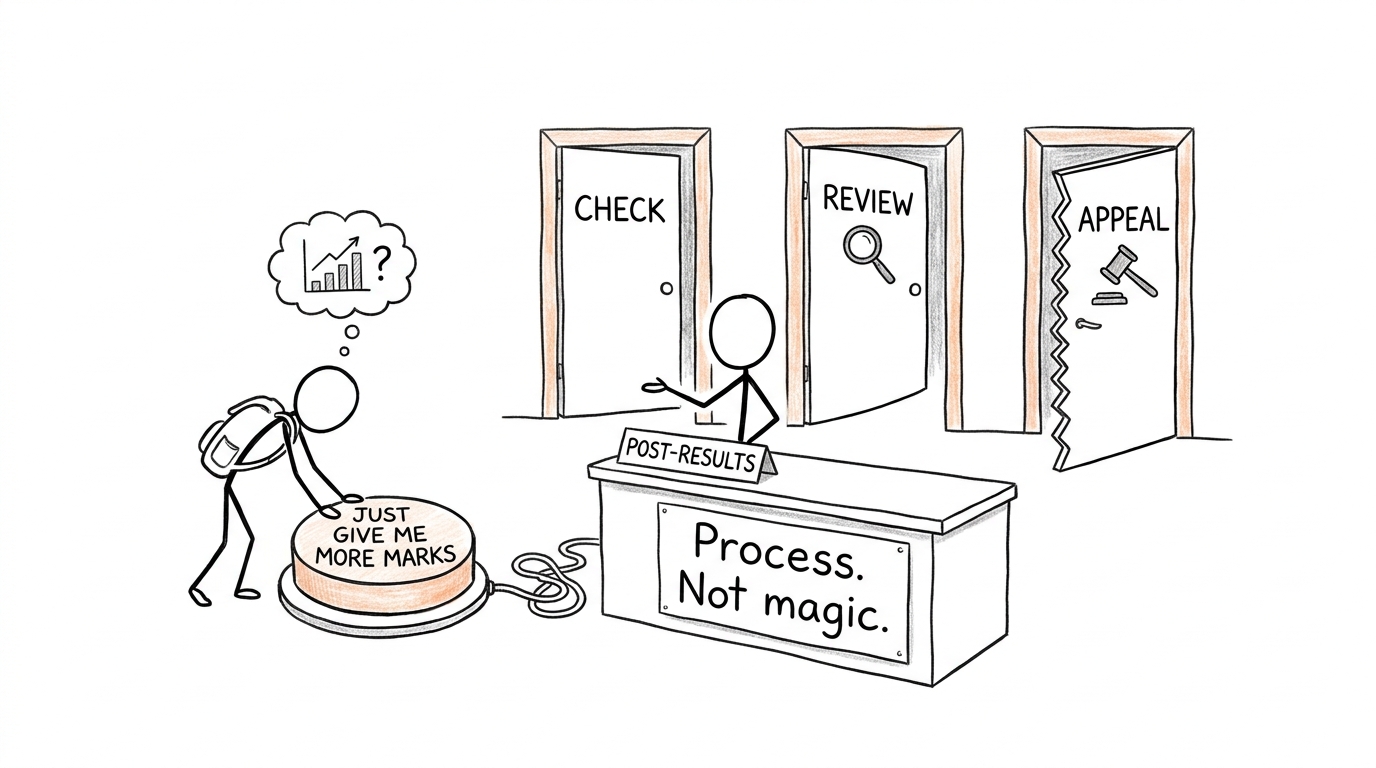 A student discovers that a check, review and appeal are different services
Give written consent and let your centre apply
For most students, the school or college submits the request to AQA, Pearson Edexcel or Eduqas. Written consent is required after results have been issued because the reviewed mark and overall grade can go down as well as up.
Private candidates should contact the centre where they entered the examination or follow their awarding body's arrangements.
For the June 2026 series, GCSE results are released to candidates on Thursday 20 August, and JCQ lists 24 September 2026 as the awarding-body deadline for standard reviews of results. Schools usually set earlier internal deadlines, so never wait until the final date. Services, priority arrangements and charges can differ between boards and centres.
A standard review of marking is normally completed within twenty calendar days of the awarding body receiving it. Your school will communicate the outcome.
When requesting a review makes sense
A review is more reasonable when several pieces of evidence point in the same direction:
- you are close to a boundary;
- the higher grade matters for your next step;
- your teacher has inspected the script;
- a specific marking issue has been identified;
- the answer appears to meet a higher level descriptor;
- you understand and accept the downside.
Business papers contain extended responses involving application, analysis and evaluation. That does not make every disappointing mark questionable. It does mean a knowledgeable teacher's comparison of your answer with the exact mark scheme can be valuable.
A review is less convincing when it is based only on a predicted grade, mock result or feeling that the examination went well. Those are reasons to investigate, not evidence that the examiner made an error.
Appealing a GCSE Business grade
Appealing a GCSE Business grade is a later stage. You do not normally move straight from results day to an appeal because you disagree with the grade.
First, the appropriate review of marking or other post-results service is requested. If concerns remain, the school or college may appeal on permitted grounds, including a possible marking or procedural error. An appeal is not simply another opportunity to ask for more marks.
Schools must also provide a route for students to challenge a centre decision not to request a review. Ask for the centre's internal appeals procedure if your school declines and you believe clear evidence has been overlooked.
Common mistakes to avoid
- Using the wrong boundary: check the correct board, qualification and exam series.
- Requesting every paper automatically: identify which component contains the suspected error.
- Treating a review as a guaranteed increase: marks can rise, stay unchanged or fall.
- Ignoring extended-response descriptors: focus on application, analysis, evaluation and judgement rather than answer length.
- Missing the school deadline: the centre may need time to inspect scripts and collect consent.
- Confusing a review with an appeal: an appeal normally follows the review process.
- Focusing only on one grade: consider whether the possible change genuinely affects your next step.
Make a calm decision, then keep moving
A result deserves attention, but it does not deserve unlimited control over the weeks that follow. Check the evidence, discuss the script with your teacher and request a review only when there is a credible reason.
Start with the Edexcel GCSE Business grade boundaries, or select your board through the grade boundaries hub. Then speak to your exams officer promptly.
While the outcome is pending, keep building the subject you can still influence. MathsGenie's free GCSE Maths revision hub brings together revision lessons, practice questions, past papers, predicted papers, mark schemes and video solutions. Short GCSE Maths mini tests can help you turn the uncertainty of results day into a clear next step.