

GCSE Business Grade: What It Means for Sixth Form
GCSE business grade sixth form guide: see how grades 9-1 affect A Level Business entry, what colleges check, and how to plan confidently.
Results day can make one number feel like a verdict on your future. It is not. The clearest GCSE business grade sixth form answer is that your grade may influence entry to A Level Business, but there is no universal national requirement. Each school or college sets its own conditions, often considering GCSE English, maths and your overall results alongside Business.
A grade 5 in GCSE Business is a common subject-specific expectation where Business has been taken, but some providers ask for a grade 4, some prefer a grade 6, and others do not require GCSE Business at all. Always check the published requirements for the course and year in which you will enrol.
Your quick sixth-form entry checklist
Before deciding whether you can progress to A Level Business:
- Check the exact course page for your chosen sixth form or college.
- Look for both general entry requirements and Business-specific conditions.
- Check the required GCSE English and maths grades.
- Ask what happens if you miss a requirement by one grade.
- Compare A Level Business with available vocational Business courses.
- Attend an open evening and ask whether GCSE Business is required.
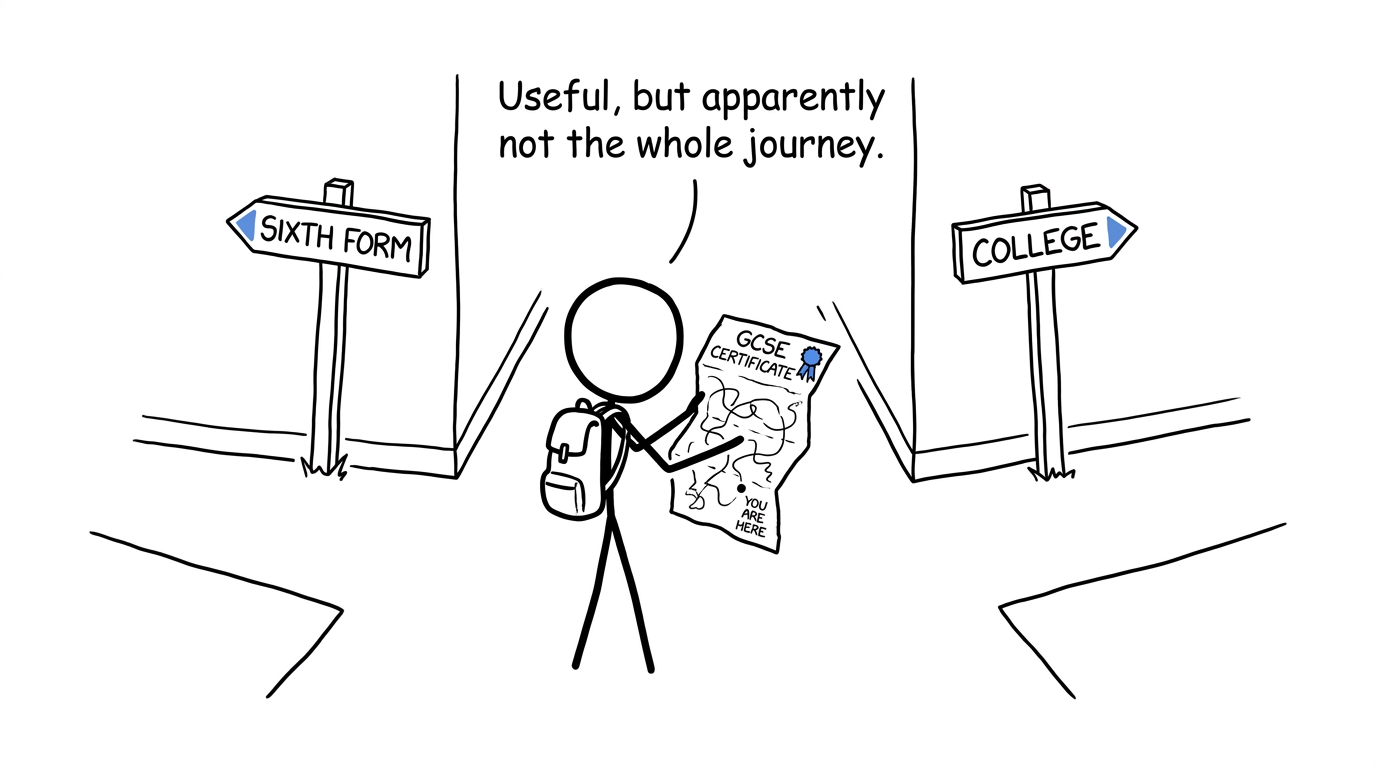 A student discovers that a GCSE grade is useful but not the whole post-16 journey
GCSE business grade meaning: a grade-by-grade guide
The following breakdown is guidance rather than a national admissions rule. Published entry criteria differ considerably between providers.
Grades 9 to 7
A grade from 9 to 7 shows very strong performance at GCSE. You have probably demonstrated secure knowledge, accurate application to business contexts and the ability to analyse or evaluate decisions.
These grades should meet the GCSE Business condition at most providers, although admission can still depend on your wider GCSE profile. Do not assume that a high Business grade compensates automatically for a missed English or maths requirement.
A Level Business is also a step up. You will meet longer case studies, unfamiliar organisations, more demanding chains of analysis and judgements supported by evidence. Explore the free A Level Business revision hub to see what progression involves.
Grade 6
A grade 6 is a strong foundation for progressing to A Level Business. It commonly meets or exceeds providers' subject-specific expectations.
Your next priority should be identifying how you earned it. If calculations and data interpretation were weaker than extended writing, strengthen those skills before September. If your numerical work was secure but evaluation cost marks, practise building balanced, context-sensitive conclusions.
Students considering the Edexcel course can preview its content through Edexcel A Level Business revision.
Grade 5
Grade 5 often occupies the important middle ground. Many sixth forms and colleges use it as an entry benchmark for Business, English or maths, but it is not a nationwide rule.
A grade 5 suggests that A Level Business may be a realistic option, provided you meet the provider's overall entry criteria. You should arrive ready to improve the precision of your explanations and become more confident with percentages, ratios, averages and financial information.
If maths is part of your offer, use the GCSE Maths revision hub to choose your exam board and target weak topics.
Grade 4
A grade 4 is a standard pass and may be accepted by some A Level Business courses. Other providers require a grade 5 in Business, maths or English, so this is where checking the precise wording becomes especially important.
Do not rule yourself out before speaking to the sixth form. Admissions teams may distinguish between a required grade and a preferred grade, and some courses do not expect applicants to have studied GCSE Business previously.
If A Level entry is not available, a Level 3 vocational Business qualification may provide another post-16 route. Its assessment structure can differ significantly, so compare the actual course rather than treating it as an automatic substitute.
Grades 3 to 1 or ungraded
These results are less likely to meet direct A Level entry requirements, particularly if your English or maths grades are also below the provider's threshold. However, they do not end your route into Business.
A college may offer a Level 2 programme, a vocational pathway or the opportunity to progress after strengthening core qualifications. In England, students who have not achieved the required standard in GCSE English or maths will normally need to continue studying those subjects as part of their post-16 programme.
The useful question is not simply, “Can I take A Level Business now?” It is, “Which available route gets me to the next suitable level?”
Why maths and English matter for A Level Business
GCSE Business is only one signal. Sixth forms frequently look closely at English because A Level Business requires structured written analysis, accurate terminology and justified conclusions.
Maths matters because the subject includes quantitative decision-making. You may need to interpret data and work confidently with percentages, ratios, revenue, costs, profit, break-even information and financial performance. For example, the underlying relationships include:
Profit=total revenue−total costs\text{Profit} = \text{total revenue} - \text{total costs}Profit=total revenue−total costsand
Percentage change=new value−original valueoriginal value×100\text{Percentage change} = \frac{\text{new value} - \text{original value}}{\text{original value}} \times 100Percentage change=original valuenew value−original value×100These are not isolated calculations. At A Level, you must usually explain what a result means for the business in the case study.
Use AQA GCSE Maths revision or Edexcel GCSE Maths revision to repair gaps through lessons and exam-style questions. Short Edexcel GCSE Maths mini tests can also build accuracy without requiring a full paper.
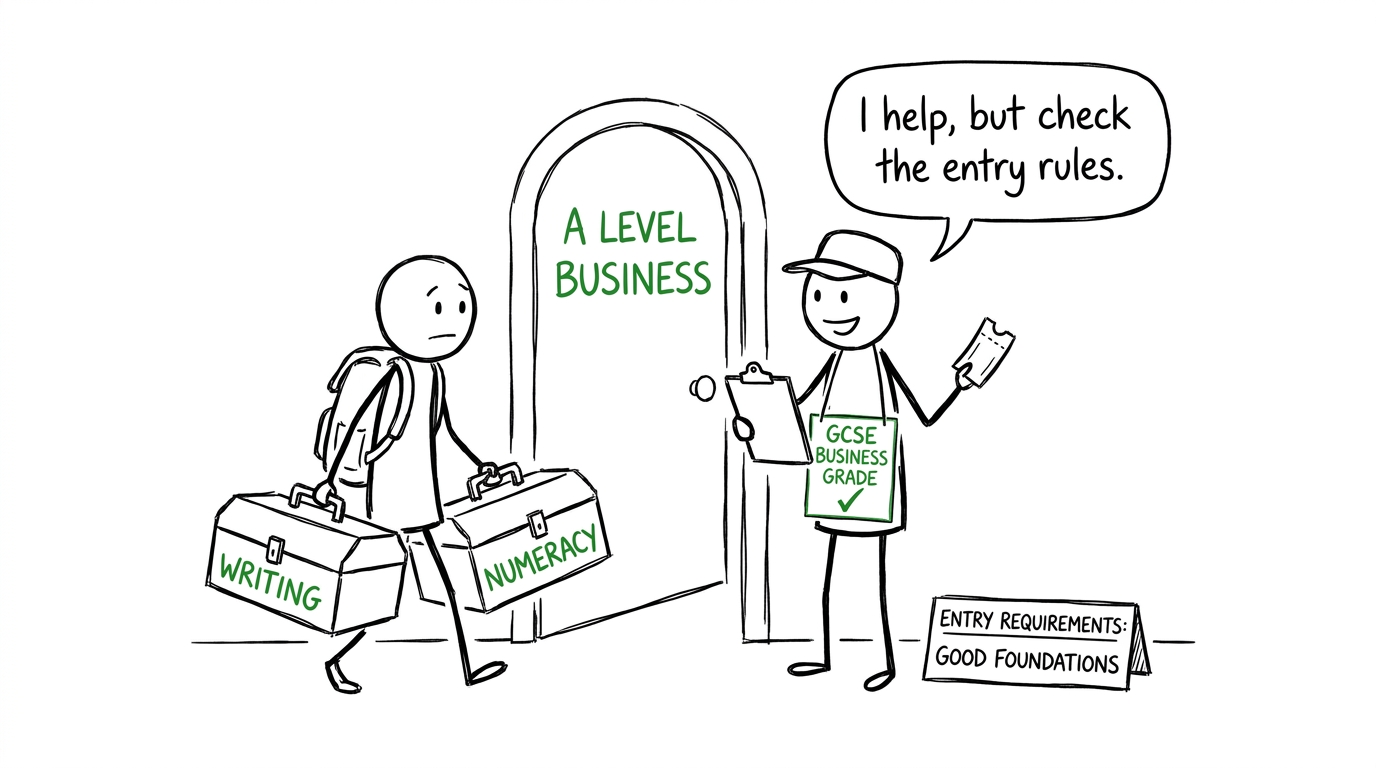 A student brings writing and numeracy toolboxes to the door of A Level Business
Progressing to A Level Business without GCSE Business
Previous study of Business is not always required. Awarding-body specifications can have no formal prior-learning requirement, while leaving course admission decisions to schools and colleges.
That distinction matters: being academically permitted to study a qualification is not the same as meeting a particular sixth form's admissions policy.
If you have not taken GCSE Business, demonstrate readiness through strong English and maths results, curiosity about organisations and current affairs, and a willingness to apply ideas to unfamiliar contexts. Previewing topics such as marketing, finance, operations and strategy can make the transition calmer. MathsGenie's Eduqas Business revenue and costs guide offers a useful picture of the financial content involved.
Common mistakes when interpreting your grade
Treating a typical requirement as universal. A nearby college asking for grade 5 does not mean every provider will do the same.
Checking only your Business result. General entry requirements and GCSE English or maths conditions may decide whether you receive an offer.
Assuming GCSE success guarantees an easy A Level. The new course demands deeper application, analysis and evaluation.
Ignoring alternative routes. A vocational Business course may suit your grades, preferred assessment style and future plans better.
Waiting until results day to investigate. Compare requirements early, but check them again before enrolment because providers can update course information.
Turn your grade into a next step
Your GCSE Business grade is evidence, not an identity. Grades 9 to 6 usually create a strong platform; grade 5 often meets published expectations; grade 4 depends more heavily on the provider; and lower grades may point towards a different first step. None of those statements replaces checking your chosen course.
Once you know the requirement, focus on what remains controllable. Build the English and numeracy that Business will demand, then preview the A Level course rather than guessing what it contains.
Start with MathsGenie's free A Level Business revision resources, including revision lessons, practice questions, past papers, mark schemes and topic guides. For any maths grade still standing between you and sixth form, combine targeted practice with GCSE predicted papers, mini tests and video solutions. A grade tells you where you are. Good revision decides what happens next.











