GCSE Biology Study Planner: Work Back from Exam Day
GCSE biology study planner: build a realistic weekly revision schedule by working back from exam day with retrieval, topic checks and past papers that fits.
The hardest part of Biology revision is often not understanding cells or homeostasis. It is looking at an entire specification and wondering what to do tonight.
A GCSE biology study planner solves that problem by working backwards. Start with the date of each Biology paper, reserve the final weeks for timed practice, and then divide the remaining content into manageable weekly targets. Instead of guessing from one evening to the next, every session has a purpose.
The essential process is:
- confirm your exam board, qualification and paper dates
- list the content assessed on each paper
- diagnose your strongest and weakest areas
- reserve time for past papers, corrections and final recall
- allocate earlier weeks to learning and topic questions
- protect space for maths and your other GCSE subjects
That last point matters. A Biology plan that consumes every available evening is not realistic for a student also preparing for GCSE Maths, English and several other exams.
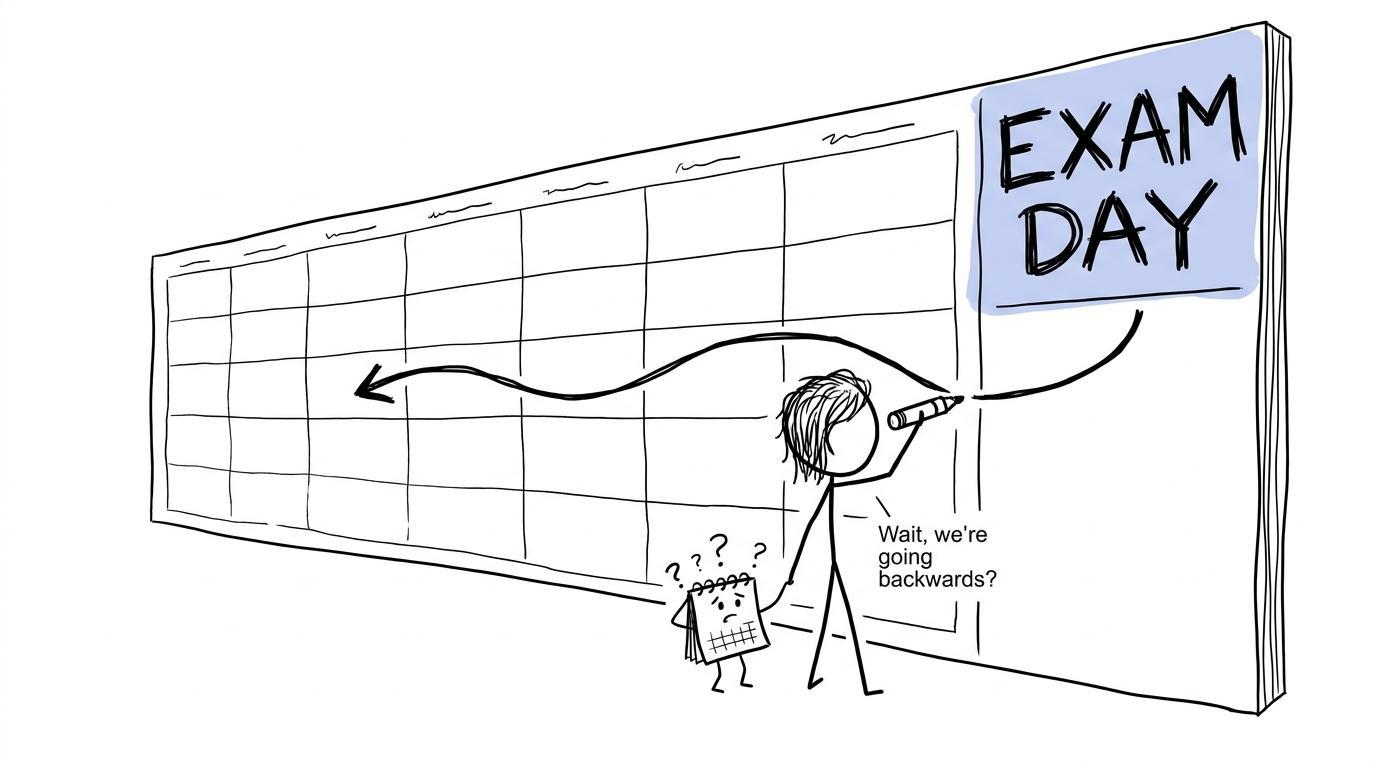 A student drawing revision arrows backwards from exam day
Begin with the exam, not this week
Weekly planning feels productive, but it can hide an important question: productive for what?
Your real destination is a particular paper on a particular date. Before writing any revision tasks, confirm:
- whether you take separate Biology or Combined Science
- your exam board, such as AQA, Edexcel, OCR or Eduqas
- whether you are entered for foundation or higher tier
- the content assessed on each paper
- the date, start time and duration shown on your school timetable
Use your own candidate timetable as the final authority. Exam structures and content divisions differ between boards, and separate Biology is not interchangeable with the Biology component of Combined Science.
For instance, the current AQA separate Biology specification uses two equally weighted papers. Paper 111 covers cell biology, organisation, infection and response, and bioenergetics; Paper 222 covers homeostasis and response, inheritance, variation and evolution, and ecology. Edexcel, OCR and Eduqas organise their content differently, so copy headings from your specification rather than borrowing somebody else's checklist.
Science assessment also reaches beyond remembering facts. Questions test knowledge, application, practical understanding, data interpretation, evaluation and conclusions. Your planner therefore needs more than flashcards.
Build your GCSE biology study planner backwards
Place both Biology paper dates at the end of the plan. Then create four phases moving backwards from them.
The final days: recall and calm
Keep the last few days before each paper relatively light. Use them to:
- retrieve essential definitions and processes from memory
- review required or core practicals
- revisit your error log
- practise calculations, units and graph interpretation
- check equipment and exam arrangements
This is not the moment to begin an untouched topic. Sleep and a clear mind are more useful than a panicked late-night rewrite of the textbook.
The final two weeks: timed performance
Reserve roughly the final 222 weeks for complete papers or substantial timed sections. Alternate between Paper 111 and Paper 222 content where your board separates topics that way.
After each attempt, mark it carefully and sort every lost mark into one of four categories:
- knowledge: the fact or process was missing
- application: you knew the idea but could not use it in context
- practical: variables, method, evaluation or apparatus caused difficulty
- exam technique: you misread a command word, omitted data, forgot units or ran out of time
A score alone tells you where you are. Categorising mistakes tells you what to do next.
This is the same feedback habit that makes GCSE Maths past-paper practice effective. Attempt, mark, diagnose, repair and retest.
The middle phase: mixed questions and weak-topic repair
Before full papers dominate, schedule mixed exam questions and targeted repair sessions. A topic is not secure merely because your notes look familiar. It is secure when you can retrieve the relevant knowledge and apply it to an unfamiliar question without support.
Government science curriculum research highlights the value of retrieval over extended periods, followed by feedback. In practical terms, return to a topic on different days rather than spending one long evening on it and never seeing it again.
Use a simple spacing pattern:
- first attempt after learning
- short retrieval around 222 days later
- another check approximately 111 week later
- mixed-paper retrieval later in the plan
If a check goes badly, move the topic back into the repair column. The calendar should respond to evidence.
The early phase: coverage and understanding
The earliest weeks are for rebuilding knowledge and completing focused topic questions. Break broad headings into testable units. “Organisation” is too large for one session; digestion, enzymes, the heart and plant transport are clearer targets.
Each unit should receive at least three different actions:
- retrieve key facts or label a process from memory
- answer application or data questions
- check the mark scheme and record one correction
Do not allocate equal time automatically. A secure topic needs occasional maintenance. A weak, high-mark topic may need several returns.
Calculate what will fit before filling the calendar
A plan becomes believable when its workload fits the time available.
Let WWW be the number of revision weeks before the paper, SSS the Biology sessions you can realistically complete each week, and RRR the sessions reserved for papers and final review. Your available content sessions are:
C=WS−RC = WS - RC=WS−RThis is a planning formula, not a command to fill every possible hour. Leave around 10%10\%10% to 20%20\%20% of your available sessions unallocated as catch-up space. School deadlines, illness and tired evenings happen. A planner without slack breaks the first time real life appears.
Aim for repeatable sessions of around 303030 to 454545 minutes rather than heroic blocks. A useful Biology session contains:
- 555 to 101010 minutes of closed-book recall
- 151515 to 252525 minutes of focused questions
- 555 to 101010 minutes of marking and correction
The correction is part of the revision, not administration after it.
Rank topics using evidence
Students often begin with the topic they enjoy most because starting feels easier there. A backward plan asks a less comfortable but more useful question: where are the marks currently leaking?
Create a traffic-light audit from a diagnostic paper, school assessment or mixed question set:
- red: cannot explain or start questions without notes
- amber: basic recall is sound, but application is inconsistent
- green: accurate under closed-book conditions
Then give each topic a priority based on weakness, likely breadth and the number of times it has already been revisited. Keep the decision simple: reds appear most often, ambers regularly and greens occasionally.
MathsGenie's guide to finding your weakest GCSE topics explains the same evidence-led approach. For OCR students, the OCR Biology revision routine also shows how active recall, practical work and data questions can fit together.
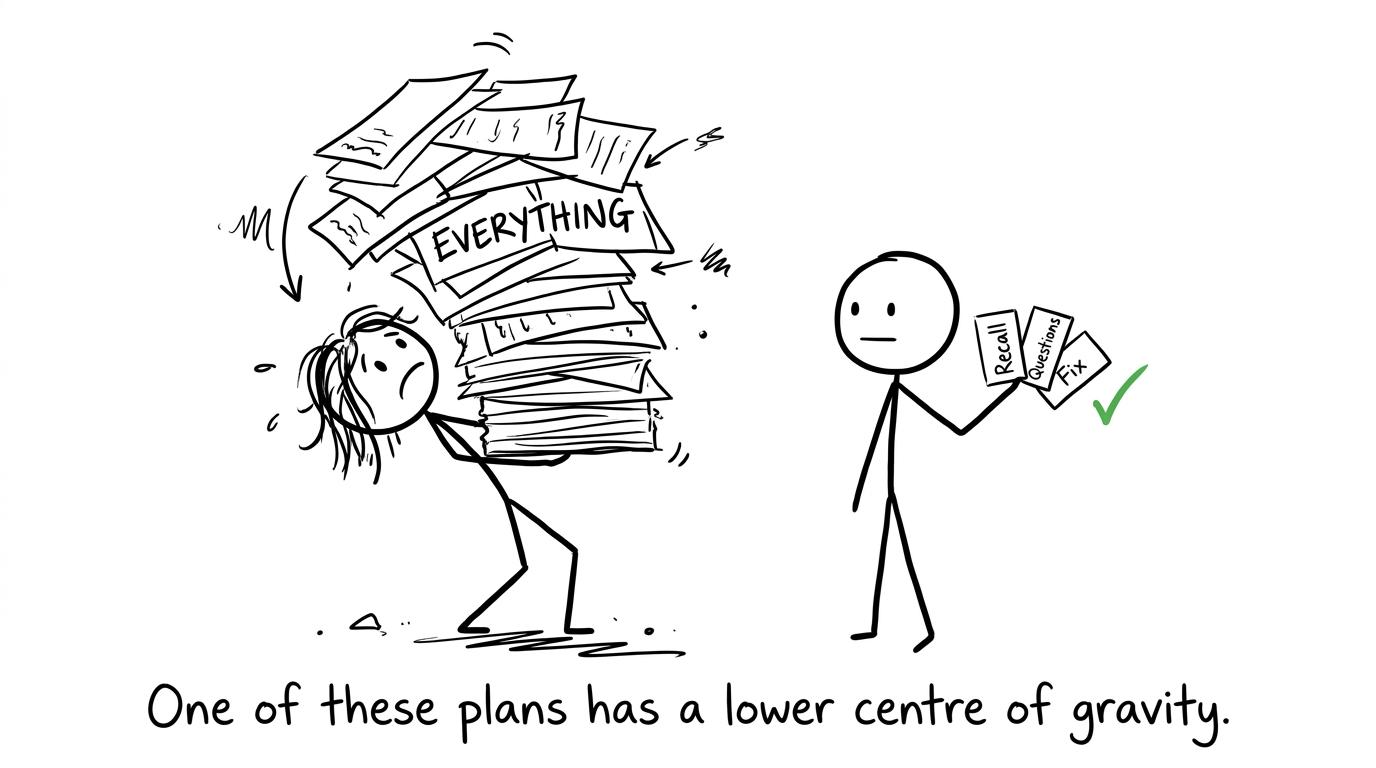 A student choosing small revision cards instead of carrying every note
Include practical skills and Biology maths every week
Practical questions should not be postponed until the end. For each required or core practical, be able to identify:
- the independent, dependent and control variables
- important apparatus and method choices
- how reliability or accuracy could be improved
- risks and suitable precautions
- the expected pattern in the results
- how data would support a conclusion
Biology also requires mathematical fluency. Your weekly plan should rotate through percentages, ratios, averages, rates, graph interpretation, magnification, unit conversion and standard form where these appear in your specification.
These skills transfer directly from GCSE Maths. If numerical work is slowing down your science answers, use the MathsGenie GCSE Maths revision hub for lessons and practice questions, then test retention with GCSE Maths mini tests.
A good timetable connects subjects rather than pretending they live in separate rooms. Graphs practised in maths can strengthen data analysis in Biology. Rearranging formulae can support magnification and rate calculations. Clear working makes errors easier to detect in both subjects.
Make Biology fit alongside GCSE Maths
Working backwards should reveal crowded weeks early enough to change them.
Mark every exam on one master calendar, not on separate subject planners. If Biology Paper 111 sits close to a maths paper, begin Biology paper practice earlier and keep maths active with shorter tasks. Maths skills fade when left untouched, so maintain at least a small weekly session even during a Biology-heavy phase.
For structure, adapt the routines in the GCSE maths revision timetable. Short topic sessions can sit on busy school nights, while longer paper sessions belong where you have enough time to mark them properly.
Choose papers that match your board and tier. MathsGenie provides dedicated collections for AQA GCSE Maths past papers, Edexcel GCSE Maths past papers and OCR GCSE Maths past papers, with mark schemes and worked solutions where available.
Use a weekly review to keep the plan alive
Set aside 101010 minutes at the end of each week. Ask:
- Which planned sessions were completed?
- Which topics improved when retested?
- Where are the same mistakes recurring?
- Is the next paper receiving enough attention?
- Does another subject now need more space?
Move unfinished tasks deliberately. Do not copy everything into the following week until it becomes an impossible backlog. Keep the highest-priority task, shorten another and discard work that no longer offers enough value.
Common mistakes when planning Biology revision
Planning from the present only
A list for this week can feel organised while leaving no time for full papers. Reserve the final stages first, then allocate content.
Treating every topic equally
Equal time looks fair but ignores what you can already do. Use diagnostic evidence and retests to direct your effort.
Counting note-making as mastery
Notes can clarify knowledge, but they do not prove recall. Every session should include an attempt made without looking.
Completing papers without reviewing them
A stack of marked papers is not automatically progress. Each lost mark needs a cause, a corrective task and a retest date.
Forgetting practical and mathematical skills
Definitions alone will not prepare you for unfamiliar data, calculations or evaluations. Mix these question types throughout the plan.
Creating a timetable with no spare capacity
Plans fail when every evening is full. Catch-up space is not wasted time; it is what keeps the rest of the planner usable.
Turn exam day into a sequence of smaller decisions
An exam date can feel threatening when it is only a distant square on a calendar. Working backwards changes it into a sequence: final review, timed papers, mixed practice, topic repair and first coverage.
Build your GCSE Biology plan around your own specification and timetable, then let weekly evidence decide what moves next. Alongside it, use MathsGenie as your free maths revision base. Revision lessons and practice questions rebuild individual skills; mini tests reveal whether they have stuck; past papers, predicted papers, mark schemes and video solutions prepare those skills for exam conditions.
Start by confirming your Biology papers. Then open the MathsGenie one-month revision plan and adapt its diagnose, practise, mark and fix cycle across your calendar. You do not need to predict every difficult day. You need a plan sturdy enough to adjust when one arrives.