GCSE Biology Results Day Questions Answered
GCSE biology results day questions answered clearly, including grades, boundaries, combined science results, marking reviews and sensible next steps.
Results day has a strange ability to make one Biology grade feel larger than the rest of your life. Students see a number; parents immediately wonder what it means, whether it is correct and what should happen next.
The short answer to most GCSE biology results day questions is this: check the exact qualification, compare the result with any entry requirement, and speak to your school before requesting a review. Grade boundaries are set only after marking, while a review can leave a mark unchanged or move it up or down.
For summer 2026, GCSE results are released to students on Thursday 20 August 2026. Your school decides how and when you receive them, so check its collection or online-access arrangements.
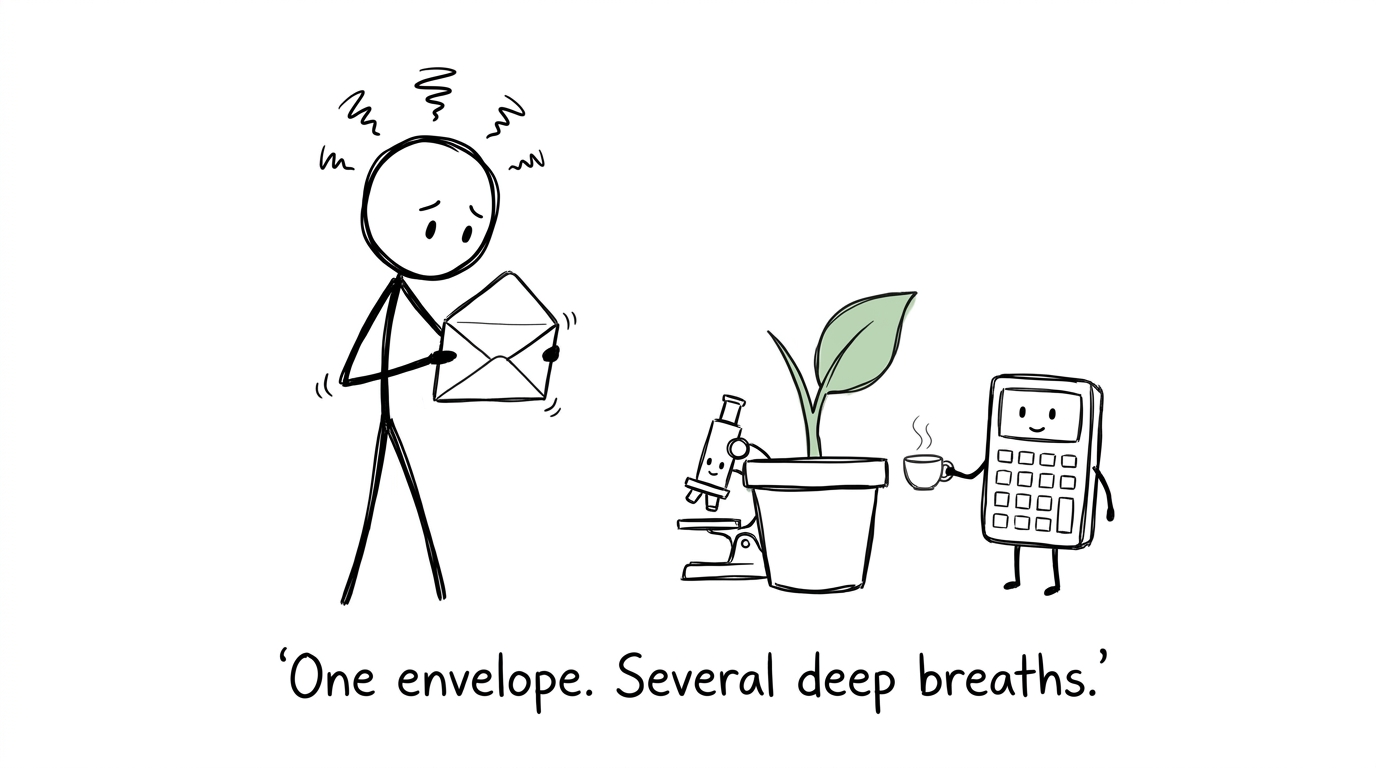 A nervous GCSE student opening a results envelope while a calculator offers tea
A calm results-day checklist
Before interpreting the Biology result:
- Confirm whether it is GCSE Biology or Combined Science.
- Check the exam board: AQA, Edexcel, OCR or Eduqas.
- Note whether the entry was foundation or higher tier.
- Compare the grade with sixth-form or college entry requirements.
- Ask a Biology teacher about the mark and grade boundary if anything looks surprising.
- Contact the exams officer promptly if you want to see a script or discuss a review.
The MathsGenie GCSE Biology revision hub is also useful for identifying your exam board and reviewing the topics covered by your qualification.
When is GCSE Biology results day in 2026?
GCSE Biology results are released with other GCSE results on Thursday 20 August 2026. Results cannot be given to candidates before 8.00 am8.00\text{ am}8.00 am, although your school may open later or use a secure online portal.
Take any identification your school requests and keep the results slip. If you cannot attend, contact the school beforehand rather than assuming a parent can collect it for you.
Will I receive a separate Biology grade?
Only if you took separate GCSE Biology, sometimes informally called triple science. In that case, Biology appears as its own grade alongside Chemistry and Physics.
If you took Combined Science, you receive a double grade for the whole qualification, such as 777 to 777 or 555 to 444. You do not receive independent Biology, Chemistry and Physics grades because marks from the science papers contribute to the combined result.
Students following Pearson can compare this distinction through the Edexcel GCSE Biology resources and the separate Edexcel Combined Science revision hub.
What do GCSE Biology grades mean?
GCSE Biology uses grades 999 to 111, with 999 the highest. A grade 444 is commonly described as a standard pass and grade 555 as a strong pass, but sixth forms and colleges set their own entry requirements.
For tiered GCSEs, foundation tier normally makes grades 111 to 555 available. Higher tier normally covers grades 444 to 999, with a limited safety-net grade 333 for candidates who narrowly miss grade 444. Combined Science uses paired grades and has corresponding tier limits.
The most important question is not whether a grade sounds good in isolation. It is whether it meets the requirement for your intended course.
Why are this year’s grade boundaries different?
Grade boundaries are the minimum raw marks needed for each grade. Exam boards set them after papers have been taken and marked because they need evidence about the difficulty of that year’s assessments.
A more demanding paper may have lower boundaries; a more accessible paper may have higher ones. This adjustment is intended to keep the standard required for a grade comparable between years. There is no fixed quota stating that only a certain number of students can pass or achieve grade 999.
Do not use an old boundary to declare what your 2026 grade “should” be. Use the official boundary for your board, qualification and tier published on results day.
Can I find out my actual mark?
Your results slip may show a grade without all the component-level detail you want. Ask your teacher or exams officer for your raw mark, the relevant boundary and, where available, the marks on individual papers.
That information gives context. Being one mark below a boundary does not itself prove a marking error, but it may prompt a teacher to inspect the script. AQA students can revisit the qualification structure through the AQA GCSE Biology revision page, while Edexcel students can compare topic coverage using the Edexcel Biology revision guides.
Can I see my marked Biology papers?
Schools and colleges can use exam-board access-to-scripts services to obtain marked papers. A teacher can then check whether answers appear to have been missed, totals look incorrect or the mark scheme may not have been applied reasonably.
Requests normally go through the school rather than directly from the student. Procedures and deadlines vary by board and service, so ask quickly. Looking at a script is often more sensible than requesting a review based only on disappointment.
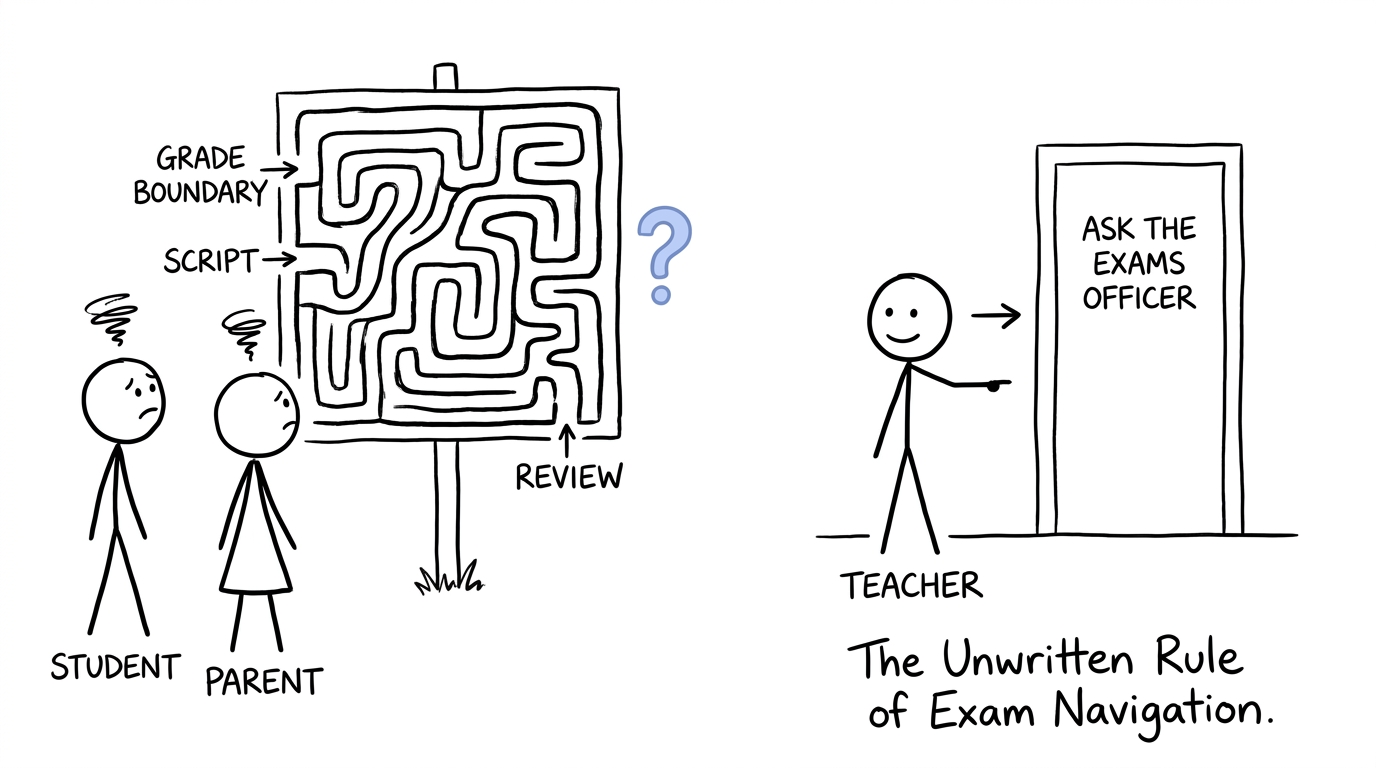 A student and parent navigating a results maze with help from an exams officer
Should I request a review of marking?
A review is appropriate when there is a specific reason to suspect a marking error. It is not simply a second attempt to gain an extra mark because the result was close to a boundary.
The school submits most requests and needs the candidate’s written consent. Marks and subject grades can be lowered, confirmed or raised. Fees may also apply, depending on the board and outcome.
For the June 2026 series, the JCQ deadline for awarding bodies to receive standard review-of-results requests is 24 September 2026, but schools often set earlier internal deadlines. Speak to your exams officer immediately if the grade affects a course place.
What if the grade is lower than I need?
Contact the sixth form or college rather than assuming the decision is final. Entry policies belong to individual institutions, and staff may consider the complete results profile or suggest another route.
Then separate two questions: does the result need checking, and do you need a new academic plan? A script review addresses possible marking errors. A resit or alternative course addresses what happens next. They are not the same decision.
If Biology calculations were a weakness, keep the underlying numerical skills active through the GCSE Maths revision hub. Percentages, graphs, rates and standard form remain valuable across science courses.
What should I do if I am continuing with Biology?
Treat the result as evidence rather than a verdict. If you are moving towards A Level Biology, revisit weak areas before the course begins, particularly practical methods, data interpretation and precise scientific vocabulary.
OCR students can use the OCR Biology revision guides, while OCR Twenty First Century students should use the matching OCR Twenty First Century Biology resources. Staying with the correct specification matters because topic organisation and assessment structures differ.
Common results-day mistakes
The most common errors are practical rather than scientific:
- Confusing a Combined Science double grade with a separate Biology grade.
- Comparing boundaries from different boards, tiers or years.
- Assuming one mark below a boundary guarantees a successful review.
- Requesting a review without understanding that the mark can fall.
- Missing a school’s internal post-results deadline.
- Letting one result delay conversations with a college or sixth form.
- Turning immediately to more revision without first diagnosing what happened.
A result becomes useful when it changes the next decision. If another attempt is needed, MathsGenie’s guide to efficient GCSE Biology revision explains how to combine recall, exam questions and mark-scheme feedback.
Your next step with MathsGenie
Results day closes one chapter, but it does not settle every future one. Confirm the qualification, understand the boundary, ask for informed advice and act before any deadline.
When it is time to rebuild, start with MathsGenie’s free GCSE Biology resources. Use revision lessons and guides to repair knowledge, practice questions and mini tests to check recall, then past papers, predicted papers and mark schemes to develop exam technique. If calculations caused trouble, video solutions and GCSE Maths topic practice can help you make the numerical side of Biology feel routine rather than uncertain.