GCSE Biology Remark: How the Review Process Works
GCSE biology remark guidance for results day: understand reviews of marking, deadlines, risks and when challenging your Biology grade makes sense.
A Biology result can feel strangely final. One number appears on a slip, yet behind it sit two papers, dozens of responses and months of work. If your grade is unexpectedly low or just below a boundary, a GCSE biology remark may be worth discussing with your school. The short answer is: ask for your marked scripts, compare them with the mark scheme and request a review only where there is credible evidence of a marking error.
The official service is called a review of marking, not a re-mark. Your mark can rise, fall or remain unchanged, so this should be an evidence-led decision rather than a reaction to disappointment.
Your results-day decision checklist
Before requesting a review, check that you can answer yes to most of these questions:
- Is your result lower than your teachers reasonably expected?
- Do you know your total mark and the boundary for the next grade?
- Have you confirmed whether the result is for separate Biology or Combined Science?
- Has a Biology teacher examined your marked script and the relevant mark scheme?
- Can they identify specific answers where the mark scheme may not have been applied correctly?
- Would the higher grade affect sixth-form entry, a course requirement or another important decision?
- Do you accept that your mark and grade could go down?
- Have you checked your school’s deadline and fee?
Being one or two marks below a boundary is a reason to investigate. It is not, by itself, proof that a review will find an error.
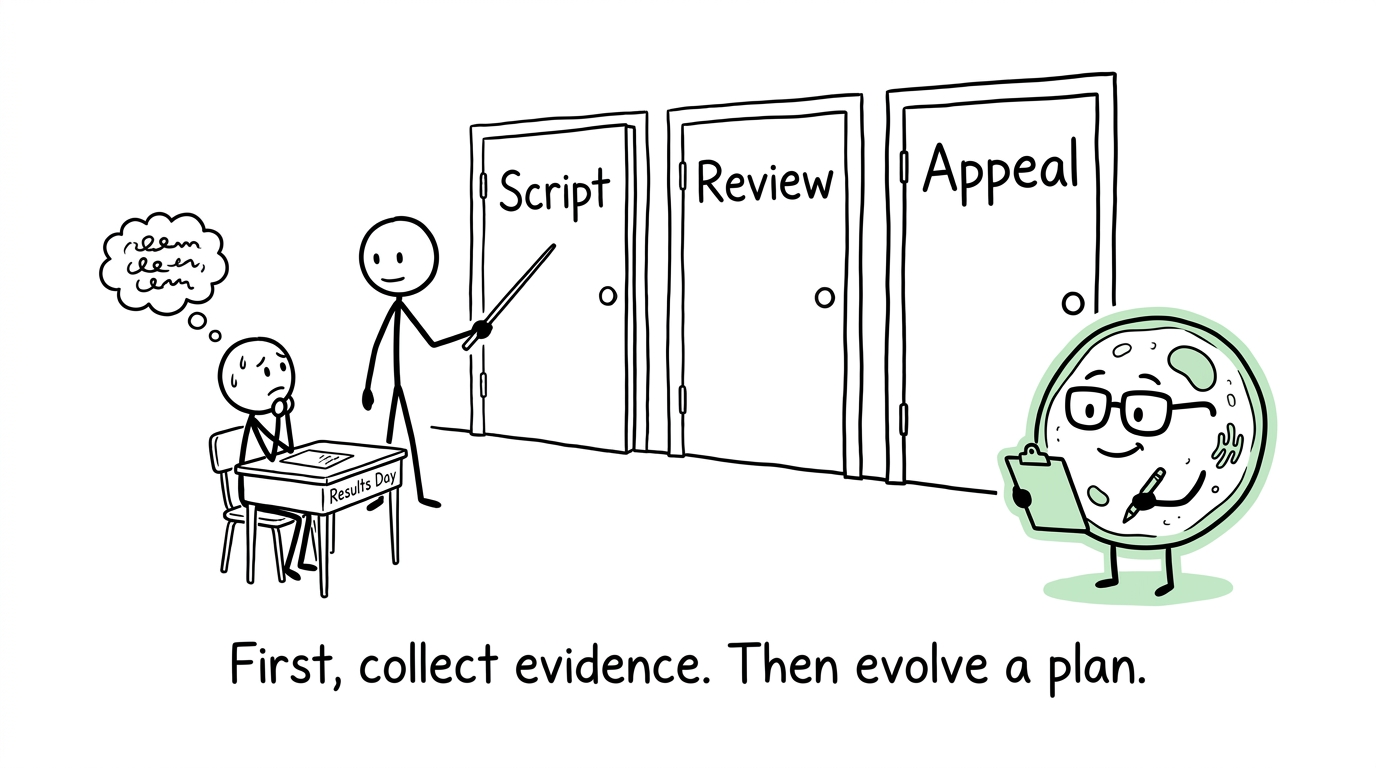 A student chooses between script, review and appeal doors while a biology teacher recommends collecting evidence first
How the GCSE biology re-mark process works
Check the result and grade boundary
GCSE results day for the June 2026 series is Thursday 20 August 2026. Start by finding your overall mark, not simply your grade. Then compare it with the correct boundary for your board, qualification and tier.
MathsGenie’s GCSE grade boundaries hub brings the available exam-board information together. Edexcel students can go directly to the GCSE Biology grade boundaries.
Be precise. A separate Biology qualification is not the same as Combined Science, and foundation and higher tier boundaries differ. Your school can confirm your specification and component marks.
Speak to your teacher and exams officer
Students usually cannot submit a review directly. Your school or college requests it through AQA, Edexcel, OCR or Eduqas, while private candidates may have direct arrangements with their awarding organisation.
Ask your Biology teacher which paper looks unusual. Comparing Paper 1 and Paper 2 can reveal whether one component is noticeably out of line with your usual performance. Your exams officer can explain the centre’s fee, consent form and internal deadline.
Request access to your marked script
A copy of the script is often the most useful next step. It lets a teacher compare your answers with the published mark scheme before money and risk enter the decision.
This matters particularly in Biology. Short factual answers can be relatively clear, while extended responses, practical evaluations and explanations using unfamiliar contexts may require more judgement. A teacher should look for a genuine mismatch between your answer and the mark scheme, not simply an answer that was nearly right.
You can become familiar with this distinction through GCSE Biology revision resources, AQA GCSE Biology questions and papers or Edexcel GCSE Biology past papers.
Choose the correct post-results service
A clerical re-check checks administrative steps, including whether every part was marked and whether marks were recorded and totalled correctly.
A review of marking includes clerical checks and considers whether the agreed mark scheme was applied correctly. The reviewer does not simply mark the entire paper afresh. Where the original mark was reasonable, it should remain. Where an error is found, the corrected mark replaces it.
For June 2026 GCSEs, the awarding-body deadline for standard reviews is 24 September 2026. Schools commonly set earlier internal deadlines, and access-to-script arrangements vary by board. Act promptly and use the date supplied by your exams officer.
Give written consent and await the outcome
Your school must obtain your written consent after results are published because the outcome may lower your mark or subject grade. Fees differ between exam boards and are normally charged per reviewed component; your centre may also have its own payment process. Ask whether the fee is waived or refunded if your overall grade changes.
A standard review has an official completion target of within 20 calendar days. Do not delay sixth-form enrolment while waiting. Explain that a review is pending and provide the current result.
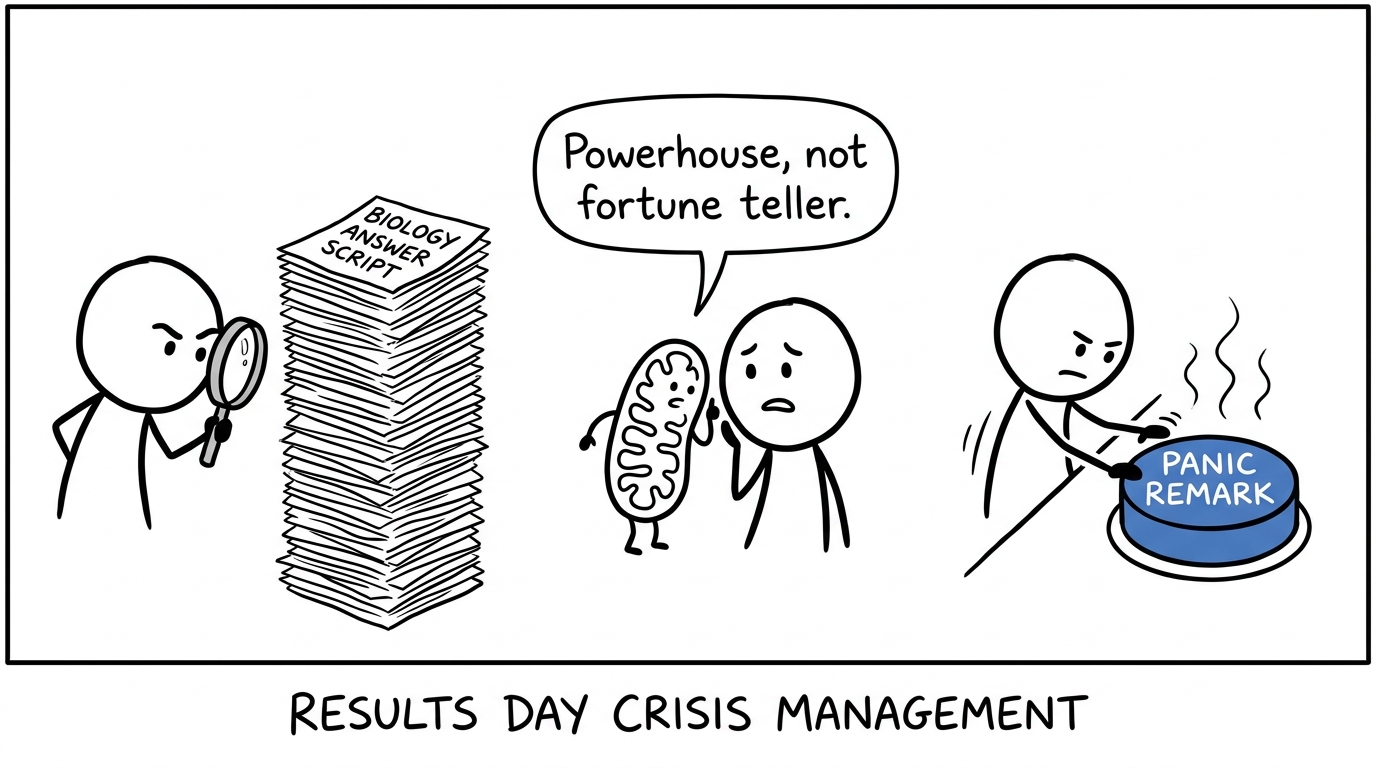 A calm examiner checks a Biology script while a student resists pressing a panic remark button
When requesting a Biology review makes sense
A review is strongest when several pieces of evidence align: you are close to a meaningful boundary, the result is inconsistent with secure prior evidence, and a subject specialist can identify particular responses that may have been marked incorrectly.
It is weaker when the argument is only that you worked hard, usually achieved a higher grade or need extra marks. Those feelings are understandable, but reviewers correct errors rather than award marks for circumstances or potential.
If you took Combined Science, use the GCSE Science revision hub to identify the exact qualification and papers. Biology performance contributes to the combined award, so a changed Biology component mark may not necessarily change either final grade.
Appealing a GCSE Biology grade
An appeal is not the first step. If concerns remain after the review, the head of centre can appeal on permitted grounds, such as an unresolved marking error or a failure to follow the correct procedure. For the June 2026 process, an appeal must normally be made within 30 calendar days of the review outcome.
Your school must also provide a way for you to challenge its decision if it refuses to request a review. Ask for the centre’s internal appeals procedure rather than trying to contact an examiner yourself.
Common mistakes to avoid
- Calling it an automatic re-mark: the reviewer checks for errors in the original marking.
- Looking only at the grade: obtain the total and component marks first.
- Assuming closeness guarantees success: boundaries measure distance, not evidence of error.
- Reviewing both papers automatically: your teacher may find that only one component warrants review.
- Ignoring the downside: marks and grades can decrease.
- Missing the school deadline: it may be earlier than the awarding body’s deadline.
- Confusing a review with an appeal: the review comes first.
Make the decision calmly, then move forward
A disappointing result creates urgency, but a sound decision begins with evidence: boundary, script, mark scheme and teacher judgement. Start with the Edexcel GCSE Biology grade boundaries, or select your board through MathsGenie’s Biology hub.
Whatever the outcome, keep building the habits that protect marks in future exams. Use MathsGenie’s revision lessons, practice questions, past papers, predicted papers, mark schemes, video solutions and mini tests to turn each missed mark into a specific improvement, in Biology, GCSE Maths and the subjects that come next.