

GCSE Biology November Resit: Is It Available?
GCSE biology November resit options explained: learn whether Biology is available, who can retake it, and how to plan for the next realistic exam series.
A disappointing Biology result can make November look like the obvious second chance. It arrives quickly, the knowledge is still relatively fresh, and GCSE Maths resits happen then. But the central fact is simple: a GCSE biology November resit is not normally available for the standard GCSE qualification in England.
Under current Ofqual arrangements, the November GCSE series is available for English Language and Mathematics to eligible students aged at least 161616 on 313131 August of that year. Standard GCSE Biology, including specifications from AQA, Pearson Edexcel and OCR, is normally available in the summer examination series instead.
That does not mean you cannot retake Biology. It usually means waiting until the following May and June, arranging an entry through a school, college or approved private exam centre, and retaking the complete qualification.
The short answer and your next steps
Use this checklist before making a revision plan:
- Confirm whether your qualification is GCSE Biology, GCSE Combined Science or International GCSE Biology.
- Check the exact exam board and specification code on your results documents.
- Do not assume that the November rules for GCSE Maths also apply to science.
- Ask your school, college or exam centre when your qualification is next available.
- Confirm whether the centre accepts former students or private candidates.
- Check which papers, tier and practical arrangements apply.
- Find out whether the grade you already hold meets your next provider's entry requirements.
- If you are also retaking maths, treat November maths and summer Biology as two separate deadlines.
The distinction between qualifications matters. A Pearson Edexcel International GCSE Biology timetable, for example, may include a November series, but that does not create a November sitting for the ordinary Pearson Edexcel GCSE Biology qualification used in England.
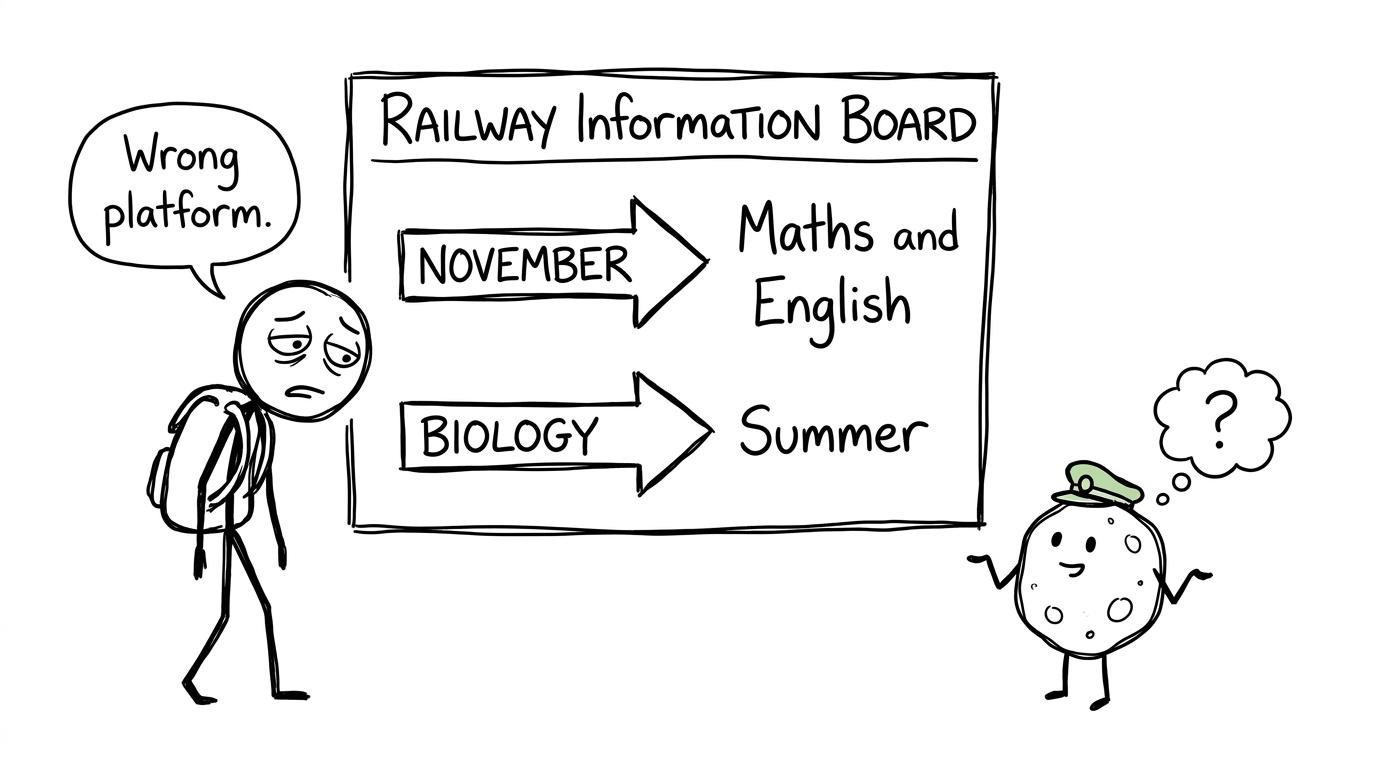 A student discovers that Biology and the November exam series are on different platforms
Why GCSE Biology is not normally offered in November
November is not a general repeat season for every GCSE. In England, it is a limited examination series built principally around GCSE Mathematics and English Language.
Current official guidance for the November series says that those two GCSEs are available to students who are aged 161616 or over by the relevant August deadline. Official UK timetables reinforce the distinction: November GCSE timetables list Mathematics and English Language, while GCSE Biology papers appear in the summer timetable.
This can feel arbitrary if Biology is the result holding back your plans. Yet exam availability is determined by qualification rules and exam-board series, not simply by whether an individual wants to resit sooner.
If you are also considering a maths retake, read the November GCSE resits guide for Maths and English. It explains the separate rules that make a November maths entry possible.
GCSE Biology is not the same as International GCSE Biology
The word international is easy to overlook on a timetable. It changes the answer.
Some International GCSE qualifications operate additional examination series, including November opportunities. These are separate qualifications with their own specifications, paper codes and entry rules. You cannot assume that a November International GCSE paper is a resit route for the GCSE Biology course you previously took.
Before paying an entry fee, match all of the following:
- qualification title;
- awarding body;
- specification code;
- paper codes;
- examination series;
- centre acceptance rules.
Students in Wales, Northern Ireland or outside England should also check the arrangements for their own awarding body and qualification. The safest source is always the exam centre making the entry, supported by the current official timetable.
When can you realistically resit GCSE Biology?
For a standard GCSE Biology qualification in England, the realistic opportunity is normally the next summer series. Biology commonly has more than one written paper, so the examinations may be spread across May and June.
A resit is generally a fresh entry for the full qualification. It is not normally possible to repeat only the paper on which you performed least well and combine that mark with a stronger paper from the previous summer. Your centre should confirm the component requirements for your exact specification.
If your original result was for Combined Science, you cannot simply enter one Biology paper to improve the overall Combined Science grade. Combined Science is a distinct qualification covering biology, chemistry and physics. The GCSE Combined Science resit revision plan explains why the complete qualification and correct tier need to be considered.
Who arranges the entry?
Current students should begin with their school or college examinations officer. Former students may be able to return to their previous centre, but centres are not required to accept every external candidate.
If that is not possible, you will need to find an approved centre willing to enter private candidates for your exact Biology specification. Ask about:
- entry deadlines;
- centre and exam-board fees;
- identification requirements;
- access arrangements;
- the specification and tier offered;
- practical-activity requirements;
- the dates of every required paper.
Fees and policies vary between centres, so obtain written confirmation before planning around an entry. A centre offering GCSE Maths to private candidates may not necessarily offer laboratory-based science qualifications.
Who is a Biology resit realistic for?
The better question is not merely, “Can I resit?” It is, “Would a resit change my next step enough to justify the time?”
A summer Biology resit may be realistic if:
- a sixth form, college course or training provider requires a particular science grade;
- you have confirmed that a higher Biology result would satisfy that requirement;
- an exam centre can make the correct entry;
- you can revise the complete specification rather than a few favourite topics;
- you have enough time alongside current courses, employment or other resits;
- your previous performance shows identifiable gaps that can be repaired.
It may be less useful if your chosen course already accepts your existing science result, if it requires Combined Science rather than separate Biology, or if the provider needs a different qualification entirely. Ask the admissions team what it accepts before committing money and months of revision.
A near-miss can make improvement feel plausible, but no previous mark guarantees a future grade. Grade boundaries change between examination series, and a resit still tests the complete specification. The productive approach is to diagnose lost marks rather than rely on how close the result appeared.
What to do if you also need a November maths resit
This is where the calendar can work in your favour. GCSE Maths may be retaken in November if you meet the age rule, while Biology normally waits until summer. The two subjects therefore need different revision peaks.
Until November, place greater timed-exam emphasis on maths while keeping Biology active through shorter retrieval sessions. After the maths papers, shift more time towards Biology without abandoning any current course.
The GCSE Maths revision hub lets you select Edexcel, AQA, OCR, Eduqas, WJEC or CCEA resources. If you take Pearson Edexcel, the dedicated Edexcel GCSE Maths revision page brings together foundation and higher tier lessons, worksheets and exam practice.
A sustainable week is more valuable than an ambitious timetable you abandon. The GCSE one-month maths revision plan provides a useful short-cycle structure for the final approach to November.
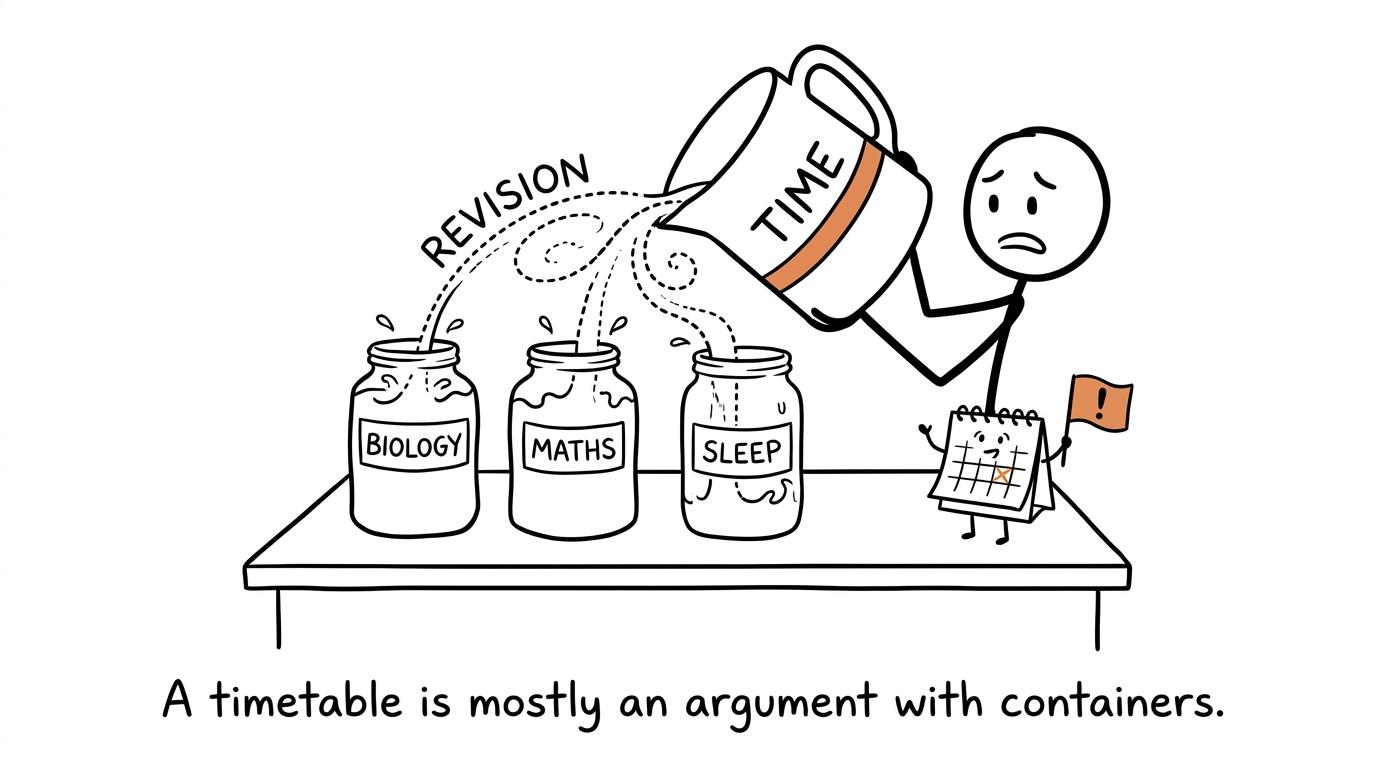 A student balances Biology, Maths and sleep in three revision jars
Build a Biology resit plan around evidence
Waiting for summer gives you time, but time only helps when it produces feedback.
Begin with the specification and a diagnostic paper. Mark it carefully, then sort lost marks into categories:
- missing biological knowledge;
- weak application to unfamiliar contexts;
- practical-method errors;
- misunderstood command words;
- mathematical or graph skills;
- incomplete extended responses;
- poor timing.
Revision should follow what the evidence reveals. Reading every chapter again can feel safe because it avoids judgement. A marked paper is less comfortable, but much more informative.
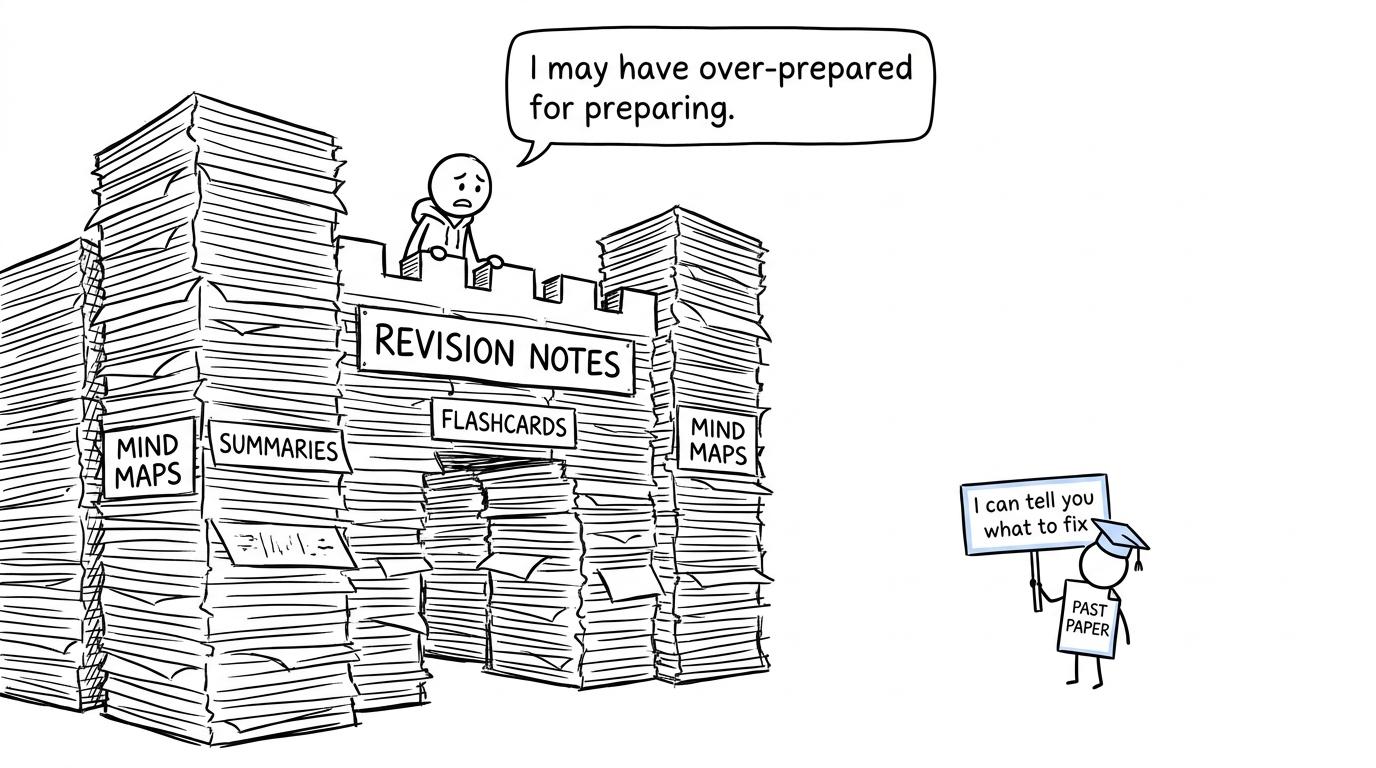 A revision-note fortress hides from a small but useful past paper
Do not neglect mathematical skills in Biology
Biology papers can require percentages, ratios, rates, means, graph interpretation, standard form and magnification. These are not separate from the science; they are tools used to communicate scientific evidence.
Useful relationships may include:
percentage change=changeoriginal value×100\text{percentage change}=\frac{\text{change}}{\text{original value}}\times 100percentage change=original valuechange×100 mean=sum of the observationsnumber of observations\text{mean}=\frac{\text{sum of the observations}}{\text{number of observations}}mean=number of observationssum of the observations magnification=image sizeactual size\text{magnification}=\frac{\text{image size}}{\text{actual size}}magnification=actual sizeimage sizeCheck units before substituting values, show your method and consider whether the final answer is sensible. If the underlying maths is costing you science marks, use MathsGenie's revision lessons and practice questions to repair that skill directly.
The most effective paper practice follows a loop: complete, mark, diagnose, repair and retest. The guide to when to start GCSE past papers explains how to move from topic questions towards full timed papers without using all your useful material too early.
Common mistakes when planning a Biology resit
Assuming every GCSE has a November sitting
The November availability of GCSE Maths and English Language does not extend automatically to Biology, Chemistry, Physics or Combined Science.
Confusing GCSE with International GCSE
A November International GCSE Biology timetable is not evidence that your standard GCSE Biology specification is available. Match the complete qualification title and code.
Revising before confirming an entry
Revision is valuable, but an exam plan needs an accepting centre, the correct specification and confirmed component requirements. Settle the administration early.
Retaking the wrong science qualification
Separate GCSE Biology and GCSE Combined Science are not interchangeable. Check what appears on your results documents and what your intended provider requires.
Focusing only on remembered content
Knowing definitions is not enough. Biology examinations also test application, practical understanding, data analysis, mathematical skills and extended responses.
Completing papers without repairing mistakes
A pile of marked papers is not progress by itself. Use each mark scheme to identify what failed, return to the relevant topic and retest it. The same principle is central to the GCSE Maths resit results-day plan.
Make the next exam series count
For most students taking standard GCSE Biology in England, November is not the available resit window. The realistic route is the next summer series. A November Biology sitting may exist for a differently titled qualification, such as some International GCSEs, but only the exact specification and official timetable can answer that question safely.
Confirm the qualification first. Confirm the centre second. Then build the revision plan.
If GCSE Maths is also part of your next step, MathsGenie can carry the daily work: free revision lessons to rebuild methods, practice questions and mini tests to expose weak areas, and past papers, predicted papers, mark schemes and video solutions to develop exam performance. Start with the guide to revising GCSE Maths efficiently, use the revision planner to protect your time, and turn each lost mark into a specific action.











