

GCSE Biology Grade Meaning for Sixth Form
GCSE biology grade sixth form guide: understand typical A Level Biology entry expectations, maths requirements and practical next steps for students.
The results envelope can make one number feel like a verdict on your future. It is not. Your GCSE biology grade sixth form providers consider is mainly evidence of how prepared you are for a faster, more analytical course. It does not create one national rule.
Many schools and colleges ask for grade 666 or 777 in GCSE Biology, or equivalent grades in Combined Science, before allowing students to progress to A Level Biology. Some also require grade 555 or 666 in GCSE Maths. Entry policies vary, however, so your provider's current prospectus is always the final authority.
Your quick entry-requirements checklist
Before selecting A Level Biology, check:
- the required GCSE Biology grade if you take separate sciences;
- the required pair of Combined Science grades, such as 666-666 or 777-777;
- any separate GCSE Maths requirement;
- whether Chemistry or another science grade is considered;
- the sixth form's overall GCSE entry criteria;
- what happens if you miss a requirement by one grade.
Do not rely on a friend's offer or last year's rules. Requirements can differ between providers and admission years.
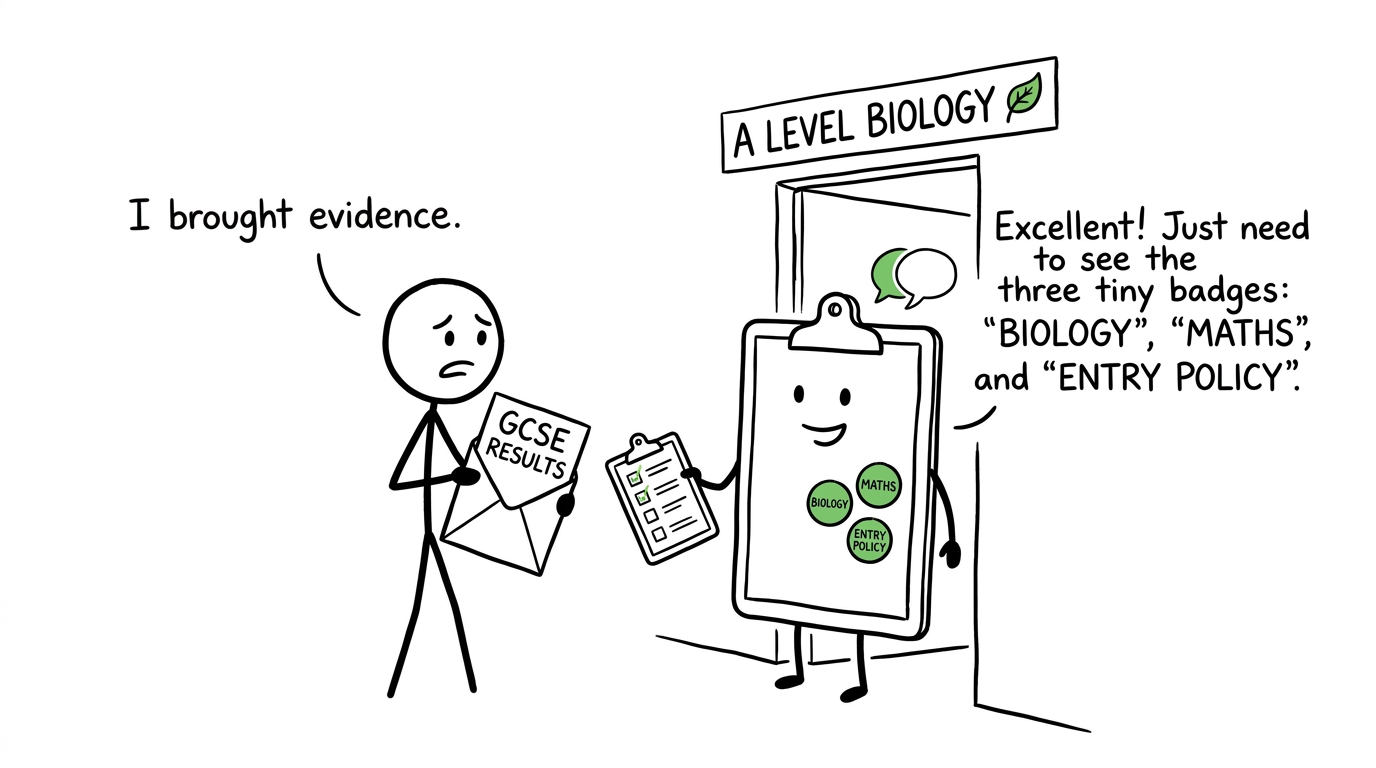 A student presenting GCSE evidence at the A Level Biology doorway
GCSE biology grade meaning: a grade-by-grade guide
The following breakdown describes common expectations, not guaranteed admission decisions.
Grades 999 and 888: a strong academic foundation
Grades 999 or 888 suggest that you have handled demanding GCSE content, application questions and scientific data confidently. You are likely to meet the Biology requirement at most sixth forms, provided you also satisfy their overall entry policy and any Maths or Chemistry conditions.
These grades do not make A Level Biology easy. The course introduces greater depth, unfamiliar contexts, longer explanations and more demanding practical analysis. Your advantage is preparation, not immunity from hard work.
Grade 777: meets many higher entry thresholds
A grade 777 is a common requirement among more selective sixth forms. It indicates a strong foundation for progressing to A Level Biology, particularly when supported by secure Maths and other science results.
If you study Combined Science, check the exact wording carefully. A provider asking for 777-777 is referring to the two grades awarded for Combined Science, not a separate Biology grade.
Grade 666: accepted by many providers
Grade 666 is frequently used as the minimum Biology requirement, although some providers set the threshold at grade 777. A grade 666 suggests that A Level progression may be realistic, but you should inspect your topic-level strengths rather than looking only at the final number.
Weaknesses in calculations, practical methods, genetics, cell biology or interpreting graphs can become more visible at A Level. Addressing them during the summer is more useful than worrying about whether your grade was only just above a boundary.
Grade 555: possible, but provider-dependent
A grade 555 is a strong pass at GCSE, but it falls below the published A Level Biology requirement at many schools and colleges. Some providers may still consider it alongside your Combined Science profile, Maths grade, teacher judgement or wider results. Others will apply their minimum requirement firmly.
Ask the admissions team directly rather than assuming that you are excluded. If A Level Biology is unavailable, investigate related Level 333 science pathways and whether they support your longer-term plans.
Grade 444: a pass, but usually below A Level entry expectations
Grade 444 is a standard pass. It is valuable, but it does not usually show the depth expected for immediate entry to A Level Biology where the published threshold is grade 666 or 777.
That is not the same as saying you cannot succeed in science. It means the next route may need to be different. Speak to your school or college about resits, applied science qualifications or another course that can build your scientific knowledge progressively.
Grades 333 to 111: focus on the next achievable step
Grades 333 to 111 normally fall below sixth-form A Level entry criteria. Your best next step is a conversation with a careers adviser, science teacher or college admissions team about resitting, foundation pathways or suitable vocational options.
A lower result closes some immediate routes, but it does not define your eventual destination. Qualifications are sequences. The important question is which next step gives you a realistic chance to progress.
Why your GCSE Maths grade matters for A Level Biology
Modern Biology is not a maths-free subject. Current A Level specifications require quantitative work involving ratios, percentages, standard form, units, graphs, means, probability, uncertainty and rearranging equations. At least 10%10\%10% of A Level Biology assessment marks are allocated to mathematical skills at Level 222 or above.
That explains why many sixth forms ask for GCSE Maths grade 555 or 666 alongside science grades. The requirement is about readiness for biological data, not about turning Biology into A Level Maths.
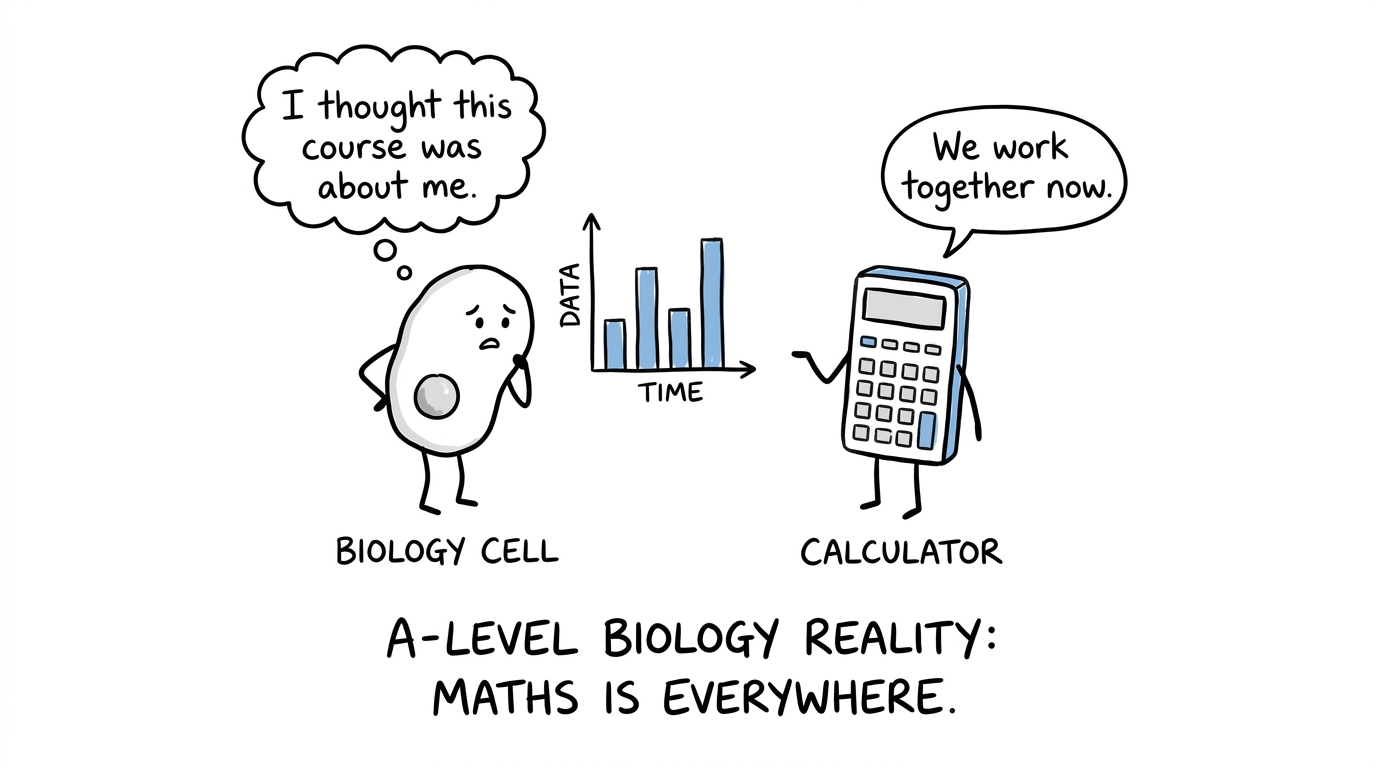 A cell discovering that calculators belong in Biology too
If calculations cost you marks, use the GCSE Maths revision hub to rebuild the foundations. Useful starting points include GCSE Maths revision guides, standard form revision and probability revision.
How to prepare for progressing to A Level Biology
First, compare your predicted grades with the published criteria for every provider you are considering. Apply to sensible alternatives rather than building your plans around one threshold.
Next, separate your Biology knowledge from your mathematical fluency. You may remember respiration accurately but still lose marks through unit conversions or graph interpretation. Use GCSE Maths past papers to identify those gaps, then return to focused topic practice instead of repeatedly completing full papers.
Finally, preview the destination. The AQA A Level Biology revision page shows the greater depth of content and the emphasis on applying ideas to data and unfamiliar situations. Students considering Eduqas can also explore the Eduqas A Level Biology revision guides.
Common mistakes when interpreting your grade
- Treating one threshold as a national rule: entry requirements are set by individual schools and colleges.
- Confusing separate and Combined Science: a Biology grade of 666 and Combined Science grades of 666-666 are different qualification profiles.
- Ignoring Maths requirements: meeting the Biology threshold may not be enough if the course also asks for grade 666 in Maths.
- Assuming admission guarantees success: A Level Biology requires consistent revision, practical understanding and data analysis.
- Giving up before asking: providers may explain alternative courses, resit routes or their process for near-miss results.
Your grade is information, not identity
A GCSE grade tells a sixth form something useful about your current preparation. It cannot describe your curiosity, future discipline or every route available to you.
Check the precise entry criteria, strengthen your scientific maths and make a realistic set of post-161616 choices. MathsGenie can support that transition with free revision lessons, practice questions, past papers, predicted papers, mini tests, mark schemes and video solutions. Start with your weakest GCSE Maths skill, then explore the AQA A Level Biology resources to see what the next stage genuinely involves.











