Is GCSE Biblical Hebrew Useful Without A Level?
GCSE Biblical Hebrew useful without A-level? Learn what it adds, how sixth forms may count it, and how to balance it with maths revision.
It is easy to assume that every GCSE needs a sequel. If you take Biblical Hebrew now, perhaps it is only worthwhile if A Level Biblical Hebrew comes next. That is not how qualifications work.
The short answer to is gcse biblical hebrew useful without a-level is yes. It remains a recognised GCSE, can contribute to sixth-form entry totals, and develops language, textual analysis and disciplined revision skills. You do not have to continue the subject for those benefits to count.
But usefulness is not the same as necessity. Biblical Hebrew is unlikely to be required for an unrelated A Level or university course, and it should not consume revision time needed to meet essential English, maths or subject-specific entry requirements. Its value depends on the qualification you earn, the skills you build and the opportunity cost of preparing for it.
The quick verdict
GCSE Biblical Hebrew may be useful without A Level study because it can:
- count as a full GCSE in applications where a provider considers your number or profile of GCSE results;
- count within the language element of the English Baccalaureate, where the relevant qualification and school arrangements apply;
- demonstrate proficiency in translation, grammar and close reading;
- develop analysis of literary, historical and cultural context;
- strengthen memory, attention to detail and evidence-based writing;
- provide a foundation for later independent study, even if you never take the A Level.
It is less useful if pursuing it causes your results in maths, English or subjects required for your intended post-16 courses to fall. Before deciding how much revision time to give it, check the actual entry policy of your chosen sixth form or college.
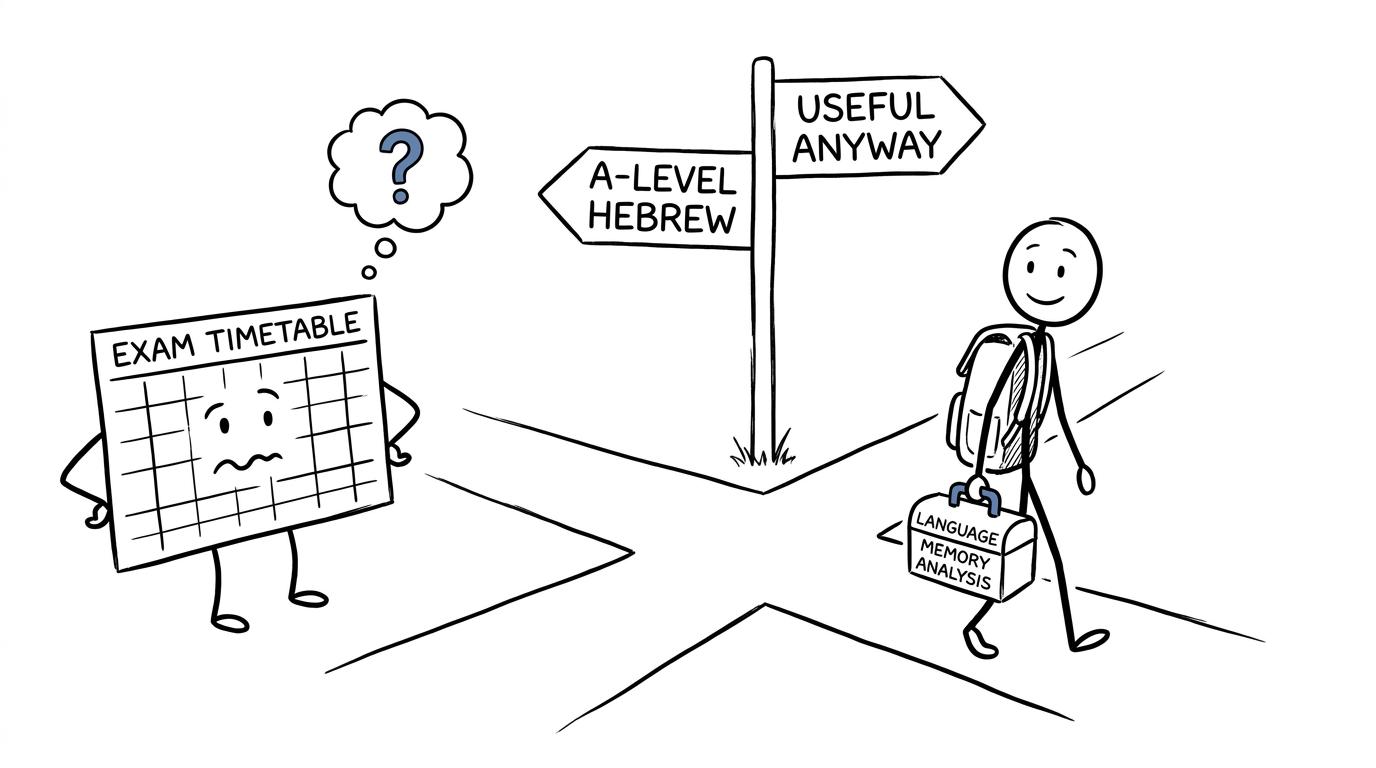 A student discovers that a GCSE can remain useful without an A Level sequel
What GCSE Biblical Hebrew actually involves
The current Pearson Edexcel GCSE Biblical Hebrew qualification, specification 1BH0, is a grades 9-1 ancient-language GCSE. It is not simply a test of recognising vocabulary or recalling familiar passages.
The qualification has two externally examined components. Each lasts 222 hours, carries 100100100 marks and contributes 50%50\%50% of the final result.
Language
The language component assesses reading and understanding unseen Biblical Hebrew. Students answer comprehension questions and translate passages into English. The specification also offers choices involving grammatical structures or the translation of simple English sentences into pointed Biblical Hebrew.
This rewards precision. A small change in a verb form, subject or object can alter the meaning of a sentence. You have to inspect the evidence rather than rely on the general feeling of a passage.
Literature
The literature component uses set texts. Students need to understand content and context, identify grammatical and literary features, translate material, and analyse or evaluate how ideas are presented. It includes short responses, extended responses and a synoptic comparison across the texts.
That combination matters when judging the qualification's wider value. It develops both technical language knowledge and the ability to construct an interpretation supported by evidence.
Does it count if you stop after GCSE?
Yes. A completed GCSE does not disappear because you choose different subjects at A Level. It remains part of your qualifications record, and UCAS applicants are normally required to declare the qualifications they have taken.
Biblical Hebrew is also recognised as an ancient language in national GCSE subject requirements. Eligible Biblical Hebrew qualifications can count towards the language component of the EBacc. The EBacc is a school performance measure and combination of subjects, not a separate qualification awarded to an individual student, so it should not be confused with an extra certificate.
The important distinction is between counting and being specifically required. Biblical Hebrew may count among the GCSEs considered by a sixth form, but that does not mean it replaces every named condition in an admissions policy.
How sixth forms and colleges may treat it
Post-16 entry rules are set by individual schools and colleges. There is no single GCSE profile that guarantees entry everywhere.
Many providers publish both:
- a general requirement, such as a certain number of GCSEs within a stated grade range; and
- subject-specific requirements for individual A Levels.
A full GCSE in Biblical Hebrew may contribute to the general total where the provider accepts it. However, it will not normally replace a required grade in English Language, maths, science or the GCSE related to your intended A Level.
For example, a provider may require a particular GCSE maths grade for A Level Mathematics and a separate minimum grade in English. In that situation, a strong Biblical Hebrew result improves your overall profile but does not override the named maths condition.
Check three things directly in the current prospectus:
- Is the entry calculation based on your best GCSEs, all GCSEs or a fixed number?
- Are any subjects excluded or treated differently?
- What grades are required for each A Level you want to take?
If the wording is unclear, ask the admissions team. A direct answer is more reliable than assumptions based on another college's rules.
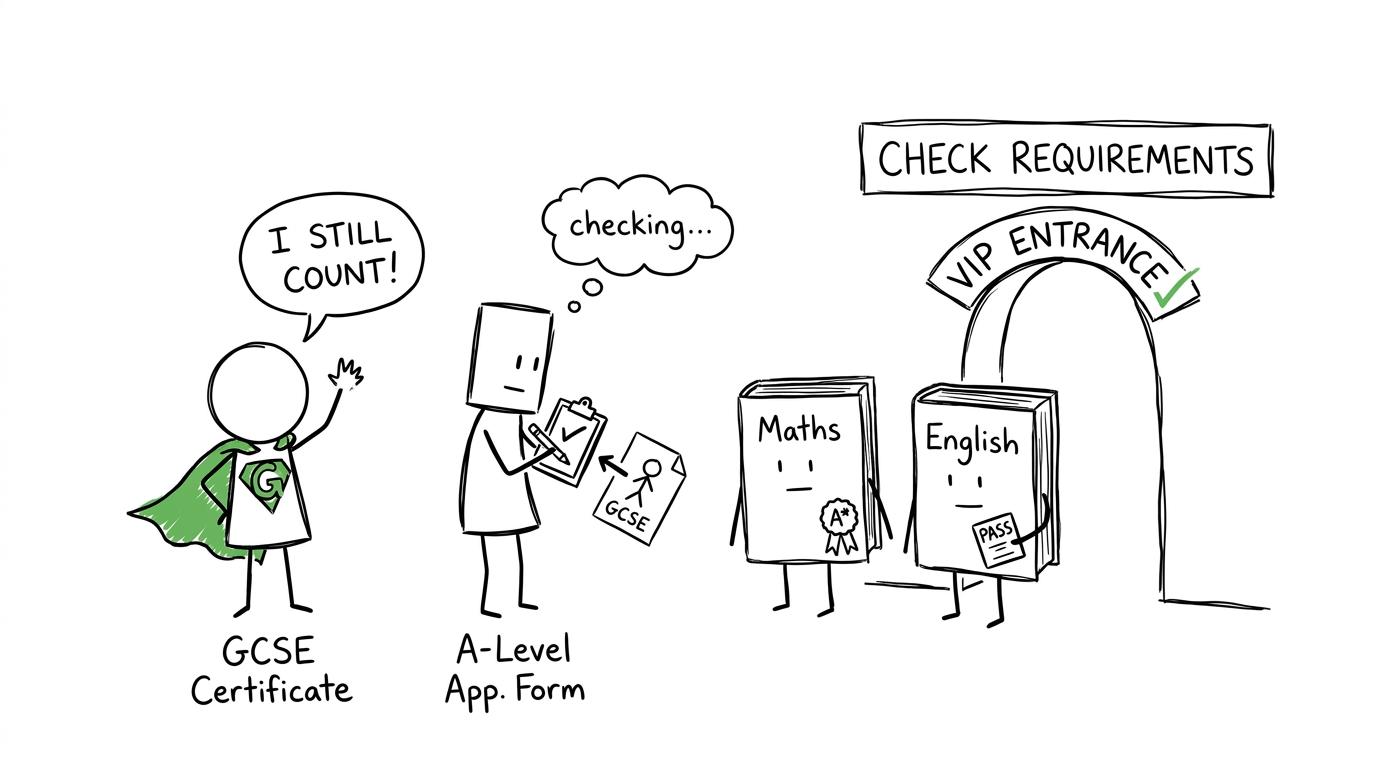 A GCSE certificate explains that it still counts while maths and English guard the requirements entrance
The skills remain useful beyond Biblical Hebrew
A subject can be useful without being vocational. Most GCSE knowledge is not valuable because you repeat the exact examination task forever. It is valuable because it changes how carefully you can think.
Close reading and grammatical precision
Translation requires you to notice structure, endings, roots and relationships between words. You learn that a plausible interpretation is not necessarily an accurate one.
That habit transfers to subjects built around precise wording. In maths, command words and constraints matter. A question asking you to estimate, prove, show or calculate is not asking for the same kind of response. Before practising papers, confirm your board and tier through the GCSE maths topics by exam board and tier guide.
The transfer is a thinking habit, not a shortcut. Knowing Biblical Hebrew will not teach trigonometry, but careful reading may help you avoid answering a nearby question rather than the one printed on the page.
Memory built around patterns
Vocabulary, grammatical forms and set-text knowledge require retrieval. Productive revision therefore involves recalling material, checking it and returning to weak areas.
The same principle works in maths, although maths also demands application. A method must be retrieved and then used in an unfamiliar setting. MathsGenie's GCSE maths revision hub supports this with topic lessons, practice questions, papers and revision tools for the major exam boards.
Evidence-based analysis
The literature paper asks students to select evidence, compare texts and reach reasoned conclusions. This is useful preparation for essay subjects such as English Literature, History, Religious Studies and some humanities courses.
It also encourages intellectual caution: what can the text support, and what have you merely assumed? In maths, the parallel is showing a valid chain of reasoning rather than writing an unsupported answer.
Working across different systems
Biblical Hebrew asks you to move between languages while preserving meaning. That develops mental flexibility and comfort with unfamiliar conventions. These qualities can help with later language study, theology, ancient history, linguistics and independent textual study, even where Biblical Hebrew is not a formal entry requirement.
Will it help with university applications?
It can contribute to your overall academic record, but its importance should be kept in proportion.
Universities and courses set their own entry requirements. Many expect particular post-16 qualifications and may also specify minimum GCSE grades, especially in English and maths. More selective or professionally oriented courses can apply additional GCSE conditions.
Biblical Hebrew may show academic range and sustained engagement with a demanding language. Yet it is not a universal advantage, and students should not claim that it automatically makes an application distinctive. Your achieved grades, required subjects and suitability for the chosen course matter more than novelty alone.
If you already have possible degree courses in mind, inspect their published entry requirements. Work backwards from what is explicitly required rather than trying to guess what might look impressive.
Balancing Biblical Hebrew with GCSE maths revision
The hidden cost of every subject is time. An extra hour spent revising one paper is an hour unavailable elsewhere. That does not mean Biblical Hebrew should always receive less time. It means revision should respond to evidence.
Begin with four questions:
- Which subjects have non-negotiable post-16 grade requirements?
- Where are you currently losing the most recoverable marks?
- Which examinations are closest?
- Which subject needs frequent short retrieval rather than occasional long sessions?
Biblical Hebrew may suit regular vocabulary, grammar and set-text recall. Maths needs repeated question practice, correction and mixed-paper experience. The GCSE maths revision timetable guide can help you build a week around genuine weaknesses rather than whichever subject feels most comfortable.
For a shorter deadline, use the one-month GCSE maths revision plan to organise focused practice. If you take AQA, the AQA GCSE Maths revision area provides board-specific lessons, questions and papers. Edexcel students can build exam stamina with Edexcel GCSE Maths past papers and diagnose smaller gaps through Edexcel mini tests.
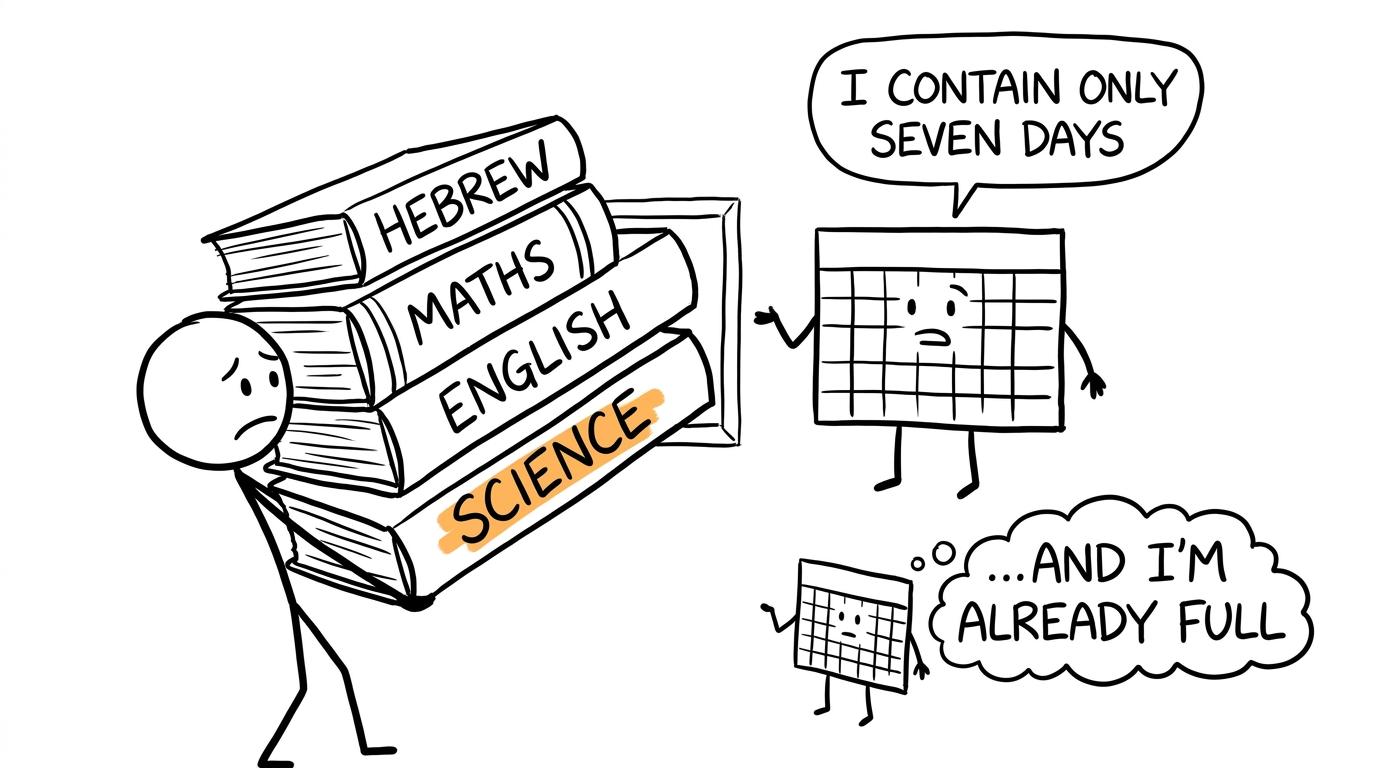 A weekly calendar discovers that GCSE revision books cannot all occupy the same hour
Common mistakes when judging its usefulness
Assuming a subject is pointless unless continued
A GCSE records achievement at GCSE level. Its skills and contribution to your qualification profile do not depend on taking the A Level.
Assuming every college counts qualifications identically
Some providers use best-grade totals, averages or specific subject lists. Read the admissions policy for your intended year of entry.
Treating it as a substitute for required subjects
An excellent Biblical Hebrew grade does not usually replace a named maths, English or science requirement. General and subject-specific conditions must both be checked.
Overstating skill transfer
Translation can develop precision, but it does not directly revise algebra, geometry or probability. Transferable habits support subject knowledge; they do not replace it.
Revising according to guilt
Students often give time to the subject with the largest pile of notes. A better method is to use tests and marked papers to identify where the next revision session can recover marks.
A qualification can be useful without becoming your future
GCSE Biblical Hebrew can give you a recognised qualification, evidence of language proficiency and experience in close textual analysis. It can count towards general sixth-form GCSE totals and the EBacc language component where the relevant rules apply. None of that requires you to continue to A Level.
Its practical value still depends on your plans. Check college requirements, protect the subjects carrying specific grade conditions and allocate revision time according to evidence. A subject does not have to determine your destination to have been worth learning.
For maths, make that evidence visible. Start with the MathsGenie GCSE maths revision hub, choose your exam board and tier, and use free revision lessons and practice questions to repair individual topics. Then move through mini tests, past papers and predicted papers, checking every attempt with mark schemes and video solutions. The aim is not to revise everything equally. It is to know what each qualification gives you, then spend your remaining time where it can matter most.