

Is a GCSE Biblical Hebrew Revision Bootcamp Worth It?
GCSE Biblical Hebrew revision bootcamp guide: learn what courses offer, how to assess the cost, and when paying for holiday revision is worthwhile.

Revision courses are easiest to buy when revision feels hardest. A deadline is approaching, confidence is slipping, and a concentrated day of expert teaching sounds like the answer. But is a GCSE Biblical Hebrew revision bootcamp actually worth paying for?
The short answer is: sometimes. A focused course can be valuable when it matches your specification, addresses identifiable weaknesses and provides expert feedback that you cannot easily obtain elsewhere. It is less likely to be worthwhile if it simply compresses familiar notes into a long day, promises an unrealistic transformation or takes time away from more urgent subjects, including GCSE maths.
The right question is not merely, “Is the course good?” It is, “Is this the best use of my remaining time and revision budget?”
A quick bootcamp value checklist
Before booking, look for:
- teaching designed specifically for GCSE Biblical Hebrew rather than Modern Hebrew or a general religious studies course;
- explicit alignment with the current OCR specification and your prescribed literature;
- separate attention to language skills and literature preparation;
- opportunities to attempt exam-style questions under timed conditions;
- individual feedback from a teacher with relevant subject and examination experience;
- a manageable group size and a clear timetable;
- materials you can continue using after the course;
- transparent information about fees, cancellations and what is included.
If several of these details are missing, ask the provider before paying.
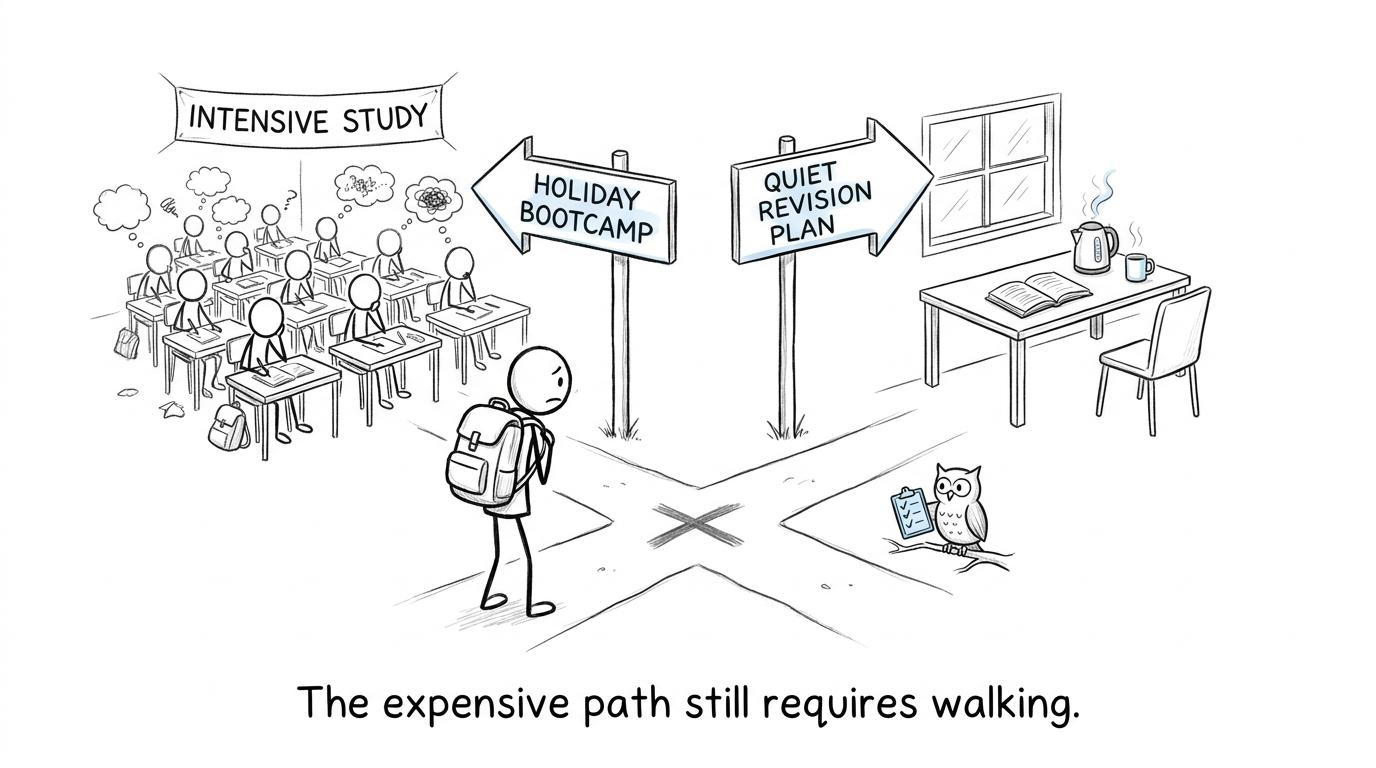 A student choosing between a holiday bootcamp and a quiet revision plan
What GCSE Biblical Hebrew revision bootcamps offer
There is no universal definition of a revision bootcamp. One provider may offer a single online workshop; another may run several classroom sessions during a school holiday. Prices, teaching hours, class sizes and resources therefore vary considerably.
A useful course should explain exactly what happens during the booked hours. Common features include a specification overview, grammar consolidation, vocabulary recall, unseen translation practice, literary text revision, exam technique and timed tasks. Some courses may also provide recordings, booklets, annotated passages or follow-up support.
For the OCR GCSE in Biblical Hebrew, candidates need preparation that reflects the qualification's language and literature demands. The precise prescribed texts and administrative details can change between specification cycles, so families should compare any course outline with the current specification and information supplied by the school or examination centre.
Language revision
Language sessions may revisit morphology, syntax, vocabulary and the process of translating accurately. Strong teaching does more than present rules. It helps students diagnose why marks are being lost: perhaps a form is being misidentified, a small word is being overlooked or an English translation is not precise enough.
The best question to ask is whether students will produce answers and receive feedback. Listening to an explanation can feel productive, but examination performance depends on retrieving knowledge and applying it independently.
Literature preparation
A literature session should be tied to the correct prescribed material. It may cover secure translation, narrative or poetic context, significant themes and the use of textual evidence in examination responses.
Be cautious if the advertisement says only “complete literature revision”. Ask which texts are covered, how much time is devoted to each and whether the teaching corresponds to the current examination requirements. A polished general lecture may still be poorly matched to your paper.
Exam practice and feedback
Timed practice is often the feature that makes a paid course genuinely different from independent revision. A knowledgeable teacher can identify patterns that a student may not notice alone, then explain how to improve the next response.
Useful feedback should be specific and actionable. “Revise grammar” is broad. Identifying the forms, vocabulary groups or response habits that need attention gives the student something concrete to practise after the session.
When a bootcamp is genuinely worth paying for
A bootcamp has the strongest case when it solves a particular problem.
You have limited access to specialist teaching
Biblical Hebrew is a specialist subject. If regular access to an experienced teacher is limited, a well-designed course may provide clarification and informed feedback that are difficult to reproduce through notes alone.
That does not make every specialist course worthwhile. It makes tutor expertise especially important. Ask about the teacher's experience with the qualification, the specification and the relevant prescribed texts rather than relying on broad claims about language teaching.
Your weak areas are already known
A concentrated course works best when the student can arrive with a diagnosis: weak vocabulary recall, uncertainty with particular grammatical forms, slow translation or underdeveloped literature responses.
A bootcamp cannot sensibly repair every gap in one day. It can, however, help untangle a small number of obstacles and provide a plan for the remaining revision period.
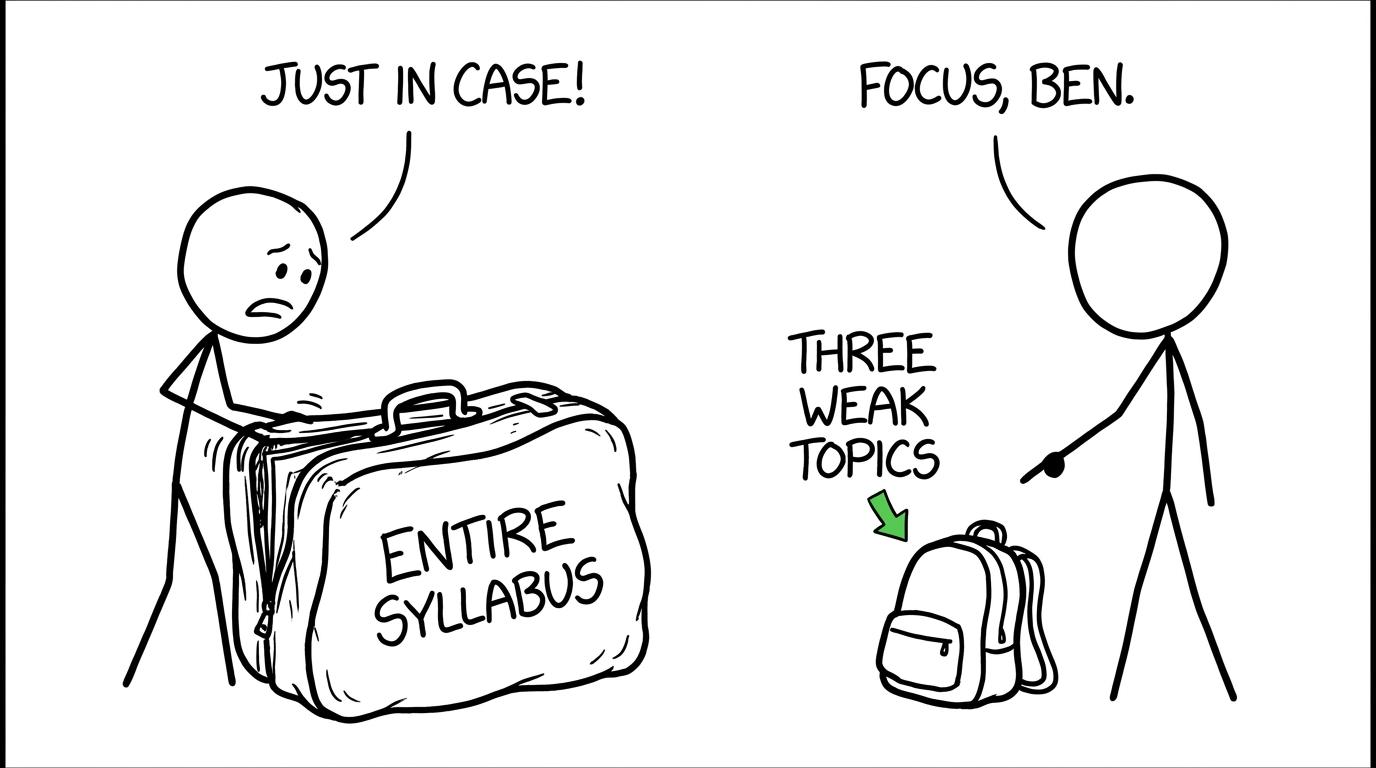 A student trying to pack the entire syllabus into one revision day
It includes active practice
A strong timetable should require students to recall, translate, write, check and improve. If most of the day consists of copying notes, the same time might be used more effectively at home.
Look for a healthy cycle:
- brief explanation;
- independent attempt;
- accurate checking;
- targeted feedback;
- another opportunity to apply the correction.
This principle applies across subjects. MathsGenie's free GCSE maths revision lessons, for example, combine explanations with questions because understanding becomes dependable only when it survives independent practice.
You will use the course after it ends
The value of a bootcamp is rarely confined to the teaching hours. Its real benefit is the quality of the revision it changes afterwards.
A student who turns feedback into a weekly plan, revisits errors and completes further timed practice may gain lasting value. Someone who puts the booklet away has mostly bought a day of reassurance.
When the cost is probably not justified
A course may be unnecessary when the student already has reliable teaching, clear school resources and regular marking. In that situation, another set of explanations may add less than quiet, deliberate practice.
It may also be poor value when:
- the provider does not identify the examination board or specification;
- the correct prescribed literature is not confirmed;
- the group covers students with widely different needs;
- there is no marked work or individual feedback;
- the timetable relies heavily on passive lectures;
- ambitious grade promises replace a clear teaching plan;
- attendance would remove too much time from higher-priority subjects.
No ethical provider can guarantee a particular grade. Examination outcomes depend on prior knowledge, continued revision, performance on the day and the demands of the paper.
How to judge the price sensibly
The advertised fee alone does not reveal value. Compare what the payment buys and what alternative use could be made of the same time and money.
One simple measure is:
cost per useful teaching hour=total feehours of relevant, active teaching\text{cost per useful teaching hour} = \frac{\text{total fee}}{\text{hours of relevant, active teaching}}cost per useful teaching hour=hours of relevant, active teachingtotal fee“Useful” matters. Lunch, registration, broad motivational talks and topics outside your specification should not be counted as targeted teaching simply because they appear in the timetable.
Then consider the additional value of marked work, reusable materials, recordings or follow-up access. Also check for travel costs, required books and cancellation conditions. For an online course, confirm whether sessions are live, whether recordings are provided and whether students can ask questions.
Finally, calculate the opportunity cost. A holiday contains a finite number of focused revision hours. Time devoted to Biblical Hebrew cannot simultaneously be spent addressing weak algebra, geometry or statistics.
Students balancing several papers can use MathsGenie's free revision planner to see whether the course fits the wider examination schedule rather than judging it in isolation.
Protecting your GCSE maths revision time
Biblical Hebrew may be the subject creating the most anxiety, but it is rarely the only examination approaching. A bootcamp should fit inside a balanced plan, not consume the plan.
Before booking, review recent assessments across every subject. For maths, use the GCSE revision resources to match weak topics with focused lessons and questions. Then use GCSE past papers to distinguish a topic gap from an exam-timing problem.
Short diagnostic tasks can be particularly useful when time is tight. MathsGenie's GCSE mini tests allow students to check smaller areas without committing immediately to a full paper. Closer to the examination period, GCSE predicted papers can provide further practice, although they should complement rather than replace official past papers and complete specification coverage.
This comparison matters because paid revision should be used where payment adds something distinctive. Maths revision lessons, practice questions, video solutions and mark schemes are already available free through MathsGenie. That may leave more of the revision budget available for specialist Biblical Hebrew feedback, if it is genuinely needed.
Questions to ask a course provider
A short email before booking can prevent an expensive mismatch. Ask:
- Which qualification and current specification does the course follow?
- Which prescribed texts will be taught?
- How are language and literature divided across the timetable?
- How much independent exam practice is included?
- Will written work receive individual feedback?
- What is the maximum group size?
- What materials or recordings can be used afterwards?
- What happens if the course is cancelled or the student cannot attend?
Clear, specific answers are a positive sign. Vague replies make it difficult to assess whether the programme matches the student's needs.
Common mistakes when choosing a revision course
Booking because panic feels like evidence
An approaching examination creates urgency, but urgency does not prove that a course is necessary. Diagnose the weakness first. The solution may be specialist teaching, or it may simply be a consistent practice routine.
Confusing Biblical Hebrew with another course
Confirm that the programme prepares students for GCSE Biblical Hebrew. General Hebrew language teaching, Modern Hebrew and broader biblical studies may be valuable in their own contexts, but they are not automatically aligned with this qualification.
Ignoring the prescribed literature
A course can be excellent in general and still be wrong for the student's examination. Check the texts and specification before paying.
Expecting attendance to replace revision
A course is an intervention, not a substitute for preparation. Vocabulary retrieval, translation practice and literature review must continue afterwards.
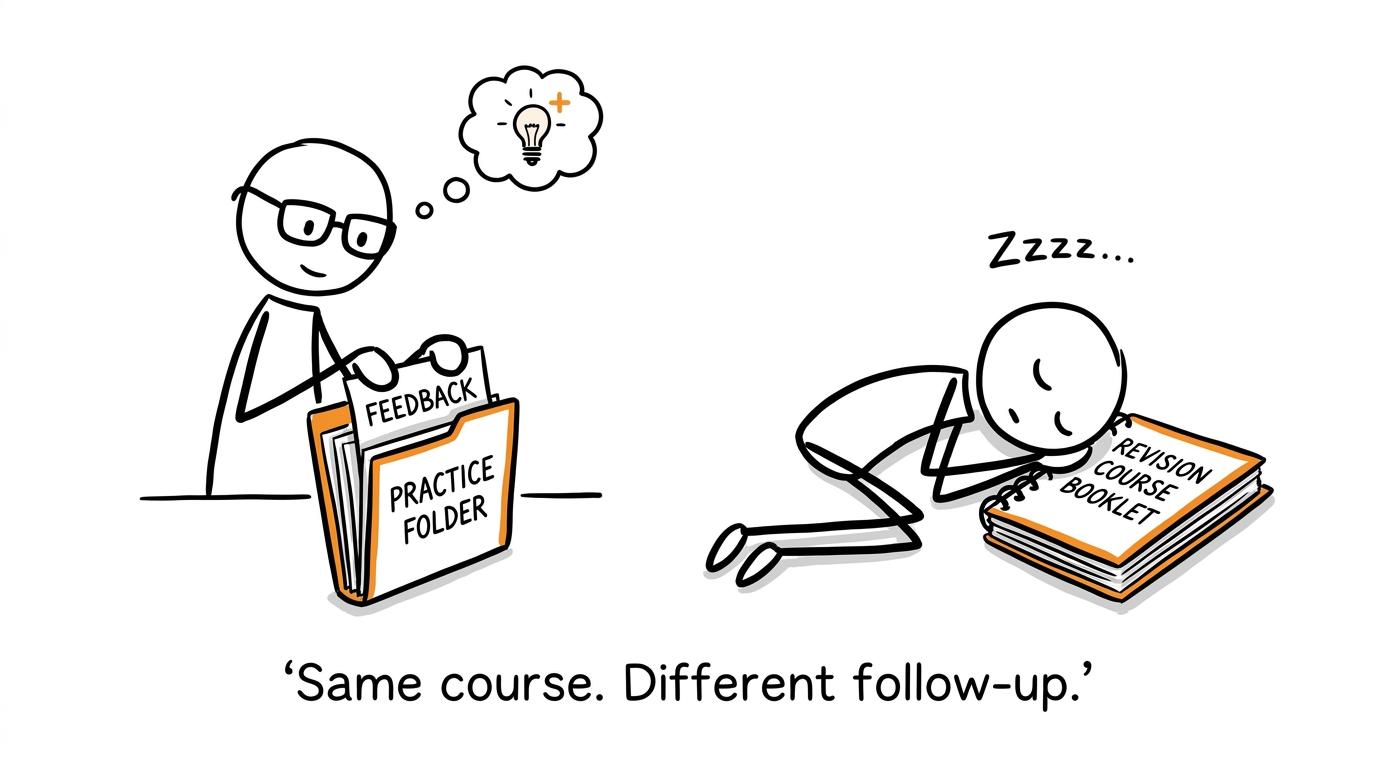 Two students making very different use of their bootcamp materials
Sacrificing the whole revision timetable
A long course can create hidden costs if it displaces essential work elsewhere. Keep maths moving through targeted GCSE practice questions and video lessons, then schedule full papers when concentration and time permit.
The verdict
A GCSE Biblical Hebrew revision bootcamp can be worth the cost when it offers specification-specific expertise, active examination practice and individual feedback on weaknesses the student cannot resolve independently. It is unlikely to offer good value when it is generic, passive or purchased mainly to relieve anxiety.
Before booking, compare the course with the current OCR requirements, ask the provider precise questions and decide what improvement the course is expected to produce. Most importantly, reserve time to act on the feedback afterwards.
Then protect the rest of the examination plan. Start with MathsGenie's free GCSE revision hub, use past papers with mark schemes, practise with predicted papers, and turn weak topics into manageable next steps. A paid course may provide direction in a specialist subject. Consistent practice is what carries that direction into the examination room.










