

GCSE Biblical Hebrew Mock Results: Your Next Steps
GCSE Biblical Hebrew mock results can guide smarter revision. Learn how to analyse lost marks, set priorities and build a focused plan for your next test.

A mock result can change the atmosphere of an entire day. A pleasing grade brings relief; a disappointing one can make months of work feel invisible. Yet GCSE Biblical Hebrew mock results are most useful when you treat them as information rather than a verdict.
The short answer is this: look beyond the grade, identify exactly where marks were lost, group those losses by cause, and turn the largest recoverable gaps into specific revision tasks. Then retest them. This gives you a plan based on evidence, not anxiety.
That principle matters especially if you are balancing Biblical Hebrew with GCSE maths. Both subjects reward precise knowledge, careful reading and the ability to perform under time pressure. The content differs, but the way you learn from a mock is remarkably similar.
Your mock-results checklist
Before beginning more revision, collect:
- your marked question paper and total raw mark;
- the mark scheme, if your teacher has shared it;
- your component or section marks;
- any written teacher feedback;
- the grade boundary used by your school;
- the current specification and set-text list;
- a notebook or spreadsheet for recording lost marks.
Your aim is not simply to ask, “What grade did I get?” Ask three better questions:
- Where did the marks go?
- Why did they go?
- What will I do differently next time?
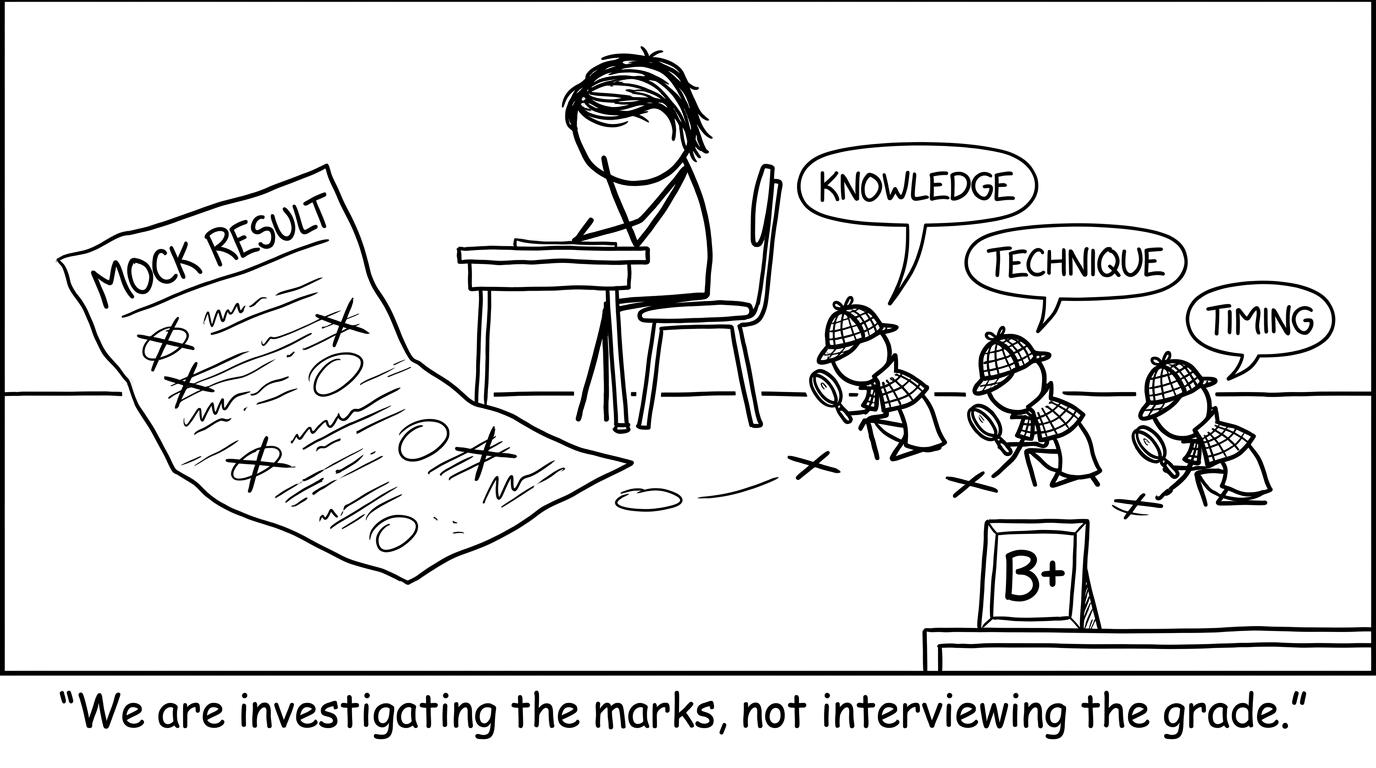 A mock result investigated by knowledge, technique and timing detectives
Understand what your Biblical Hebrew result measures
The current Pearson Edexcel GCSE Biblical Hebrew qualification is linear, untiered and graded 999 to 111. It has two externally examined components, each worth 50%50\%50% of the qualification and carrying 100100100 marks.
- Component 1: Language assesses comprehension, language knowledge and translation.
- Component 2: Literature assesses knowledge, translation, analysis and response to the prescribed texts.
The assessment objectives across the qualification are weighted as follows:
| Assessment objective | What it measures | Qualification weighting |
|---|---|---|
| AO1 | Knowledge and understanding of the language | 50%50\%50% |
| AO2 | Knowledge and understanding of literature | 25%25\%25% |
| AO3 | Analysis, evaluation and response to literature | 25%25\%25% |
This structure matters because equal component marks can hide different problems. A language weakness may involve vocabulary, morphology, syntax or translation accuracy. A literature weakness may come from insecure textual knowledge, limited analysis, unsupported points or misunderstanding what a command word requires.
For examinations from 2026 to 2028, the prescribed selections come from Genesis, covering Joseph’s rise to power, and Kings, covering the miracles of Elisha. Always check that your mock used the correct material for your examination series.
Read the raw mark before the grade
Your mock grade is useful, but it is not an official summer result. Final GCSE grade boundaries are set after examinations have been taken and marked because paper difficulty can vary between series. A school must therefore choose an indicative method for grading its mock.
Ask your teacher:
- Was the mock an unmodified past paper?
- Were historical boundaries used?
- Was the paper shortened or adapted?
- Had your class completed all the assessed content?
- Were the school’s boundaries deliberately cautious?
Calculate your percentage only to describe your performance on that particular paper:
percentage score=mark achievedmaximum mark×100\text{percentage score}=\frac{\text{mark achieved}}{\text{maximum mark}}\times 100percentage score=maximum markmark achieved×100Do not treat the percentage as a guaranteed GCSE grade. It becomes more useful when compared with your previous attempts under similar conditions.
The same caution applies to maths mocks. The GCSE grade boundaries guide explains why boundaries change and why the underlying marks often tell you more than the headline grade.
Separate your result into useful categories
A long list of incorrect answers does not yet constitute a revision plan. Every lost mark should be assigned to a reason.
Knowledge gaps
You did not know the required vocabulary, grammatical form, textual detail or literary feature. These gaps need direct learning followed by retrieval practice.
For language questions, separate vocabulary from morphology and syntax. “I need to improve grammar” is too broad. “I confuse pronominal suffixes” is actionable.
For literature, distinguish between not knowing the text and knowing it but failing to use relevant evidence. Those require different repairs.
Application errors
You knew the underlying material but could not apply it in an unfamiliar passage or question. This often appears when a recognised form is missed in context or when a learned literary point is not connected to the wording of the question.
Application improves through fresh questions, not repeated rereading. Close the notes, attempt a new task and check whether you can select the knowledge independently.
Exam-technique losses
These include ignoring a command word, giving too little detail for the available marks, leaving a claim unsupported or translating so freely that the original structure disappears.
Technique errors can be expensive because they may recur across many questions. Study the mark scheme and ask what visible evidence the examiner needed.
Accuracy and timing losses
Some marks disappear through omitted words, unchecked references, rushed endings or unanswered questions. Mark the point where your work became hurried. That tells you whether the difficulty was the whole paper or one section that absorbed too much time.
This diagnostic habit transfers directly to maths. The MathsGenie GCSE maths revision hub lets you move from a broad result to board-specific revision lessons and practice questions for Edexcel, AQA, OCR and Eduqas.
Build a marks-leak table
Record only information that changes your next action. A useful table looks like this:
| Area | Why marks were lost | Next revision action | Retest evidence |
|---|---|---|---|
| Vocabulary | Meaning not recalled | Retrieval practice on missed words | Short unseen passage |
| Morphology | Form identified incorrectly | Review the specific form and classify new examples | Closed-book quiz |
| Translation | Important detail omitted | Compare translation closely with the mark scheme | Fresh passage |
| Literature | Point lacked textual support | Pair each claim with precise evidence | Timed paragraph |
| Timing | Final response unfinished | Set section checkpoints | Timed paper section |
Avoid vague actions such as “revise translation” or “do more Hebrew”. A useful action names the skill, the task and the evidence that will show improvement.
In maths, the equivalent might be one specific weakness such as rearranging formulae or interpreting cumulative frequency. The GCSE maths topics by board and tier guide can help Foundation and Higher students translate a mock-paper error into the correct topic area.
Choose priorities instead of revising everything
Not every lost mark deserves equal attention. Begin with problems that are repeated, worth several marks or relatively quick to correct.
You can think about priority using:
revision priority=recoverable marks×likelihood of recurrencetime needed to improve\text{revision priority}=\frac{\text{recoverable marks}\times\text{likelihood of recurrence}}{\text{time needed to improve}}revision priority=time needed to improverecoverable marks×likelihood of recurrenceThis is a decision-making tool, not an examination formula. Its purpose is to stop one fascinating but low-impact detail consuming an entire evening.
Choose three priorities for the coming week:
- one language-knowledge weakness;
- one literature or analysis weakness;
- one performance habit, such as timing or checking.
That is usually more productive than rewriting every note you own. Put the tasks into your revision planner and decide in advance when each retest will happen.
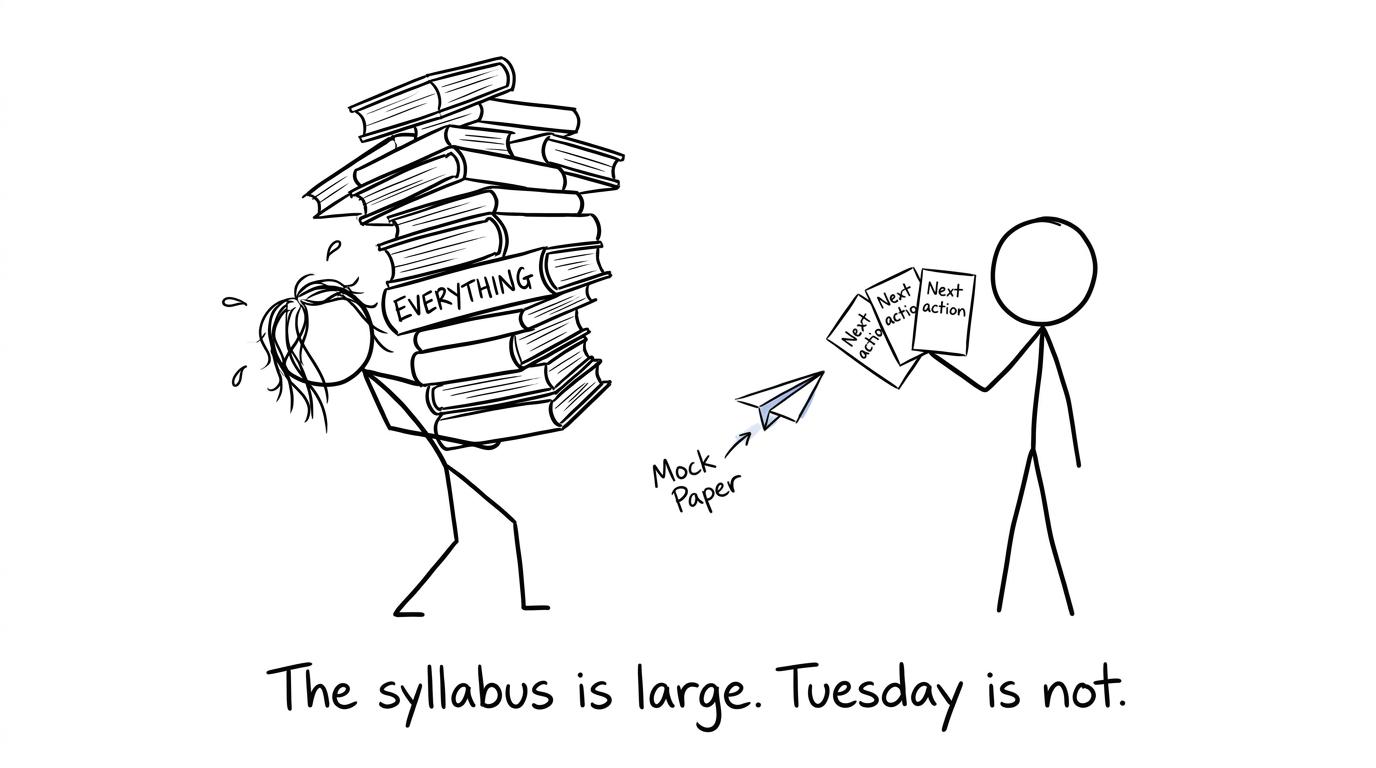 A student choosing three next actions instead of carrying every revision book
Use a repair-and-retest cycle
Revision has not worked merely because a topic now looks familiar. You need evidence that you can retrieve and apply it without support.
Use this cycle:
- Diagnose: choose one precise weakness from the mock.
- Repair: relearn the necessary knowledge or technique.
- Practise: complete focused questions without copying notes.
- Check: mark carefully and explain each remaining error.
- Retest: return to the skill after a gap using unseen material.
- Mix: test it later within a timed section or full paper.
Do not immediately repeat an answer from memory and count it as mastery. Change the passage, wording or context where possible.
For your maths preparation, GCSE mini tests offer a manageable way to check whether a repaired topic survives without prompts. Once individual skills are secure, use the MathsGenie past-paper library to test selection, timing and stamina.
The same progression applies across subjects: targeted practice repairs the part; a full paper checks whether the parts work together.
Connect the method to your GCSE maths revision
MathsGenie does not teach Biblical Hebrew, but the diagnostic method should not remain trapped in one subject. If your Hebrew mock revealed that you rush later sections, overlook command words or revise passively, those habits may also be costing marks in maths.
Take your latest maths mock and repeat the process:
- label each lost mark by topic;
- separate knowledge gaps from slips and misreads;
- choose the three largest recoverable leaks;
- use a revision lesson to rebuild each method;
- complete practice questions without notes;
- check solutions and mark schemes;
- retest through a mini test or unseen paper.
The guide to using Edexcel GCSE maths past papers properly develops this process for Edexcel students, while the broader advice on when to start GCSE past papers applies across exam boards.
Predicted papers are most valuable after this repair work. They are fresh practice, not promises about the real examination. Use them to expose remaining gaps, then return to the relevant lesson or question set.
Common mistakes when reviewing mock results
Focusing only on the grade
A grade compresses many different performances into one symbol. Record the raw mark, section profile and causes of lost marks before drawing conclusions.
Revising the easiest material first
Comfort is not the same as progress. Begin with a recoverable weakness that repeatedly costs marks, even if it feels less pleasant.
Treating every error as a knowledge gap
A student who knew the material but misread the command word does not need another hour of note-making. The required repair is better question reading and timed application.
Reading the mark scheme without reattempting
A solution can feel obvious once it is visible. Close it, wait, and reproduce the skill independently on fresh material.
Completing more papers without reviewing them
A paper is not finished when it has been marked. It is finished when its errors have produced targeted practice and a successful retest.
Comparing your mock grade with another school
Different schools may use different papers, content coverage and indicative boundaries. Compare your present evidence with your own earlier performance instead.
Turn the result into your next move
Your mock result cannot tell you what will happen in the final examination. It can tell you where your current system is leaking marks.
Read the component scores. Classify the errors. Choose three priorities. Repair each weakness and demand evidence from a retest. That is how GCSE Biblical Hebrew mock results begin changing what you revise next, rather than merely changing how you feel.
Then apply the same discipline to maths. Start at the free GCSE maths revision hub, choose your exam board and tier, and use MathsGenie’s revision lessons, practice questions, mini tests, past papers, predicted papers, mark schemes and video solutions to turn every mock-paper mistake into a better final-exam decision.










