GCSE Biblical Hebrew Last Minute Revision Plan
GCSE Biblical Hebrew last minute revision plan with a calm three-day timetable for vocabulary, grammar, set texts, past papers and exam confidence.
Three days before an exam, the mind has a strange habit: it counts everything you do not know and ignores everything you still have time to improve.
This GCSE Biblical Hebrew last minute revision plan gives you a calmer approach. Over three days, you will diagnose the gaps, secure useful vocabulary and grammar, revisit the set texts, practise under time pressure and protect the sleep that helps you think clearly. You cannot relearn the whole course. You can become more accurate with the knowledge you already have.
The plan is designed for Pearson Edexcel GCSE Biblical Hebrew. If your teacher has given you different instructions, set passages or assessment arrangements, follow those first.
Your three-day checklist
Keep the plan visible and cross off each task as you complete it:
- Confirm which component you are sitting and its start time.
- Check the current specification and your teacher's set-text list.
- Complete one short diagnostic task before revising.
- Prioritise recurring vocabulary, verb recognition and syntax.
- Revisit each set passage through translation, context and literary features.
- Use a past or sample paper with its mark scheme.
- Create one error sheet containing only your weakest material.
- Stop revision at a sensible time and prepare your equipment.
This is not a promise that three days will make everything easy. It is a way to spend the remaining time on actions that can still affect your marks.
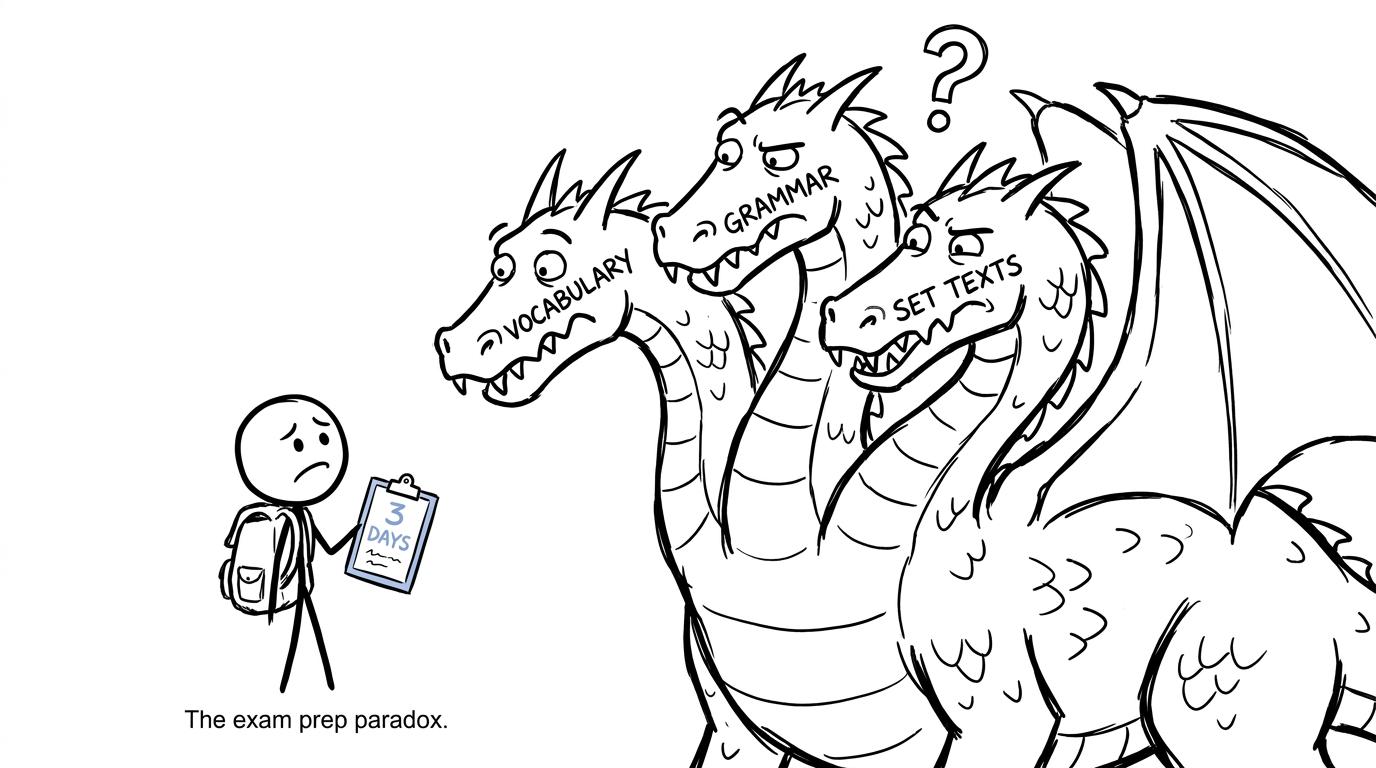 A calm student facing the three revision dragons of vocabulary, grammar and set texts
Know what the exam is asking you to do
The current Pearson Edexcel GCSE Biblical Hebrew qualification has two externally examined components. Component One, Language, is a two-hour paper worth 100100100 marks and 50%50\%50% of the qualification. It assesses comprehension and translation of unseen Biblical Hebrew. In part of the paper, candidates choose between answering grammar questions and translating prescribed English sentences into pointed Biblical Hebrew.
Component Two, Literature, is also a two-hour paper worth 100100100 marks and 50%50\%50% of the qualification. It assesses translation, knowledge and understanding of the set texts, including their context, grammar and literary features.
For examinations from 202620262026 to 202820282028, the published set texts include Genesis chapters 414141 to 434343, concerning Joseph's rise to power, and II Kings chapters 444 to 777, concerning the miracles of Elisha. Confirm your precise requirements with your teacher because revising the wrong passages is an expensive last-minute mistake.
Unlike GCSE maths, this qualification is not divided into foundation and higher tiers. Do not borrow tier language or assumptions from Edexcel, AQA, OCR or Eduqas maths papers. Read the instructions for the Biblical Hebrew component in front of you.
Day one: diagnose before you revise
Panic says, "Start reading everything." Evidence says, "Find the marks you are losing."
Run a short diagnostic
Spend the first session on selected questions from an official past paper or sample assessment material. Use the correct source booklet and work without notes. You do not need to complete a full two-hour paper if doing so would consume the energy needed to repair your weaknesses.
Mark the work carefully. For every lost mark, assign one cause:
- vocabulary was not recognised;
- the root or verb form was misidentified;
- a prefix, suffix or construct relationship was missed;
- the syntax was understood incorrectly;
- the English translation was unnatural or incomplete;
- set-text context or literary knowledge was missing;
- time pressure caused the error.
Then choose the three categories costing you the most marks. This is your priority list. The same diagnostic habit works well across GCSE subjects; MathsGenie's guide to finding your weakest topics quickly explains why mistakes are more useful when they are classified rather than merely counted.
Secure high-utility language knowledge
Use the official core vocabulary list supplied for Component One, together with your teacher's materials. Test from Biblical Hebrew to English because that is the direction most directly required for unseen comprehension and translation.
Do not spend hours producing beautiful flashcards. Cover the meaning, attempt retrieval, check it and place the word into one of three piles: secure, hesitant or unknown. Revisit the hesitant and unknown piles later that day.
Next, review the forms you repeatedly confused in the diagnostic. Focus on recognition rather than rewriting an entire grammar book. Ask:
- Can I identify the root?
- Can I recognise person, gender and number where relevant?
- Have I noticed attached pronouns and common prefixes?
- Can I explain how the clause connects to the previous one?
Finish day one by translating a short unseen section slowly and accurately. Check every omitted word. Record no more than ten important corrections on your error sheet.
Day two: connect language with literature
Day one finds the leaks. Day two repairs them.
Revisit the set texts actively
Divide the prescribed chapters into manageable sections. For each section, close your notes and write brief prompts covering:
- what happens immediately before and after the passage;
- who is speaking or acting;
- the significance of the passage within the wider narrative;
- distinctive language, repetition, contrast or other literary features;
- grammatical forms your teacher has highlighted;
- lines you cannot yet translate confidently.
Then check your notes and correct the gaps. This is stronger than repeatedly reading a prepared translation because the exam requires you to retrieve and apply knowledge.
Avoid memorising an English translation without attending to the Hebrew. A familiar story can create false confidence: you may remember what happens while overlooking what a particular form actually says. Move between the original passage, your own translation and the contextual notes.
Practise the option you intend to choose
In the Language paper, prepare for the grammar option or the translation-into-pointed-Biblical-Hebrew option that your teacher has taught you. Three days before the exam is usually not the moment to switch paths simply because the other option looks shorter.
Complete a small set under time pressure. Afterwards, inspect the mark scheme and examiner guidance. The useful question is not just "Was I right?" but "What did the mark scheme require me to show?"
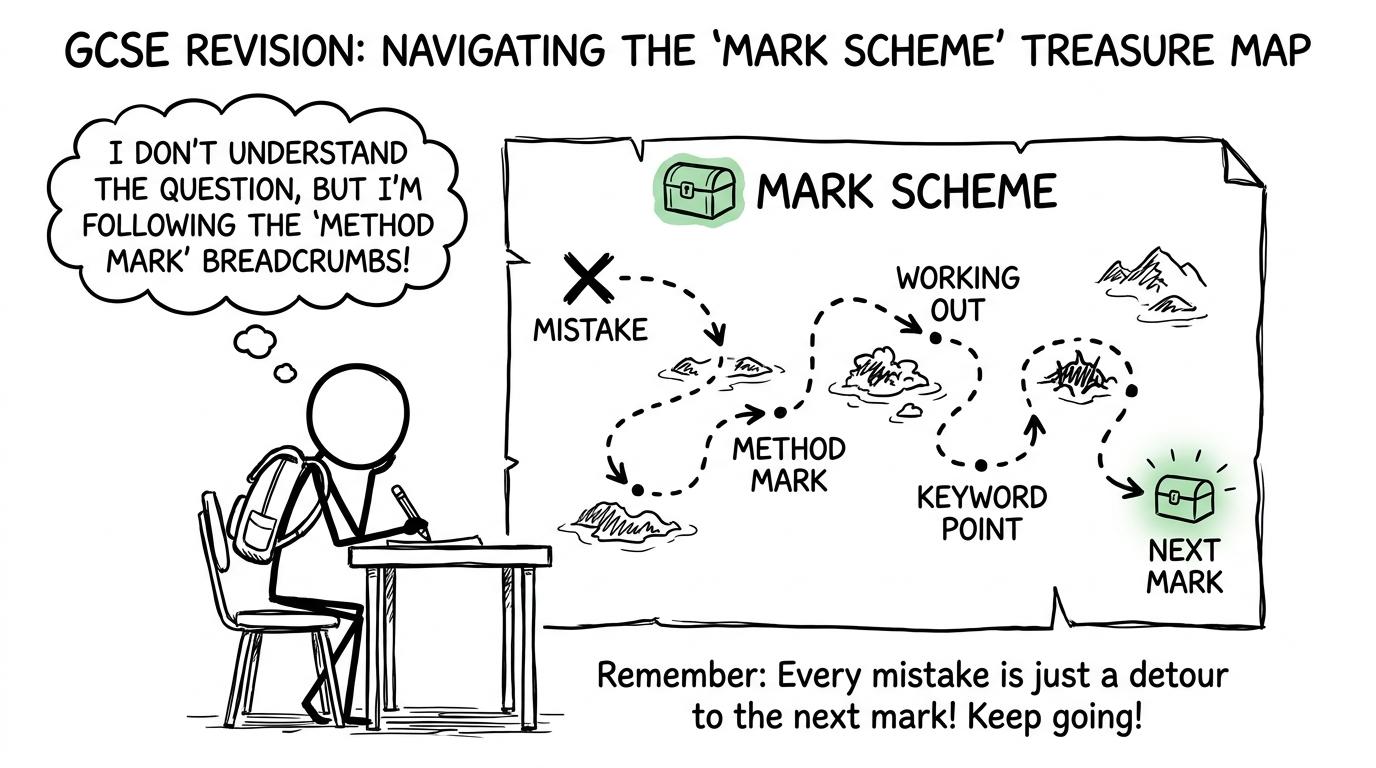 A student following a mark-scheme treasure map from a mistake to the next mark
This mark, fix, retest cycle is also central to using GCSE past papers properly. If Biblical Hebrew sits alongside maths in your exam week, keep the subjects separate but use the same disciplined feedback loop. The GCSE maths revision hub lets you choose the correct board and tier for your maths papers.
End with a controlled mixed session
Finish day two with three short blocks: vocabulary retrieval, unseen language and one set-text section. Mark each block before moving on. Short, purposeful sessions make it easier to notice whether a weakness has actually improved.
If you also need to fit in maths, do not let one anxious subject swallow the entire timetable. MathsGenie's one-week GCSE maths plan can help you reduce maths revision to a clear daily block while Biblical Hebrew takes temporary priority.
Day three: rehearse, reduce and rest
The final day should become narrower as it progresses. New material expands anxiety. Retrieval and correction create control.
Rehearse exam conditions
In the morning, complete a timed paper section or a carefully selected mixture of questions. Use only the materials permitted for that task. Practise moving on when a question is consuming too much time, then return if time remains.
Mark the work immediately. Select the five corrections most likely to help tomorrow. Rewrite the rule, meaning or contextual point in a form you can review quickly. Do not copy the whole mark scheme.
For students balancing several exams, the GCSE maths night-before plan uses the same principle: choose a small exam-style set, repair a few repeated errors and stop before tiredness turns revision into noise.
Make your final review sheet
Your final sheet should contain only fragile knowledge:
- vocabulary you still hesitate over;
- verb forms or grammatical distinctions you confuse;
- set-text transitions and contextual details;
- literary features that need precise explanation;
- one reminder about timing or checking translations.
Read it once in the late afternoon and test yourself once in the early evening. Adding thirty more facts is less valuable than making ten weak facts retrievable.
Protect the final night
Pack your pens and approved equipment, check the location and start time, and set an alarm. Aim for a full night's sleep rather than extending revision into the early hours. Teenagers are generally advised to obtain around eight to ten hours of sleep, and sacrificing most of a night is unlikely to improve clear reading or careful translation.
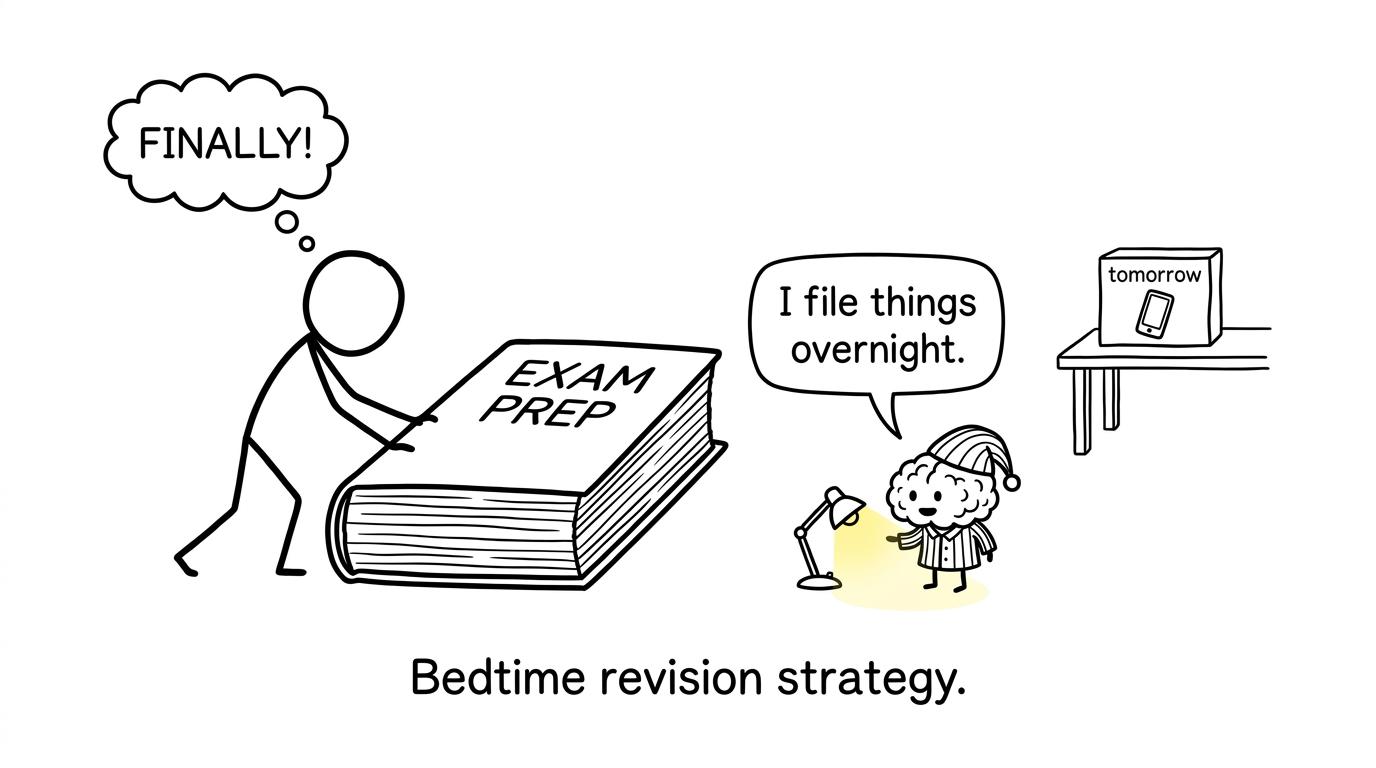 A tiny brain filing revision overnight while the student's phone waits outside
A calm approach inside the exam
Read the instructions before beginning, including any choices. For unseen language, establish the broad action and participants before polishing individual sentences. Attend to each word, but make the final English sound coherent.
If one form will not resolve, record the best defensible translation and continue. An uncertain word should not be allowed to consume the time available for the rest of the passage.
In literature answers, respond to the command word. Translation, identification, explanation and analysis are different jobs. Use precise references to the passage and connect literary observations to their effect or significance rather than listing techniques without explanation.
Common last-minute revision mistakes
Trying to cover the entire specification
Breadth feels responsible, but shallow rereading rarely repairs specific errors. Prioritise the areas revealed by your diagnostic.
Revising the story but not the language
Knowing the narrative does not guarantee accurate translation. Keep returning to roots, forms, syntax and the wording of the passage.
Ignoring the mark scheme
A completed paper is only a diagnosis. The improvement happens when you understand why marks were withheld and attempt a similar task again.
Switching resources repeatedly
Use the specification, your teacher's materials, official assessment material and one error sheet. Searching endlessly for a perfect resource consumes the time meant for retrieval.
Letting Biblical Hebrew erase every other subject
Protect short maintenance blocks for nearby exams. For maths, Edexcel GCSE mini tests provide focused practice, while Edexcel predicted papers can be used as timed rehearsals when appropriate.
Three days can still be useful
Last-minute revision works best when its ambition becomes smaller and sharper. You are not trying to become a different student by exam morning. You are trying to recognise more vocabulary, avoid repeated grammatical errors, recall the set texts more securely and use the paper's time with greater care.
Start now with one diagnostic section and one honest error list. Then follow the plan without continually renegotiating it.
When your Biblical Hebrew session ends, make MathsGenie your base for free maths revision. Use the revision lessons and practice questions to repair individual skills, then test them through mini tests, past papers, predicted papers, mark schemes and video solutions. Calmness is not the absence of work. It is knowing exactly what the next piece of work should be.