

GCSE Biblical Hebrew Exam Time of Day: Does It Matter?
GCSE Biblical Hebrew exam time of day explained: learn whether morning or afternoon affects performance and how to prepare calmly for either session at school.
The clock can feel unusually important on an exam day. A morning paper raises one worry: Will my brain be awake? An afternoon paper creates another: Will I lose focus while waiting? If you are searching for GCSE Biblical Hebrew exam time of day advice, the short answer is reassuring: timing may affect how alert you feel, but there is no reliable evidence that either morning or afternoon gives every student a universal advantage.
Research suggests that performance can vary with a student's body clock, sleep and daily routine. However, preparation, subject knowledge and exam technique remain far more controllable. You normally cannot choose the session, so the useful goal is to prepare your body and mind for the time printed on your school timetable.
The quick answer and exam-day checklist
The Pearson Edexcel GCSE Biblical Hebrew qualification has two written components. In the Summer 2026 timetable, Component 1: Language was scheduled in the morning and Component 2: Literature in the afternoon. Both papers lasted two hours. Future dates and sessions may change, so always use the timetable issued by your school or exam centre.
Your practical checklist is:
- confirm the date, session and arrival time with your school;
- check whether you are sitting Language or Literature;
- keep your sleep and waking routine consistent during exam season;
- eat familiar food rather than experimenting on the day;
- practise concentration at approximately the relevant time;
- arrive early with the equipment your centre requires;
- judge the paper by its questions, not by how sleepy or nervous you felt beforehand.
That last point matters. Feeling slightly tired is not the same as performing badly. Students often mistake a sensation for a prediction.
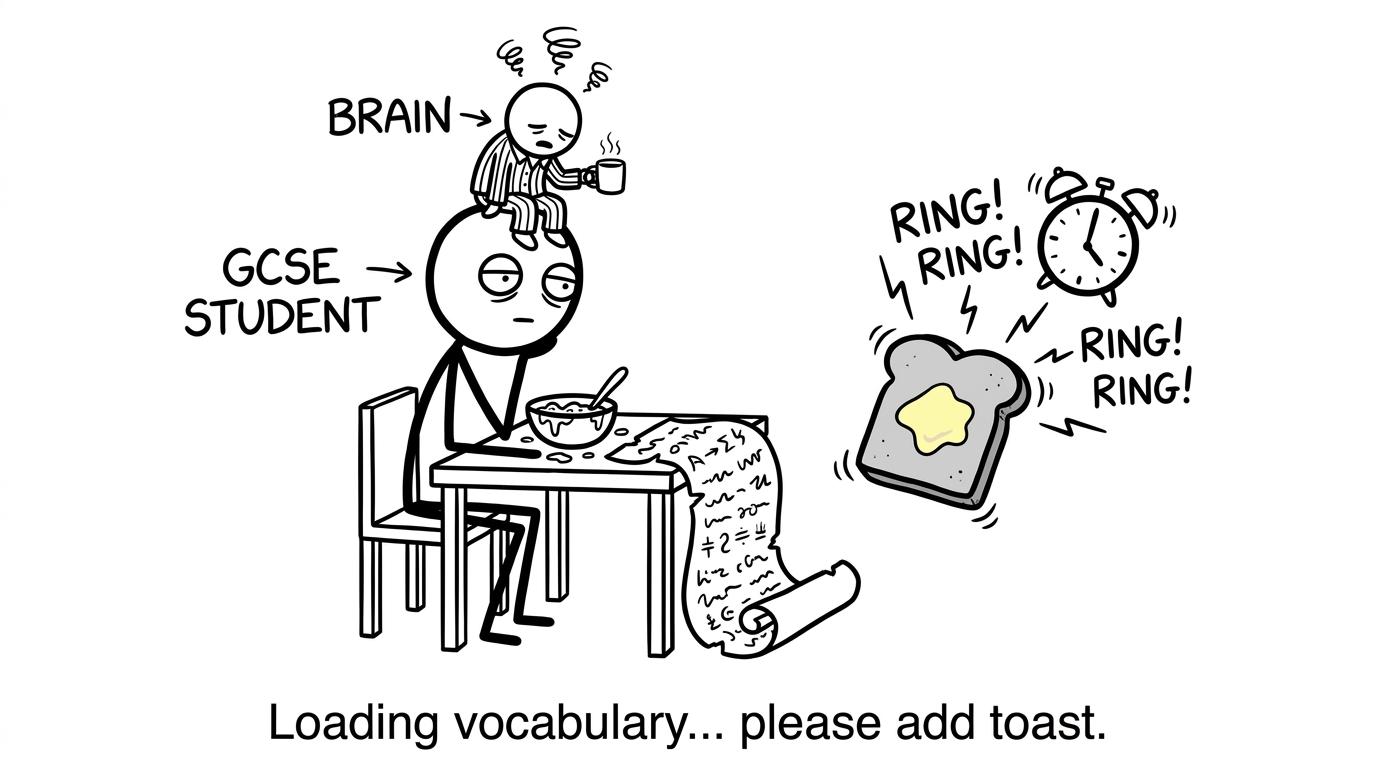 A sleepy student's brain loads vocabulary with help from breakfast
When is the GCSE Biblical Hebrew exam held?
Biblical Hebrew GCSE is currently offered by Pearson Edexcel under qualification code 1BH0. It consists of two externally examined components, each worth 50%50\%50% of the qualification:
- Component 1: Language, covering comprehension, translation and grammatical knowledge or composition;
- Component 2: Literature, covering the prescribed texts, translation, analysis and comparison.
The official Summer 2026 timetable placed Language in a morning session and Literature in an afternoon session. That arrangement does not prove that one component is easier because of timing. The papers assess different knowledge and skills, so their results cannot provide a clean morning-versus-afternoon comparison.
JCQ's published UK starting times for the 2025/26 academic year were 9.00 am for morning examinations and 1.30 pm for afternoon examinations. Centres were permitted to begin within a limited window around those times while following security and supervision rules. Your school's stated arrival and start times therefore take priority over an assumption based on the national timetable.
Do not confuse Biblical Hebrew with Modern Hebrew. They are different GCSE qualifications with different specifications and timetables.
Does morning versus afternoon affect performance?
Possibly, but not in a simple or deterministic way.
Studies of adolescents have found what researchers call a synchrony effect: some people perform better when a task matches their preferred time of day. Morning types may be more effective earlier, while evening types can improve later. Other research has found stronger average performance in the early afternoon, but results differ according to age, task, season, sleep and research setting.
A review of research into adolescent chronotypes found evidence of relationships between circadian preference and cognitive or academic performance, while also noting variation between studies and the influence of multiple factors. That is why claims such as “afternoon exams are always easier” go beyond the evidence.
For Biblical Hebrew specifically, there is no sound basis for promising that one scheduled session will raise or lower your grade. Your response is marked against the same mark scheme, and Pearson's marking principles require candidates to receive consistent treatment. The time printed on the timetable does not create a separate grading standard.
Timing can influence your state. It does not rewrite what you know.
Why the morning paper may feel harder
A morning exam can expose an inconsistent sleep routine. If you usually wake late at weekends, an early alarm followed by a demanding translation paper may feel abrupt. The problem is not necessarily “morning ability”; it may be the sudden change in your schedule.
NHS guidance says most teenagers need around 888 to 101010 hours of sleep and advises against all-night cramming. A regular sleep routine is more useful than trying to force one perfect night immediately before the paper.
For a morning session:
- wake at a similar time for several days beforehand;
- allow enough time to eat, dress and travel without rushing;
- use a brief recall activity only if it settles you;
- avoid trying to learn a large new section before leaving home;
- follow your normal approach to caffeine rather than suddenly increasing it.
You can rehearse morning focus without exhausting yourself. Complete a short, timed recall task at the likely exam time, then mark it later. Maths students can use the 20-minute GCSE maths revision routine to build this habit around their other papers.
Why the afternoon paper brings different challenges
An afternoon exam offers more time after waking, but extra time can become extra anxiety. The temptation is to revise continuously until the last possible moment. By the time the paper starts, attention has already been spent.
A better afternoon routine includes:
- a normal morning rather than a revision marathon;
- one short review of high-priority material;
- a familiar, balanced lunch that is neither skipped nor unusually heavy;
- water in accordance with your centre's rules;
- a clear stopping point before you enter formal exam conditions.
If you have another paper that morning, your school will manage the timetable and any required supervision. Do not improvise arrangements or assume that a clash lets you choose another session.
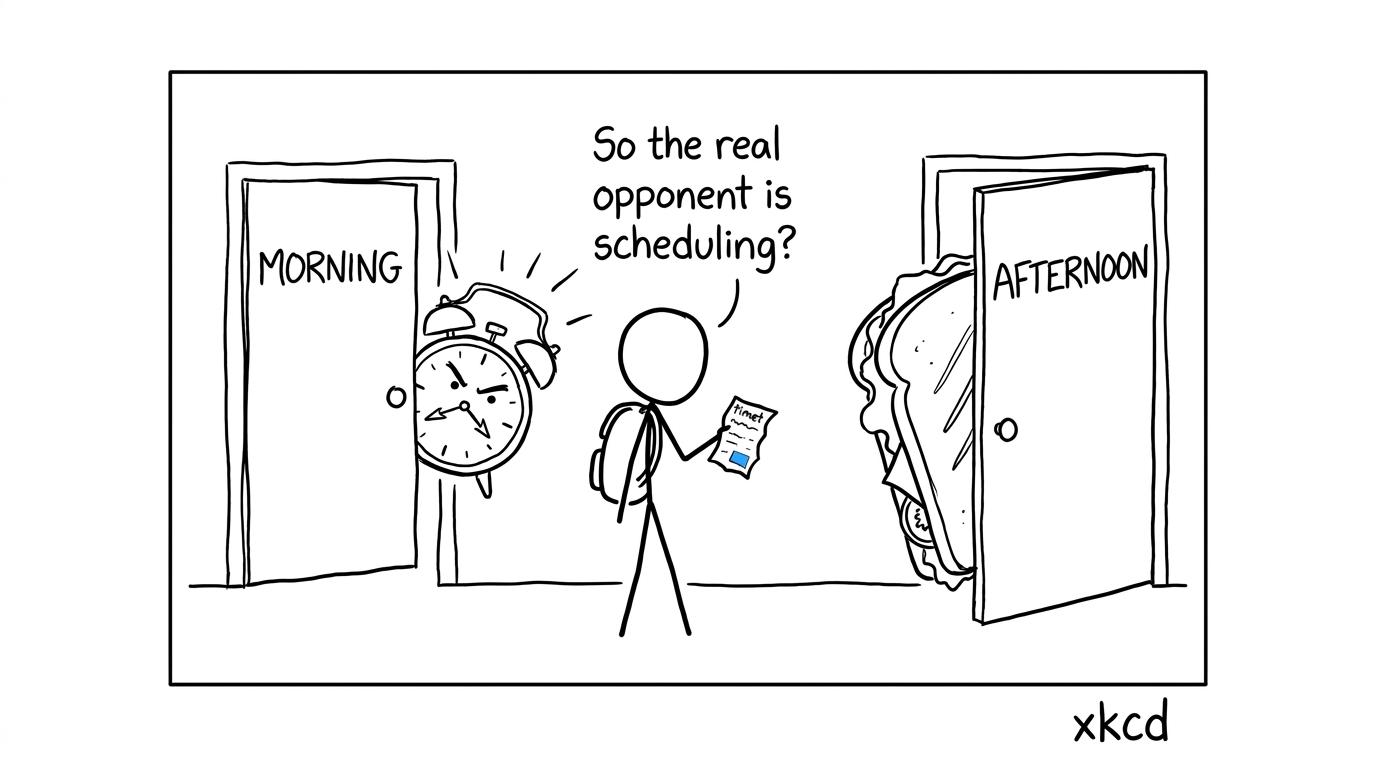 A student chooses between an alarm clock and a giant lunch sandwich
Prepare for the session you actually have
The most useful response to exam timing is rehearsal. Not because every practice paper must begin at precisely the official hour, but because familiarity reduces the number of surprises competing for attention.
Match some practice to the real session
If your paper is in the morning, occasionally complete focused practice in the morning. If it is in the afternoon, test your concentration after lunch. Keep other practice sessions at convenient times so your revision remains sustainable.
This principle also helps with GCSE maths. Start from the GCSE maths revision hub, choose the correct board and tier, and use short practice to test how your concentration changes across the day. Edexcel students can use GCSE maths past papers, while the wider hub supports students following Edexcel, AQA, OCR, Eduqas, WJEC and CCEA specifications.
Separate tiredness from knowledge gaps
After a timed task, do not write only “bad session” or “too tired”. Identify what actually happened:
- Was vocabulary missing?
- Did you misread an instruction?
- Did attention drift during a long passage?
- Did you know the content but run out of time?
- Did anxiety cause you to rush the opening questions?
MathsGenie's guide to finding your weakest GCSE topics uses the same evidence-based idea: diagnose the specific source of lost marks, practise it, then retest it.
Use marking as feedback
A completed paper is useful only when you examine the result. Compare your response with the mark scheme, record recurring errors and return to the underlying content. Do not conclude that an afternoon session caused every mistake made after lunch.
For maths preparation, Edexcel GCSE predicted papers provide fresh timed practice, while the guide to using past papers properly explains how to turn errors into targeted revision.
What matters more than the time of day?
Three factors deserve more attention than whether the clock says morning or afternoon.
Sleep consistency: One heroic early night cannot fully repair a week of irregular sleep. Protect a repeatable routine throughout the examination period.
Paper familiarity: Know which component you are sitting and what its instructions require. Language and Literature assess different skills, even though each contributes equally to the qualification.
Calm execution: Read each instruction, use the marks as a guide to the expected depth, and move on when a question is consuming disproportionate time. Return if time remains.
The same habits support maths performance. The GCSE maths exam-week checklist helps you organise equipment, short revision sessions and paper-day routines without turning the final evening into a panic.
Common mistakes when thinking about exam timing
Assuming an afternoon paper is automatically easier
Some students feel more alert later, but others lose energy after lunch. Research does not support one universal best session for every adolescent or every task.
Trying to change the scheduled session
The timetable is set nationally and administered by your centre. Speak to your examinations officer about genuine clashes, access arrangements or illness, but personal preference is not normally a reason to select morning or afternoon.
Comparing two different Biblical Hebrew components
Language and Literature are not interchangeable tests. A difference in marks cannot be attributed to timing alone because the content and assessment objectives differ.
Cramming because the exam is in the afternoon
Extra hours before the paper do not need to be filled. A short retrieval session followed by food, movement and a mental break is usually a more sensible plan.
Ignoring the official timetable
Online summaries can become outdated. Check the timetable supplied by your school, including the required arrival time. The MathsGenie Biblical Hebrew grade boundaries page is useful for understanding previous outcomes, but grade boundaries do not tell you when your next examination starts.
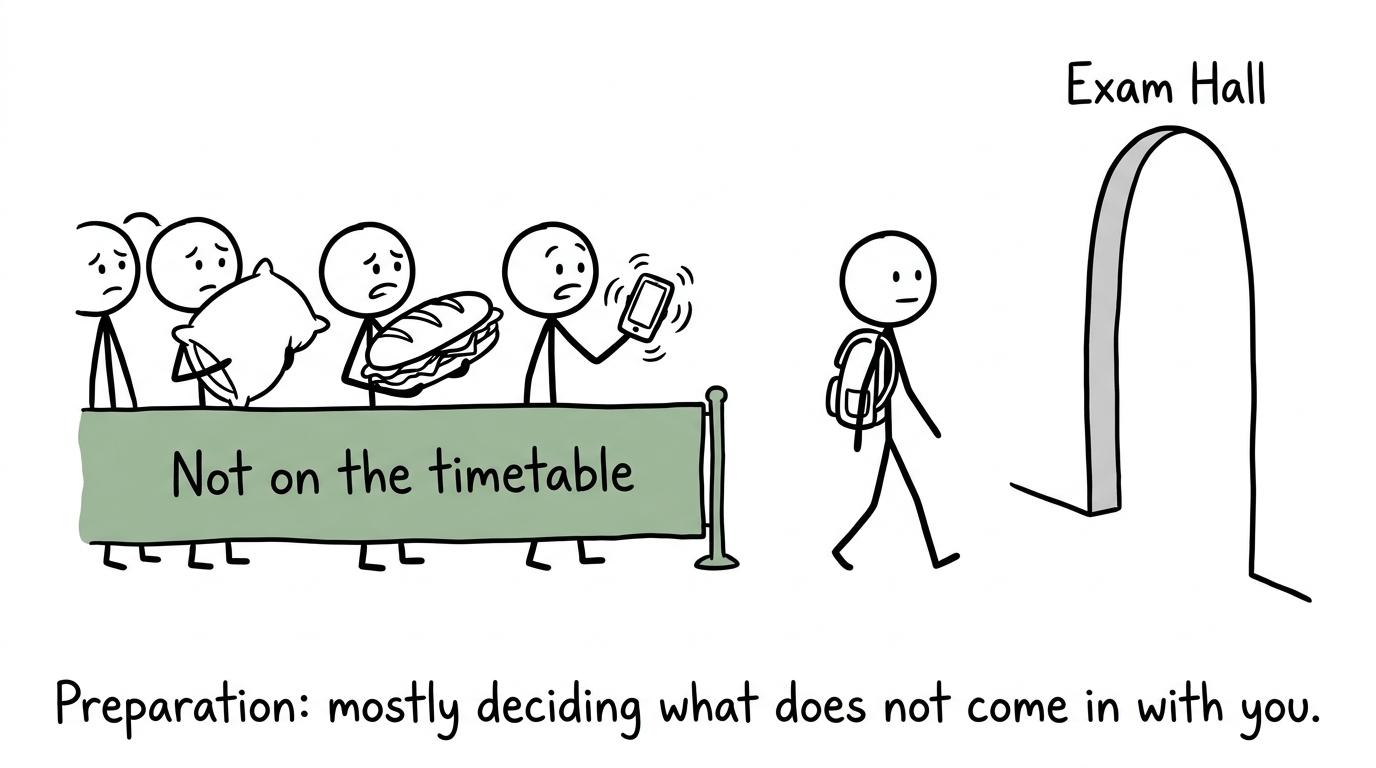 An exam candidate leaves tiny worries outside the exam hall
A calm conclusion: prepare the routine, not the clock
The time of day may slightly influence alertness, particularly when it clashes with your natural preference or sleep routine. It does not decide your result. There is no convincing basis for treating either a morning or afternoon GCSE Biblical Hebrew session as universally better.
Confirm the timetable, protect your sleep, rehearse concentration at the relevant time and enter the room with a simple plan. The clock is a condition of the exam, not a verdict on your performance.
For the maths papers surrounding your Biblical Hebrew exam, make MathsGenie your free revision base. Use revision lessons and practice questions to repair weak topics, mini tests to build concentration, and past papers or predicted papers to rehearse full exam conditions. Mark every attempt with the available mark schemes and video solutions, then organise the next steps with the revision planner. Start with the GCSE maths revision resources and turn the time you can control into marks you can earn.










