GCSE Bengali Weekend Revision Routine
GCSE Bengali weekend revision made manageable: use this focused Saturday and Sunday routine for listening, speaking, reading and writing practice.
The final weekends before an exam can feel strangely unhelpful. You finally have more time, yet the size of the task makes it difficult to begin. “Revise Bengali” sits on the page like one enormous job.
A useful GCSE Bengali weekend revision routine makes that job smaller. Divide the weekend between listening, speaking, reading and writing, practise under realistic conditions, mark what you can, and finish with a short list of weaknesses for next time. You do not need to spend every waking hour revising. You need a routine that produces evidence of what you can do.
This plan is based on the current AQA GCSE Bengali structure. AQA assesses four equally weighted skills: listening, speaking, reading and writing, each contributing approximately 25%25\%25% of the qualification. Check your own entry information and school guidance before choosing materials, particularly your tier and speaking arrangements.
Your weekend revision checklist
Before Saturday morning, prepare the following:
- your correct exam board and tier information
- one listening or reading paper
- the associated audio and mark scheme
- one writing task
- speaking prompts, a timer and a recording device
- a vocabulary list divided by theme rather than alphabetically
- an error log with space for mistakes and next actions
- a clear finishing time for both days
AQA GCSE Bengali currently has Foundation tier, covering grades 111-555, and Higher tier, covering grades 444-999. All four assessments must be taken at the same tier, so use material that matches your entry.
Start by opening the AQA GCSE Bengali past papers on MathsGenie. Choose one paper or section rather than downloading everything. A good plan reduces decisions before revision begins.
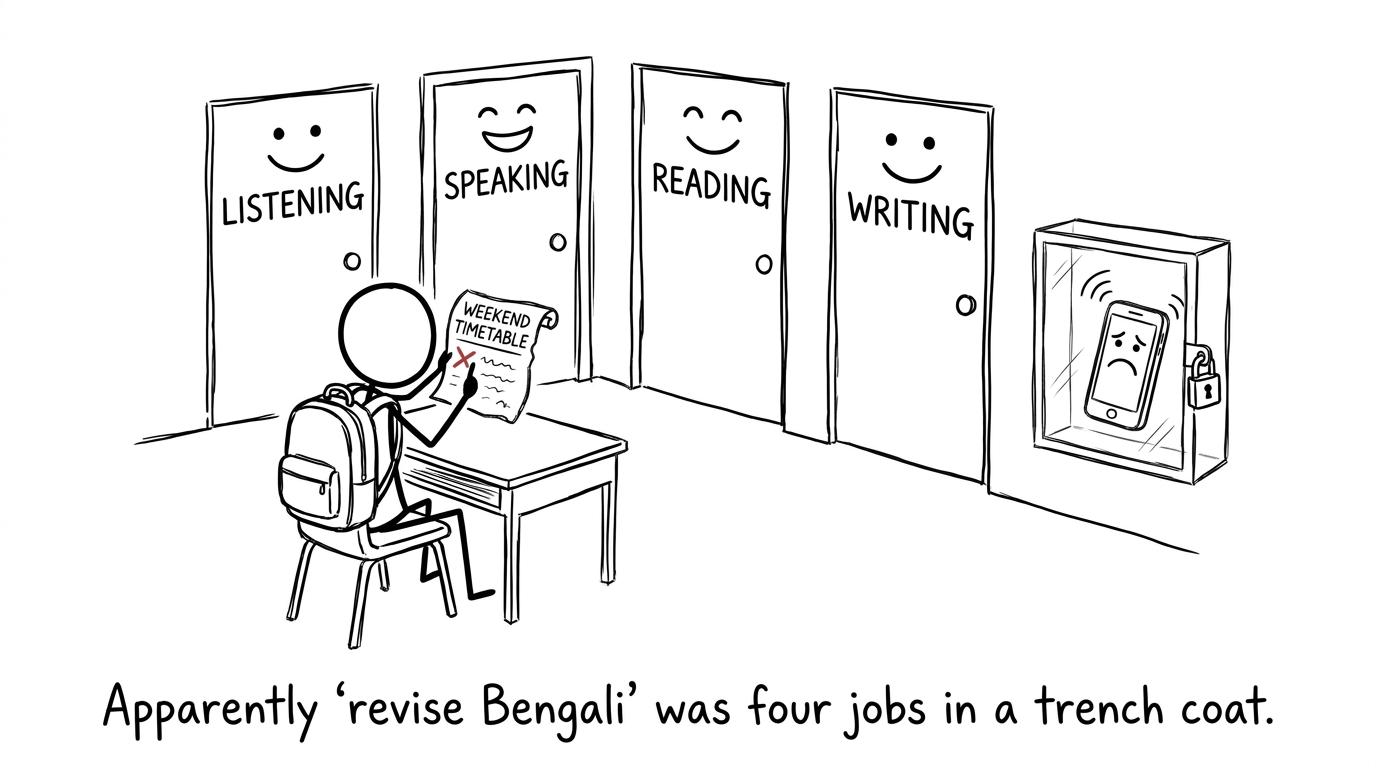 A student discovers that Bengali revision contains four separate skills
The Saturday routine: diagnose and repair
Saturday should reveal what needs attention. It is not a performance designed to make you feel clever. It is a diagnostic session designed to make Sunday more useful.
Begin with active vocabulary recall
Spend approximately 202020 minutes recalling vocabulary without looking at your notes. Select one specification theme and create four columns:
- words you can recognise and use
- words you recognise but cannot produce
- words you repeatedly confuse
- useful phrases for giving and justifying opinions
Then check your list against your notes. This order matters. Looking first creates familiarity; recalling first tests memory.
Do not copy entire vocabulary pages. Concentrate on language that helps across several tasks: time markers, connectives, opinions, reasons, comparisons, negatives and references to past, present and future events.
Complete a timed listening section
Use a section of an official listening paper with the correct audio. AQA listening includes 555 minutes of reading time within the published duration, so practise using that opening period deliberately.
Before the recording begins:
- underline question words
- identify whether the answer must be in English or Bengali
- predict the type of detail required, such as a reason, opinion or activity
- notice negatives and changes of time
During the audio, write only what the question requires. After marking, replay difficult extracts and identify why each answer was lost. Was the vocabulary unknown? Did you hear the word but misunderstand the question? Did you miss a negative? These are different problems and require different fixes.
Take a proper break
After 404040-505050 minutes of concentrated work, leave the desk. A short walk, food or water is more useful than turning the break into unplanned phone time.
A break has a boundary. Decide when it begins and when you will return. The purpose is to recover your attention, not to test whether you can resist an endless feed.
Use reading to find precise gaps
Complete a timed reading section next. Current AQA papers assess responses in both English and Bengali and include translation from Bengali into English. Follow the instructions on the particular paper carefully.
On your first reading, identify the overall message. On the second, locate evidence for each answer. Do not assume that recognising one familiar word proves the meaning of the whole sentence.
Mark the section on the same day. MathsGenie’s guide to using GCSE past papers properly explains the wider attempt, mark, fix, retest cycle. Although the examples are often mathematical, the principle transfers directly: completing a paper measures performance; reviewing it creates learning.
End Saturday with an error log
Limit the log to useful information:
| Skill | What went wrong | Why it happened | Next action |
|---|---|---|---|
| Listening | Missed an opinion | Did not recognise the key phrase | Relearn and test the phrase |
| Reading | Added an unsupported detail | Answered from assumption | Underline textual evidence |
| Writing | Used only one time frame | Did not plan the response | Add a tense checklist |
| Speaking | Paused after an unexpected question | Relied on memorised answers | Practise spontaneous follow-ups |
Do not write “careless” as the explanation. Name the behaviour. A precise weakness can be practised; a vague judgement cannot.
If identifying weaknesses feels difficult, adapt the process in MathsGenie’s guide to finding weak GCSE topics. For Bengali, replace mathematical topic labels with vocabulary, comprehension, grammar, translation, pronunciation and task-completion labels.
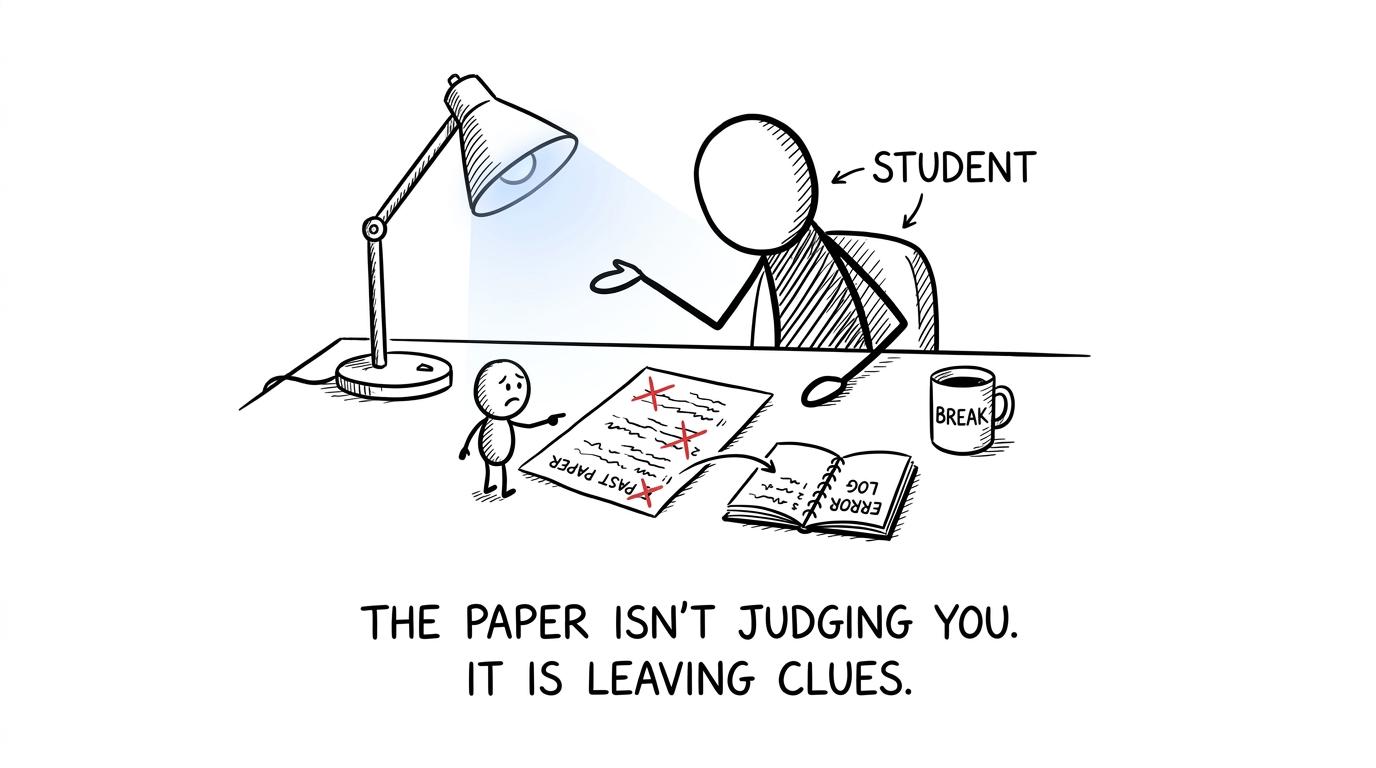 A marked paper leaves clues for the student rather than passing judgement
The Sunday routine: produce and consolidate
Sunday moves from understanding Bengali to producing it. That means speaking and writing, followed by a short retest of Saturday’s weakest area.
Warm up with spontaneous speaking
Choose a familiar specification theme and speak for 606060-909090 seconds without a script. Record yourself, listen once and note:
- whether every part of the prompt was addressed
- whether opinions were supported with reasons
- whether different time frames appeared naturally
- where pronunciation became unclear
- where pauses interrupted meaning
Do not record the same polished answer repeatedly. The speaking assessment rewards interaction and includes spontaneous communication. Ask a teacher, family member or revision partner to add an unplanned follow-up question where possible.
Useful practice should resemble the role-play, photo-card and general-conversation demands of the assessment, but your teacher’s current instructions should take priority. Speaking arrangements involve preparation and controlled assessment conditions that cannot be recreated exactly at home.
Plan before writing
Choose one writing task at the correct tier. Before composing, spend a few minutes converting every bullet point into a small checklist. Missing a required detail can restrict the marks available even when the language itself is strong.
Your plan should identify:
- the purpose and audience
- every bullet point
- relevant vocabulary
- opinions and justifications
- suitable time references
- one or two accurate, varied structures you can control
Then write under a time limit. Accuracy matters more than forcing complicated language you cannot handle reliably. Once finished, check verbs, agreements, spelling, negatives, time frames and whether every part of the task has been covered.
Mark for patterns, not just totals
A raw mark tells you how the performance went. A pattern tells you what to do next.
If several answers lose marks because you misread instructions, your next session should include instruction-language practice. If writing repeatedly lacks development, practise extending opinions with reasons and consequences. If listening errors cluster around one theme, revisit that theme’s vocabulary before attempting another recording.
This is the same principle behind MathsGenie’s past-paper revision system: the value lies in connecting an attempt to the mark scheme, reviewing the method and recording progress.
Finish with a short retest
Return to one weakness from Saturday for 151515-202020 minutes. Use fresh material rather than simply reading the corrected answer.
For example, you might test the vocabulary again without notes, answer a different listening extract on the same theme, translate a new short passage or respond to another unexpected speaking question. The aim is to discover whether the correction can now be used independently.
A compact routine is easier to repeat during a busy school week. The structure in the 20-minute GCSE revision routine can be adapted for Bengali: recall, practise, check and log the next action.
How to balance Bengali with GCSE maths
Bengali revision should not quietly consume the weekend needed for maths, English and science. Plan around your full exam timetable, not whichever subject feels most urgent at the moment.
One sensible weekend might contain approximately 333 focused hours of Bengali across two days, divided into short sessions. Protect separate blocks for other subjects and leave space for rest. If your Bengali speaking assessment is sooner than your written papers, temporarily give speaking greater priority.
For maths, use the same evidence-led approach. The GCSE maths revision hub lets you choose the correct board, including Edexcel, AQA, OCR and Eduqas. You can then use revision lessons, practice questions and papers without spending the beginning of every session searching.
If you take AQA maths, the AQA GCSE maths past papers can provide a separate timed weekend block. Nearer the exam, GCSE predicted papers are useful for maths rehearsal, but they should supplement rather than replace official past papers and specification coverage.
Adjust the routine in the final weeks
With several weekends remaining, use shorter paper sections and spend more time repairing vocabulary and grammar. As the exam approaches, increase the realism of your practice.
A simple progression is:
- Several weeks before: diagnose by skill and rebuild weak language.
- Two or three weekends before: combine timed sections with speaking and writing practice.
- Final full weekend: complete realistic sections, mark carefully and fix only the most important recurring errors.
- Weekend immediately before: reduce the volume, review your error log and protect sleep.
The GCSE one-month revision plan offers a useful model for spacing diagnostics, targeted practice and timed papers across several weeks. Adapt its rhythm rather than its subject content.
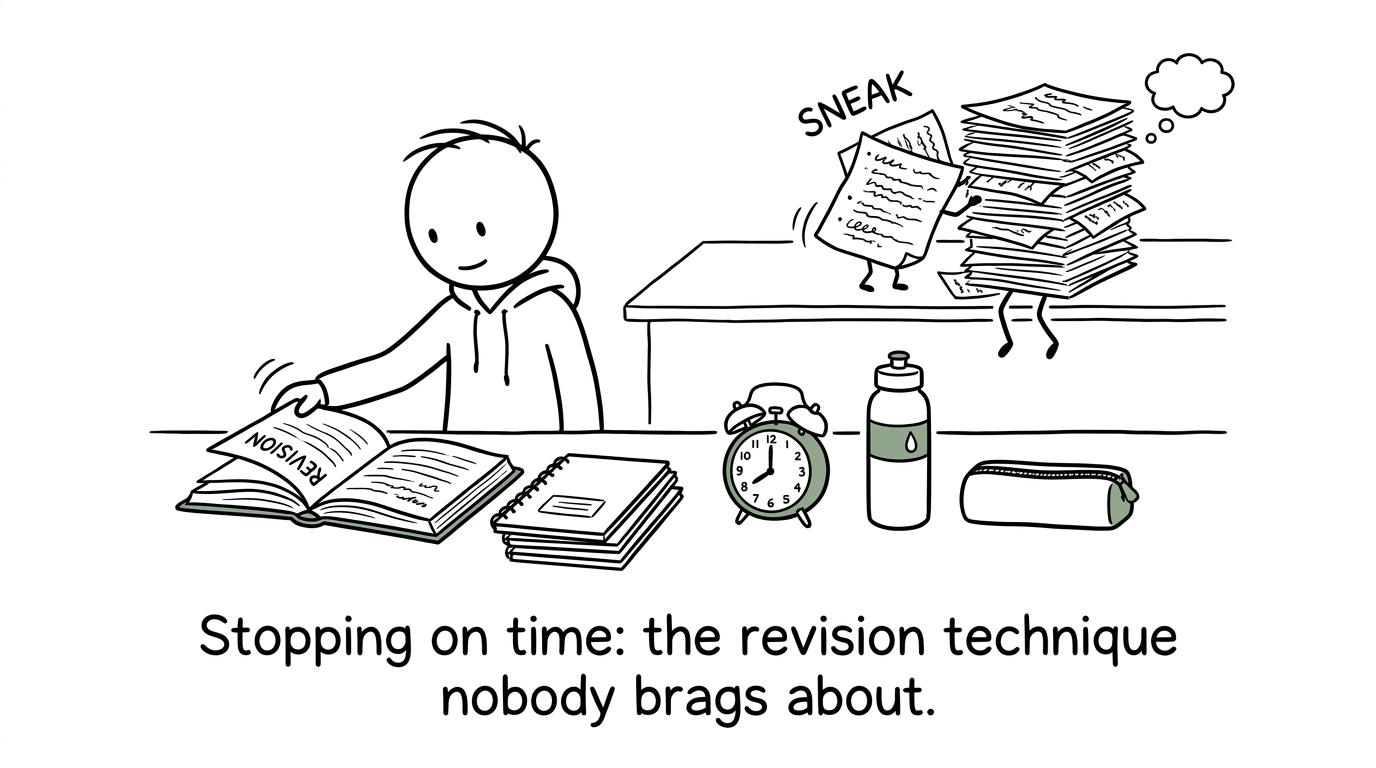 A student ends revision on time while an enormous pile of notes tries to return
Common GCSE Bengali weekend revision mistakes
Revising only your strongest skill
Reading may feel comfortable because you control the pace. Speaking may feel uncomfortable because mistakes are audible. Comfort, however, is not evidence of priority. Give all four skills attention, then allocate extra time according to your error log and exam order.
Memorising complete speaking scripts
Prepared language can build confidence, but rigid scripts are fragile. An unexpected question can make the whole answer collapse. Practise reusable phrases and spontaneous responses instead.
Completing papers without reviewing them
A pile of finished papers can create the appearance of work while preserving the same mistakes. Mark promptly, classify errors and retest the weakest area.
Using the wrong tier or answering in the wrong language
Check Foundation or Higher before starting. Within listening and reading papers, check whether each section requires answers in English, Bengali or a non-verbal format. Instructions are part of the assessment.
Turning Sunday evening into a marathon
Late cramming often reflects an unclear plan, not a lack of effort. Set a stopping time, prepare your materials for the week and sleep. Revision should make the next day more manageable, not borrow attention from it.
Make this weekend produce evidence
A calm weekend is not one without hard questions. It is one in which each difficult question has somewhere to go: into an error log, a vocabulary list, a speaking prompt or the next short retest.
Begin with the AQA GCSE Bengali paper collection, choose one manageable section and follow the cycle: attempt, mark, diagnose, repair and retest. Then use MathsGenie to keep your wider GCSE maths revision organised with free revision lessons, practice questions, mini tests, past papers, predicted papers, mark schemes and video solutions.
Do not try to win the whole exam in one weekend. Build a weekend you can repeat. That is how a large subject becomes a series of clear next steps.