GCSE Bengali State vs Private Results: The Data
GCSE Bengali state vs private results explained: what current data shows, why raw grade gaps mislead, and how to focus your GCSE revision effectively.
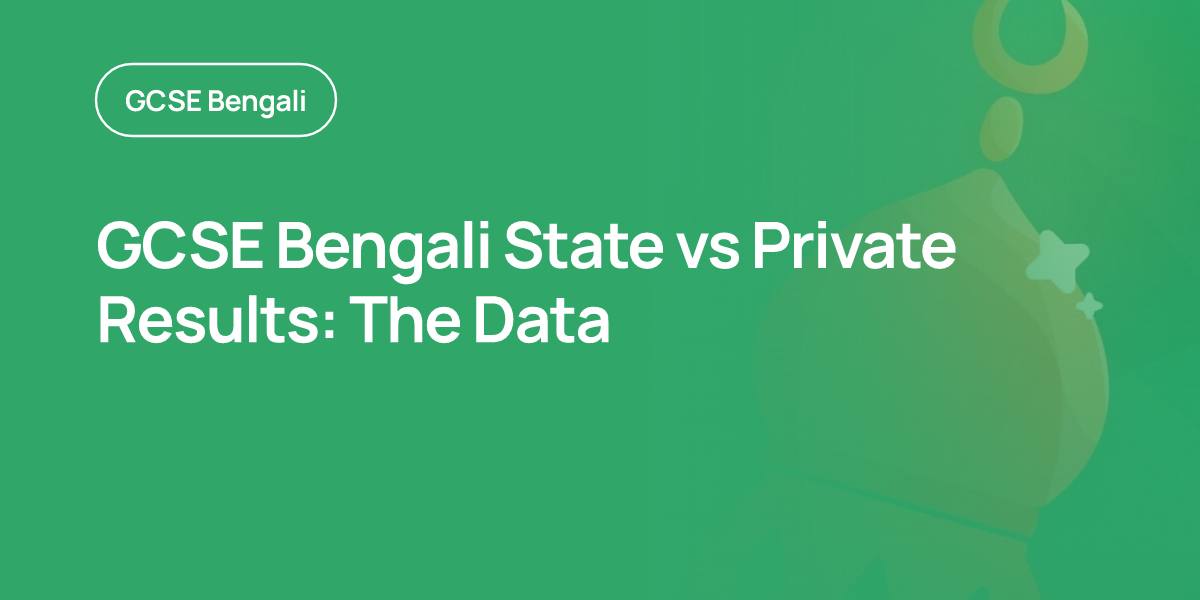
A results table can make school type look like destiny. One column says state, another says private, and the difference appears to explain everything.
But the evidence on GCSE Bengali state vs private results does not support such a simple conclusion. Current official datasets allow Bengali entries and grades to be examined by establishment or centre type, yet there is no reliable headline figure proving that private-school pupils achieve substantially better Bengali grades because they attend private schools. Bengali is offered by relatively few independent schools, cohort sizes can be small, and the pupils entered may differ considerably between sectors.
The practical answer is reassuring: every candidate follows the same specification for their exam board and is judged against the same grade boundaries. Your school type does not place a ceiling on your result.
The evidence in one short checklist
Before interpreting any comparison, check five things:
- Is the table specifically about Bengali, or all GCSE subjects combined?
- Does “state” mean academies, comprehensive schools, selective schools or every state-funded centre together?
- How many Bengali candidates are included in each group?
- Are the figures percentages of entries or percentages of all pupils?
- Does the analysis compare similar pupils, or merely two different populations?
That final question matters most. A difference between two groups is not automatically evidence that school type caused the difference.
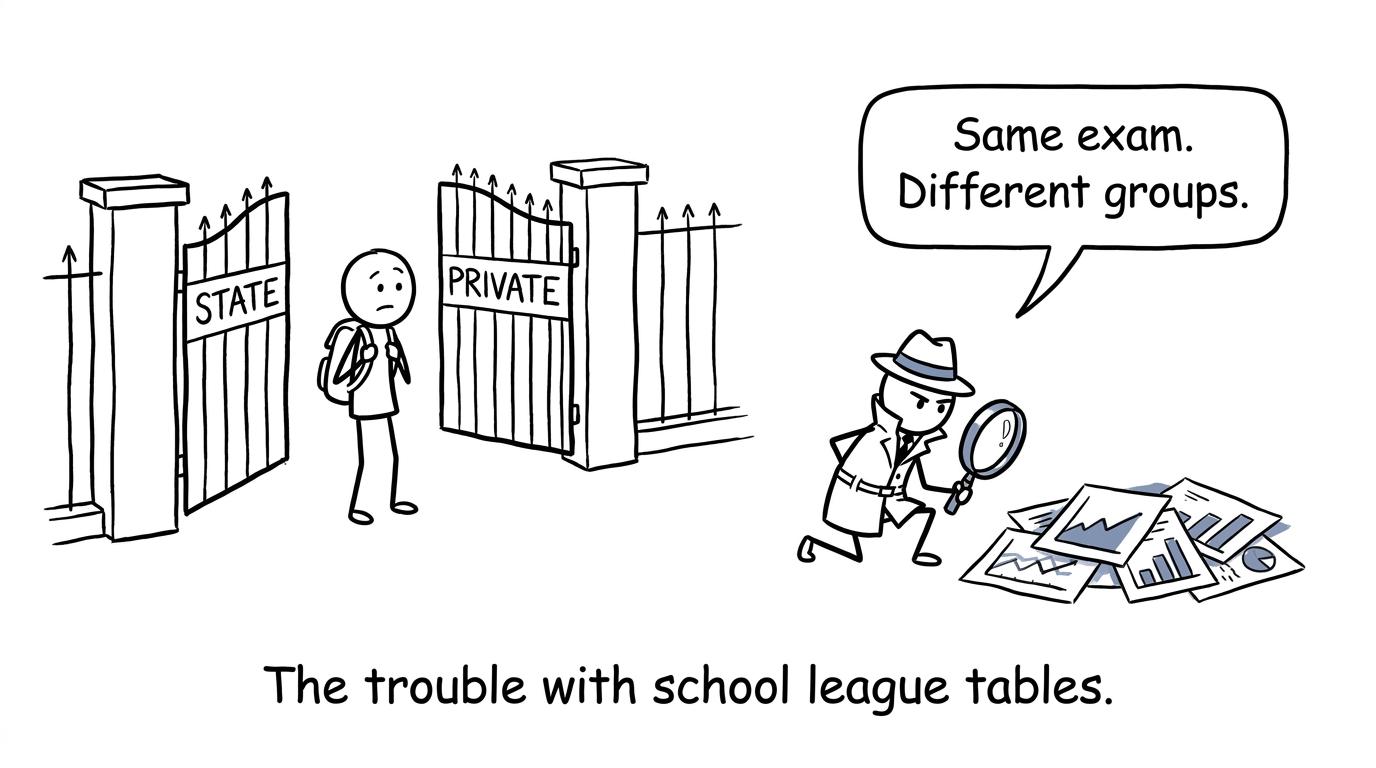 A student and data detective examine state and private school charts
What the latest national results show
Ofqual’s summer 2025 results report gives a clear all-subject comparison for England. Across all GCSE subjects combined, 20.7%20.7\%20.7% of results from state-funded centres were at grade 777 or above, compared with 48.1%48.1\%48.1% in independent schools. At grade 444 or above, the corresponding figures were 66.5%66.5\%66.5% and 89.6%89.6\%89.6%.
Those are genuine differences, but they are not GCSE Bengali figures. They combine mathematics, English, sciences, languages and every other included subject. Quoting them as proof of a Bengali attainment gap would answer a different question.
There is another complication. “State school” is not one uniform category. The same Ofqual release separated academies, free schools, comprehensives, secondary modern schools and selective schools. Overall results varied markedly between those groups. A binary state-versus-private label hides much of the variation within the state sector itself.
Ofqual also explains that centre types come from the National Centre Number register and are largely self-reported. The Department for Education uses establishment-type classifications in its Key Stage 4 datasets. These systems are useful, but their categories are not always interchangeable.
Bengali provision is uneven across school types
A 2024 Cambridge University Press & Assessment analysis of Department for Education data examined which schools provided different GCSE subjects. Its figures show that Bengali was uncommon in independent schools and concentrated more heavily in some non-selective academy groups.
| School category | Schools providing Bengali |
|---|---|
| Non-selective academies in highly selective areas | 1.6%1.6\%1.6% |
| Other non-selective academies | 2.8%2.8\%2.8% |
| Selective academies | 0.7%0.7\%0.7% |
| Independent schools | 0.3%0.3\%0.3% |
These are provision rates, not pass rates. They tell us how widely Bengali was available among schools in each category, not how well candidates performed.
Still, they reveal why a raw outcome comparison must be treated carefully. If only 0.3%0.3\%0.3% of independent schools provide Bengali, the independent-school candidate group may be small and highly concentrated. Results from a handful of centres can move noticeably from one year to another.
The Department for Education’s current Key Stage 4 data contains school-level subject entries and grades, including establishment type. In principle, researchers can aggregate those records. A responsible Bengali comparison would need to report entry numbers, explain suppressed or missing values, distinguish school categories and avoid treating a small sample as a national rule.
Why a raw grade gap would not prove a school effect
Suppose two sectors record different percentages at grade 777 or above. The basic rate would be calculated as
Grade 7+ rate=entries achieving grades 7–9total valid entries×100.\text{Grade } 7+ \text{ rate}=\frac{\text{entries achieving grades } 7\text{--}9}{\text{total valid entries}}\times 100.Grade 7+ rate=total valid entriesentries achieving grades 7–9×100.That calculation describes an outcome. It does not explain it.
Candidate selection can differ
Some schools teach Bengali as a timetabled subject. Others enter pupils who already speak or encounter Bengali outside school. Entry policies may differ, and candidates’ prior reading, writing, listening and speaking experience may not be comparable.
A school might enter nearly every interested pupil, while another enters only candidates expected to achieve high grades. The second school could produce a higher percentage without providing more effective teaching.
Small cohorts create volatile percentages
Bengali has far fewer entries than GCSE mathematics. With a small cohort, each result represents a relatively large share of the total. The general relationship is
percentage contribution per candidate=1n×100%,\text{percentage contribution per candidate}=\frac{1}{n}\times 100\%,percentage contribution per candidate=n1×100%,where nnn is the number of candidates in the group. As nnn becomes smaller, one result changes the displayed percentage more sharply.
That is why entry counts should sit beside percentages. A rounded rate without its denominator can look much more certain than it is.
Prior attainment and local context matter
School sectors differ in admissions, location, pupil characteristics and prior attainment. Selective state schools also tend to look very different from non-selective state schools in overall GCSE tables.
To estimate a genuine school-type effect, an analysis would need to compare similar candidates and account for relevant background factors. A simple average does not do that. It shows association, not causation.
The exam itself does not change by school sector
For AQA GCSE Bengali specification 863886388638, candidates are assessed in listening, speaking, reading and writing. Each skill contributes approximately 25%25\%25% of the qualification. Foundation tier covers grades 111 to 555, while higher tier covers grades 444 to 999, with an allowed grade 333 for higher-tier candidates who narrowly miss grade 444.
All four assessments must be taken at the same tier and in the same series. The total scaled mark is 240240240 on either tier.
Most importantly, AQA does not publish one set of boundaries for state schools and another for independent schools. The same series and tier use the same thresholds. You can check the latest AQA GCSE Bengali grade boundaries on MathsGenie.
So even if national group averages differ, the route to your individual grade remains the same: earn marks across the assessed skills.
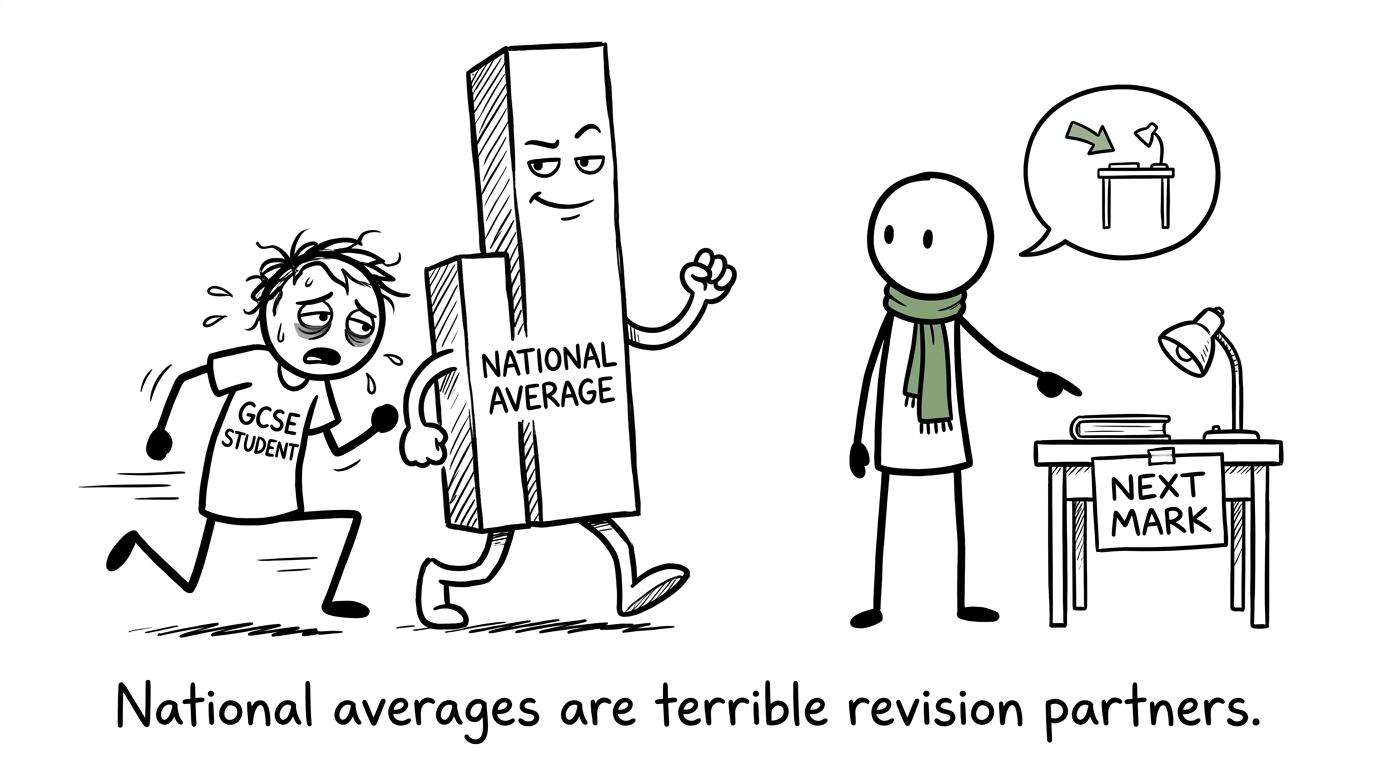 A student races a national bar chart while a friend points to the next mark
What this means for your maths revision
You may be taking Bengali, but your immediate concern could still be GCSE maths. The statistical lesson transfers directly: averages describe groups; your practice evidence describes you.
A national percentage cannot identify whether you lose marks through algebra, ratio, geometry or rushed calculator work. A marked paper can.
Start with the GCSE Maths revision hub, selecting the correct board and tier. MathsGenie includes resources for Edexcel, AQA, OCR, Eduqas, WJEC and CCEA, so check the logo on your paper rather than assuming every specification is identical.
Use this revision cycle:
- Complete a paper or mini test under timed conditions.
- Mark it strictly using the mark scheme.
- Record whether each lost mark came from knowledge, method, accuracy or time.
- Return to the relevant revision lesson and practice questions.
- Retest the topic before attempting another full paper.
The guide to using GCSE past papers properly explains why the improvement happens after marking, not merely while sitting the paper. If you are unsure where to begin, use the process for finding your weakest GCSE topics.
For Edexcel candidates, GCSE maths past papers and mark schemes provide realistic exam practice. Shorter sessions can follow the 20-minute maths revision routine, while a GCSE maths revision timetable helps balance maths with Bengali and your other subjects.
Common mistakes when reading school results
Treating all-subject figures as Bengali results
The large state-private differences reported in national headlines usually combine all GCSE subjects. They cannot be relabelled as Bengali outcomes.
Ignoring the number of entries
A percentage without a cohort size is incomplete evidence. This is particularly important when a subject is offered by very few schools in one sector.
Assuming higher attainment proves better teaching
Grades may reflect prior attainment, admissions, home language experience, entry policy and other factors. Raw results alone cannot isolate teaching quality.
Comparing incompatible categories
“Independent”, “academy”, “selective”, “comprehensive” and “all state-funded” have distinct meanings. Combining or switching categories can create a misleading comparison.
Letting group averages weaken personal expectations
Neither a high sector average nor a low one guarantees an individual result. Your marked work, recurring errors and response to feedback are more useful for planning revision.
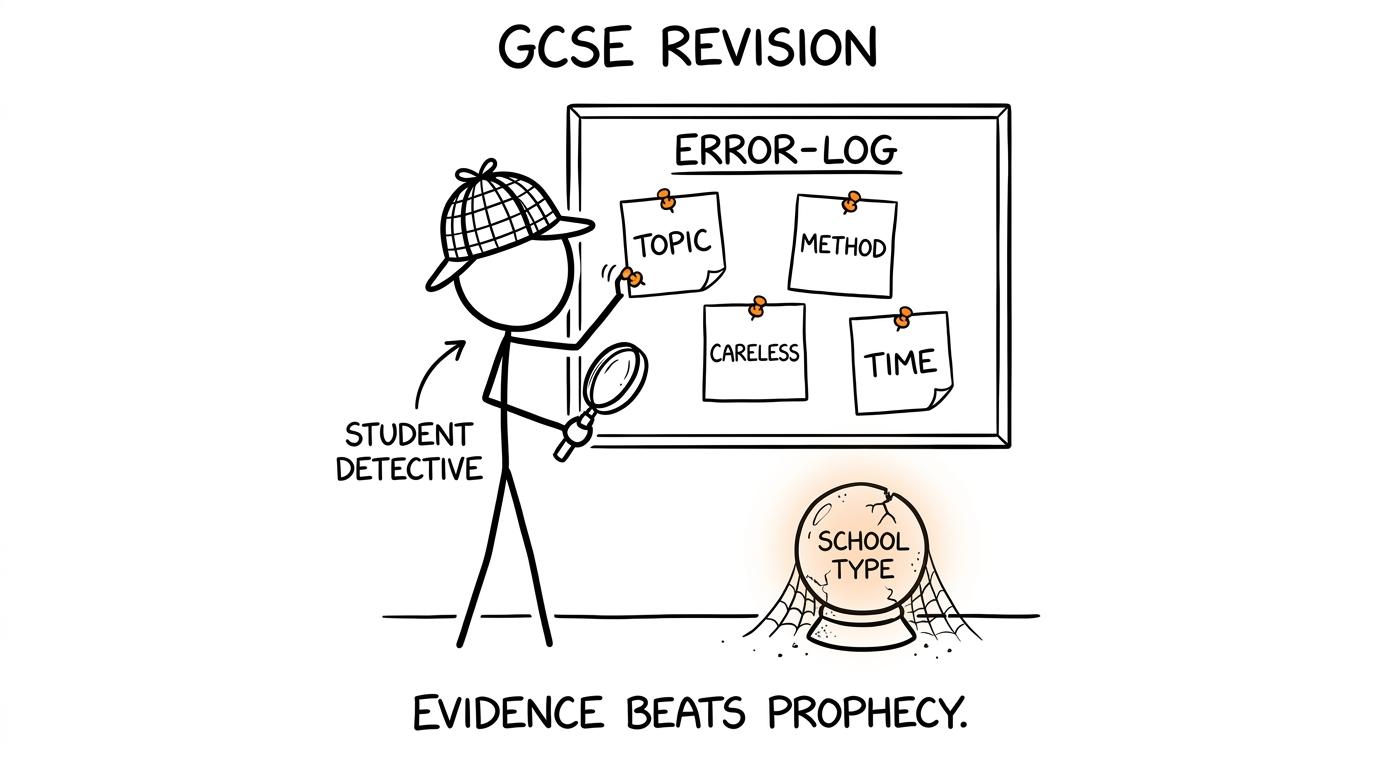 A student detective builds an error log while a school-type crystal ball gathers dust
The fairest conclusion
The available evidence does not support a confident claim that GCSE Bengali grades differ substantially between state and private schools because of school sector. Official data shows a broad private-school advantage across all GCSE subjects, but that is not Bengali-specific. It also shows that Bengali provision is much rarer in independent schools, making simple comparisons vulnerable to small and unrepresentative cohorts.
The data can describe who entered and which grades were awarded. Without careful controls, it cannot tell you how the same pupil would have performed in a different school.
That distinction is more than statistical caution. It gives control back to the student. Use MathsGenie’s free revision lessons, practice questions, mini tests and revision planner to identify what needs work. Then build exam confidence with past papers, mark schemes, video solutions and predicted papers. Your school category belongs in a dataset; your next mark is earned on the page.