

GCSE Bengali Speaking Exam: What to Expect
GCSE Bengali speaking exam explained: timings, role-play, photo card, general conversation, preparation rules and practical revision tips for AQA students.
The GCSE Bengali speaking exam can feel unusually uncertain. In a written paper, the questions sit quietly on the page. In speaking, another person is listening, the recording is running and you must respond in real time.
The reassuring truth is that the assessment follows a clear structure. For the current AQA GCSE Bengali specification, you complete a role-play, a photo card and a general conversation, in that order. You receive supervised preparation time before the assessment, and the total speaking time depends on whether you take foundation or higher tier.
One important check comes first: confirm your qualification with your teacher or exams officer. This guide covers AQA GCSE Bengali, specification 8638. Pearson Edexcel International GCSE Bangla is a different qualification and does not currently have a speaking component.
The GCSE Bengali speaking exam at a glance
AQA GCSE Bengali has foundation and higher tiers. Foundation covers grades 1-5, while higher covers grades 4-9. Speaking is Paper 2 and contributes one quarter of the overall GCSE.
| Part | Foundation tier | Higher tier | Marks |
|---|---|---|---|
| Supervised preparation | 12 minutes | 12 minutes | Not assessed |
| Role-play | About 2 minutes | About 2 minutes | 15 |
| Photo card | About 2 minutes | About 3 minutes | 15 |
| General conversation | 3-5 minutes | 5-7 minutes | 30 |
| Total speaking time | 7-9 minutes | 10-12 minutes | 60 |
Your assessment is recorded and conducted by a teacher-examiner, but AQA marks the recording externally. The three assessed parts run consecutively.
Your basic checklist is:
- confirm that you are taking AQA GCSE Bengali;
- know whether you are entered for foundation or higher tier;
- choose your first general conversation theme in advance;
- practise the role-play, photo card and conversation as separate skills;
- rehearse with a timer and another person;
- prepare flexible language rather than one enormous script.
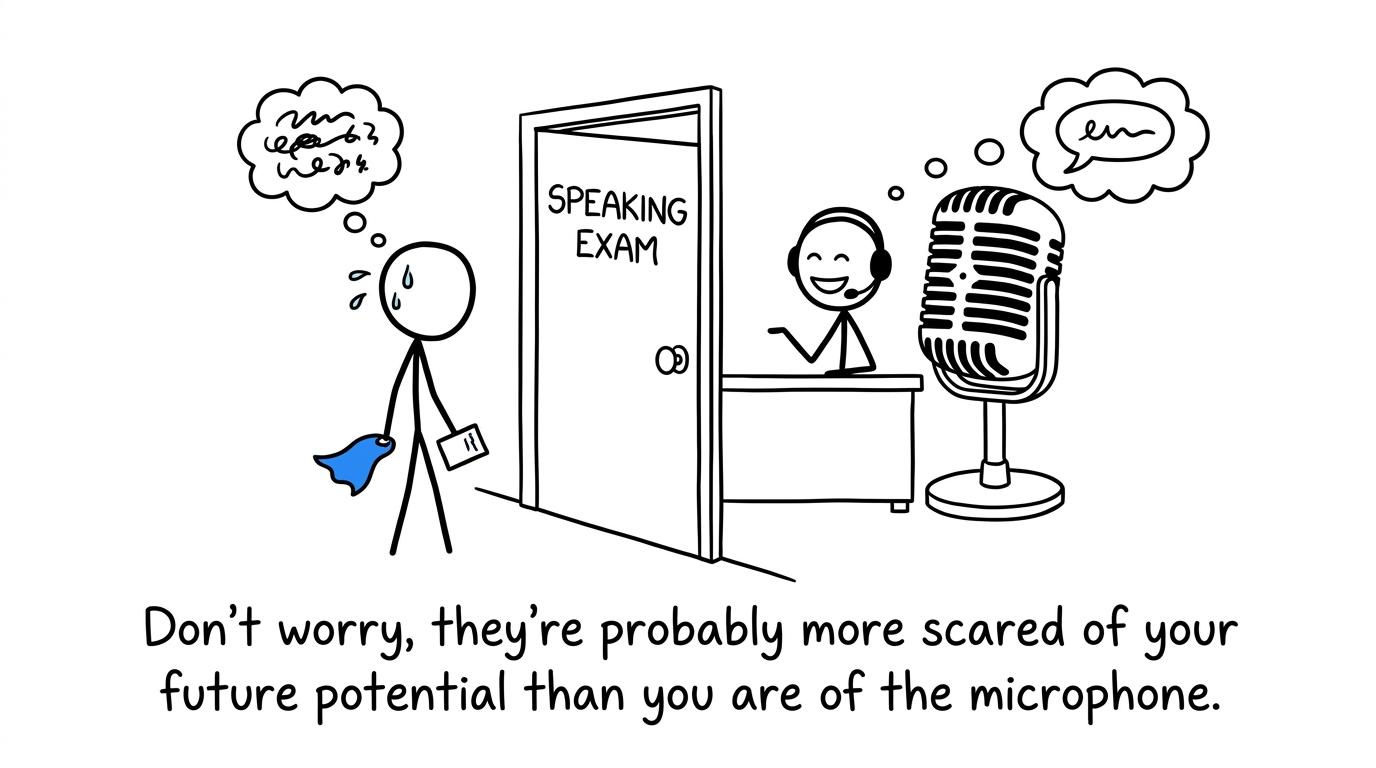 A nervous student discovers that the speaking exam microphone is less frightening than expected
What happens during the preparation time?
Immediately before the assessment, you receive 12 minutes of supervised preparation. You are given the role-play card and photo card allocated to you.
You may make notes, but you cannot use a dictionary. You must not write on the stimulus cards themselves. Your notes can support the role-play and photo card, but they cannot be used for the general conversation.
Preparation time is therefore not an invitation to write perfect paragraphs. It is a short planning window. Use it to identify:
- who you are supposed to be in the role-play;
- where the exchange is taking place;
- what information each prompt requires;
- where you must ask a question;
- what you can see in the photograph;
- opinions, reasons and relevant time frames for the printed photo-card questions.
Short prompts are generally more useful than full sentences. If your page becomes a script, you may spend the assessment reading rather than interacting. That can make your delivery less spontaneous and leave you vulnerable when an unseen question arrives.
A sensible approach is to divide the preparation time deliberately. Read both cards first, plan the role-play, develop ideas for the photo and use the final moments to check that every printed prompt has been covered.
What to expect from the role-play
The role-play is a brief, practical exchange based on a situation shown on your card. You might be speaking to somebody in a shop, school, tourist setting or another context connected to the specification themes.
There are five tasks. The symbols and prompts on the candidate card tell you what information to communicate. One prompt requires you to ask a question, while another leads to an unexpected question from the teacher-examiner.
That unseen element sometimes causes unnecessary worry. It is not designed to produce a long speech. Listen for the key words, identify what has been asked and give a relevant response. A short complete sentence is usually safer than an ambitious answer that never addresses the question.
The role-play carries 15 marks: ten for communication and five for knowledge and use of language. This means successful communication matters enormously. You need to complete each task, make your intended meaning clear and use appropriate Bengali.
Practise these habits:
- listen until the examiner has finished;
- answer the precise prompt rather than reciting a related paragraph;
- include the necessary detail;
- know several simple ways to ask questions;
- recover calmly if you hesitate;
- keep the exchange natural and concise.
You are not expected to turn every response into a miniature essay. The role-play rewards purposeful interaction.
What happens in the photo-card section?
The photo card is worth 15 marks and is assessed for communication. You discuss a photograph connected to one of the GCSE themes.
Three questions are printed on your candidate card, allowing you to prepare ideas. The teacher-examiner also asks two questions that are not printed for you. At foundation tier, this section lasts about two minutes; at higher tier, it lasts about three minutes.
Begin by making the visual information clear. Think about people, location, activity, mood and anything in the background that supports your description. Then be ready to move beyond description into opinions or related experiences when the questions require it.
A useful response usually has layers:
- a direct answer;
- one relevant detail;
- an opinion or reason where appropriate;
- a different time frame if the question invites one.
Do not invent elaborate stories about the people in the image. Your job is to communicate clearly and respond to the questions, not solve a mystery hidden inside the photograph.
How the general conversation actually works
The general conversation is the longest and most heavily weighted section. It is worth 30 of the 60 speaking marks, so preparation should reflect its importance.
The AQA specification contains three themes:
- Identity and culture, including family, technology, free time, food, sport, customs and festivals;
- Local, national, international and global areas of interest, including home, healthy living, social issues, the environment and travel;
- Current and future study and employment, including school, post-16 education, careers and ambitions.
Before the assessment, you nominate the theme you want to discuss first. The conversation then covers two themes: your chosen theme and another theme that has not been covered by the photo card. This arrangement ensures that the speaking assessment reaches across all three themes.
You cannot take preparation notes into this section. That is why memorising a single rigid speech is risky. The examiner may change the wording, ask for a reason, move to a related topic or invite you to speak about a different time.
Prepare reusable building blocks instead:
- clear opinions;
- reasons and justifications;
- past experiences;
- present routines;
- future plans;
- comparisons;
- follow-up details;
- natural questions you can ask.
The conversation is assessed for communication, range and accuracy, pronunciation and intonation, and spontaneity and fluency. A small pause to think is not a disaster. An answer that responds naturally is more valuable than a polished paragraph answering a different question.
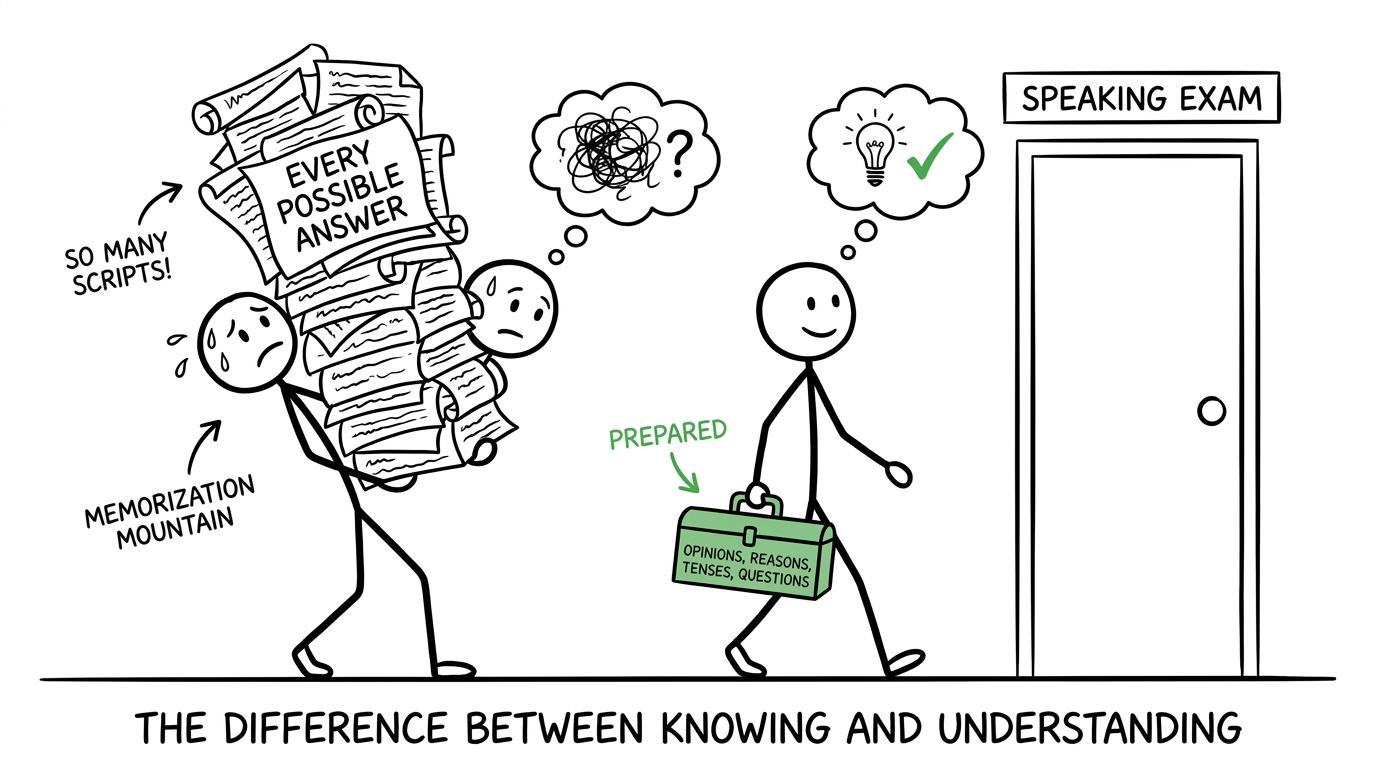 One student carries endless scripts while another brings a compact speaking-skills toolbox
How to revise without memorising everything
Speaking improves through retrieval, not repeated reading. Looking over a model answer may feel productive, but the real test is whether you can produce an answer after hearing an unfamiliar question.
Create question cards for each specification topic. Shuffle them, answer aloud and record yourself. On the next attempt, change one feature: give a different reason, use another time frame or extend the answer with a comparison.
A strong weekly routine could include:
- one short role-play drill;
- one timed photo-card discussion;
- questions from two conversation themes;
- one recording reviewed for clarity and hesitation;
- a repeat attempt after correcting weak language.
Ask a teacher, family member or classmate to vary the wording. They do not need to speak Bengali perfectly to select questions, time your responses and notice whether you stop after one sentence.
This method resembles effective maths revision. A solution only becomes secure when you can reproduce the method without looking. MathsGenie’s guide to starting GCSE past papers at the right time explains the same progression from short diagnostic practice to realistic timed performance.
When Bengali revision sits alongside maths, avoid allowing whichever subject feels most urgent to consume the whole evening. Use the GCSE Maths revision hub for focused maths sessions, then protect a separate speaking slot in your revision planner. Twenty attentive minutes of spoken recall is more useful than an hour spent decorating notes.
Common mistakes in the Bengali speaking assessment
Giving one-word answers
A single word may communicate something, but it rarely demonstrates the range needed in the conversation. Answer directly, then add a reason, detail or example when the task allows it.
Missing a role-play bullet
Each task matters. During preparation, check every prompt and identify the one requiring you to ask a question. Do not let one long answer consume the time needed for the remaining tasks.
Reading notes like a script
Notes should trigger ideas, not replace speaking. Reading full sentences can flatten your intonation and make unexpected questions harder to manage.
Describing only the photograph
The photo card begins with visual material, but the prescribed questions can take you into related opinions and experiences. Listen to what each question actually asks.
Memorising one answer for every topic
Rigid scripts create the illusion of control. Flexible vocabulary, opinions, reasons and time phrases cope better with changed wording.
Panicking after a mistake
A corrected word or restarted sentence does not erase the rest of your performance. Repair the message and continue. Communication is still possible after an imperfect verb ending or momentary hesitation.
Neglecting the general conversation
It is worth half of the speaking marks. Spending most of your revision on the predictable role-play prompts is comfortable, but it is not proportionate.
Managing Bengali alongside GCSE maths revision
Exam season rewards systems that reduce decision-making. Decide in advance which resource belongs to which session.
For maths, choose the correct board and tier. AQA students can use the AQA GCSE Maths revision area, while Edexcel students can work through Edexcel GCSE Maths past papers. OCR students have a dedicated collection of OCR GCSE Maths past papers.
For Bengali, organise practice by speaking task and theme. Keep a simple error log containing phrases you could not recall, questions you misunderstood and answers that needed more development. Return to those weaknesses rather than repeating your strongest topic.
Near the maths exams, Edexcel predicted papers, mini tests, mark schemes and video solutions can provide fresh timed practice. The same principle applies to speaking: practise under realistic conditions, review what happened and make the next attempt more precise. If pressure begins to encourage last-minute cramming, use the GCSE night-before revision plan to keep the final evening controlled.
Walk into the assessment knowing the shape of it
The GCSE Bengali speaking assessment is not an unstructured conversation. It has three defined stages: a role-play, a photo card and a general conversation. You know the themes, the order, the broad timings and what each section is designed to assess.
Your goal is not flawless speech. It is to listen, communicate and keep the interaction moving. Practise the format until the sequence feels ordinary, build flexible answers rather than scripts and give the general conversation the time its marks deserve.
Then bring the same disciplined routine to your maths preparation. Start with MathsGenie’s free revision lessons and practice questions, use past papers with mark schemes and video solutions, and finish with mini tests or predicted papers when you need realistic rehearsal. Clear structure makes exams feel smaller and gives each revision session a useful next step.










