GCSE Bengali Results Day: Is Your Grade Wrong?
GCSE Bengali results day wrong grade? Follow a calm first-hour checklist, check your marks and ask your school about scripts and marking reviews.
Results day can turn on a single line of text. You open your results, find Bengali, and the grade is much lower than your mock or predicted grade. The immediate thought is often: this cannot be right.
If you are searching for gcse bengali results day wrong grade advice, the first step is simple: speak to your exams officer or a senior teacher before leaving school. Ask for your component marks, grade boundaries, exact qualification details and the school's post-results procedure. Do not request a review blindly. First gather the evidence that helps you and your teachers judge whether an administrative or marking error may have occurred.
A disappointing result is not, by itself, proof of a mistake. But you are entitled to ask sensible questions, understand the options and have your concern handled through the proper process.
Your first-hour checklist
In the first hour after receiving your result:
- Check your name, candidate number, subject title and grade.
- Confirm the awarding organisation and exact qualification code.
- Ask for your overall mark and any available paper or component marks.
- Compare your mark with the published grade boundaries.
- Tell your Bengali teacher why the result seems unexpected.
- Ask whether a copy of your marked script can be accessed.
- Request the school's written post-results procedure and internal deadline.
- Tell your sixth form or college promptly if the grade affects your place.
- Photograph or safely store every document you receive.
- Do not sign a review request until the possible outcomes and fees have been explained.
For the summer 2026 series, GCSE results are released on Thursday 20 August 2026. JCQ's final deadline for awarding bodies to receive most reviews of results is 24 September 2026, but schools normally set earlier internal deadlines. Treat the date given by your exams officer as the deadline that matters to you.
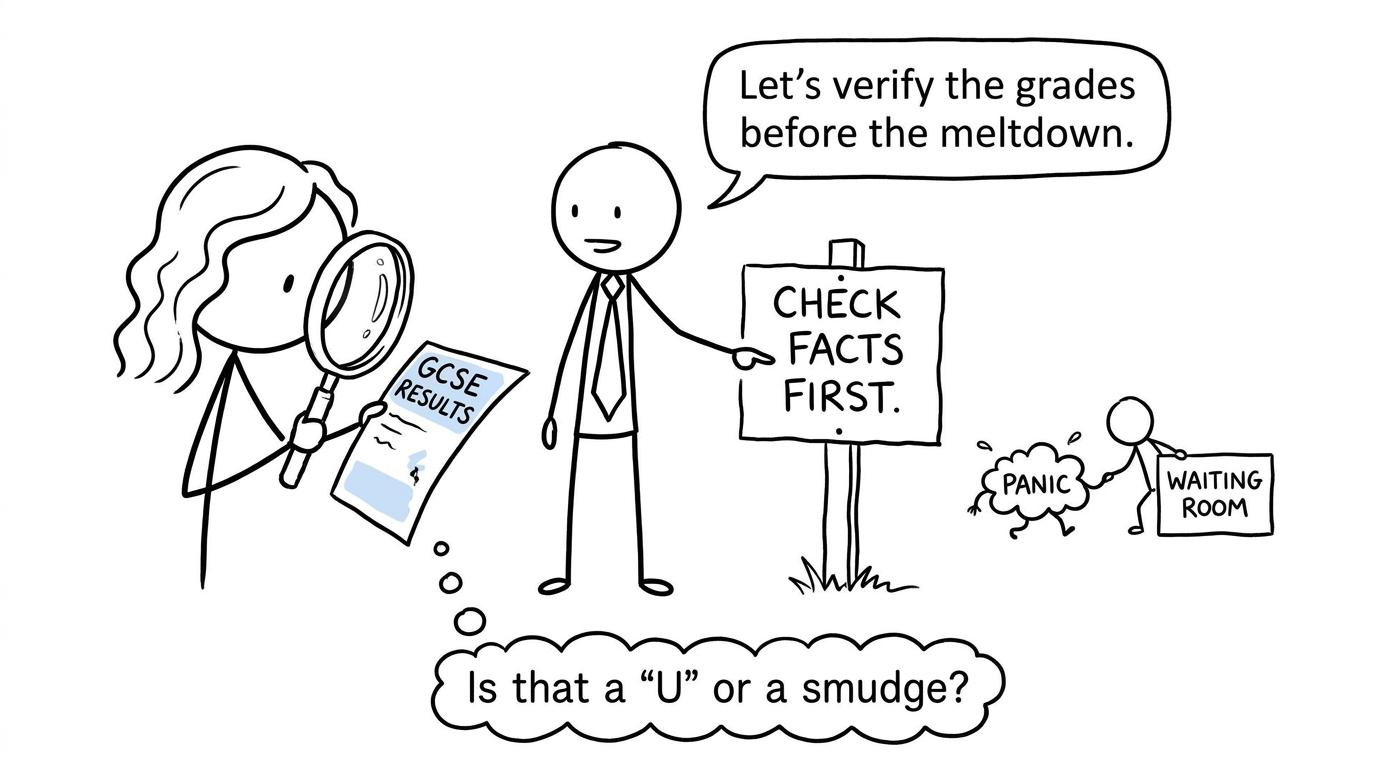 A student calmly checks the facts before letting results-day panic take over
What to do during the first hour
The first few minutes: check the result itself
Read the results slip slowly. Results day is noisy, and an unexpected grade can make careful reading strangely difficult.
Confirm that the entry belongs to you and note the exact subject name. Depending on the qualification, your paperwork may use wording such as Bengali, Bangla or International GCSE Bangla. These labels are not interchangeable, so record the awarding organisation, specification and entry code rather than relying on what the course was called informally at school.
Check whether the result is complete or whether anything is marked as pending, missing or unclassified. If you suspect an entry or administrative problem, show the slip to the exams officer immediately.
The next few minutes: ask for the mark breakdown
A grade gives you the outcome. A mark breakdown gives you something to investigate.
Ask for:
- your total mark;
- marks for each paper or component, where available;
- the relevant grade boundaries;
- confirmation that all expected components were included;
- any information already visible through the awarding organisation's results system.
Your predicted grade is useful context, but it is not part of the formal calculation of your result. Predictions and mock grades are estimates based on earlier evidence. The awarded grade is based on the assessed work submitted in the real examination series and the grade boundaries for that series.
The more useful question is therefore not simply, “Why is this lower than my prediction?” It is, “Does the component information reveal a plausible error or an unexpectedly marked paper that should be inspected?”
Before the hour ends: find the right person
Speak to your Bengali teacher if they are available, but make sure the exams officer knows about the concern. Post-results requests for school candidates normally have to go through the school or college. A teacher can assess the academic evidence; the exams officer manages consent, forms, fees and deadlines.
Explain the discrepancy precisely. Mention an unusually low component, a missing result, a large difference from consistently marked school work or a progression requirement. Avoid claiming that the examiner must be wrong before anyone has seen the evidence.
If Bengali is required for your sixth-form or college place, contact the admissions team that day. Tell them that you are discussing a possible post-results service with your school. Do not promise that the grade will change, because no review can guarantee that.
A predicted grade and an awarded grade are different things
Predicted grades can be careful and well informed, yet still differ from final results. A mock may have used different grade boundaries, covered fewer topics or been marked under different conditions. Performance can also vary between components.
That does not mean you should ignore a surprising result. It means the size of the surprise is only the beginning of the investigation.
Think like you would when checking an unexpected maths answer. You would not erase everything immediately. You would inspect the information, retrace the process and identify where an error could realistically have occurred. The same discipline helps on results day.
This is also why grade boundaries matter. Being close to the next boundary may affect whether you and your teacher consider a review worthwhile, but closeness alone does not prove that marking was wrong. A review exists to correct errors in how the mark scheme was applied, not to award extra marks because a candidate narrowly missed a grade.
Which post-results service might apply?
Access to scripts
Your school can use the awarding organisation's Access to Scripts service to obtain a copy of marked work where the service is available. This lets an appropriate teacher inspect the marking before advising you about a review.
Ask how quickly the script can be obtained, whether every relevant component is accessible and what consent is required. The awarding organisation's access deadline may differ from its review deadline, while your school's internal deadline may be earlier than both.
A script is evidence. It can reveal an unmarked response, a possible application error or a paper that was marked consistently even though the final performance was below expectations.
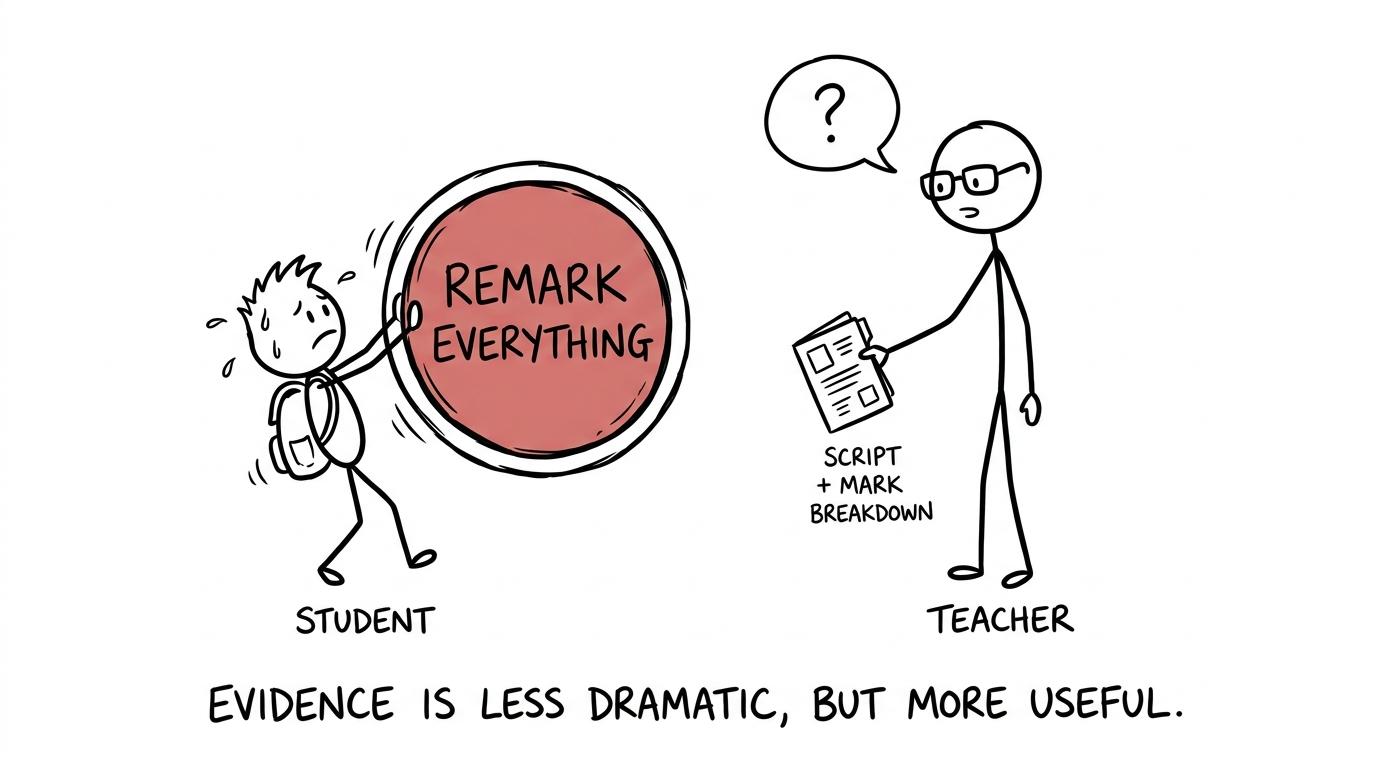 A dramatic remark button loses out to the much more useful script and mark breakdown
Clerical re-check
A clerical re-check, often called Service 1, checks administrative details such as whether all parts were marked and whether marks were totalled and recorded correctly. It does not reconsider the academic judgement applied to each response.
This may be relevant where the evidence suggests a missing mark, an unmarked section or an incorrect total.
Review of marking
A review of marking, commonly called Service 2, checks whether the original mark scheme was applied correctly. It is a review of the original marking, not an entirely fresh re-mark designed to find extra marks.
You must give informed written consent because your mark and grade can rise, stay the same or fall. A fee may apply, depending on the awarding organisation and your school's policy. Ask who pays, when payment is required and what happens to the fee if the grade changes.
For the June 2026 series, JCQ states that a non-priority review should be completed within 20 calendar days of the awarding body receiving it. Do not assume that every board offers a priority GCSE service. Current government guidance notes that GCSE priority availability is more limited than at A Level, so your exams officer must check the rules for your exact qualification.
Appeal after a review
An appeal is not usually the first step. If concerns remain after a review outcome, the school may be able to appeal on permitted grounds, including an alleged marking or procedural error. JCQ's 2026 appeals guidance sets a deadline of 30 calendar days from the review outcome for the awarding organisation to receive an appeal.
If your school decides not to request a clerical re-check or review of marking, ask for its internal appeals procedure. Schools must make a process available for students who disagree with such a decision. Private candidates should contact their awarding organisation or the centre through which they entered.
Protect your next steps while the result is checked
A review and a backup plan can run at the same time. This is not pessimism. It is good administration.
If your place depends on the result, ask the sixth form or college:
- whether it will hold your place while a review is considered;
- whether another subject result can satisfy the requirement;
- what evidence it needs from your school;
- when it requires an update.
Meanwhile, keep your maths plans moving. Use the GCSE Maths revision hub to choose your exam board and appropriate resources. If a maths resit is part of your next step, the GCSE maths resit results-day plan explains how to turn a result into a practical revision sequence.
Start with diagnosis rather than random practice. The guide to finding your weakest GCSE topics helps you convert lost marks into clear priorities. You can then organise those priorities with the free MathsGenie revision planner.
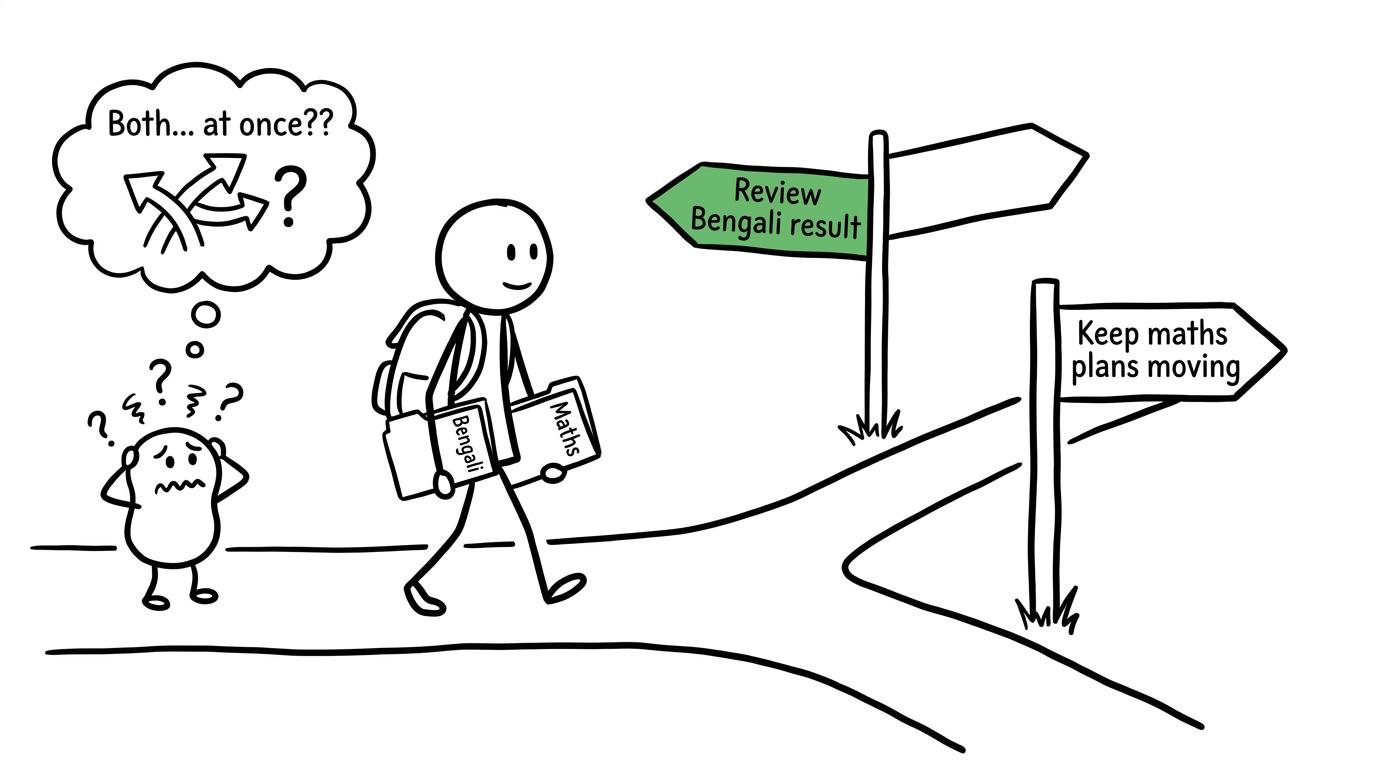 A student discovers that checking a Bengali result and continuing a maths plan can happen at the same time
Common mistakes when a Bengali grade looks wrong
Leaving school without speaking to anyone
Email can be useful, but a short results-day conversation often identifies the correct contact and internal deadline immediately. At minimum, obtain the exams officer's details and send a written summary that day.
Treating a prediction as proof
A strong mock history supports the reason for asking questions, but it does not prove an examination error. Component marks, scripts and the mark scheme provide stronger evidence.
Asking for “a remark” without knowing the service
Access to scripts, a clerical re-check and a review of marking do different jobs. Ask which service is being proposed and why it fits the evidence.
Forgetting that a mark can fall
There is no grade protection in a review of marking. Your informed consent confirms that you understand the result may go down, remain unchanged or go up.
Waiting for the published final deadline
Your school needs time to inspect evidence, obtain consent and submit the request. Its internal deadline may arrive well before 24 September 2026.
Stopping all other planning
Do not let one disputed result freeze every decision. Contact your destination, investigate the grade and continue preparing for the subjects still ahead.
For maths, short tasks can restore a sense of movement. Try the GCSE mini tests, then learn how to use GCSE mark schemes as a revision coach. Edexcel students can progress to GCSE Maths past papers with mark schemes when they are ready for timed practice.
Turn uncertainty into a clear next action
An unexpected Bengali result can feel personal, especially when it conflicts with months of school evidence. The most useful response is neither blind acceptance nor instant accusation. It is a calm sequence: verify the entry, collect the marks, speak to the right staff, inspect the available evidence and use the correct post-results service if there is a reasonable concern.
Do that within the first hour, and you replace panic with a process.
Then keep moving. MathsGenie gives you free revision lessons, practice questions, mini tests, past papers, predicted papers, mark schemes and video solutions for GCSE and A Level maths. Open the MathsGenie GCSE Maths revision area, choose your exam board and make the next piece of progress while your Bengali result is being properly checked.