GCSE Bengali Remark Appeal: Is It Worth It?
GCSE Bengali remark appeal guide: understand reviews, fees, deadlines, mark changes and when challenging your AQA result may genuinely be worthwhile.
Results day can shrink an entire course into one uncomfortable number. If your GCSE Bengali grade is below what you expected, especially by only a few marks, requesting a “remark” may feel like the obvious response.
A GCSE Bengali remark appeal can be worthwhile when there is specific evidence of a marking or administrative error and the possible benefit matters to your next step. It is less sensible when the request rests only on disappointment or a hopeful prediction. The official process begins with access to available marked material, a clerical re-check or a review of marking. An appeal normally comes later, after the review outcome.
For the current AQA GCSE Bengali specification, students take listening, speaking, reading and writing components, each worth 25%25\%25% of the qualification. That creates four possible places to investigate, but it does not mean all four should automatically be reviewed.
Your results-day checklist
Before paying or giving consent, take these steps:
- Confirm that your qualification is AQA GCSE Bengali, specification 8638.
- Ask your exams officer for your component marks and the relevant grade boundaries.
- Find out exactly how many marks separate you from the grade above.
- Request available marked material promptly so a Bengali teacher can examine it.
- Identify whether the concern is clerical or relates to how the mark scheme was applied.
- Check your school’s internal deadline and charges.
- Understand that a mark and final grade can rise, stay unchanged or fall.
- Treat an appeal as a later stage, not another name for the initial review.
The useful principle is simple: investigate first, decide second.
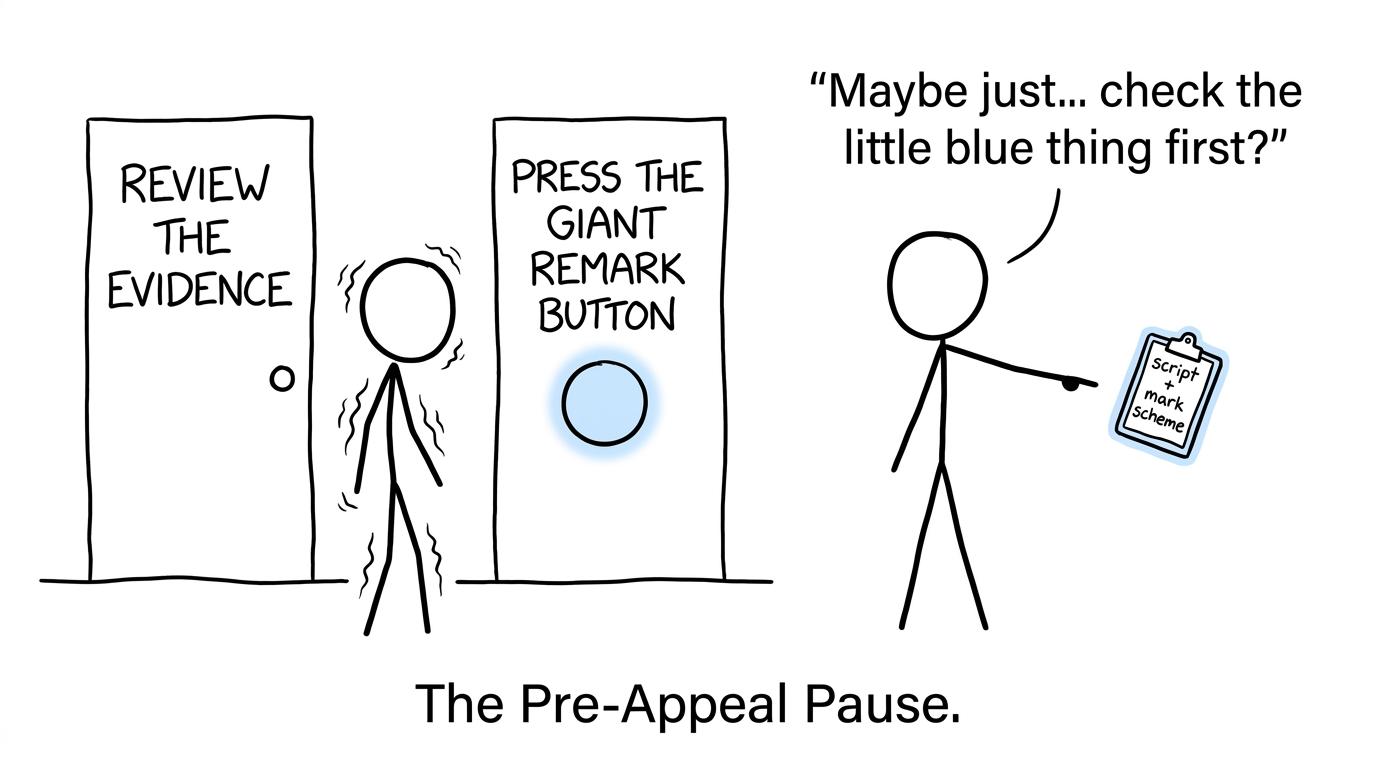 A student choosing evidence before pressing a giant remark button
What a GCSE Bengali “remark” actually means
“Remark” is the familiar term, but the official service is usually called a review of marking. It is not an automatic fresh mark by an examiner who starts from nothing.
The reviewer considers the original marking and checks whether the mark scheme was applied correctly. Administrative errors must be corrected. For responses involving judgement, the reviewer considers whether the original mark was one that a marker could reasonably have awarded while applying the mark scheme properly.
This distinction matters in a language qualification. A student and teacher may prefer a different mark for an extended Bengali response, but disagreement alone does not establish a marking error. A stronger case identifies something specific: relevant content appears to have been overlooked, a mark-grid descriptor seems to have been applied incorrectly, or part of the response was not marked.
AQA GCSE Bengali has four equally weighted components:
| Component | Qualification weighting | What may need investigating |
|---|---|---|
| Listening | 25%25\%25% | Whether answers were credited and recorded correctly |
| Speaking | 25%25\%25% | Whether the recorded performance was assessed against the correct criteria |
| Reading | 25%25\%25% | Whether acceptable responses received the appropriate credit |
| Writing | 25%25\%25% | Whether communication and language were judged using the published levels |
A request is made for a particular component. Reviewing one paper does not cause every part of the qualification to be reconsidered.
The three routes after receiving your result
Access to scripts or assessment material
For written components, ask your school or college whether it can obtain a priority copy of the marked paper. AQA currently offers priority access to marked GCSE papers free of charge, with a published deadline of 3 September 2026 for the June 2026 series.
Availability can differ for recorded or digitally submitted work, so your exams officer should confirm what can be accessed for the speaking component. Do not wait for the public deadline: schools commonly set earlier internal cut-offs so staff have time to review evidence and submit requests.
A script is most useful when a teacher compares it carefully with the mark scheme. The purpose is not to calculate every mark as if judgement never exists. It is to locate a credible error.
Clerical re-check
A clerical re-check is the narrower and cheaper service. It checks matters such as whether all pages were marked, the marks were counted and the result matches the marks recorded on the paper.
For AQA’s June 2026 series, the published fee is currently £9.70\pounds 9.70£9.70 per component and the request deadline is 24 September 2026. A clerical re-check can take up to ten calendar days.
Choose this route when the concern is administrative. It does not reconsider the academic judgement applied to a Bengali writing response.
Review of marking
A review of marking includes the administrative checks and asks a reviewer to consider whether the original marking was correct under the mark scheme.
AQA’s published June 2026 fee is £44.85\pounds 44.85£44.85 per GCSE component, including a copy of the reviewed script. The standard deadline is 24 September 2026, and the service can take up to 202020 calendar days. AQA states that the review fee is not charged when the overall subject grade changes, although your school may have its own administrative arrangements or fee.
Written consent is required after results have been issued because the outcome can be higher, unchanged or lower. There is no grade protection.
When is a GCSE Bengali review genuinely worth it?
The distance from a boundary matters, but it is not enough by itself. One mark below the next grade creates a potentially valuable opportunity, not evidence that the marking is wrong.
A request is strongest when several of these conditions apply:
- You are close to the grade boundary above.
- A qualified teacher has examined the available response and identified a plausible marking error.
- One component is unexpectedly weak compared with your other Bengali components.
- The result is materially different from reliable evidence gathered under exam conditions.
- The higher grade affects a sixth-form place, course requirement or another meaningful decision.
- You understand and accept the financial cost and downside risk.
It may be less worthwhile when you are many marks away, no specific problem can be found, or the expected grade came from informal classroom work that did not closely reproduce the assessment conditions.
The decision can be framed without pretending it is perfectly predictable:
Value of review=strength of evidence+importance of outcome−cost and downside risk\text{Value of review}=\text{strength of evidence}+\text{importance of outcome}-\text{cost and downside risk}Value of review=strength of evidence+importance of outcome−cost and downside riskThis is a decision framework, not a probability calculator. Exam boards do not promise that being close to a boundary makes an increase likely.
How to assess the evidence calmly
Start with component marks rather than the overall grade. Because each Bengali component contributes 25%25\%25%, a weak result in one area may explain the final outcome. Ask whether the mark looks surprising for a reason that can be checked.
Then separate three ideas:
- Surprise: “This is lower than I expected.”
- Suspicion: “This component is inconsistent with the evidence.”
- Grounds: “This response appears to meet a descriptor or contains an acceptable answer that was not credited.”
Only the third gives a review a solid foundation.
This evidence-led habit is useful in maths revision too. A total mark tells you where you finished; the paper tells you why. MathsGenie’s guide to finding your weakest GCSE topics uses the same principle: inspect lost marks, classify the cause and act on evidence.
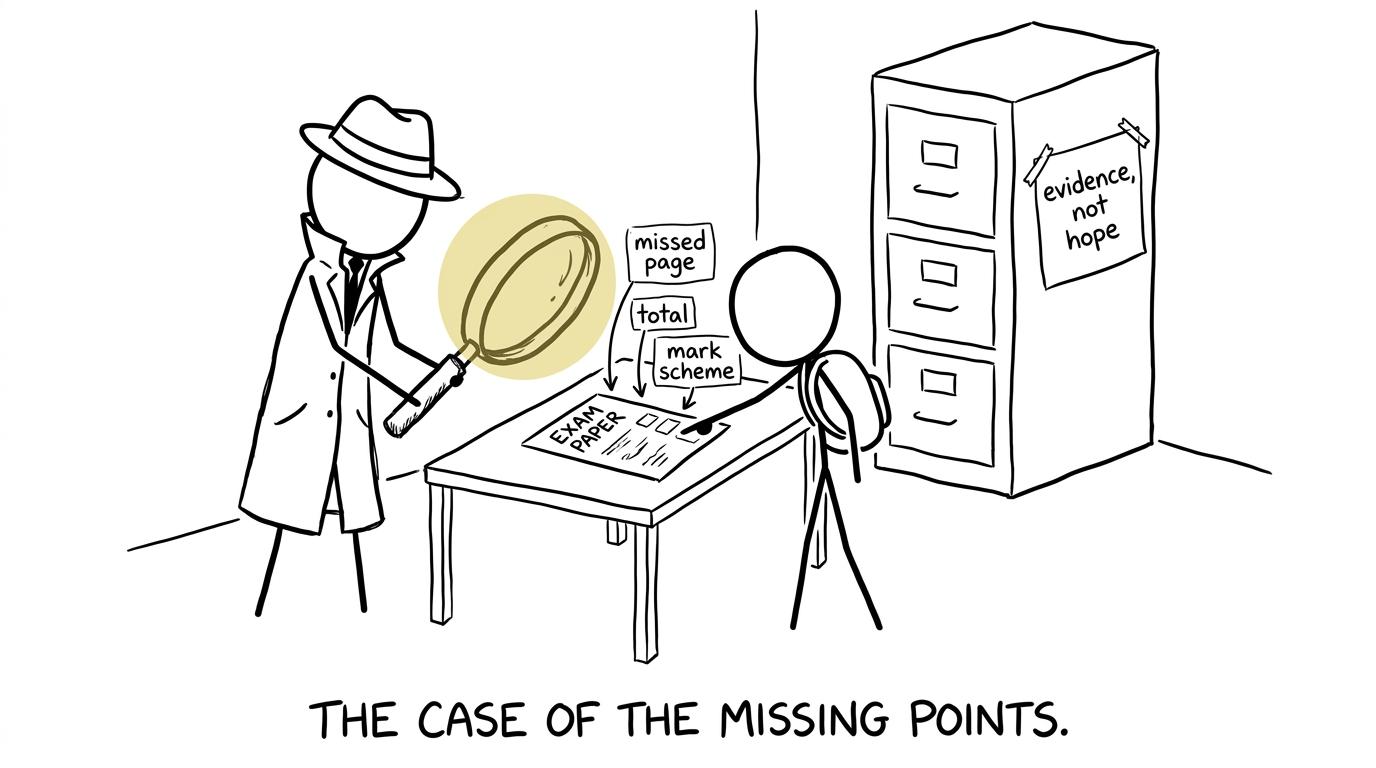 An exam-script detective looking for evidence rather than hope
How an appeal differs from a review of marking
An appeal is not the first step and cannot normally be used simply because you dislike the grade. The relevant post-results service must be completed first.
If the school or college remains concerned after the review, it can appeal on grounds such as an uncorrected marking error or procedures not being followed consistently, properly or fairly. Private candidates can generally deal directly with the awarding organisation or work through the centre that entered them.
The process usually has two stages:
- Stage one: a preliminary appeal considered by a senior person who was not previously involved.
- Stage two: an appeal hearing before a panel, including an independent member.
Under current JCQ arrangements, an appeal following a review of results must normally be submitted within 303030 calendar days of the review outcome. AQA’s published 2026 charges are £133.20\pounds 133.20£133.20 for stage one and £228.20\pounds 228.20£228.20 for stage two, charged per candidate at component level for review-of-marking appeals. AQA does not charge when the appeal is upheld.
These fees and deadlines can change by series. Your exams officer should verify the current figures before you proceed. If your school refuses to request a review, it must have an internal process through which you can challenge that decision.
Common mistakes when requesting a remark or appeal
Waiting for the exam board’s final deadline
Your school’s deadline is the one that matters in practice. It may be considerably earlier than the published awarding-body date.
Reviewing every component without evidence
Fees are generally charged per component. Begin with the component where the result and available evidence create the clearest concern.
Assuming a remark cannot reduce the grade
Marks can rise, remain unchanged or fall. Read the consent information before signing it.
Confusing a clerical re-check with a marking review
A re-check looks for administrative problems. It does not reconsider the academic judgement applied to an extended answer or speaking performance.
Treating an appeal as a second speculative remark
An appeal needs grounds. The school should be able to explain the suspected marking or procedural error rather than merely saying the grade feels harsh.
Letting the result stop all other revision
A post-results request and a resit plan can run on separate tracks. If maths is part of your next step, continue with the GCSE maths revision hub, then use GCSE predicted papers and board-specific past papers to keep progressing.
What to do while waiting for the outcome
A review is a request for correction, not a revision strategy. If you may resit GCSE maths or are moving towards A Level study, use the waiting period deliberately.
Start with Edexcel GCSE maths past papers, or choose your board through the main GCSE hub. Mark each attempt carefully and use the method in MathsGenie’s mark scheme guide to identify the first point at which each solution went wrong.
Short sessions are easier to sustain than a dramatic new timetable. The 20-minute GCSE maths revision routine combines recall, exam questions and immediate feedback. For a longer plan, use the GCSE revision timetable guide.
The broader lesson is the same in Bengali and maths: outcomes improve when action follows evidence.
Make the decision from evidence, not results-day emotion
A GCSE Bengali review is worth requesting when the grade is important, the mark is within realistic reach and a teacher can point to a credible error. Start by obtaining component information and available marked material. Choose the correct service, meet your school’s deadline and consent only after understanding that the result can move in either direction.
If the evidence is not there, that does not make the original disappointment unimportant. It simply means your time and money may be better spent on the next controllable step.
For maths, make that step concrete with MathsGenie’s free GCSE resources: revision lessons, practice questions, mini tests, past papers, predicted papers, mark schemes and video solutions. Choose one weak area, practise it, check the evidence and return stronger.