GCSE Bengali Paper 4: What to Actually Expect
GCSE Bengali Paper 4 explained: timings, Foundation and Higher question types, translation, mark priorities and a calm exam-day revision plan for students.
The uncomfortable part of a writing exam is not always the writing. It is the uncertainty before it: how many tasks will appear, which ones offer a choice, how long each response should be and whether the translation is as important as the longer answer.
For GCSE Bengali Paper 4, the short answer is this: it is AQA's writing paper, worth 25%25\%25% of the qualification. Foundation students have 111 hour and complete four questions; Higher students have 111 hour 151515 minutes and complete three. Both papers test whether you can communicate accurately in Bengali, respond fully to prompts and translate meaning from English into Bengali.
This guide refers specifically to AQA GCSE Bengali specification 8638. That matters because Pearson Edexcel International GCSE Bangla has a different assessment structure and does not use the same Paper 4 format. Confirm your exam board, specification and tier with your teacher before using any revision advice.
GCSE Bengali Paper 4 at a glance
Before revising individual themes, make sure you understand the paper itself.
- It is a written examination completed in Bengali.
- Dictionaries are not permitted.
- Foundation lasts 111 hour and is marked out of 505050 raw marks.
- Higher lasts 111 hour 151515 minutes and is marked out of 606060.
- Paper 4 contributes 25%25\%25% of the overall GCSE.
- Foundation candidates answer four questions.
- Higher candidates answer three questions.
- Some extended tasks offer a choice, but every bullet point in the chosen task matters.
- The translation is from English into Bengali.
- You must take the same tier across all four Bengali skills.
Foundation tier covers grades 111-555, while Higher covers grades 444-999. Your school makes the entry, so do not infer your tier from the difficulty of one practice paper.
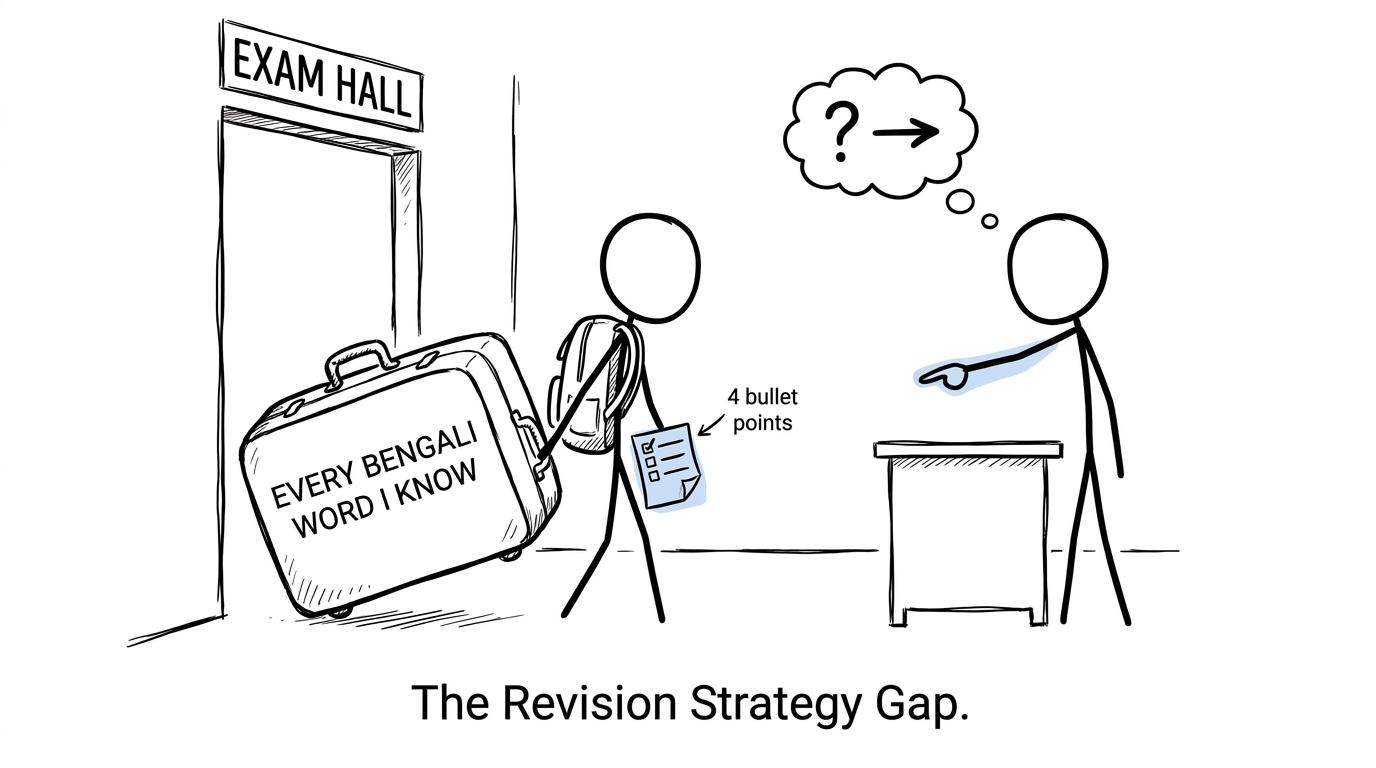 A student discovers that a short bullet-point checklist is more useful than carrying every Bengali word into the exam
What is different about the Foundation paper?
Foundation Paper 4 moves from tightly supported communication towards a longer structured response. Its progression is deliberate: four clear sentences, a short passage, a translation and then a response of approximately 909090 words.
| Task | What you produce | Marks |
|---|---|---|
| Question 1 | Four sentences responding to a photograph | 888 |
| Question 2 | Approximately 404040 words covering four brief bullet points | 161616 |
| Question 3 | English-to-Bengali translation of at least 353535 words | 101010 |
| Question 4 | Approximately 909090 words covering four detailed bullet points, with a choice of two tasks | 161616 |
The photograph message
The first question rewards direct communication. You write four sentences connected to a photograph, with each sentence marked separately. This is not an invitation to create an elaborate story. Four relevant, understandable sentences are safer than ambitious writing that becomes unclear.
The task favours familiar vocabulary and dependable sentence construction. Practise producing distinct statements rather than rewriting the same observation four ways.
The short passage
Question 2 asks for approximately 404040 words of continuous writing based on four brief bullet points. Coverage is crucial. A polished paragraph addressing only three prompts cannot fully satisfy the task.
The useful habit is simple: identify the four requirements, plan one clear idea for each and then connect them naturally. The mark scheme considers both content and quality of language, so relevant communication and accuracy work together.
Foundation translation
The translation contains an English passage of at least 353535 words. It tests whether you can convey key messages and apply Bengali grammar and structures accurately.
Translation is not a word-matching exercise. Read the complete sentence, identify its meaning and then express that meaning naturally in Bengali. If an English phrase cannot be translated literally, preserve the message rather than forcing an unnatural construction.
The structured writing task
The final Foundation question is approximately 909090 words. You select one of two tasks and respond to four compulsory, detailed bullet points.
This question favours students who can sustain a response while remaining relevant. It usually gives more room to express opinions, refer to different time frames and add supporting detail. The choice should be made according to which set of prompts you can cover most accurately, not simply which title looks familiar.
What is different about the Higher paper?
Higher Paper 4 removes the very short photograph and 404040-word tasks. It begins with the structured 909090-word response, moves to a substantial open-ended task and finishes with translation.
| Task | What you produce | Marks |
|---|---|---|
| Question 1 | Approximately 909090 words on four bullet points, with a choice of two tasks | 161616 |
| Question 2 | Approximately 150150150 words on two detailed bullet points, with a choice of two tasks | 323232 |
| Question 3 | English-to-Bengali translation of at least 505050 words | 121212 |
The approximately 909090-word response
Higher Question 1 uses the same broad format as the final Foundation task. To reach the strongest mark range, you need to address every bullet point, communicate opinions and demonstrate a suitable variety of vocabulary and structures.
Variety should serve meaning. A controlled response using different time frames and sentence patterns is stronger than one overloaded with memorised phrases that do not answer the prompts.
The approximately 150150150-word response
Question 2 carries 323232 marks, more than half of the Higher paper. You choose one of two tasks and answer two detailed bullet points. The mark scheme considers content, range of language and accuracy.
This is where Paper 4 most clearly differs from shorter writing assessments. The examiner is looking for sustained communication: developed ideas, opinions with reasons, appropriate detail and enough grammatical range to handle the task. Both bullet points are compulsory, even if one offers much more to say.
A common trap is spending most of the response on the first prompt and rushing the second. Before writing, divide your intended content between them. Balance is not about making both sections exactly equal; it is about developing both adequately.
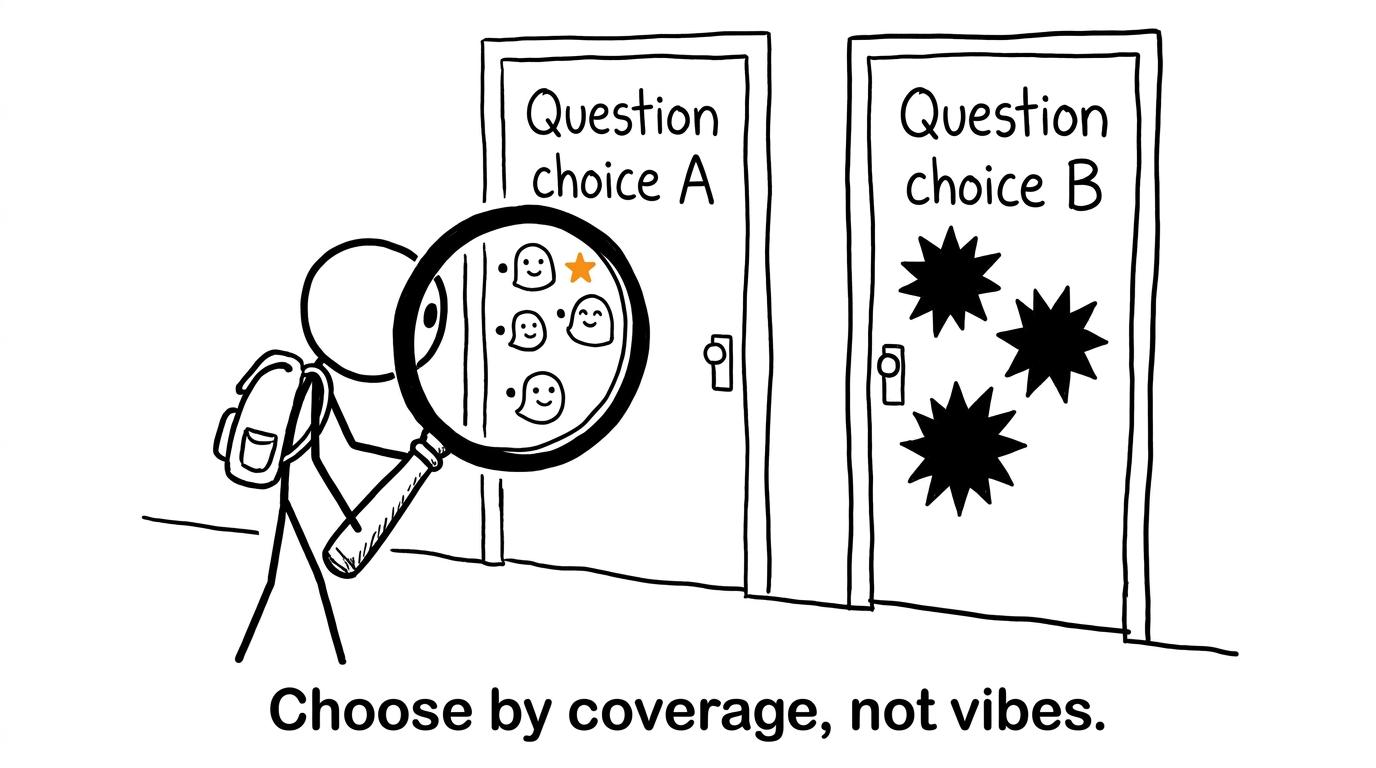 A student carefully chooses between two writing questions by inspecting the bullet points rather than trusting vibes
Higher translation
The final task translates an English passage of at least 505050 words into Bengali. Although it is shorter than the extended response, it still carries 121212 marks and can expose gaps in tense, agreement, word order and everyday vocabulary.
Revise translation in complete phrases. After translating, compare your Bengali response with the English source clause by clause. Check whether every person, action, time reference, negative and opinion has survived the journey.
What topics can Paper 4 favour?
There is no reliable list of exact future questions. AQA can draw on all three specification themes:
- identity and culture, including family, technology, free time, customs and festivals;
- local, national, international and global interests, including home, social issues, the environment and travel;
- current and future study and employment, including school, post-161616 education and careers.
Paper 4 therefore favours flexible language over one memorised essay. Build reusable language for opinions, reasons, comparisons, past experiences and future intentions, but practise adapting it across themes.
The same principle applies in maths revision: methods must survive unfamiliar wording. MathsGenie's GCSE maths revision hub organises lessons and questions by exam board, while its guide to finding your weakest GCSE topics shows how to turn mistakes into focused revision. For Bengali, create the equivalent list using themes, grammar and task types.
A practical timing plan
AQA does not require you to follow a particular time split. The following plans are starting points to test during timed practice.
Suggested Foundation timing
| Stage | Suggested time |
|---|---|
| Photograph sentences | 555 minutes |
| Approximately 404040-word passage | 141414 minutes |
| Translation | 131313 minutes |
| Approximately 909090-word response | 232323 minutes |
| Final check | 555 minutes |
Suggested Higher timing
| Stage | Suggested time |
|---|---|
| Approximately 909090-word response | 181818 minutes |
| Approximately 150150150-word response | 383838 minutes |
| Translation | 141414 minutes |
| Final check | 555 minutes |
Do not adopt these timings blindly. Test them, record where you ran short and adjust. MathsGenie's advice on using past papers properly offers a useful transferable cycle: attempt, mark, identify the error, repair it and retest.
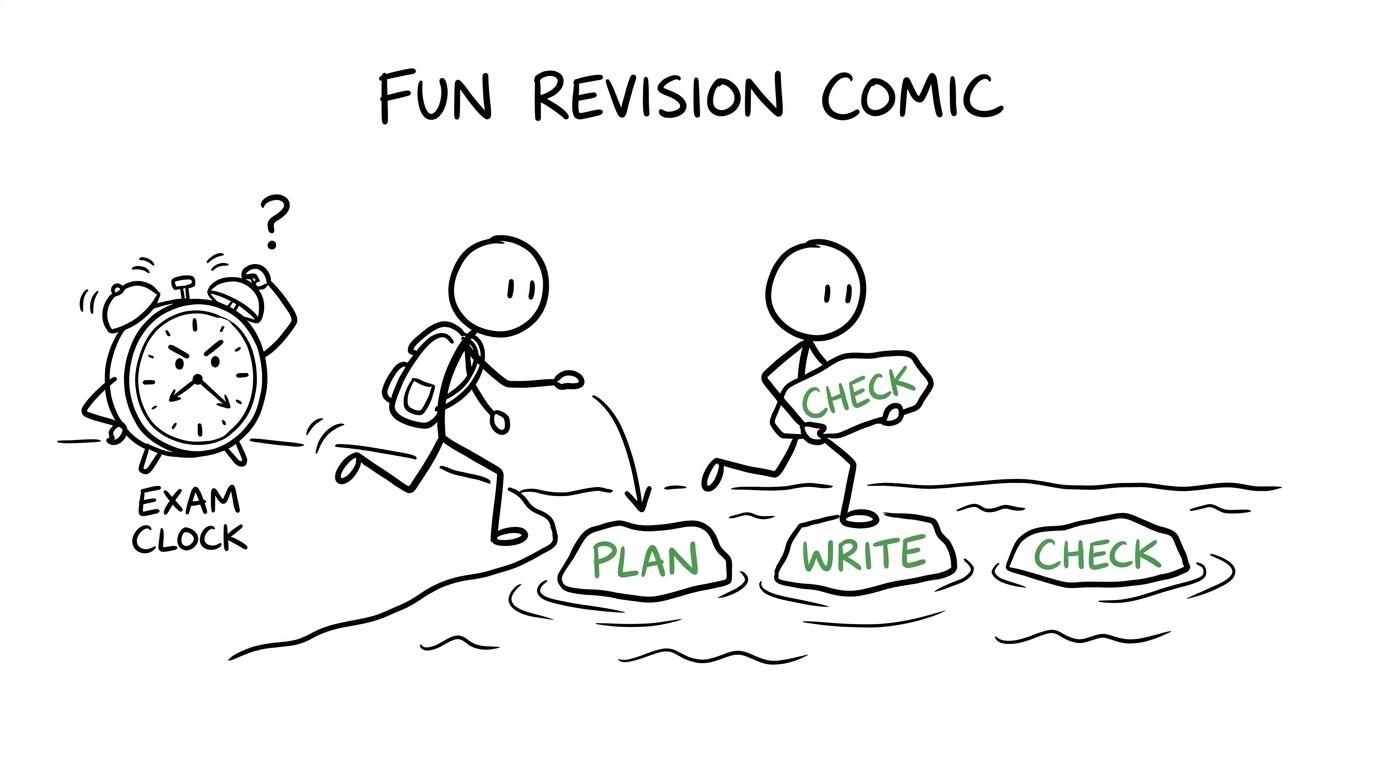 A calm student escapes a chasing exam clock by stepping across plan, write and check
How to revise for the writing paper
Practise the real task shapes
Do not revise only by reading vocabulary lists. Regularly produce four-sentence messages, approximately 404040-word passages, structured 909090-word answers, extended 150150150-word answers and translations appropriate to your tier.
Use official Bengali papers supplied by your school or exam board for the exact format. Then apply a disciplined review routine. MathsGenie's GCSE past papers collection demonstrates how useful it is to keep papers and mark schemes together, even though that collection is for maths rather than Bengali.
Build a writing error log
Separate mistakes into categories:
- missed bullet point;
- unclear meaning;
- inaccurate verb or tense;
- spelling or script error;
- English word order transferred into Bengali;
- weak opinion or missing reason;
- omitted translation detail;
- poor time management.
Patterns matter more than isolated errors. The MathsGenie 202020-minute revision routine can be adapted: recall vocabulary, write a short response, check it and record one correction.
Rehearse without a dictionary
AQA does not permit dictionaries in GCSE Bengali Paper 4. Complete some practice under the same restriction. This teaches you to paraphrase when the perfect word does not arrive.
If you forget a sophisticated term, use simpler Bengali that you know is accurate. Clear communication earns more than a half-remembered expression used incorrectly.
Common mistakes in GCSE Bengali Paper 4
Missing a bullet point. Examiners assess the response to the set task, not the essay you hoped would appear. Tick each prompt only after you have addressed it.
Choosing too quickly. Read both options. Select the task for which you have the best coverage across every prompt.
Treating approximate word counts as the whole target. Length alone does not create quality. Relevant content, range and accuracy matter. Avoid answers that are drastically short, but do not add empty sentences merely to increase the count.
Translating word by word. This can distort Bengali word order and meaning. Translate clauses and messages, then check each detail against the source.
Writing an impressive opening and rushing the end. Protect time for every bullet point and for the translation.
Failing to check negatives and time references. A missing negative or incorrect tense can reverse the message.
Practising only favourite themes. A strong answer about family cannot rescue you if the chosen task concerns the environment or future employment.
Go into Paper 4 knowing the shape
The paper becomes less mysterious once its structure is familiar. Foundation builds from short communication to a 909090-word response. Higher concentrates its marks in sustained writing, especially the 323232-mark open-ended task. Both tiers reward coverage, understandable Bengali, controlled language and faithful translation.
Use official AQA Bengali material from your teacher for subject-specific practice. For the rest of your exam season, MathsGenie remains your free home for maths revision lessons, practice questions, mark schemes, video solutions, mini tests, past papers and predicted papers. Start with the GCSE exam-week checklist, then use MathsGenie's mini tests to keep your maths revision moving alongside Bengali.
Knowing the format will not write the answers for you. But it removes avoidable uncertainty; and that gives your preparation somewhere useful to begin.