

GCSE Bengali Listening Exam Prep That Works
GCSE Bengali listening exam prep made practical: train sound recognition, vocabulary recall, question reading and exam technique with a calm weekly plan.

The frustrating thing about a listening paper is that you can know the Bengali word when it is written down and still miss it when somebody says it. The recording moves on. Your memory hesitates. Suddenly, one unfamiliar phrase seems to swallow the whole answer.
Effective GCSE Bengali listening exam prep is not simply doing more full papers. You need to train the smaller skills hidden inside listening: recognising sounds, separating a sentence into words, retrieving vocabulary quickly, noticing opinions and time frames, and recovering when you miss something.
For AQA GCSE Bengali, listening is worth 25%25\%25% of the qualification. Foundation has 404040 marks and lasts 353535 minutes, including five minutes of reading time; Higher has 505050 marks and lasts 454545 minutes, also including reading time. The assessment uses recorded standard speech and tests general understanding, key details, opinions and messages. Always check the current specification and arrangements with your teacher before the examination.
Your Bengali listening preparation checklist
A useful plan should include:
- short listening sessions several times a week
- vocabulary retrieval without notes
- sound-to-word recognition practice
- prediction during the initial reading time
- separate practice for gist, detail and opinion
- careful review using transcripts where available
- an error log that records why each mark was lost
- occasional full papers under examination conditions
The important shift is from “How many recordings have I completed?” to “Which listening skill became stronger today?”
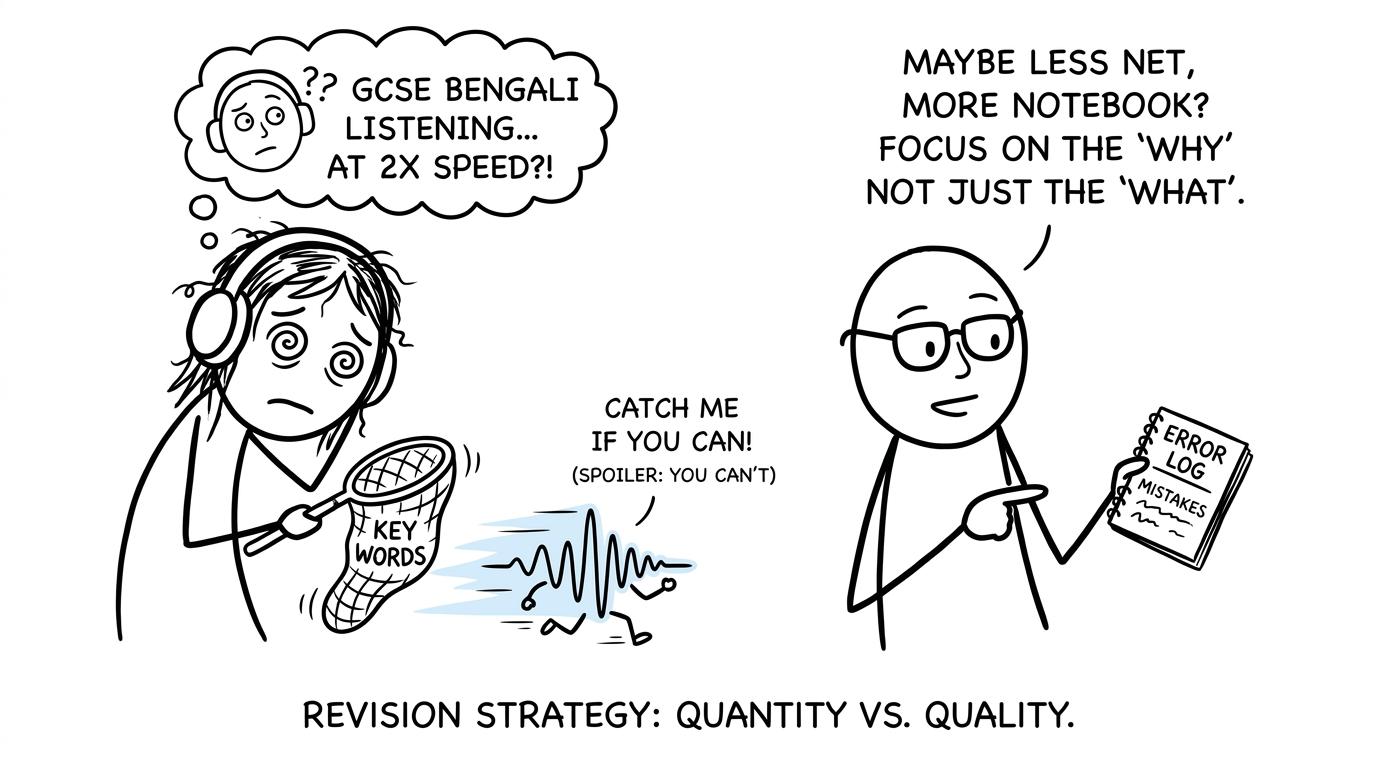 A student trying to catch fast-moving key words from a listening recording
Train recognition, not just vocabulary knowledge
Vocabulary lists are necessary, but silent recognition is not enough. In the examination, words arrive joined together, at natural speed and without a helpful pause after every item.
For each important topic word, practise three directions:
- Bengali audio to English meaning
- Bengali audio to written Bengali
- English meaning to spoken Bengali
The first direction is closest to the listening paper. The second develops accurate sound discrimination. The third strengthens your memory for pronunciation, which can make the word easier to recognise when someone else says it.
Organise vocabulary by likely contexts such as family, school, relationships, free time, technology, local area, holidays, work and social issues. Include verbs, adjectives, connectives and opinion phrases as well as nouns. A student who recognises “train”, “hotel” and “beach” may still misunderstand a holiday passage if they miss “wanted”, “although” or “disappointing”.
Use retrieval rather than repeated reading. Cover the meaning, play or say the word, and force yourself to recall it. Revisit missed items after a gap. Research reviewed by Ofsted on language learning supports planned revisiting and retrieval for building fluent, long-term vocabulary knowledge.
Break listening into smaller drills
A full paper mixes many difficulties together. That makes it realistic, but not always useful for diagnosis. Improvement often comes faster when you isolate one process at a time.
Practise segmentation
Segmentation means hearing where one word ends and the next begins. Choose a short Bengali clip and listen to only one sentence. Write down every word or sound group you can identify, then compare your attempt with a transcript where one is available.
Do not immediately replay the entire passage. Work with the troublesome sentence. Listen, pause, record what you heard, check and retry. At first, reading the transcript while listening can help you connect the sound stream to written words. Then remove the transcript and test whether the connection remains.
Separate gist from detail
On one listen, ask only: who is speaking, what is the situation, and is the overall message positive, negative or mixed?
On another listen, look for specific details such as a reason, destination, activity or problem. Trying to capture every word immediately can overload your attention. Listening for a defined purpose gives your brain a filter.
Train time and opinion signals
Examiners can test whether something happened previously, happens now or is planned for the future. Build small collections of phrases that signal past, present and future events. Do the same for positive views, negative views, preferences, comparisons and changes of mind.
Pay particular attention to contrast words. A speaker may begin with a positive statement and then qualify it. The final opinion may matter more than the first familiar adjective you hear.
Turn the reading time into a listening plan
The initial five minutes are not waiting time. They are your first chance to reduce uncertainty.
Read the questions and identify what each answer must contain. Are you listening for a person, reason, activity, place, advantage, problem or opinion? If answer options are provided, underline the difference between them rather than rereading what they have in common.
Predict possible vocabulary, but keep predictions flexible. If a question is about transport, you might expect vehicles, journey times, cost, delays or preferences. This preparation makes relevant sounds easier to notice. It should not make you force the recording to match your guess.
Also mark questions that contain more than one requirement. Missing the second part of an instruction is an avoidable loss of marks, regardless of how much Bengali you understand.
Use a three-pass practice method
When practising with a suitable recording, give each attempt a different purpose.
First pass: answer under realistic conditions
Complete the questions without pausing or consulting vocabulary. This shows what you can currently do when the recording controls the pace.
Second pass: diagnose the missed information
Return only to the questions you lost. Decide whether the cause was:
- unknown vocabulary
- a known word that you failed to recognise in speech
- weak segmentation
- a missed negative or contrast
- confusion about time
- misunderstanding the question
- remembering the right detail but writing the wrong response
This classification matters. Learning more vocabulary will not repair a question-reading problem.
Third pass: repair and retest
Use the transcript, dictionary or teacher guidance to understand the difficult section. Then put those supports away and listen again later. If you can answer only while looking at the transcript, the skill is not secure yet.
This is the same principle MathsGenie recommends in its guide to using GCSE past papers properly: attempt, mark, diagnose, repair and retest. The subject changes, but honest feedback remains the engine of revision.
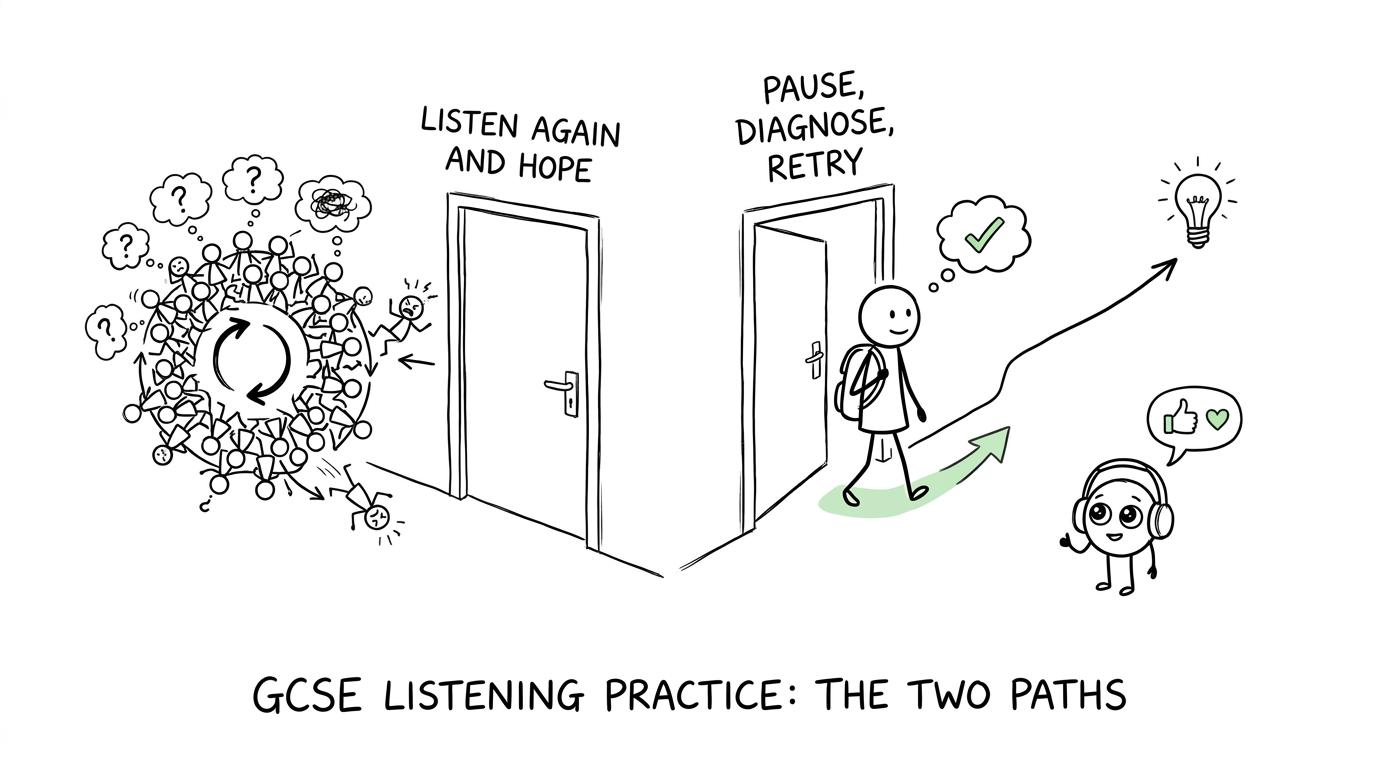 A student choosing deliberate diagnosis instead of replaying and hoping
Build a listening error log
An error log turns a disappointing score into instructions for the next session. For every lost mark, record:
- the topic and question
- the key word or phrase
- what you thought you heard
- what was actually said
- the type of error
- the action needed before your next attempt
Keep categories specific. “Bad at listening” cannot guide revision. “I recognise this verb in writing but not at normal speed” can.
After several sessions, look for patterns. If most errors concern opinions, schedule opinion-language drills. If you repeatedly miss familiar words in connected speech, prioritise transcription and segmentation. If the Bengali is understood but your answers are incomplete, practise reading instructions and giving precise responses.
A weekly routine that fits beside GCSE maths
Bengali preparation cannot consume every revision evening, particularly when you are also managing GCSE maths and other subjects. Short, repeated sessions are more sustainable than occasional marathons.
A balanced week could contain:
- two short vocabulary-and-sound retrieval sessions
- one segmentation or transcription session
- one question-reading and prediction drill
- one timed listening section followed by error analysis
- a later retest of the week's weakest phrases
Use the MathsGenie revision planner to protect space for both subjects. Planning removes the nightly decision about what to revise and makes spaced practice easier.
For maths, continue working through the free GCSE maths revision hub. A short GCSE mini test can keep retrieval active on a day when Bengali is your main focus. If you need a broader structure, the GCSE maths revision timetable guide explains how to combine focused topic work with timed assessment.
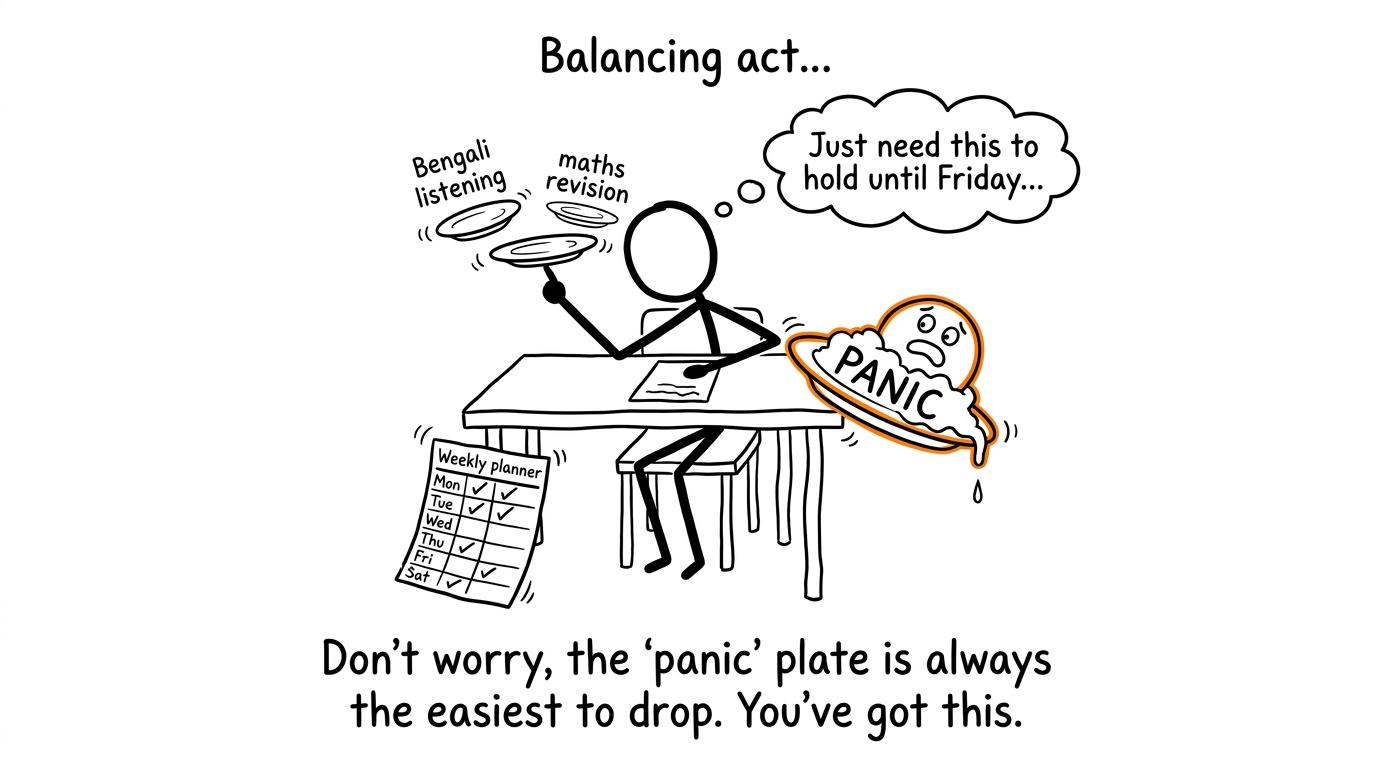 A student balancing Bengali listening and maths revision while pushing panic aside
Move from drills to full listening papers
Micro-practice builds individual skills. Full papers teach you to combine them while managing concentration and time. You need both.
Begin with individual sections if a complete paper currently produces more guessing than learning. Once you can diagnose your errors reliably, complete official papers for your specification under realistic conditions. Use the correct tier and obtain the matching audio, question paper and mark scheme through your school or awarding body's official materials.
Do not calculate progress from one score alone. Compare the pattern of mistakes. A similar mark can hide genuine improvement if you now understand longer passages but lose marks through answer precision. Equally, a higher mark on a familiar paper may reflect memory rather than stronger listening.
Apply the same discipline to maths. MathsGenie's Edexcel GCSE maths past papers include mark schemes and solutions for checking how marks are awarded. Nearer the exam, Edexcel predicted papers can provide fresh maths questions, but they should follow targeted revision rather than replace it.
Common mistakes in GCSE Bengali listening prep
Replaying without changing the task
Hearing the same passage repeatedly may make it familiar without improving the underlying skill. Give every replay a purpose: gist, detail, transcription, sound recognition or checking an inference.
Revising only topic nouns
Messages often depend on verbs, negatives, connectives, intensifiers and opinion language. Build vocabulary sets around complete meaning, not isolated objects.
Stopping after checking the transcript
Understanding an explanation feels satisfying, but it is not the same as independent recall. Close the transcript and retest after a delay.
Panicking after one missed phrase
A missed word does not necessarily destroy the question. Keep following the speaker and collect the information you can. Mentally replaying the missed section while the recording continues usually causes a second loss.
Using papers without an error log
A score tells you where you are. It does not tell you what to do next. Classify mistakes and convert each one into a specific revision action.
Neglecting exact examination requirements
Use resources for the correct qualification, board and tier. GCSE Bengali and International GCSE Bangla are distinct qualifications, so do not assume that their formats or timings are interchangeable.
Prepare for the sound, not just the subject
The listening paper feels fast because recognition has to happen in real time. The answer is not endless replaying. It is deliberate practice: retrieve vocabulary from sound, segment short sentences, predict the information required, identify why marks disappeared and retest the weakness later.
Make that routine part of a balanced GCSE plan. Use the free MathsGenie home page to organise your maths work around revision lessons, practice questions, mark schemes and video solutions. Add mini tests for quick retrieval, then use past papers and predicted papers to build examination stamina.
For Bengali, bring the same method: listen, diagnose, repair, retest. Calm preparation is rarely dramatic. It is simply a collection of small weaknesses that no longer surprise you on exam day.










