

GCSE Bengali Grade Boundaries Explained
GCSE Bengali grade boundaries explained: learn why marks are scaled, why thresholds change each year, and how to use past boundaries wisely in revision.
A mark can feel wonderfully solid. You count the ticks, total the score and convert it into a percentage. Surely the grade should follow automatically.
Yet GCSE grading is not built around permanent percentage rules. In this guide to GCSE Bengali grade boundaries explained, the essential answer is simple: AQA sets new boundaries after each exam series, using evidence about paper difficulty, student performance and the standard of work. Your final grade depends on your total scaled mark and that series's boundary, not on a universal percentage such as 70%70\%70% always meaning a grade 777.
That distinction matters in Bengali, where marks from listening, speaking, reading and writing are combined after particular components have been scaled.
GCSE Bengali grade boundaries at a glance
Keep these points in mind before looking at any boundary table:
- A grade boundary is the minimum total mark needed for a grade.
- AQA GCSE Bengali uses Foundation and Higher tiers.
- Foundation covers grades 111 to 555; Higher covers grades 444 to 999, with a permitted grade 333 for students who narrowly miss grade 444.
- All four skills must be entered at the same tier.
- Listening, speaking, reading and writing each contribute approximately 25%25\%25%.
- Some component marks are scaled before the overall total is calculated.
- The maximum scaled subject mark is 240240240.
- Boundaries are set after the assessments have been marked, so future figures cannot be known with certainty.
- Past boundaries are useful reference points, not promises.
You can inspect the published figures on MathsGenie's AQA GCSE Bengali grade boundaries page.
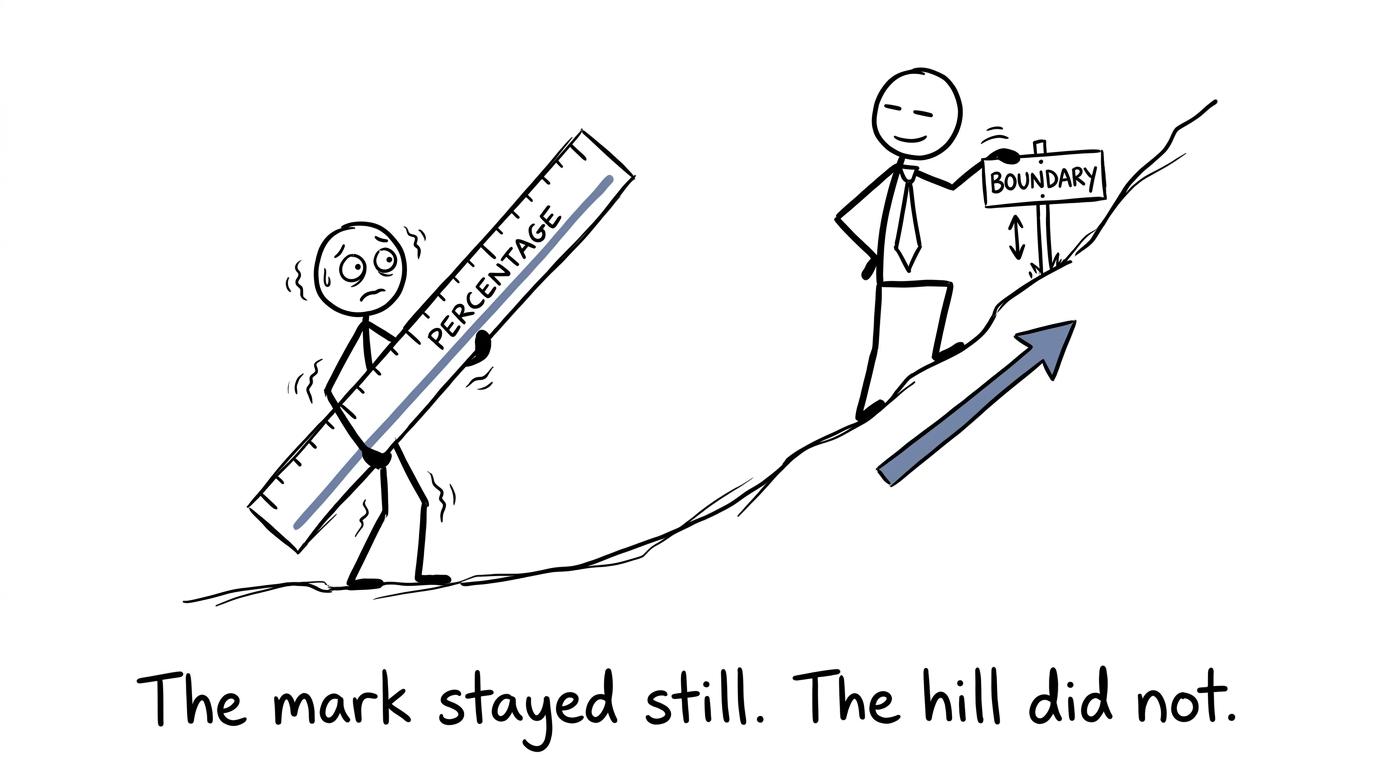 A student watches a grade boundary move while the mark stays still
Why your Bengali mark is not just a percentage
A percentage tells you what proportion of the available marks you achieved:
Percentage=mark achievedmaximum mark×100\text{Percentage}=\frac{\text{mark achieved}}{\text{maximum mark}}\times 100Percentage=maximum markmark achieved×100That calculation is valid, but it does not create your grade. There is no permanent rule saying that a particular percentage must always produce a particular GCSE Bengali grade.
For example, AQA's published June 202520252025 Higher tier boundaries placed grade 999 at 202202202 out of 240240240, grade 777 at 152152152, grade 555 at 102102102 and grade 444 at 787878. These correspond to different percentages, including approximately 84.2%84.2\%84.2% for grade 999 and 32.5%32.5\%32.5% for grade 444.
Those figures describe the June 202520252025 series only. They are not fixed targets for every future paper.
This is why saying, “I need 70%70\%70% for a grade 777,” can be misleading. The grade 777 threshold was 154154154 in 202420242024 and 152152152 in 202520252025, both out of 240240240. The required standard remained the focus, while the numerical boundary moved to reflect the evidence from each series.
How the four Bengali components become one mark
AQA GCSE Bengali assesses four skills:
| Component | Foundation raw maximum | Higher raw maximum | Scaled maximum |
|---|---|---|---|
| Listening | 404040 | 505050 | 606060 |
| Speaking | 606060 | 606060 | 606060 |
| Reading | 606060 | 606060 | 606060 |
| Writing | 505050 | 606060 | 606060 |
Each component therefore contributes one quarter of the qualification. Where the raw maximum is not 606060, AQA applies a scaling factor.
For Foundation listening, the factor is:
6040=32\frac{60}{40}=\frac{3}{2}4060=23For Foundation writing, it is:
6050=65\frac{60}{50}=\frac{6}{5}5060=56For Higher listening, it is:
6050=65\frac{60}{50}=\frac{6}{5}5060=56Speaking and reading already have maximum marks of 606060, so their scaling factor is 111.
The four scaled component marks are then added:
60+60+60+60=24060+60+60+60=24060+60+60+60=240This explains an important piece of boundary language. The subject boundary is applied to the combined scaled total out of 240240240. You should not compare an unscaled component total directly with the overall boundary.
AQA may also publish notional component boundaries. These can help describe performance on an individual paper, but the qualification grade comes from the overall subject total. A weaker listening result can be balanced by stronger performance elsewhere because it is the combined scaled mark that ultimately matters.
How GCSE Bengali grade boundaries are set
Boundaries are not chosen casually, nor are they decided by taking an arbitrary percentage of the available marks. Ofqual's published guidance explains that exam boards use statistical evidence alongside expert judgement.
The assessments are completed and marked
The board first needs evidence from the actual exam series. Even carefully designed papers can prove slightly harder or easier than anticipated once thousands of students attempt them.
That is why confirmed boundaries cannot be published meaningfully before the assessments have been taken and marking is sufficiently complete.
Statistical evidence identifies possible boundaries
The board studies the distribution of marks, the performance of questions and evidence about the cohort. Prior-attainment information can contribute to predictions about the cohort as a whole.
This does not mean that an individual student's previous results determine their Bengali grade. Every candidate taking the same specification and tier is judged against the same final boundaries.
Senior examiners review student work
Senior examiners inspect scripts around possible key boundaries. They compare the quality of current work with the expected grade standard and relevant work from previous series.
A boundary must make sense both statistically and educationally. The data suggests where to look; expert review examines whether the work at that mark genuinely reflects the intended standard.
Final boundaries maintain standards over time
If a paper proves more demanding, a lower boundary may be appropriate. If it proves more accessible, the boundary may rise. The aim is that a grade represents a comparable standard from one year to another.
This does not mean exactly the same proportion of students must receive every grade each year. The process accounts for evidence about the current cohort as well as assessment difficulty.
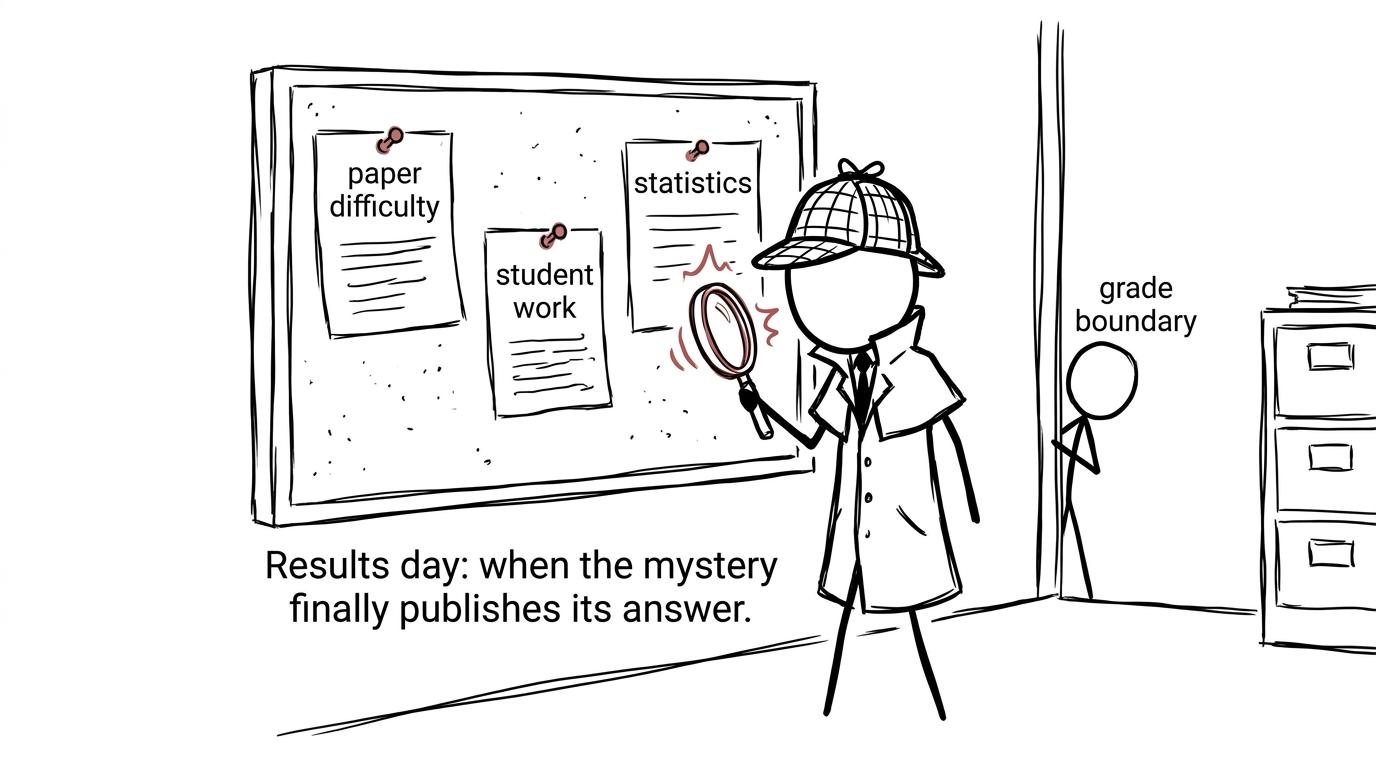 A student detective investigates the evidence used to set grade boundaries
What recent boundaries actually show
The latest complete summer series published at the time of writing is June 202520252025. The selected AQA Bengali boundaries below show the minimum scaled subject marks required.
| Tier and grade | June 202420242024 | June 202520252025 | Maximum mark |
|---|---|---|---|
| Foundation grade 555 | 131131131 | 129129129 | 240240240 |
| Foundation grade 444 | 106106106 | 104104104 | 240240240 |
| Higher grade 999 | 206206206 | 202202202 | 240240240 |
| Higher grade 777 | 154154154 | 152152152 | 240240240 |
| Higher grade 555 | 102102102 | 102102102 | 240240240 |
| Higher grade 444 | 767676 | 787878 | 240240240 |
The movement is real but not uniform. Some thresholds fell, one stayed unchanged and the Higher grade 444 boundary rose. That is a useful reminder that boundaries do not all move together according to a simple formula.
The complete figures are available through the AQA Bengali boundary history, while MathsGenie's broader AQA GCSE grade boundaries for 2025 help you compare subjects without assuming that their percentages should match.
How to use boundaries without revising badly
A boundary is best treated as context, not as the centre of your revision plan.
Build a margin above your target
If a historical grade boundary was 152152152, aiming to scrape exactly 152152152 in every practice paper leaves no room for unfamiliar wording, a difficult listening extract or an avoidable writing mistake. Use several years of figures to understand the range, then work towards a secure margin above it.
Do not invent your own predicted boundary from online reactions after an exam. Students remember different questions, sit different tiers and often estimate their marks inaccurately.
Track the four skills separately
Because each skill contributes approximately 25%25\%25%, a total score can hide where improvement is needed. Record your scaled or percentage performance in listening, speaking, reading and writing separately.
Then ask a more useful question than “What grade is this?” Ask: “Which skill is costing me marks repeatedly?”
This is the same diagnostic habit that strengthens maths revision. On MathsGenie, a student can use AQA GCSE Maths past papers, mark them carefully and trace each lost mark back to a topic. The subject changes; the feedback loop does not.
Turn marks into actions
After each assessed task:
- mark it using the official mark scheme;
- identify the exact skill behind each lost mark;
- revisit the relevant content;
- complete focused practice;
- retest under timed conditions.
For maths students balancing several GCSEs, the GCSE Maths revision hub keeps revision lessons, questions and exam resources together. Short GCSE mini tests are useful when a full paper would be too much, while Edexcel GCSE Maths predicted papers provide unseen practice for students taking that board.
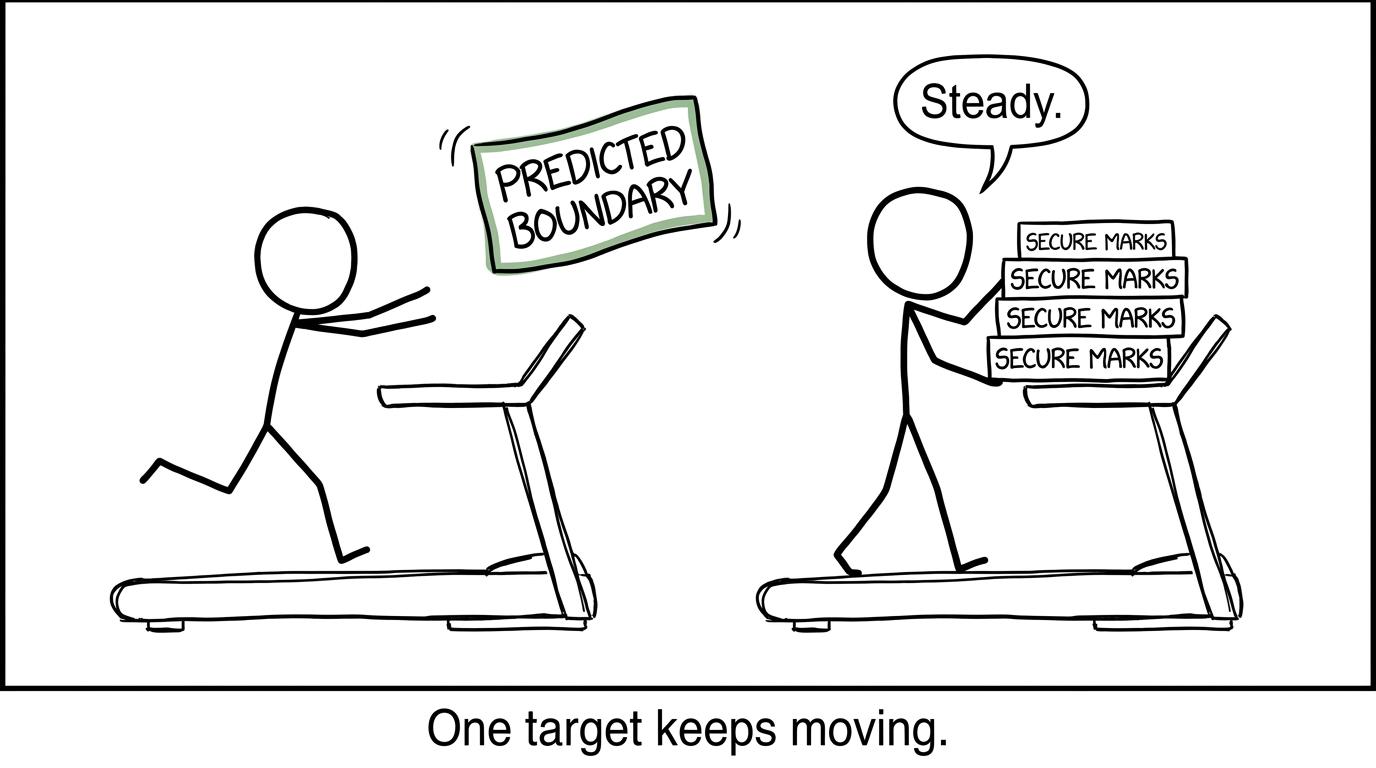 One student chases a predicted boundary while another builds secure marks
Common mistakes with GCSE Bengali boundaries
Treating a percentage as a permanent grade
A percentage is a convenient description of a score. It is not a universal grading law. Always match a mark to the correct exam series, specification and tier.
Adding raw marks without checking scaling
Foundation listening and writing are scaled, as is Higher listening. Use the combined scaled total when comparing performance with the overall boundary out of 240240240.
Using a component boundary as the final grade
Notional component boundaries are illustrative. Your qualification grade is based on the overall total across all four skills.
Comparing Foundation and Higher marks directly
The papers target different grade ranges and levels of demand. A mark on Foundation does not automatically represent the same performance as the identical numerical mark on Higher.
Assuming last year's boundary will return
Historical figures offer perspective, not certainty. Confirmed boundaries depend on evidence from the new series and are set after marking.
Revising only until you reach the old threshold
Aiming for the lowest possible successful mark creates a fragile plan. Build fluency and accuracy instead. MathsGenie's guide to using GCSE past papers properly explains how to mark, diagnose, repair and retest rather than simply collecting scores.
Make the mark the part you can control
Grade boundaries attract attention because they appear to contain the answer. Before results day, however, they are the part you cannot control. Your preparation is the part you can.
Understand the system: four equally weighted Bengali skills, scaling where required, one overall mark out of 240240240, and boundaries set separately for each series. Then stop chasing a guessed threshold. Practise the skills that produce secure marks.
The same principle belongs at the centre of GCSE maths revision. Start with MathsGenie's free revision lessons, complete targeted practice questions, and use mini tests to check whether weak methods have improved. Then move to past papers and predicted papers under timed conditions, using mark schemes and video solutions to learn from every lost mark.
Boundaries move. Well-built knowledge travels with you.











