GCSE Bengali Foundation vs Higher: Key Differences
GCSE Bengali foundation vs higher explained: compare grades, papers, timings, task demands and risks so you can discuss the right AQA tier with your teacher.
The word Higher can sound like a judgement. It is not. It describes the range of grades and level of demand in an exam paper, not the intelligence or potential of the student sitting it.
For GCSE Bengali foundation vs higher, the immediate answer is this: AQA Foundation tier offers grades 111 to 555, while Higher tier offers grades 444 to 999, with a narrow allowed grade 333 for students who only just miss grade 444. But the difference goes beyond the grade range. Timings, writing tasks, text complexity, speaking length and the risk attached to a difficult exam day all change.
This guide concerns AQA GCSE Bengali (8638). Pearson Edexcel International GCSE Bangla is a separate qualification with a different assessment structure, so check the exact specification shown on your exam entry.
The differences at a glance
| Feature | Foundation tier | Higher tier |
|---|---|---|
| Main grade range | Grades 111 to 555 | Grades 444 to 999 |
| Lowest possible outcome | Grade 111, then U | Narrow allowed grade 333, then U |
| Highest possible grade | Grade 555 | Grade 999 |
| Papers | Listening, speaking, reading and writing | Listening, speaking, reading and writing |
| Tier entry | All four assessments at Foundation | All four assessments at Higher |
| Overall weighting | Each skill contributes 25%25\%25% | Each skill contributes 25%25\%25% |
| General demand | Shorter, more accessible language and tasks | Longer, less familiar and more complex language |
| Best suited to | Students securely working towards grades 111 to 555 | Students consistently demonstrating grade 666 or above potential |
The practical checklist is simple:
- confirm that you are taking AQA GCSE Bengali rather than International GCSE Bangla;
- compare your performance across all four skills, not just speaking;
- complete timed papers from both tiers where possible;
- use mark schemes to identify whether errors come from knowledge, interpretation or timing;
- discuss the evidence with your teacher before making a tier decision.
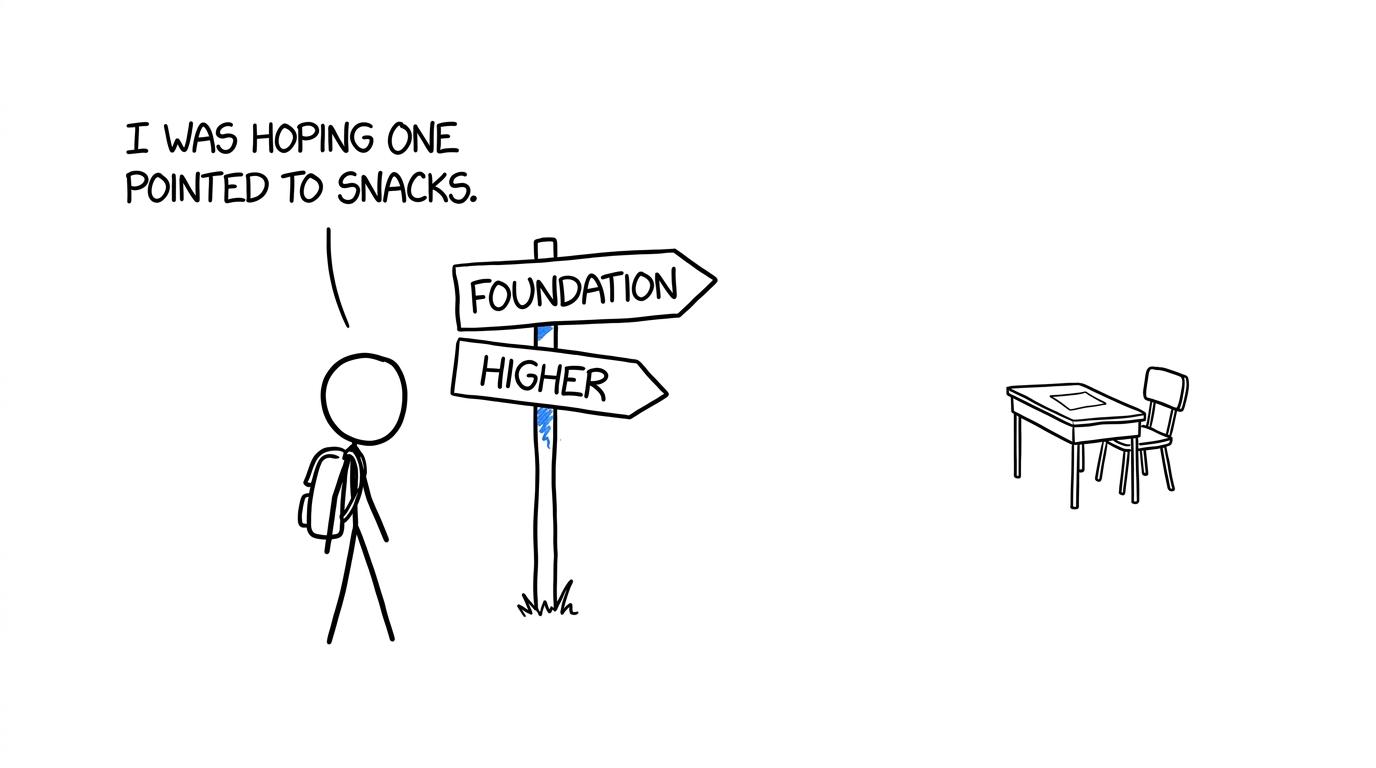 A student choosing between Foundation and Higher signposts
The grade range changes the purpose of the paper
Foundation is designed to assess achievement across grades 111 to 555. Higher is designed for grades 444 to 999. That distinction shapes almost every question.
A Foundation paper has to give students working at the lower grades enough accessible opportunities to demonstrate what they understand. Higher must separate performances stretching from grade 444 to grade 999, so it needs more demanding vocabulary, grammar, inference and sustained communication.
A grade 555 earned on Foundation has the same value as a grade 555 earned on Higher. The certificate does not identify the tier. Foundation is therefore not a lesser qualification; it is a different assessment route to an overlapping grade.
The important limitation is the cap. However strong your Foundation performance is, the highest available result is grade 555. Higher removes that ceiling, but creates a lower-floor risk. Below the narrow grade 333 safety net, the result is U rather than grades 222 or 111.
You can examine recent outcomes on the AQA GCSE Bengali grade boundaries page. Boundaries are set after each exam series, so previous figures are evidence, not promises about a future paper.
All four skills must be taken at the same tier
Students cannot take Foundation listening and Higher writing, or choose a different tier for their strongest skill. AQA requires all four assessments to be entered at the same tier and taken in the same series.
That matters for bilingual students whose skills are uneven. Someone may speak Bengali naturally at home but find formal reading or accurate written Bengali much harder. Speaking confidence alone is not sufficient evidence for Higher tier.
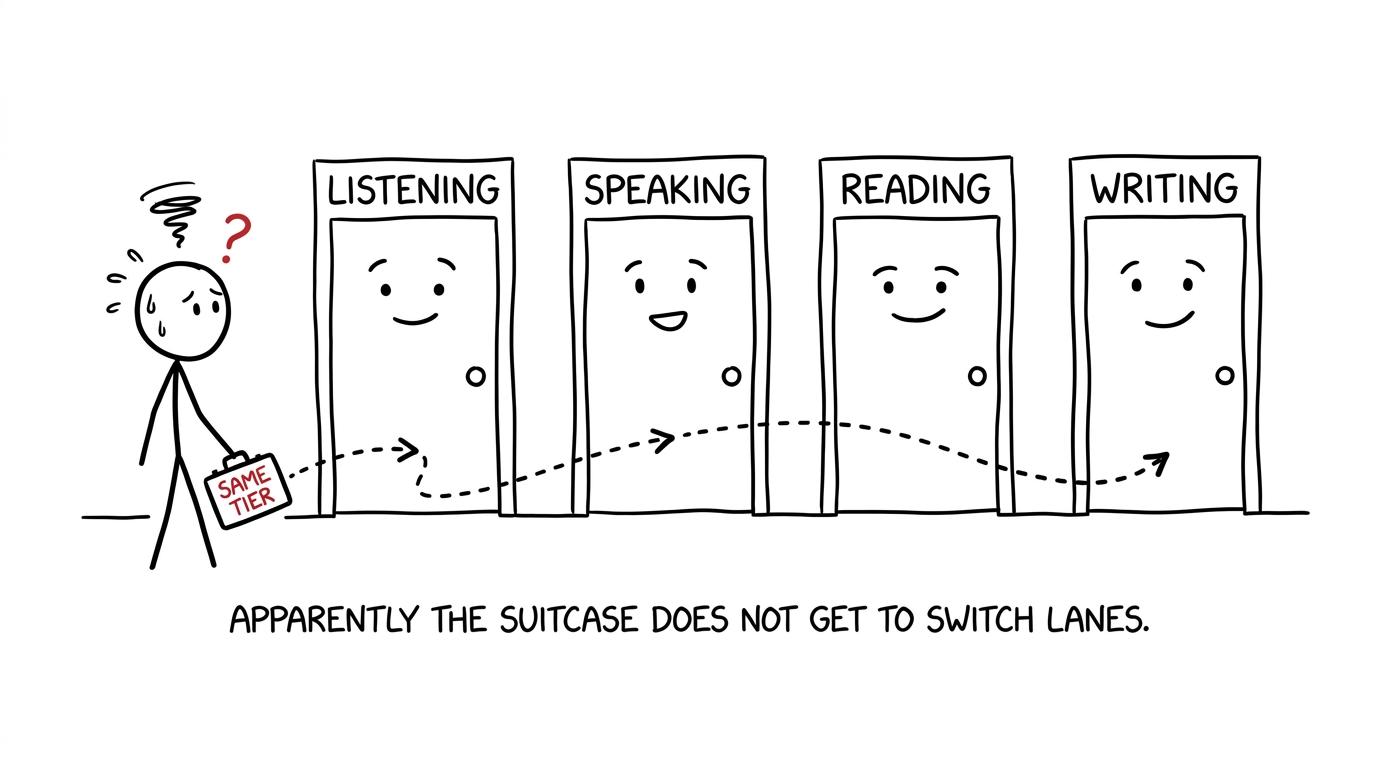 Four GCSE language exam doors and one same-tier suitcase
Listening becomes longer and less forgiving
Foundation listening lasts 353535 minutes, including 555 minutes of reading time, and carries 404040 raw marks. Higher lasts 454545 minutes, including the same reading time, and carries 505050 raw marks.
Both papers include questions presented in English and questions presented in Bengali. On Higher, students should expect greater complexity and a stronger need to identify opinions, details and implied meaning rather than simply matching familiar words.
Listening success is not just vocabulary recall. You must keep track when a speaker changes direction, gives a reason or contrasts two ideas. Practising with the audio under timed conditions is therefore more useful than reading a transcript first.
Speaking requires more sustained interaction
Both tiers assess a role-play, a photo card and a general conversation. Foundation speaking lasts approximately 777 to 999 minutes, while Higher lasts approximately 101010 to 121212 minutes, in addition to supervised preparation time.
The role-play lasts approximately 222 minutes at either tier. The photo-card discussion rises from about 222 minutes at Foundation to 333 minutes at Higher. The largest difference is the general conversation: approximately 333 to 555 minutes at Foundation and 555 to 777 minutes at Higher.
Higher candidates therefore need to sustain answers, respond spontaneously and use a broader range of language for longer. A memorised paragraph may sound impressive until the examiner asks an unexpected follow-up question. Flexible language is more valuable than a script.
Reading uses longer and more demanding material
Foundation reading lasts 454545 minutes; Higher reading lasts 111 hour. Both are marked out of 606060 and include responses in English, responses in Bengali and translation from Bengali into English.
At Higher tier, texts can demand more careful interpretation of viewpoint, context and unfamiliar language. The translation passage is also longer: the specification sets a minimum of 353535 words at Foundation and 505050 words at Higher.
The extra time does not make Higher relaxed. It exists because the material requires more processing. Students need to distinguish what a text actually says from what seems plausible from one familiar word.
Writing changes most visibly
Foundation writing lasts 111 hour and is marked out of 505050. Its tasks include four sentences about a photograph, an approximately 404040-word response, translation into Bengali and an approximately 909090-word extended response.
Higher lasts 111 hour 151515 minutes and is marked out of 606060. It removes the brief photo task and asks for approximately 909090 words, approximately 150150150 words and a longer translation into Bengali.
So Higher writing is not merely Foundation with more difficult vocabulary. It asks students to organise longer responses, address every required point and maintain grammatical control across a wider range of structures. The longer task rewards development, but extra length without relevance or accuracy does not automatically earn extra marks.
Why the raw marks look different
Each of the four skills contributes approximately 25%25\%25% of the final qualification, even though the raw totals differ between papers and tiers. AQA scales some component marks before calculating the overall result, producing a final total out of 240240240.
That is why comparing a Foundation listening raw mark directly with a Higher listening raw mark can mislead. Compare like with like: the same tier, component and exam series.
In June 202520252025, for example, the overall Foundation boundaries included 129129129 for grade 555 and 104104104 for grade 444, both out of 240240240. On Higher, the boundaries included 102102102 for grade 555, 787878 for grade 444 and 666666 for the allowed grade 333. These figures do not show that Higher was easier. The papers targeted different ranges of demand, and the overlapping grades were awarded to comparable standards.
Use the wider AQA GCSE grade boundaries hub to check the correct subject and series rather than relying on a boundary remembered from another exam.
How to decide which tier is appropriate
A good decision is based on repeated evidence, not ambition alone or one unusually successful mock.
Foundation may be the more sensible route when a student is working securely around grades 444 or 555, finds Higher reading and listening consistently inaccessible, or needs the full range of grades below 444 to remain available. Higher becomes appropriate when performance across listening, speaking, reading and writing consistently supports grade 666 or above and the student can cope with unfamiliar material under timed conditions.
Ask these questions:
- Can you complete Higher papers without leaving large sections blank?
- Can you sustain the longer writing and speaking tasks accurately?
- Are your reading and listening marks stable, rather than dependent on familiar topics?
- Does your recent evidence place you safely above the Higher grade 444 region?
- Would a maximum grade 555 prevent you from reaching a realistic target?
The final entry is normally handled by your school, so raise concerns early with your Bengali teacher or exams officer.
What Bengali tiering can teach you about maths revision
Many students reading this will face the same Foundation-versus-Higher decision in GCSE Maths. The grade ranges are broadly familiar, but paper formats and boundaries belong to each specific subject and exam board. Never transfer a Bengali mark target to maths.
Start with the correct board. MathsGenie provides dedicated AQA GCSE Maths grade boundaries, while its comparisons explain why raw figures differ between AQA and OCR GCSE Maths, AQA and Eduqas GCSE Maths, and AQA and WJEC GCSE Maths.
The principle is transferable: choose a tier using performance on the actual specification, not assumptions about which paper sounds more impressive. Students following a different regional qualification should be especially careful; the AQA and CCEA GCSE Maths comparison shows why qualification structures must be checked before marks are compared.
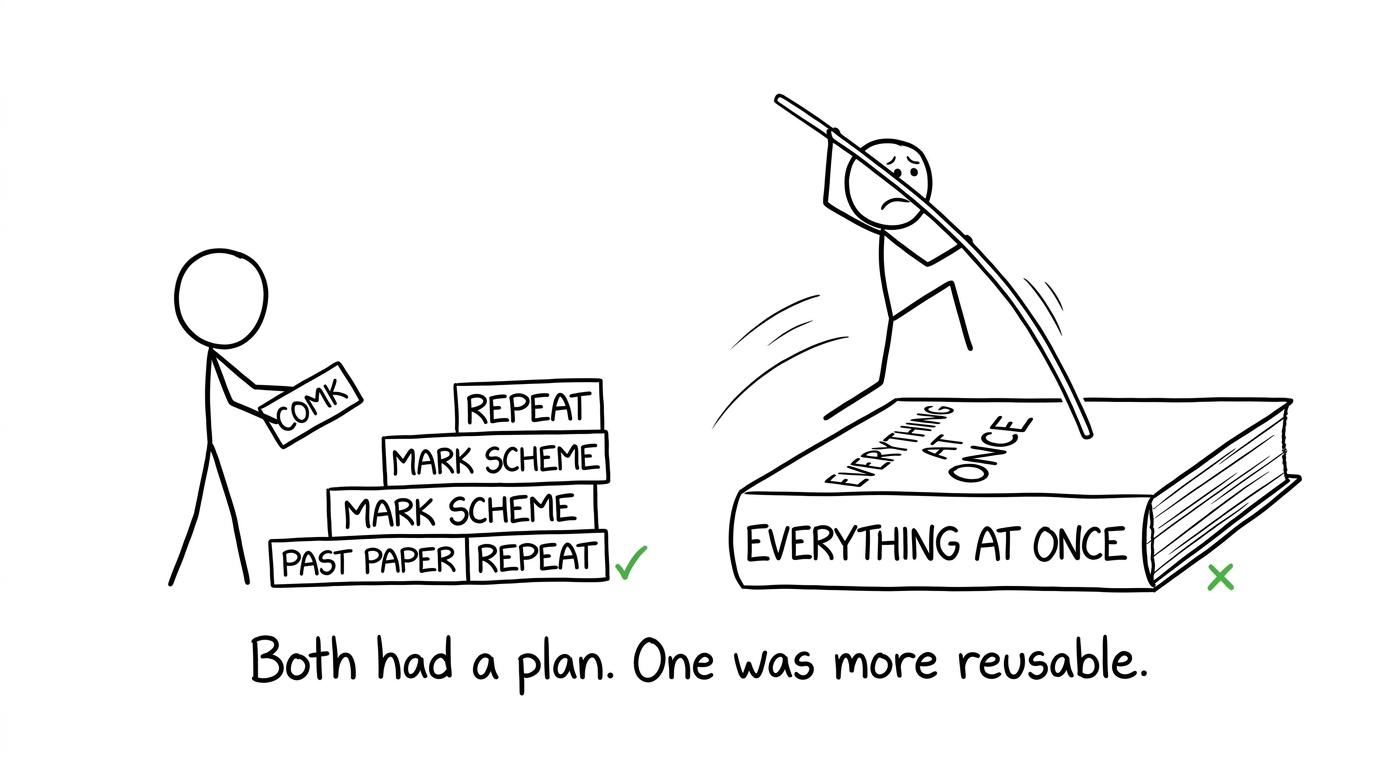 Two contrasting revision plans involving steps and a pole vault
Common mistakes when comparing the tiers
Assuming Foundation questions are simply easier versions
The tier affects task length, language range, inference and the grades the paper must distinguish. The assessment experience changes, not just the final few questions.
Choosing Higher because speaking feels natural
Conversational fluency can hide gaps in formal reading, spelling, translation and grammatical accuracy. Review all four components before deciding.
Treating the allowed grade 333 as a normal Higher outcome
It is a narrow safety net for students who just miss grade 444. A lower mark results in U, so Higher carries genuine risk for a student whose performance is unstable around that boundary.
Comparing raw marks from different tiers
Different paper totals, scaling and levels of demand make casual comparisons unreliable. Use overall boundaries for the correct tier and series.
Revising only vocabulary lists
Vocabulary matters, but the exams also test spontaneous speaking, accurate writing, translation, listening interpretation and responses to unfamiliar texts. Revision must include timed application.
Choose evidence over labels
The real difference between GCSE Bengali Foundation and Higher is not that one route belongs to strong students and the other to weak students. Foundation protects access to grades 111 to 555 and uses shorter, more accessible tasks. Higher opens grades 666 to 999, while demanding longer responses, broader language and greater confidence with unfamiliar material.
Use official-style papers, mark schemes and several pieces of timed evidence before discussing your entry with your teacher. Then bring the same calm approach to GCSE Maths. MathsGenie gives you free revision lessons, practice questions, mini tests, past papers, predicted papers, video solutions and a revision planner so that your tier decision rests on progress you can see. Start with the topic that costs you the most marks, practise it, mark it honestly and repeat.