

GCSE Bengali February Half-Term Revision Plan
GCSE Bengali February half term revision made manageable: a focused seven-day plan that improves four language skills while protecting maths time.
February half-term can create a strange kind of pressure. There is enough free time to imagine transforming every subject, but not enough to revise everything at once. Bengali needs attention. Maths mocks or final exams are getting closer. Other subjects are waiting too.
The best GCSE Bengali February half term revision plan is therefore not an all-day language marathon. It is a focused week built around short daily contact with Bengali, two deeper exam-practice sessions and protected time for maths. By the end of the break, you should know your weakest language skill, have practised all four assessment areas and have a routine you can continue when school restarts.
This plan is written around AQA GCSE Bengali, the current GCSE qualification available in the UK. If you are taking an International GCSE in Bangla, check your own specification because the assessment structure may be different.
Your half-term revision checklist
Keep the week simple enough to finish:
- Confirm your exam board, tier and assessment requirements.
- Complete one short diagnostic task in Bengali.
- Choose two priority language skills rather than treating every weakness equally.
- Practise listening, speaking, reading and writing across the week.
- Use active tasks instead of repeatedly reading notes.
- Mark written work and record specific corrections.
- Protect at least three separate maths sessions.
- Finish with a plan for the first week back at school.
The point is not to complete Bengali revision in seven days. No subject is ever neatly completed. The point is to leave half-term with fewer unknowns and a repeatable system.
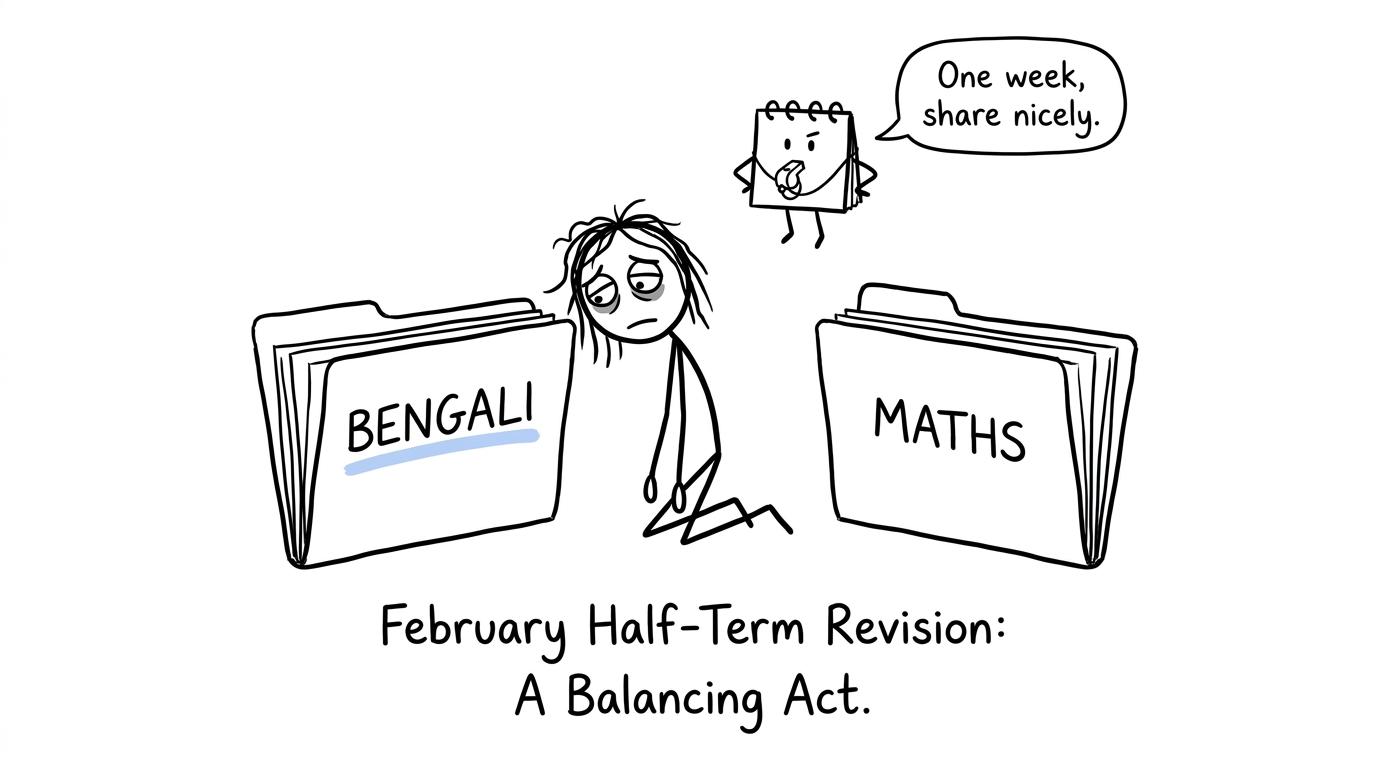 A calendar referees Bengali and maths revision during half-term
Start with the GCSE Bengali assessment
A revision plan becomes useful when it reflects the qualification you will actually sit. AQA GCSE Bengali assesses four skills: listening, speaking, reading and writing. Each contributes approximately 25%25\%25% of the overall qualification.
Students take either Foundation tier, covering grades 111 to 555, or Higher tier, covering grades 444 to 999. All four assessments must be taken at the same tier and in the same exam series. Ask your teacher if you are uncertain about your entry.
The same three broad themes appear across the papers:
- identity and culture;
- local, national, international and global areas of interest;
- current and future study and employment.
That matters because learning isolated vocabulary lists is not enough. You need to recognise and use language in contexts such as family, technology, free time, community, travel, the environment, school and future ambitions.
Before planning the week, attempt one manageable task from material supplied by your school or exam board. It could be a listening section, a reading passage, a speaking prompt or a writing question. Then classify each problem:
- vocabulary was missing;
- the language was known but not recognised quickly;
- grammar or spelling was inaccurate;
- the question was misunderstood;
- the response lacked detail;
- time pressure caused the mistake.
This is the same evidence-first approach used to find weak GCSE maths topics. A score tells you how the task went. A diagnosis tells you what to do next.
A focused seven-day Bengali plan
A realistic daily structure is 454545 to 606060 minutes of Bengali, divided into one main task and a brief retrieval activity. That leaves room for maths, other subjects and an actual break.
Day one: diagnose and organise
Confirm your tier and collect the specification, school materials, vocabulary lists and available assessment tasks. Complete one short task without revising first. Mark it where reliable answers or teacher guidance are available, then identify two priority areas.
Create a correction log with four headings: skill, mistake, reason and next action. Keep entries specific. “Writing is bad” cannot guide tomorrow's work. “I did not cover every bullet point” can.
Day two: listening and sound recognition
Choose a short listening task. Read its questions before playing the recording, note the information required and listen without pausing on the first attempt. On a second attempt, focus on missed details, negatives, opinions, time phrases and changes of tense.
Afterwards, write down a small set of useful words or phrases you failed to recognise. Say them aloud as well as reading them. Listening improves when written vocabulary becomes familiar sound.
Day three: speaking without a script
Practise a role-play, photo card or general-conversation theme that matches your specification. Use brief prompts rather than writing a full script. Record yourself, listen back and check whether your answers are audible, relevant and developed.
A strong response usually does more than state a fact. Add an opinion, reason, contrast, past experience or future intention where the task allows it. Also practise responding to an unexpected follow-up question. Speaking is interaction, not recitation.
Day four: reading for evidence
Work through a reading passage under a gentle time limit. Underline words that identify who, when, where, opinion and outcome. Distinguish what the text actually says from what seems likely from general knowledge.
When translating into English, preserve the meaning rather than forcing Bengali word order into unnatural English. Review unfamiliar vocabulary after completing the task, not every few seconds while reading. Otherwise, dictionary use can replace comprehension practice.
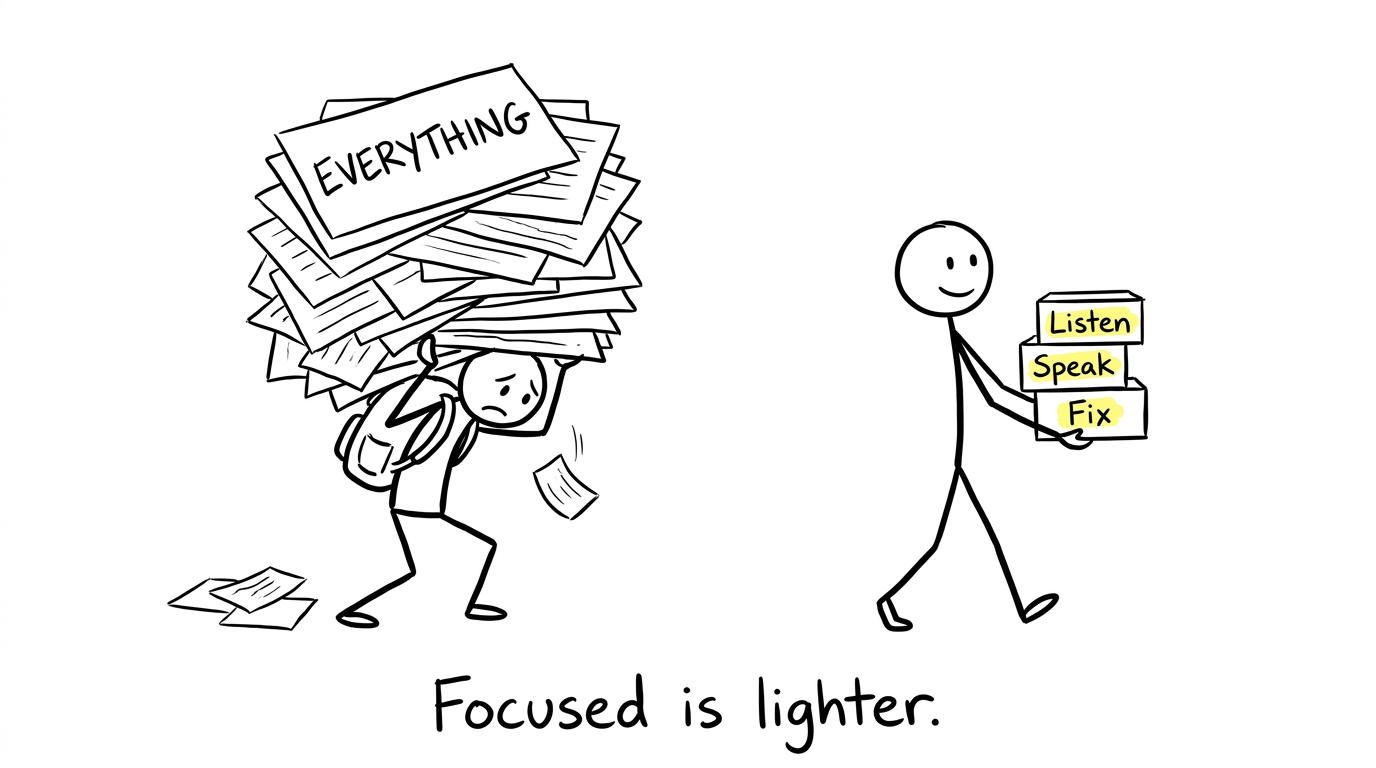 One student carries everything while another chooses three focused revision tasks
Day five: writing with a purpose
Choose one writing task appropriate to your tier. Before writing, turn every bullet point into a tiny checklist. Plan which time frames, opinions and reasons you can use accurately. Then write under timed conditions and leave several minutes for checking.
Review spelling, verb forms, agreements where relevant, repeated vocabulary and whether every part of the question has been answered. Accuracy matters, but ambitious language only helps when you can control it. A shorter accurate structure is usually more valuable than a memorised phrase used in the wrong context.
Day six: mixed practice and repair
Return to the two weaknesses identified on day one. Use fresh tasks rather than copying corrected answers. This is your chance to test whether the correction has transferred.
Finish with a short mixed session containing two or three skills. Switching between listening, reading and producing language is useful preparation because examinations require different kinds of attention, even though the components are assessed separately.
Day seven: review and continue
Do not end half-term with another large task merely to feel busy. Review the correction log, retrieve this week's vocabulary without notes and repeat a speaking response or short writing plan.
Choose three actions for the first school week, such as:
- revisit vocabulary after two days;
- complete one timed reading section;
- record one speaking answer;
- ask a teacher to check a recurring grammar issue.
Half-term succeeds when it changes what happens afterwards.
Keep maths revision protected
If Bengali expands to fill every free hour, the plan has failed its wider purpose. Students preparing for GCSE maths should reserve specific sessions before the week begins rather than hoping spare time appears.
A balanced model could include three maths blocks of 454545 to 606060 minutes. Use one to diagnose, one to repair a weak topic and one for timed mixed practice. The GCSE maths revision hub brings together free revision lessons, exam questions, worksheets and board-specific papers.
Choose work that matches your exam board and tier. Edexcel, AQA, OCR and Eduqas assess the national GCSE maths content, but paper styles and arrangements differ. If you need a sustainable weekly structure, use the GCSE maths revision timetable guide rather than improvising every morning.
Half-term is also a good point to begin limited paper practice. You do not need to spend the whole week completing full papers. A section, mini test or targeted set can provide enough evidence. The guide to when to start GCSE past papers explains how to build from short diagnostics towards full timed attempts.
For Edexcel students, GCSE maths past papers and mark schemes can reveal which topics deserve the next revision block. Once a weakness is visible, return to a lesson and practise that skill before attempting another paper. Predicted papers are better saved for later exam-season practice and should supplement, not replace, official past papers. MathsGenie's Edexcel predicted papers include mark schemes and solutions for that final phase.
Use a revision rhythm that survives school
The most valuable half-term routine is one you can shrink when normal lessons resume. A simple Bengali cycle is:
- retrieve vocabulary;
- complete one focused language task;
- check it carefully;
- record one correction;
- revisit the same skill later with fresh material.
Maths benefits from a parallel cycle: learn, practise, mark, repair and retest. If you are unsure which mathematical foundations should come first, the best order for learning GCSE maths topics provides a staged route through number, ratio, algebra, graphs, geometry, statistics and Higher-tier content.
The resemblance is useful. In both subjects, rereading feels fluent because the page is familiar. Retrieval and exam questions feel harder because they expose uncertainty. That discomfort is information.
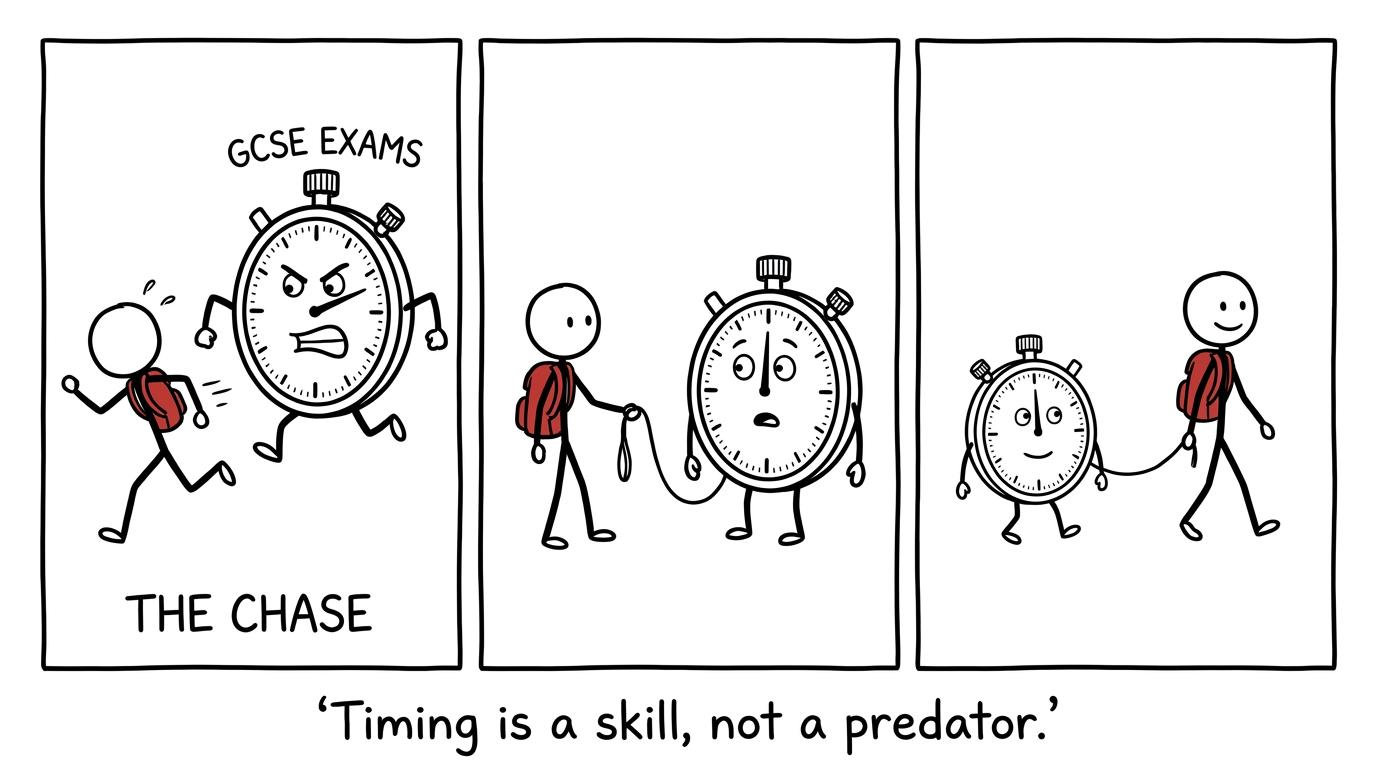 A student calmly puts a chasing stopwatch on a lead
Common mistakes during February half-term
Trying to revise the entire specification
Broad plans encourage shallow work. Select two weaknesses and maintain light contact with the other skills. Depth now gives you something reliable to build upon later.
Memorising perfect speaking paragraphs
A memorised answer can collapse when the question changes. Learn flexible vocabulary and structures, then practise adapting them to different prompts.
Counting vocabulary reviewed rather than recalled
Seeing a word is not the same as retrieving it. Cover the answer, recall it aloud or in writing, check it and return to missed items later.
Completing tasks without reviewing them
Practice without correction can reinforce the same mistake. Spend part of every session marking, comparing with reliable guidance and writing a precise next action.
Letting Bengali replace every other subject
Urgency can make one subject consume the week. Put Bengali and maths blocks into the calendar in advance, with finishing times. Rest is part of a sustainable plan too.
Using the wrong paper or tier
Check the qualification, exam board and tier before practising. AQA GCSE Bengali and International GCSE Bangla qualifications do not necessarily share the same components or task formats.
Turn one focused week into steady progress
February half-term is not your only revision window. It is a bridge between knowing that exams are approaching and having a system for meeting them.
Give Bengali regular, focused attention across all four skills. Use diagnosis to decide where deeper work belongs. Keep maths protected through short sessions built around evidence, not guesswork. If exams are becoming close enough to need a broader schedule, MathsGenie's one-month GCSE maths revision plan can help you organise the next stage.
Start today with one Bengali diagnostic and one MathsGenie mini test or topic check. Then use MathsGenie's free revision lessons, practice questions, past papers, predicted papers, mark schemes and video solutions to turn each lost maths mark into a clear next step. A calm plan will not make half-term endless. It will make the available hours count.










