GCSE Bengali Extracurricular Club: Does It Help?
GCSE Bengali extracurricular club participation can support your grade. Learn when clubs help, what to look for and how to balance Bengali with maths.
The promise of an after-school club is appealing: turn up, speak Bengali, meet people and watch your grade improve. Yet every hour after school has another possible use, especially when maths revision is waiting.
A GCSE Bengali extracurricular club can genuinely help your grade if it provides regular, structured practice in the skills your examination assesses. It is not an automatic grade booster. The benefit comes from what you do there, speaking spontaneously, listening carefully, correcting errors and practising specification content, rather than membership itself.
The sensible question is therefore not simply, “Should I join?” It is, “Will this club improve the skills I need without displacing essential revision elsewhere?”
The quick answer and checklist
A Bengali club is likely to be useful when it:
- gives you frequent opportunities to speak and listen;
- follows the topics and language required by your specification;
- includes feedback from a knowledgeable teacher or fluent speaker;
- involves active tasks rather than mainly social conversation;
- helps you practise reading and writing as well as speaking;
- fits into your week without repeatedly replacing maths, English or science revision;
- encourages consistent attendance and independent follow-up.
It is less likely to affect your grade when sessions are unstructured, unrelated to the examination or spent mostly listening to somebody else. Enjoyment and cultural connection still matter, but they should not be confused with targeted exam preparation.
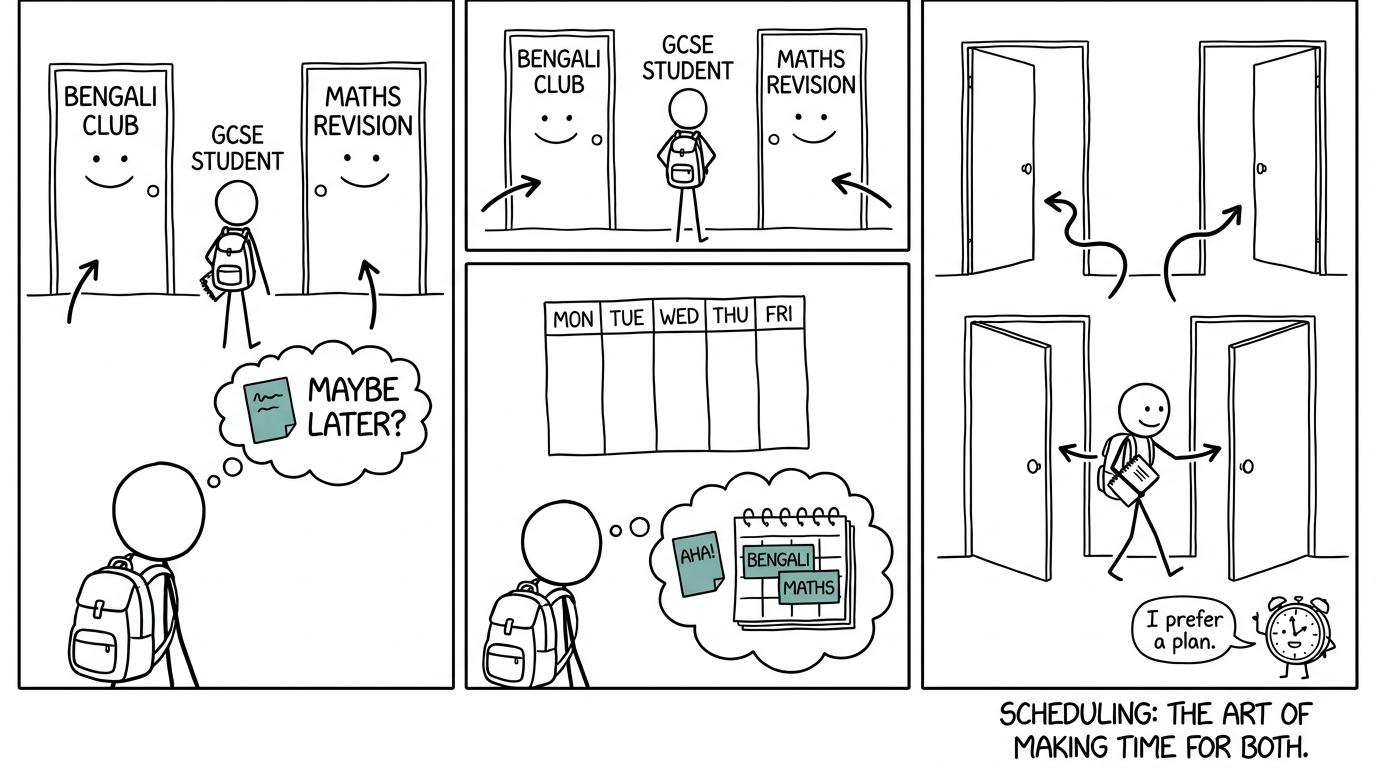 A student discovers that Bengali club and maths revision can coexist with a weekly plan
What GCSE Bengali actually assesses
Before judging a club, look at the qualification it is meant to support. At the time of writing, AQA GCSE Bengali specification 8638 assesses listening, speaking, reading and writing. Each assessment objective contributes approximately 25%25\%25% of the qualification.
That balance matters. A club built entirely around conversation may strengthen confidence and fluency, but it does not directly cover every demand of the course. Reading unfamiliar passages, translating, controlling grammar and producing accurate written responses require deliberate practice too.
The AQA course also covers themes including identity and culture; local, national, international and global areas of interest; and current and future study and employment. Students are entered for foundation or higher tier, and the chosen tier applies across the assessments.
Check your own entry with your teacher or examinations officer. Do not assume that a general Bengali community group follows the same course, tier or assessment format as your school.
How a GCSE Bengali extracurricular club may help
It creates a reason to use the language
Languages become easier to retrieve when they are used rather than merely recognised. Reading a vocabulary list can create familiarity, but familiarity is not the same as being able to produce an answer under pressure.
A useful club asks you to form sentences, respond to unexpected questions and explain opinions. Those small moments expose gaps that private rereading can hide. If you hesitate over a tense or repeatedly reach for the same basic adjective, you have found something specific to improve.
This principle is familiar in maths revision. Watching a solution can make a method look obvious; attempting a fresh question reveals whether you can actually use it. MathsGenie’s GCSE maths revision hub follows that active pattern through revision lessons, practice questions, mark schemes and video solutions.
It can improve listening and speaking confidence
A classroom cannot always provide extended individual speaking time. A smaller club may offer more turns, a wider range of voices and a lower-pressure place to make corrections.
This can support listening accuracy and spontaneous speaking, provided the session uses Bengali consistently and somebody can identify errors. Fluency without feedback may simply make an incorrect structure more fluent.
Useful activities include topic discussions, role-play, short presentations, question-and-answer rounds and listening tasks followed by precise comprehension checks. The activity should make every student produce language, not allow the most confident members to dominate.
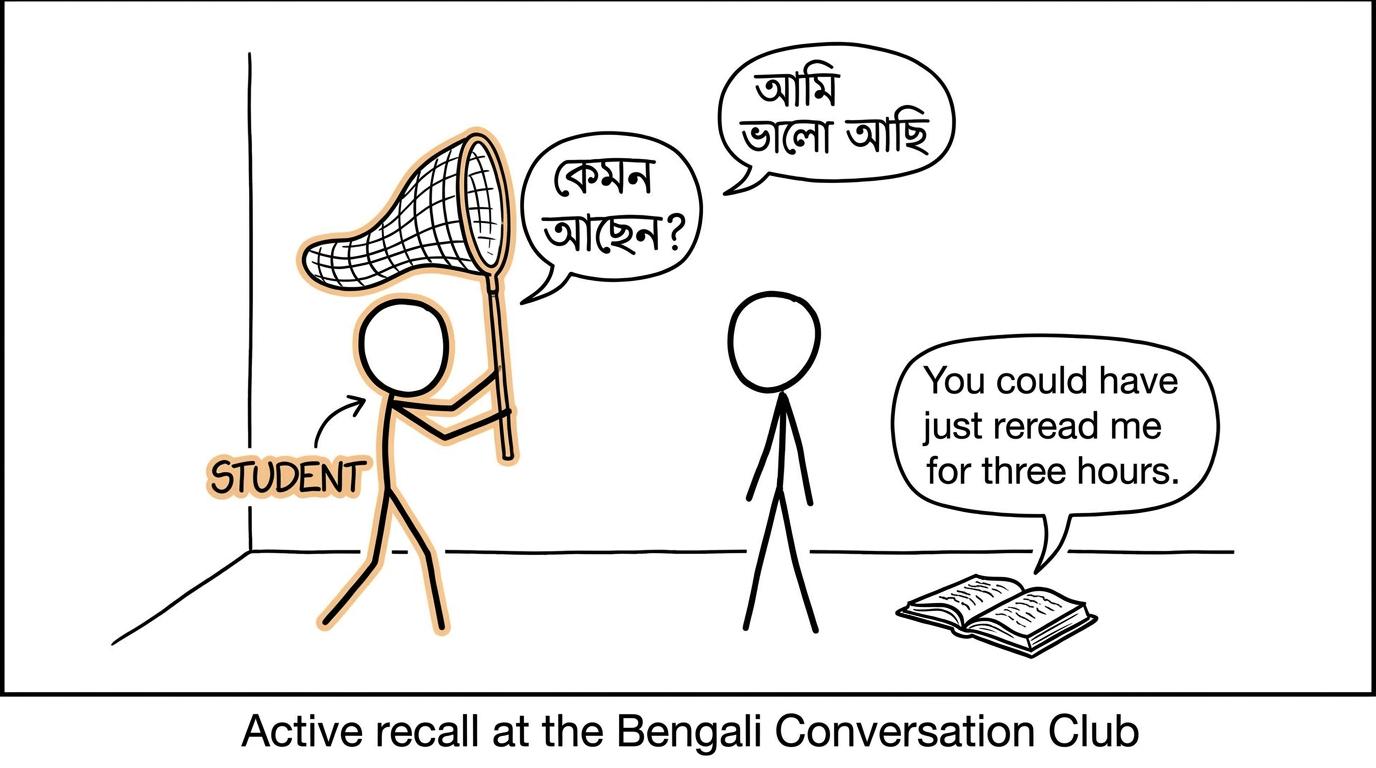 A student catches active Bengali conversation while passive rereading watches from the side
It can make cultural themes more meaningful
GCSE Bengali includes language connected to identity, customs and Bengali-speaking communities. A society may explore festivals, food, media, family life or cultural experiences in ways that make vocabulary easier to understand and remember.
That context is valuable when it leads back to examinable communication. Discussing a festival can generate vocabulary, opinions and comparisons suitable for speaking or writing. Simply attending a celebration, while worthwhile in its own right, does not necessarily rehearse the language structures that receive marks.
It can add routine and accountability
A fixed weekly session removes one decision from a crowded timetable. You know when practice will happen, other people expect you to attend, and unfinished preparation becomes visible.
Research on extracurricular participation generally reports associations with positive educational and personal outcomes, but that does not prove every club causes higher grades. Students who join clubs may differ from those who do not, and programme quality varies. Evidence is more encouraging when enrichment is structured and directly connected to learning.
For GCSE Bengali, the practical conclusion is modest but useful: regular attendance may support progress, while focused activities and feedback determine whether that progress reaches the examination paper.
What a strong Bengali club should include
Ask the organiser what a typical half-term looks like. A strong answer should mention planned topics and balanced skills, not just “conversation practice”.
Look for:
- Specification alignment: activities linked to your board’s current themes and task types.
- Balanced practice: planned listening, speaking, reading and writing.
- Corrective feedback: explanations of vocabulary, grammar, pronunciation and written accuracy.
- Inclusive participation: routines that give everyone meaningful speaking time.
- Exam familiarity: appropriate use of past questions, timings and assessment criteria.
- Independent follow-up: vocabulary or writing tasks that reinforce the session.
- Progress checks: occasional timed tasks or teacher feedback showing what has improved.
A social society need not become an examination factory. The best clubs can preserve curiosity and community while still making the learning purposeful.
How to balance Bengali club with GCSE maths revision
The main risk is not the club itself. It is unplanned displacement: one activity expands until your weakest compulsory subjects receive whatever time remains.
Start with the dates of your lessons, assessments and club meetings. Then give each subject a repeatable slot. MathsGenie’s guide to building a GCSE maths revision timetable can help you create a plan around school, rest and other commitments.
A practical weekly structure might include:
- one Bengali club session;
- one short follow-up session for vocabulary or writing;
- several focused maths sessions based on actual weak topics;
- one timed maths mini test or paper section;
- protected rest and catch-up time.
The exact allocation depends on your current grades, target grades and examination timetable. The important feature is evidence. If a maths paper shows repeated losses in algebra, your plan should make room for algebra even if Bengali feels more enjoyable.
Use the GCSE maths topics by exam board and tier to confirm what Edexcel, AQA, OCR or Eduqas can assess. If school days are crowded, the twenty-minute GCSE maths revision routine offers a manageable way to keep practising around extracurricular commitments.
How to tell whether the club is working
Do not judge progress only by whether sessions feel comfortable. Set a simple review point after several weeks and compare evidence.
For Bengali, ask:
- Can I answer unfamiliar speaking questions with less hesitation?
- Am I using a wider range of vocabulary and structures accurately?
- Has feedback reduced recurring errors in my writing?
- Can I understand new listening extracts more precisely?
- Are my timed task marks moving in the right direction?
Also examine the opportunity cost. Are you still completing planned maths practice? Are your errors reducing? The MathsGenie guide to finding your weakest GCSE topics shows how to turn lost marks into a focused revision list.
If the club is enjoyable but not improving assessed skills, you have choices. Ask for more structured tasks, add independent exam practice, attend less frequently near examinations or treat the society as cultural enrichment rather than your main revision method.
Common mistakes to avoid
Assuming attendance equals revision
Being present is not the same as retrieving vocabulary, producing language or receiving feedback. Arrive with one specific aim, such as improving spontaneous answers or checking a recurring grammatical error.
Practising only your strongest skill
Confident speakers may avoid writing; careful writers may avoid spontaneous conversation. Because GCSE Bengali assesses four areas, club activities should complement rather than deepen an existing imbalance.
Using fluent conversation as proof of exam readiness
Everyday Bengali can be a strong foundation, but an examination also rewards accurate responses to particular tasks and themes. Home fluency does not remove the need to understand the specification and mark scheme.
Letting the club replace maths practice
A language club and maths revision do different jobs. Protect regular maths retrieval, particularly if maths is a weaker subject. Short Edexcel GCSE maths mini tests are useful for students on that specification, while the main revision hub provides routes for other boards.
Completing papers without correcting mistakes
Whether you are revising Bengali or maths, the paper itself is only the diagnosis. Improvement happens when you inspect the mark scheme, identify the cause and try again. The guide to using GCSE past papers properly explains this correction cycle.
Should you join?
Join if the club is accessible, well run and likely to provide active practice you cannot easily recreate alone. Try a session, ask how activities connect to your specification and decide what independent work will still be needed.
Do not join because you have been promised an effortless grade increase. No club can substitute for balanced practice, feedback and correction. Equally, do not reject it merely because it is extracurricular. A thoughtful club can provide something valuable: a regular place where Bengali becomes a language you use, not just a subject you revise.
Keep the rest of your GCSE preparation equally deliberate. Use MathsGenie’s free revision lessons and practice questions to repair weak maths topics, then test yourself with mini tests, past papers and predicted papers. Mark your work carefully, use the video solutions when a method remains unclear, and let your revision planner protect time for both subjects.
A club can open the door. Your routine is what carries you through it.