GCSE Bengali 3 to 5: A Practical Grade Plan
GCSE Bengali 3 to 5 explained: improve vocabulary, accuracy, speaking and exam technique with a focused revision plan built around past papers.
A grade 3 can feel frustrating because it usually means you understand more Bengali than your result suggests. You recognise familiar language. You can communicate some ideas. Yet marks disappear through incomplete answers, limited vocabulary, uncertain grammar or weak exam timing.
Moving GCSE Bengali 3 to 5 is not about suddenly sounding like a perfect speaker. It means becoming more reliable across listening, speaking, reading and writing: understanding precise details, developing answers, using different time frames and correcting the mistakes that repeatedly cost marks.
That is the short answer. The longer answer is that progress comes from turning Bengali you vaguely recognise into language you can retrieve accurately under pressure.
Your grade 3 to grade 5 checklist
Focus on these changes:
- confirm your exam board, specification and tier;
- identify which of the four skills is losing the most marks;
- learn vocabulary by theme and in complete phrases;
- distinguish present, past and future meaning;
- develop opinions with reasons and details;
- practise listening without relying on one familiar word;
- answer every part of writing and speaking tasks;
- use official past papers under timed conditions;
- mark your work carefully and keep an error log;
- revisit mistakes until the corrected language can be produced from memory.
The difference between the two grades is rarely one dramatic breakthrough. It is more often a collection of small improvements that begin to hold together.
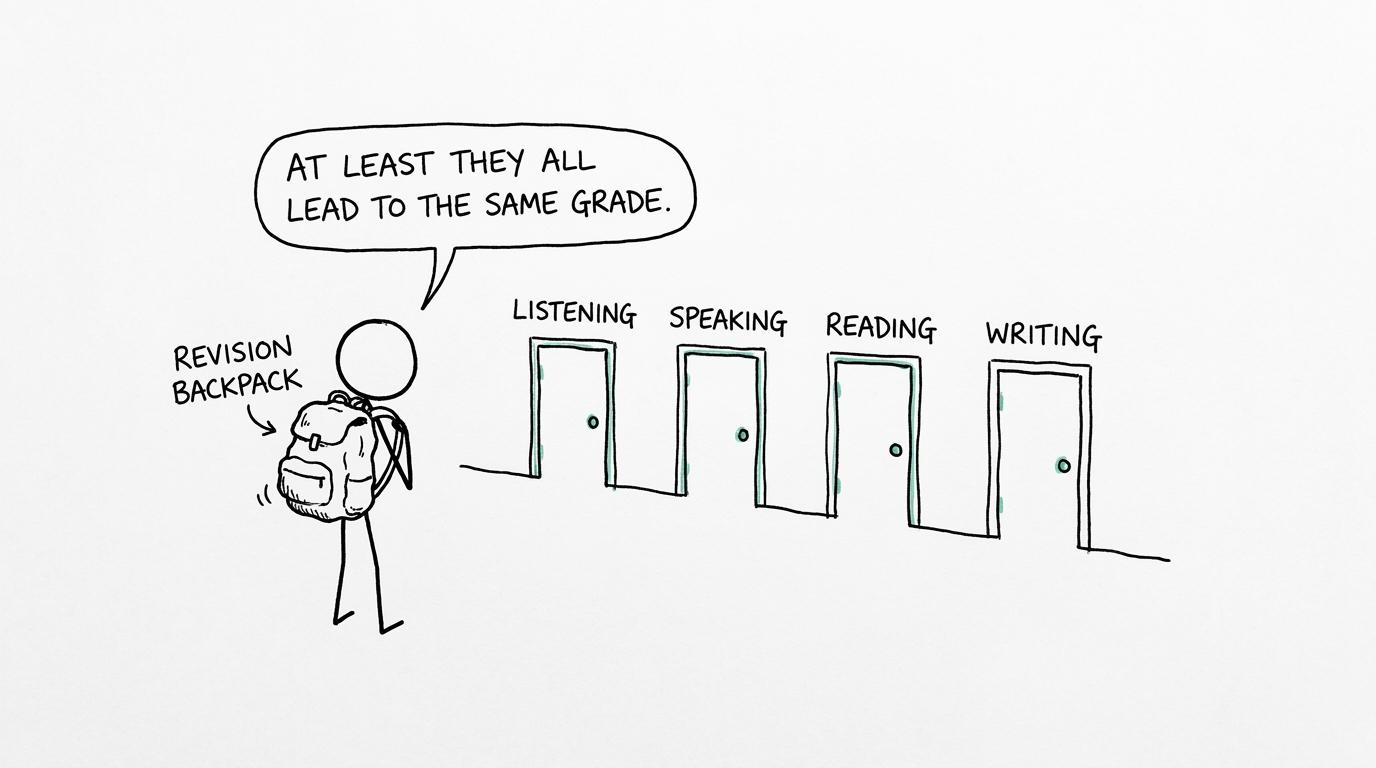 A student choosing between the four GCSE Bengali skills
Understand the GCSE Bengali assessment first
For the current AQA GCSE Bengali qualification, students are assessed in four areas: listening, speaking, reading and writing. Each contributes 25%25\%25% of the qualification. The course is linear, so the assessments are completed at the end of the course and in the same exam series.
AQA offers Foundation Tier, covering grades 1 to 5, and Higher Tier, normally covering grades 4 to 9. Students take all four assessments at the same tier. A narrowly missed grade 4 on Higher Tier may receive the permitted grade 3, but a grade 5 is available on either tier.
This matters because tier choice changes the papers you practise. Check the entry with your teacher rather than assuming that Higher Tier is automatically the best route. If you are taking a different qualification, such as an International GCSE, its assessment structure may be different.
Start by opening the AQA GCSE Bengali past papers and checking that the tier and paper labels match your course. You can also view the AQA GCSE Bengali grade boundaries, but treat previous boundaries as historical information, not a prediction. Boundaries can change between exam series according to the demands of the papers.
What separates a grade 3 from a grade 5 in GCSE Bengali?
There is no single sentence, tense or vocabulary list that guarantees a grade. GCSE grades are awarded from the combined assessment result. Still, work around grade 5 tends to be more consistent and better controlled than work around grade 3.
| Area | Grade 3 pattern | Change towards grade 5 |
|---|---|---|
| Listening | Understands the general topic but misses details | Identifies who, when, why and whether an opinion is positive or negative |
| Speaking | Gives short answers that are difficult to extend | Adds opinions, reasons, time references and relevant follow-up detail |
| Reading | Relies heavily on isolated familiar words | Uses the complete sentence and context to infer precise meaning |
| Writing | Communicates basic ideas but omits parts of the task | Covers every bullet point and links developed ideas clearly |
| Grammar | Depends mainly on familiar present-time phrases | Communicates across different time frames with greater control |
| Vocabulary | Repeats safe, general words | Selects theme-specific language and useful expressions |
| Exam technique | Leaves blanks or spends too long on one section | Attempts every accessible mark and checks against the task |
A grade 5 response does not need to be flawless. Errors can remain. The important change is that they interfere less often with communication, while the student supplies more relevant information.
Build vocabulary that works in an exam
A long vocabulary list can create the comforting feeling of revision without producing much usable language. Recognition is not the same as retrieval.
Organise vocabulary around the specification themes, including identity and culture; local, national, international and global interests; and current and future study and employment. Within each theme, learn small groups of useful language:
- key nouns and verbs;
- opinion phrases;
- reasons and connectives;
- time expressions;
- descriptive language;
- question words and negative expressions.
Learn phrases rather than isolated words wherever possible. A phrase gives you vocabulary, grammar and word order together. Test in both directions: Bengali to English for recognition, then English to Bengali for production.
Use spaced retrieval. Review new language later the same day, then after a short gap, rather than rereading one list repeatedly. Language that is slightly difficult to retrieve is often the language being strengthened.
Make speaking answers easier to extend
Students sometimes believe speaking marks depend on confidence or accent. Confidence helps delivery, but preparation should focus on communication: answering the question, developing ideas, interacting and using language with sufficient range and accuracy.
Build answers from four layers:
- a direct response;
- an opinion;
- a reason;
- one relevant detail in another time frame.
Do not memorise a single enormous script and hope the questions fit it. Memorise flexible building blocks that can be adapted. Prepare short answer frameworks for each theme, then ask a teacher, family member or revision partner to vary the wording and order of questions.
Record yourself occasionally. Listen for long pauses, repeated vocabulary and answers that never explain why. If a response is unclear, improve one feature at a time rather than rewriting everything.
Improve listening and reading precision
At grade 3, students often understand the broad subject but lose marks on contrasts, negatives, opinions and time references. The answer may depend on a small word that changes the whole meaning.
Before listening, read the question and predict the type of information required. Are you listening for a person, activity, reason, advantage or time? During the recording, avoid choosing an answer merely because you heard one matching word. Listen for the complete idea.
For reading, underline the part of the text that supports your answer. If you cannot point to evidence, you may be guessing from the topic rather than interpreting the sentence.
Practise translation as careful communication, not word replacement. Preserve who did what, when it happened, and whether the statement is positive, negative or conditional. Where a direct word-for-word translation sounds unnatural, express the same meaning clearly.
Turn writing into controlled communication
Writing improves when planning becomes brief but deliberate. Before starting, identify:
- every required bullet point;
- the audience and purpose;
- where you will show different time frames;
- which opinions you can support with reasons;
- vocabulary you know accurately enough to use.
A shorter, controlled response that addresses the task is usually more valuable than an ambitious response filled with unclear language. Range still matters, but range should expand from a secure base.
After writing, check content before spelling. Have you answered every part? Is it clear when events happened? Are opinions explained? Then inspect verb forms, negatives, agreements where relevant, word order and recurring spelling errors.
The final check should come from your own error log. Generic checking is difficult. Looking specifically for the three mistakes you commonly make is manageable.
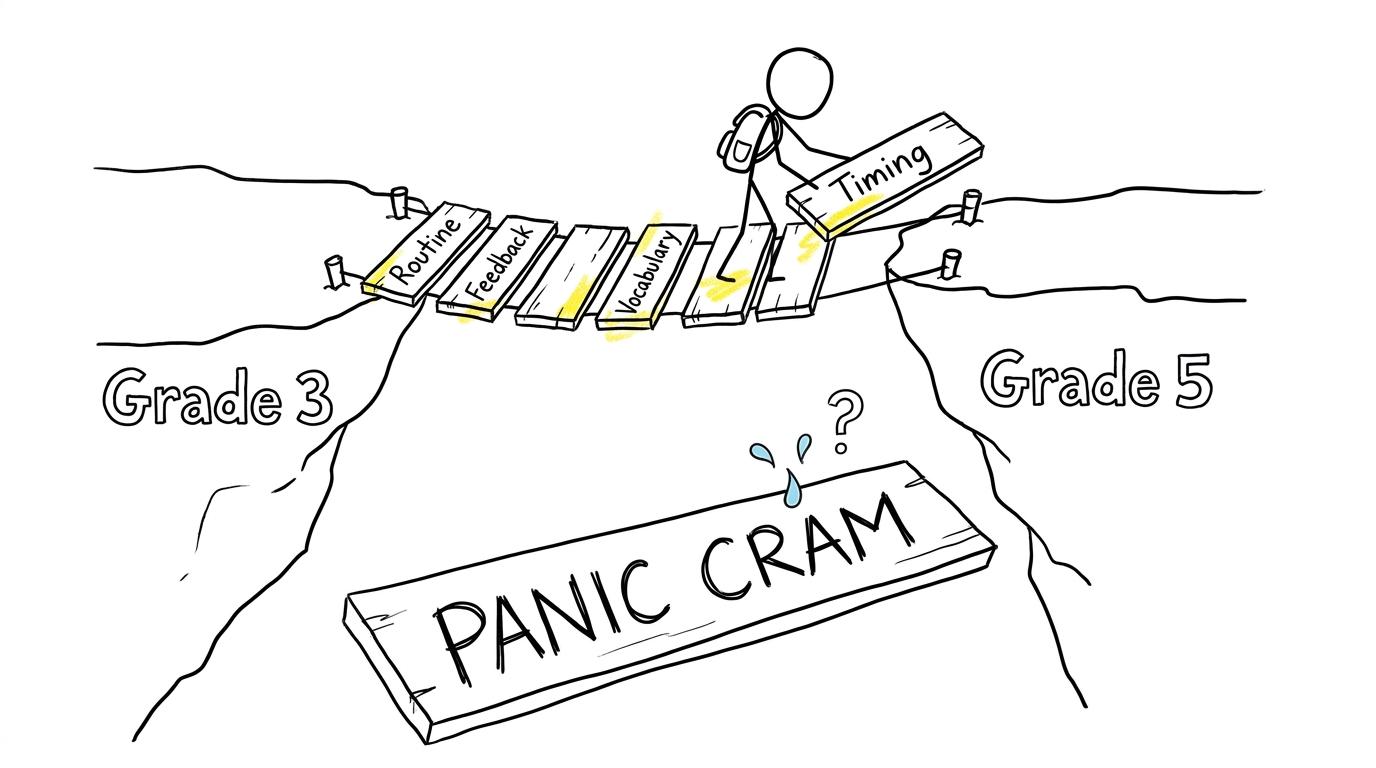 A bridge from grade 3 to grade 5 built from revision habits
Use past papers as a feedback system
Completing paper after paper without analysing mistakes can make you faster at repeating the same habits. A past paper becomes useful when it changes the next revision session.
Use this loop:
- complete one paper or section under realistic conditions;
- mark it strictly with the official mark scheme;
- record each lost mark by skill and cause;
- revise the smallest language gap responsible;
- answer a fresh question testing that gap;
- revisit it several days later.
Your error categories might include unknown vocabulary, misread negative, wrong time frame, incomplete bullet point, unclear pronunciation or poor timing. The guide to finding your weakest GCSE topics explains the same evidence-led principle used in maths revision: diagnose, practise and retest.
Do not wait until you feel fully prepared. The MathsGenie guide to starting GCSE past papers shows why papers are most valuable while there is still time to respond to what they reveal.
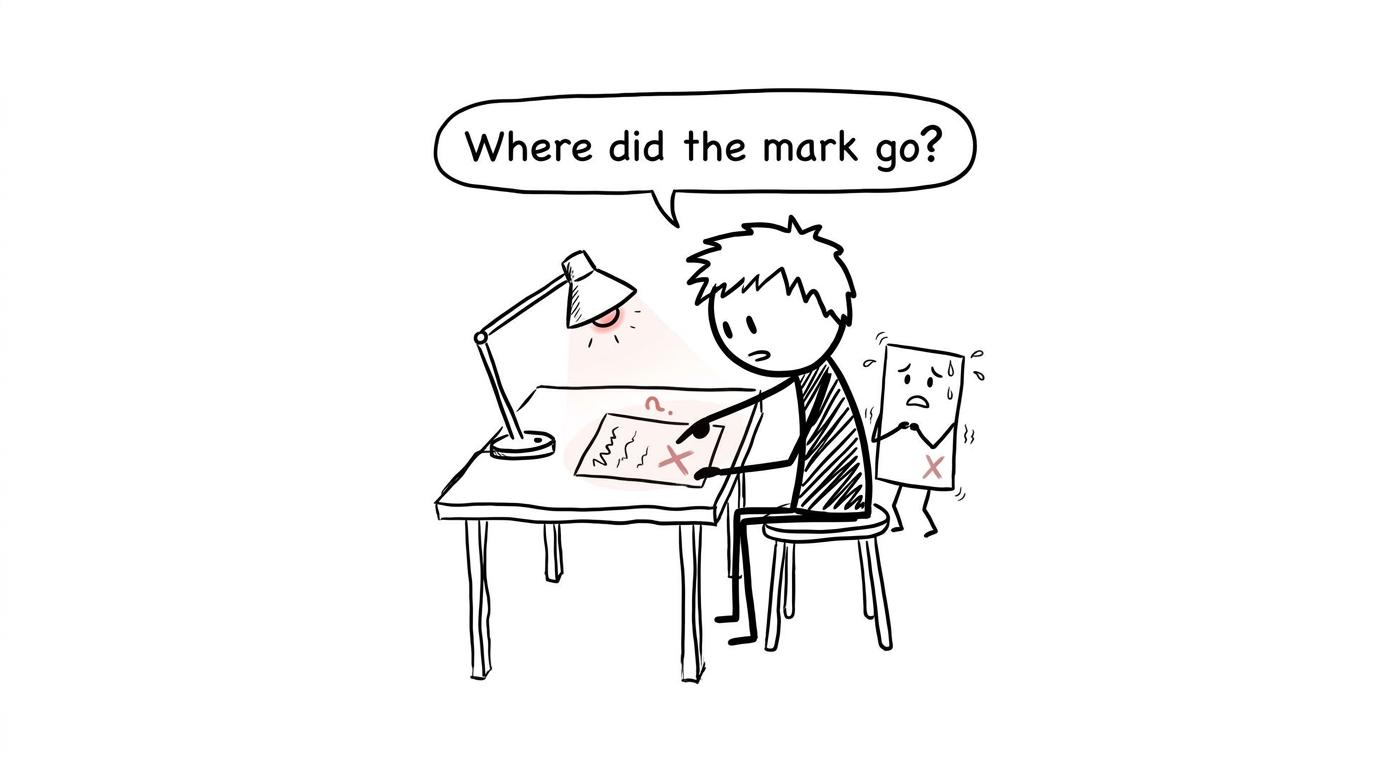 A student investigating marks lost on a practice paper
A weekly plan for moving up the grade band
A balanced week is better than spending every session on writing because it feels easiest to organise.
Early in the week
Revise one specification theme. Retrieve vocabulary, produce several accurate phrases and speak short responses aloud. Finish with listening or reading questions on that theme.
Midweek
Complete a timed section from a past paper. Mark it promptly and choose one recurring weakness to correct. If your schedule feels crowded, adapt the routine in the GCSE one-month revision plan: diagnose, focus, retrieve and test.
At the weekend
Practise a longer writing or speaking task, then review previous errors. Alternate the main assessed skill each week so no component is neglected.
Small sessions count when they contain retrieval and feedback. The MathsGenie short-session revision guide offers a useful model: learn one focused skill, answer questions, mark immediately and return to the mistake.
Common mistakes that keep students at grade 3
Revising only comfortable themes
Familiar themes create confidence but hide gaps. Use results from past papers to decide what comes next.
Memorising without adapting
A prepared paragraph may not answer the actual question. Learn reusable structures, then practise changing person, time and topic.
Giving opinions without reasons
An opinion begins an answer; it does not always develop it. Add a reason and a specific detail where the task permits.
Ignoring one assessment skill
Strong speaking cannot fully compensate for neglected reading or listening when the four AQA components are equally weighted. Revision time should reflect evidence from all four.
Counting practice instead of corrections
The number of papers completed matters less than the number of weaknesses removed. Mark schemes are not merely scoring tools. They show what the question accepted and where your interpretation failed.
Treating grade boundaries as targets
Past boundaries provide context, but they are not fixed promises for a future series. Aim to improve performance across the entire specification rather than chasing one previous raw-mark figure.
Make the move from grade 3 to grade 5 measurable
A two-grade improvement becomes less intimidating when you stop treating it as one leap. Track evidence you can influence: fewer blank answers, more complete task coverage, better vocabulary recall, clearer time frames and fewer repeated errors.
Begin with the AQA GCSE Bengali paper collection. Complete one appropriate section, mark it and identify the first weakness to repair. Then repeat the cycle.
MathsGenie is built around this way of improving: revision lessons establish understanding, practice questions make skills retrievable, mini tests reveal gaps, and past papers, predicted papers, mark schemes and video solutions develop exam judgement. Not every MathsGenie maths resource applies directly to Bengali, and predicted maths papers should never be mistaken for Bengali materials. But the revision method transfers: diagnose honestly, practise precisely and use feedback.
Start with one paper and one correction today. Grades often change when small improvements finally become dependable.