

GCSE Astronomy Year 10 Revision Head Start: Worth It?
GCSE astronomy Year 10 revision head start: see whether early revision improves recall, strengthens maths skills and avoids burnout with a practical, calm plan.
The night sky is patient. Exams are not. That contrast can make starting early feel sensible, but it can also create a nagging question: if you begin now, will you remember anything by Year 11?
The short answer is yes: a gcse astronomy year 10 revision head start can genuinely help, provided it means short, spaced review rather than beginning an exam-season timetable a year early. Use Year 10 to understand the specification, strengthen the maths behind astronomy and revisit ideas occasionally. Save intensive past-paper practice for later.
Starting early should lower future pressure. If it makes every week feel like exam week, it has stopped being a head start.
The quick verdict
Early GCSE Astronomy revision is worthwhile when you:
- keep sessions short and manageable;
- follow the current Pearson Edexcel specification;
- retrieve information instead of repeatedly reading notes;
- build supporting maths skills such as standard form, ratio and graphs;
- revisit topics after gaps rather than trying to master everything immediately;
- protect time for your other GCSE subjects, sleep and ordinary life.
It is less useful when you:
- attempt full papers before learning enough content;
- make extensive notes that you never test yourself on;
- revise at Year 11 intensity throughout Year 10;
- treat every forgotten fact as evidence that you are falling behind.
The distinction matters. Starting early is helpful. Starting urgently is not.
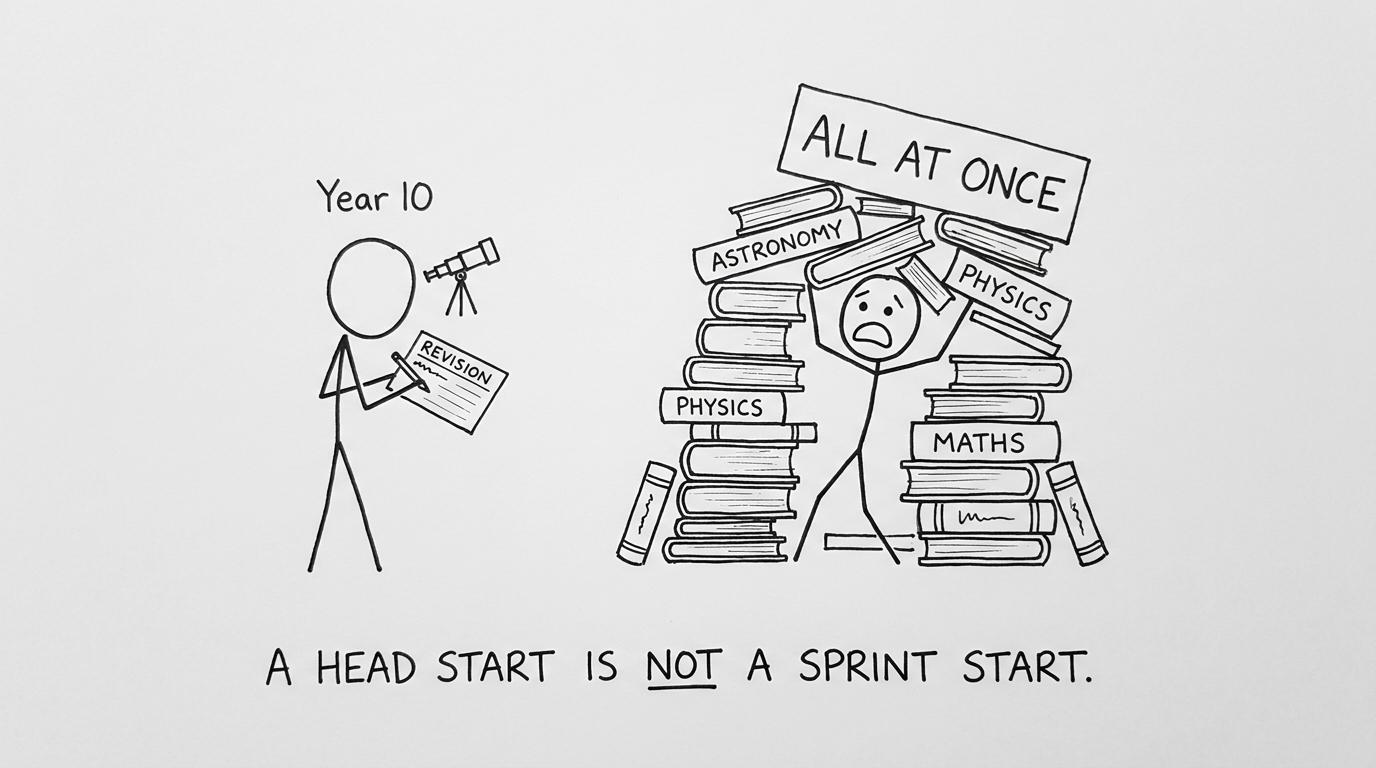 A student discovers that a head start should not become a sprint
Why GCSE Astronomy rewards an early start
Pearson Edexcel currently offers GCSE Astronomy under specification 1AS01\mathrm{AS}01AS0. Unlike GCSE Maths, it is not divided into foundation and higher tiers. Students take the same assessment, so steady breadth across the course matters.
The qualification has two externally examined papers. Paper 111 covers naked-eye astronomy and Paper 222 covers telescopic astronomy. Each paper lasts 111 hour 454545 minutes, carries 100100100 marks and contributes 50%50\%50% of the qualification. The course also develops observational knowledge and skills, with students undertaking the observational work required by the current specification and their centre.
That is a broad journey. It moves through the Earth-Moon-Sun system, time, celestial observation and planetary motion before reaching telescopes, starlight, stellar evolution, galaxies and cosmology. Beginning gently in Year 10 gives these ideas time to connect.
Astronomy also contains unfamiliar language. Terms such as right ascension, declination, parsec and apparent magnitude become easier when encountered repeatedly. A single long revision session can make terminology feel familiar for an evening. Recalling it several weeks later is a better test of whether it has become usable knowledge.
Research on learning generally supports spacing practice over time and retrieving information from memory rather than relying entirely on rereading. Classroom evidence varies by subject and implementation, so no timetable guarantees a particular grade. Still, the practical implication is reasonable: several brief encounters with a topic are usually a better Year 10 strategy than one enormous encounter followed by months of silence.
The maths advantage astronomy students often overlook
At least 20%20\%20% of the marks across GCSE Astronomy assessments must reward mathematical skills used within astronomical contexts. The current specification includes arithmetic, standard form, ratios, inverse-square relationships, significant figures, algebra, graph interpretation, gradients, angular measures and unit conversions.
This is where an early start has unusual value. You can strengthen one set of skills for two subjects at once.
For instance, astronomical distances commonly require standard form:
a×10n,1≤a<10 a \times 10^n, \qquad 1 \leq a < 10 a×10n,1≤a<10You may also need proportional reasoning, substitution into equations and rearranging formulae. Graph work can involve plotting data, finding a gradient or interpreting what a trend means physically. Angular measurement may use degrees, arcminutes and arcseconds, where:
1∘=60 arcmin 1^\circ = 60\text{ arcmin} 1∘=60 arcminand
1 arcmin=60 arcsec. 1\text{ arcmin} = 60\text{ arcsec}. 1 arcmin=60 arcsec.Year 10 is a good time to make these operations routine, without forcing every session to become astronomy revision. Begin with MathsGenie's GCSE Maths topic checklist by board and tier, then prioritise number, ratio, algebra and graphs.
If very large and very small quantities cause difficulty, use the standard form GCSE revision guide. Although the page is organised for OCR GCSE Maths, the underlying mathematical skill transfers to astronomy. Your own GCSE Maths board might be Edexcel, AQA, OCR or Eduqas, so use board-specific resources when practising exam questions.
A sustainable Year 10 revision plan
A productive head start can be surprisingly small. For most of Year 10, aim for consistency rather than volume.
Learn what your course actually requires
Keep the current Pearson specification or your teacher's course checklist nearby. Divide the content into taught, partly understood and not yet taught.
Do not independently race through every untaught topic. Previewing a definition or diagram can make a future lesson easier, but attempting to build the whole course alone may produce misconceptions that later need repairing.
Use a light weekly rhythm
A manageable week might contain:
- one 202020 to 303030 minute astronomy review;
- one short maths session on a transferable skill;
- a few minutes of low-stakes recall later in the week.
The astronomy session could involve closing your notes and writing everything you remember about one taught topic. Check the result, correct omissions and keep a small list of questions for your teacher.
The maths session should be question-based. MathsGenie's guide to revising GCSE Maths efficiently explains a useful cycle: learn, practise, mark, fix and revisit. If your foundations feel uneven, the best order for learning GCSE Maths topics provides a sensible route from number fluency towards algebra, graphs and geometry.
Revisit after a gap
Return to a topic after several days, then again after a few weeks. The purpose is not to design a perfect spacing algorithm. It is to interrupt the natural pattern of learning something once and assuming it will remain available forever.
Try to recall before checking. That moment of effort is useful because it exposes the difference between recognition and knowledge. A page can look familiar while still being difficult to explain without prompts.
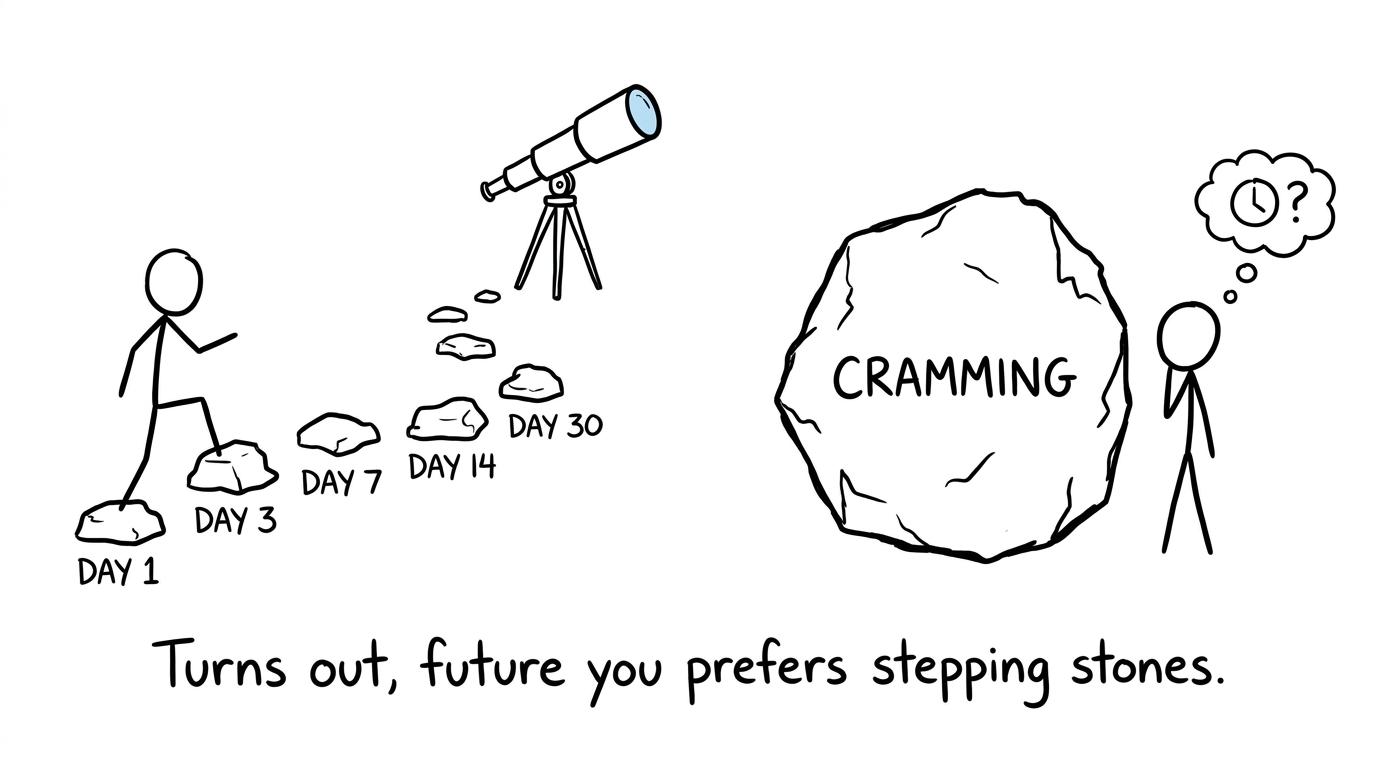 Small revision steps lead towards the telescope while cramming waits as a boulder
Keep an error and uncertainty log
Use three simple labels:
- astronomy knowledge: a fact, process or comparison you could not explain;
- maths method: a calculation, graph or rearrangement you could not complete;
- exam communication: a response that lacked units, reasoning or precision.
This turns revision into diagnosis. MathsGenie's guide to finding your weakest GCSE topics shows how mistakes can direct the next session instead of merely lowering confidence.
When should full exam practice begin?
Full past papers are usually not the best starting point in early Year 10. If much of the course remains untaught, the score mostly measures missing coverage. That is not a particularly useful diagnosis.
Begin with topic questions and short mixed tests. As your coverage grows, use selected questions from official Astronomy papers with your teacher's guidance. Later, timed sections can develop interpretation, accuracy and extended-response technique. Full papers become most valuable when you have learnt most of the specification and can review each mistake properly.
The same principle applies to maths. MathsGenie's GCSE past-paper timing guide recommends moving from diagnostic mini tests towards timed sections and complete papers. The free Edexcel GCSE Maths mini tests are useful when you need focused practice without committing to an entire paper.
Predicted papers belong later in the process. They can provide fresh exam-style practice close to the exams, but they cannot replace specification coverage, official past papers or careful marking.
Will starting early cause burnout?
Starting early does not automatically cause burnout. Excessive workload, constant pressure and revision without recovery are the greater concerns.
A useful test is to ask what the plan is doing to your life. A healthy Year 10 plan should leave room for lessons, homework, hobbies, relationships and sleep. It should be flexible during busy weeks. Missing one session should not create panic or trigger a punishing catch-up schedule.
Watch for signs that the plan needs reducing:
- you feel guilty whenever you are not revising;
- sessions keep becoming longer;
- astronomy pushes aside more urgent schoolwork;
- you repeatedly revise exhausted and retain little;
- curiosity about the subject is being replaced by dread.
If that happens, reduce the load. A 151515-minute recall session can preserve continuity better than an ambitious timetable you abandon completely. Speak to a teacher, parent, carer or appropriate school support member if exam pressure is affecting your wellbeing.
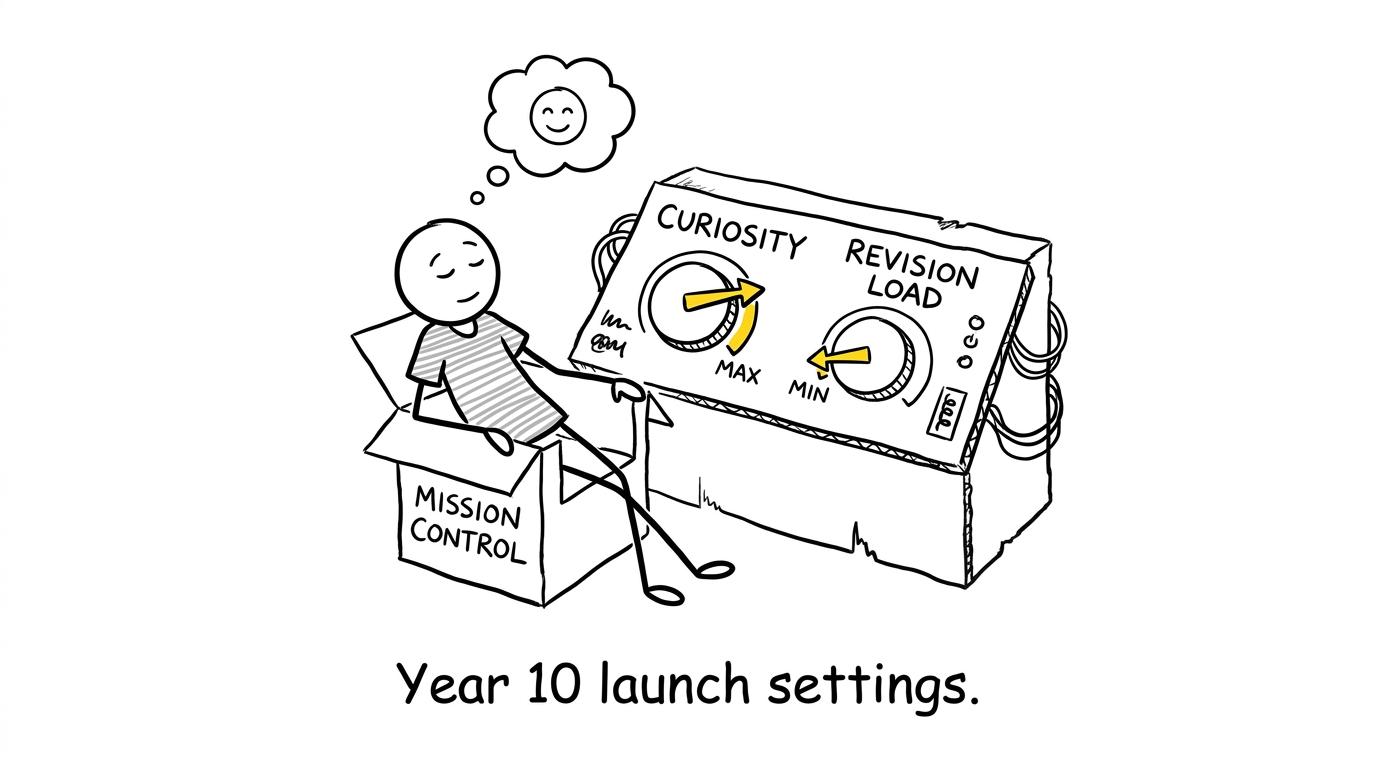 A calm student adjusts curiosity and revision load at Year 10 mission control
Common mistakes with a Year 10 head start
Confusing revision with copying
Neat notes can organise a topic, but copying does not prove that you can retrieve or apply it. Keep notes brief, then close them and answer questions from memory.
Revising beyond the specification
Astronomy invites fascinating detours. Follow them for interest, but label them clearly. Exam revision should remain anchored to the current Pearson specification and your teacher's guidance.
Ignoring the mathematics
Knowing the astronomy but losing marks through units, standard form or graph errors is avoidable. Use MathsGenie's free GCSE and A Level maths resources to repair these skills through revision lessons and practice questions.
Using papers as a score generator
A paper only improves performance when you mark it, identify why marks were lost and repair the underlying weakness. Early in the course, short tests usually provide cleaner feedback.
Treating consistency as perfection
A sustainable plan survives disrupted weeks. If you miss a session, continue with the next planned task. Do not double the workload to repay an imaginary revision debt.
The head start that actually lasts
Starting GCSE Astronomy revision in Year 10 pays off when it creates familiarity, mathematical confidence and calmer recall. It does not pay off when Year 10 becomes a rehearsal for months of exam panic.
Keep the astronomy work light and specification-led. Build the supporting maths steadily. Retrieve, check and revisit. As Year 11 progresses, increase exam practice in proportion to the content you have covered.
MathsGenie can support the mathematical side of that journey for Edexcel, AQA, OCR and Eduqas GCSE Maths. Start with a focused revision lesson, move into practice questions, check your work with mark schemes and video solutions, then use mini tests, past papers and predicted papers when the timing is right. A good head start is not about doing everything now. It is about making the next step easier.










