GCSE Astronomy vs GCSE Physics: Which to Choose?
GCSE astronomy vs GCSE physics: compare content, maths, exams and practical work, then choose the subject that best fits your strengths and plans.
Choosing a GCSE can feel strangely permanent. A short box on an options form seems to ask a much larger question: What kind of person am I good at being? For students comparing GCSE astronomy vs GCSE physics, the practical answer is simpler. Choose Astronomy if you are especially drawn to space, observation and interpreting evidence about the Universe. Choose Physics if you prefer a broader science covering forces, energy, electricity, waves, matter and space, and want the more direct preparation for A Level Physics.
There is an important complication. Your school may not offer both subjects, and Astronomy is sometimes taken in addition to the usual science route rather than instead of Physics. Before deciding, check the exact options, teaching time and exam board with your school.
The quick comparison
| Feature | GCSE Astronomy | GCSE Physics |
|---|---|---|
| Main focus | Earth, the Solar System, stars, galaxies, observation and cosmology | Energy, forces, electricity, waves, matter, magnetism, atomic physics and space |
| Current specification considered here | Pearson Edexcel Astronomy 1AS01AS01AS0 | Available through boards including AQA, Edexcel, OCR and Eduqas |
| Tiering | Untiered | Usually Foundation or Higher tier |
| Maths in written assessment | At least 20%20\%20% of marks | At least 30%30\%30% of marks |
| Practical element | At least one aided and one unaided astronomical observation | Practical work taught during the course and assessed through written questions |
| Best fit | Focused interest in space and observational evidence | Broad interest in how the physical world works |
| Preparation for A Level Physics | Helpful, particularly for space topics and data analysis | The more direct academic foundation |
A useful first checklist is:
- Does your school actually offer GCSE Astronomy?
- Would Astronomy replace another option or be an additional GCSE?
- Do you enjoy the whole of Physics, or mainly its space content?
- Are you comfortable with equations, graphs, units and standard form?
- Would you enjoy planned observations, including work outside normal lesson routines?
- Are you considering A Level Physics?
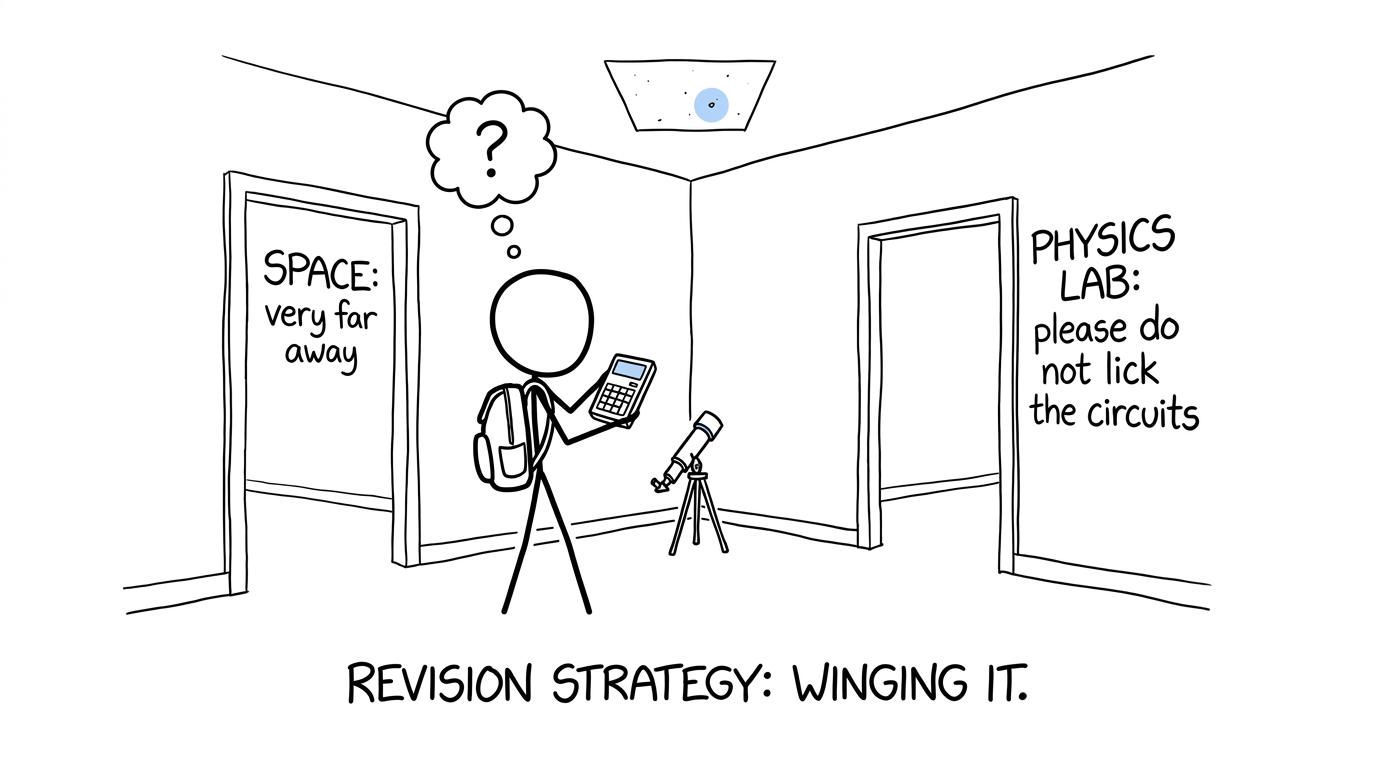 A student choosing between a space door and a physics laboratory door
What do you study in GCSE Astronomy?
Pearson Edexcel GCSE Astronomy is a specialised course about how we observe and understand the Universe. Its sixteen topics are divided between naked-eye and telescopic astronomy.
The first half includes Planet Earth, the lunar disc, the Earth-Moon-Sun system, time, Solar System observations, celestial observation, early models and planetary motion. The second moves into lunar exploration, solar astronomy, planetary systems, starlight, stellar evolution, the Milky Way and cosmology.
That range is wider than the word astronomy can initially suggest. You are not simply learning planet names. You consider how evidence is collected, why models change and what can be inferred from light, movement and large sets of data.
The qualification has two written papers:
- Paper 1: Naked-eye Astronomy, lasting 111 hour 454545 minutes and worth 100100100 marks.
- Paper 2: Telescopic Astronomy, lasting 111 hour 454545 minutes and worth 100100100 marks.
Each contributes 50%50\%50% of the qualification. Questions can include multiple-choice items, calculations, graphs, short answers and extended responses. The course is untiered, so there is no separate Foundation or Higher paper.
Students must also complete at least one unaided and one aided observation. These observations are not a separately marked piece of coursework, but the school must confirm their completion. Observational knowledge and techniques are assessed in the written papers.
This suits students who like a subject with a clear identity. It also asks for patience. Real observations involve planning, recording, evaluating conditions and accepting that clouds do not respect revision timetables.
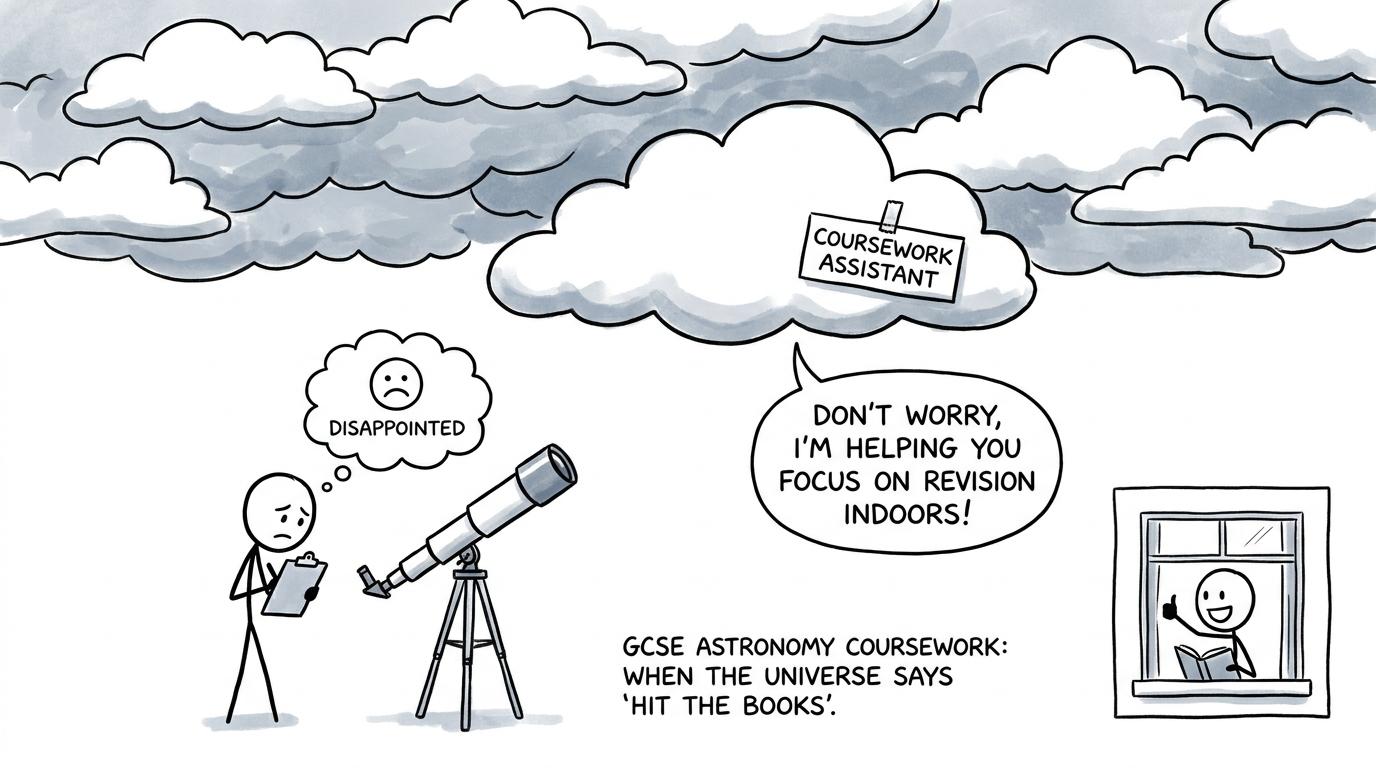 A GCSE student attempts an astronomical observation beneath an unhelpful cloud
What do you study in GCSE Physics?
GCSE Physics is broader. Exact topic organisation depends on your exam board, but the shared foundation includes energy, electricity, forces, waves, atomic structure, matter and magnetism. Separate Physics specifications also include space-related content, although its position and depth vary between boards.
For example, AQA GCSE Physics divides its content across two papers, with Space Physics included on Paper 2. Pearson Edexcel also uses two papers, each lasting 111 hour 454545 minutes and worth 100100100 marks. You should always check your own specification rather than assuming every board follows the same topic order.
MathsGenie provides board-specific resources for both AQA GCSE Physics revision and Edexcel GCSE Physics revision, including lessons, questions, worksheets and paper practice.
Physics is normally tiered. Foundation and Higher papers assess the same broad physical ideas at different levels of demand, and students complete all assessments in the same tier. Your tier affects the grades available and the mathematical demand, so discuss entry decisions with your teacher.
Physics practical work is also central. You learn how to plan investigations, handle variables, interpret measurements and evaluate methods. Practical understanding is assessed in the written examinations rather than through a separately graded coursework mark.
Which subject has more maths?
Physics has the larger formal mathematical weighting. Regulatory requirements specify that at least 30%30\%30% of GCSE Physics marks assess mathematical skills. In GCSE Astronomy, mathematical skills account for at least 20%20\%20% of the written examination marks.
The difference matters, but it should not be exaggerated. Neither course is simply a second maths GCSE. In both, the challenge is applying familiar techniques in an unfamiliar scientific setting.
Maths used in both subjects
You should expect to use:
- ratios, percentages and proportional reasoning;
- substitution into formulae;
- rearranging straightforward equations;
- graphs, gradients and data interpretation;
- significant figures and sensible rounding;
- units and conversions;
- very large or very small quantities in standard form.
Astronomy frequently places these skills in contexts involving enormous distances, timescales, angles, orbital relationships and observational data. Physics applies them across motion, forces, circuits, energy transfers, waves and material properties.
If numbers such as 3.0×1083.0 \times 10^83.0×10⁸ feel more alarming than useful, the solution is not to avoid both subjects. Build the underlying technique first using MathsGenie's standard form revision resources. Formula work, ratios and graph interpretation are also part of the wider GCSE maths topic checklist.
A student who enjoys maths may find Physics especially rewarding because equations appear across so many topics. Astronomy may suit someone who likes calculations but is equally interested in diagrams, historical models, observational limitations and extended explanations.
Which one fits your strengths better?
Choose GCSE Astronomy if you enjoy focused depth
Astronomy may fit you if you naturally ask why the Moon changes appearance, how distances in space are estimated or what starlight reveals. It rewards curiosity about one large theme and a willingness to connect geometry, physics, observation and scientific history.
You should also be comfortable learning precise terminology. Interest gets you through the door; accurate explanations earn the marks. Loving photographs of galaxies is not, by itself, the same as enjoying the academic subject.
Choose GCSE Physics if you enjoy broad problem-solving
Physics may be the better choice if you like switching between contexts. A lesson on circuits can be followed by forces, radiation or waves. The surface changes, but the habits remain consistent: identify the principle, select information, use a relationship and judge whether the result makes sense.
It is also the clearer choice if you are seriously considering A Level Physics. Astronomy can strengthen relevant knowledge and enthusiasm, but it does not replace the broad grounding in mechanics, electricity, waves and practical physics normally expected for progression. Entry requirements are set by individual schools and colleges, so check them early.
Think about how you prefer to be assessed
Astronomy's untiered structure means every student takes the same papers. Some students like that simplicity. Others may feel more secure with the Foundation and Higher pathways available in Physics.
Both subjects require more than factual recall. You will meet calculations, explanations, evidence and data. If you want to see how your current habits cope with mixed Physics questions, follow MathsGenie's method for finding your weakest Physics topics: attempt a short section, mark it and classify each lost mark as understanding, maths or exam technique.
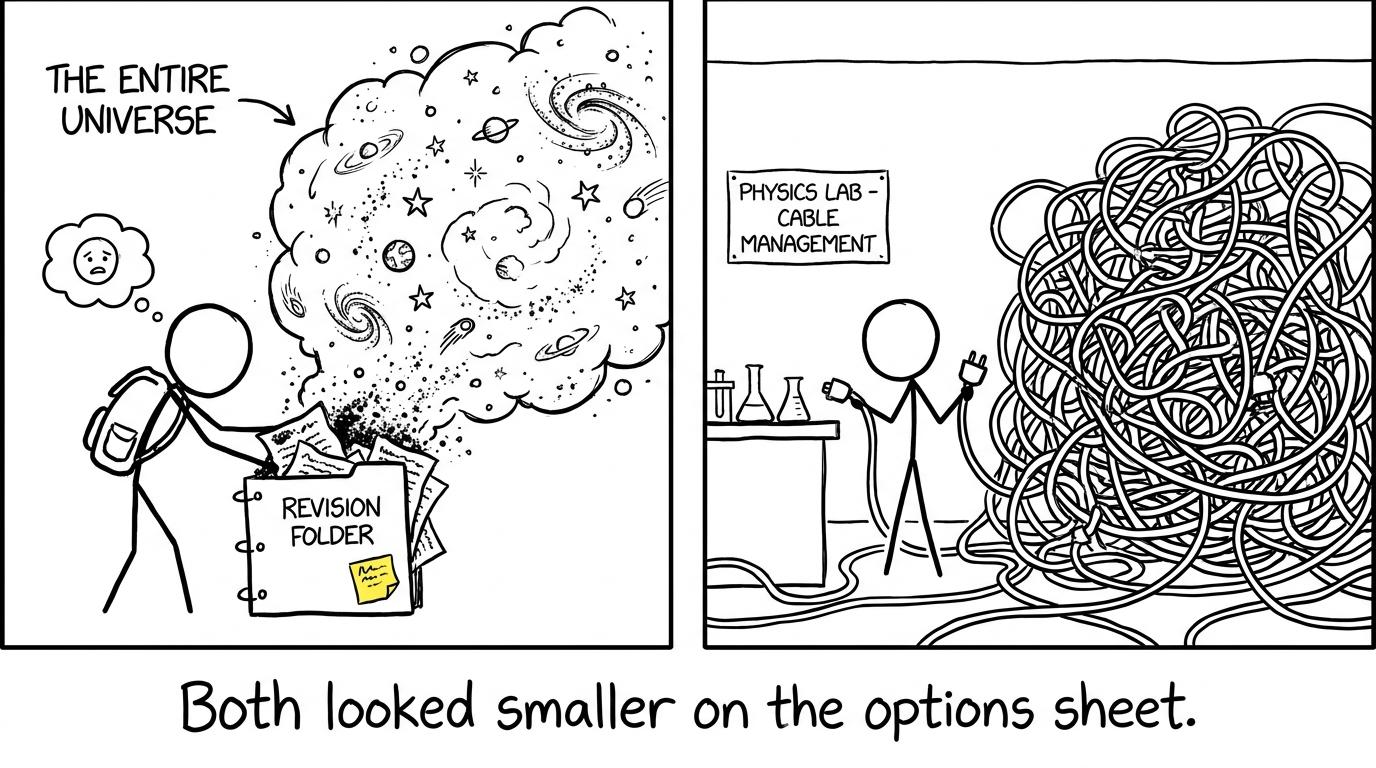 Students discover that both GCSE subjects are larger than they appeared on the options form
Astronomy and Physics are not always direct alternatives
This is the detail most likely to change your decision. Many students already study Physics through Combined Science or separate sciences. GCSE Astronomy may then sit in an optional subject block, be offered after school or not be available at all.
Ask your school four specific questions:
- Which qualification and exam board will I be entered for?
- Is Astronomy taught within the normal timetable?
- What arrangements are made for the required observations?
- Can I still follow the science route needed for A Level Physics?
Do not rely on a generic options booklet or another school's arrangements. Availability, staffing and timetabling are local decisions.
Common mistakes when choosing between them
Choosing Astronomy because it sounds easier
A narrower theme does not mean an easier GCSE. Astronomy includes substantial terminology, calculations, observational skills, data analysis and extended responses. The untiered papers assess the full grade range.
Choosing Physics only because it looks more useful
Progression matters, but motivation matters too. A subject you repeatedly practise is often a better choice than one selected for status and then avoided. Look at specification content and sample questions before deciding.
Assuming Astronomy contains no practical work
Students must undertake aided and unaided observations. Written questions can test how observations are planned, recorded and evaluated.
Ignoring the maths beneath the science
Knowing a scientific fact is not enough when a question asks you to interpret a graph or rearrange a formula. Use revision lessons to repair the method, then complete practice questions. MathsGenie's guide to revising Physics without wasting time explains this learn, practise, mark and fix cycle.
Forgetting to check progression requirements
If A Level Physics is a possibility, ask your intended sixth form or college what GCSE grades and subjects it requires. Do this before finalising your options, not after receiving your results.
Make the decision from evidence, not the subject name
The best comparison is concrete. Read the specifications provided by your school, inspect sample questions and list which tasks you would willingly practise for two years. If you want a specialised exploration of space and observation, Astronomy is likely the stronger fit. If you want broad physical science, more frequent mathematical application and direct preparation for A Level Physics, choose Physics.
Whichever route you take, your maths will support it. Start at MathsGenie's free GCSE and A Level revision hub, strengthen individual methods with revision lessons and practice questions, then use mark schemes and video solutions to understand every lost mark. Build consistency with a one-month GCSE maths revision plan, mini tests and past papers. Near the exams, GCSE maths predicted papers can add fresh timed practice after your topic gaps have been repaired.
The options form is only a starting point. The lasting advantage comes from choosing thoughtfully, practising regularly and making each mistake useful.