GCSE Astronomy: Revise Every Day or Rest?
GCSE astronomy: revise every day or rest? Learn how spacing, retrieval and recovery improve retention, then build a balanced revision routine.
A revision streak can feel reassuring. Each crossed-off day seems to prove that you are moving forwards. But when yesterday's astronomy facts disappear the moment you close your notes, effort and learning begin to look like different things.
So, should you gcse astronomy revise every day or rest? The short answer is: use frequent, short sessions, but include rest days and gaps between repeated topics. You do not need intensive astronomy revision every day. Retention is usually better served by spacing learning across time, retrieving ideas without notes and protecting sleep than by repeating the same material continuously.
The aim is not to work every possible day. It is to remember the right knowledge when the paper is in front of you.
The quick revision checklist
A balanced GCSE Astronomy plan should:
- spread revision across several weeks rather than compressing it into a few long sessions;
- revisit the same topic after a gap instead of repeatedly reading it in one sitting;
- include closed-book recall, calculations and exam-style questions;
- use feedback to correct misconceptions promptly;
- leave at least one genuine rest day each week where possible;
- protect sleep, particularly before an examination;
- keep GCSE maths active because astronomy includes numerical, graphical and data-handling demands.
A sensible starting rhythm is three or four astronomy sessions each week. Each can last around 252525 to 454545 minutes, depending on your concentration, timetable and distance from the examination. During the final weeks, you might add short recall sessions without removing recovery altogether.
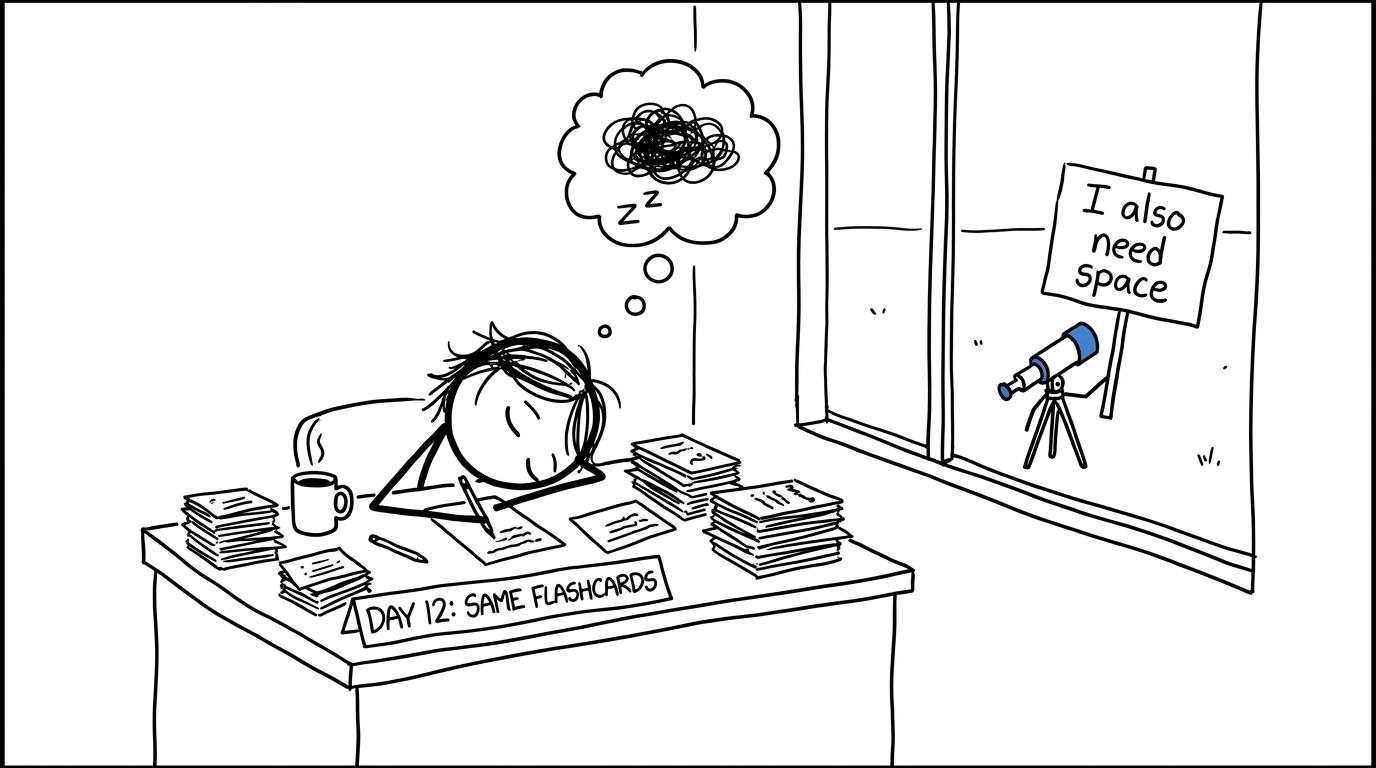 A tired student and a telescope agree that both revision and astronomy need space
Why daily revision is not automatically better
Learning can feel strongest immediately after reading a page because the information is still familiar. Familiarity, however, is not the same as durable recall. If you reread the Solar System chapter repeatedly on Sunday, your final attempt may feel easy partly because the wording and diagrams remain in working memory.
Return on Wednesday with the book closed and the experience changes. Recall requires more effort. That effort is useful: it shows whether you can reconstruct the knowledge rather than merely recognise it.
Research on the spacing effect consistently supports distributing learning over time instead of massing the same amount of practice into one sitting. A major review of spacing and retrieval practice describes spacing as one of the most reliable findings in learning research. A 202520252025 meta-analysis focused specifically on mathematics also found a small-to-medium overall advantage for spaced rather than massed practice, although the effect varied between contexts.
That distinction matters. Evidence supports spaced practice, not a magical universal timetable. There is no single number of rest days that suits every student, topic or examination date.
What rest actually does for retention
A rest day is not a reward for having revised properly. It is part of a sustainable schedule.
When learning sessions are separated, some forgetting occurs. That may sound undesirable, but partial forgetting makes the next retrieval more demanding. Successfully bringing an idea back strengthens access to it. Spacing also reduces the false confidence created by seeing the same notes repeatedly.
Sleep matters too. Research suggests that sleep can support memory consolidation, although the precise effect depends on the material and learning conditions. The practical conclusion is modest but important: replacing sleep with late-night revision is not a dependable way to gain marks.
Rest does not mean that information improves without practice. You still need to retrieve, apply and check it. A good pattern is:
learn→rest→retrieve→check→revisit\text{learn} \rightarrow \text{rest} \rightarrow \text{retrieve} \rightarrow \text{check} \rightarrow \text{revisit}learn→rest→retrieve→check→revisitThis is stronger than:
read→read again→read again\text{read} \rightarrow \text{read again} \rightarrow \text{read again}read→read again→read againThe first cycle creates evidence. The second often creates comfort.
A weekly GCSE Astronomy revision rhythm
Pearson Edexcel GCSE Astronomy is currently an untiered qualification, unlike foundation and higher tier GCSE Maths. Its two externally examined papers are equally weighted: Paper 111 covers naked-eye astronomy and Paper 222 covers telescopic astronomy. Each paper lasts 111 hour 454545 minutes and is worth 100100100 marks. The assessment includes knowledge, application, calculations, graphical work and the analysis of observations and data.
That breadth is a reason to rotate topics rather than doing astronomy in one undifferentiated block.
A balanced week
You could organise a normal revision week like this:
- Monday: retrieve one Paper 111 topic, then check gaps against your notes.
- Tuesday: no astronomy; revise another GCSE subject or rest.
- Wednesday: study one Paper 222 topic and answer questions without copying.
- Thursday: short recall of Monday's material, followed by corrections.
- Friday: rest from astronomy.
- Saturday: complete a mixed or timed set and mark it carefully.
- Sunday: rest, or spend no more than 101010 minutes planning the next week.
This gives you frequent contact without demanding a full astronomy session every day. It also creates gaps between encounters with the same content.
If your wider timetable is becoming crowded, the GCSE maths revision timetable guide can help you arrange subjects around realistic weeknight and weekend blocks.
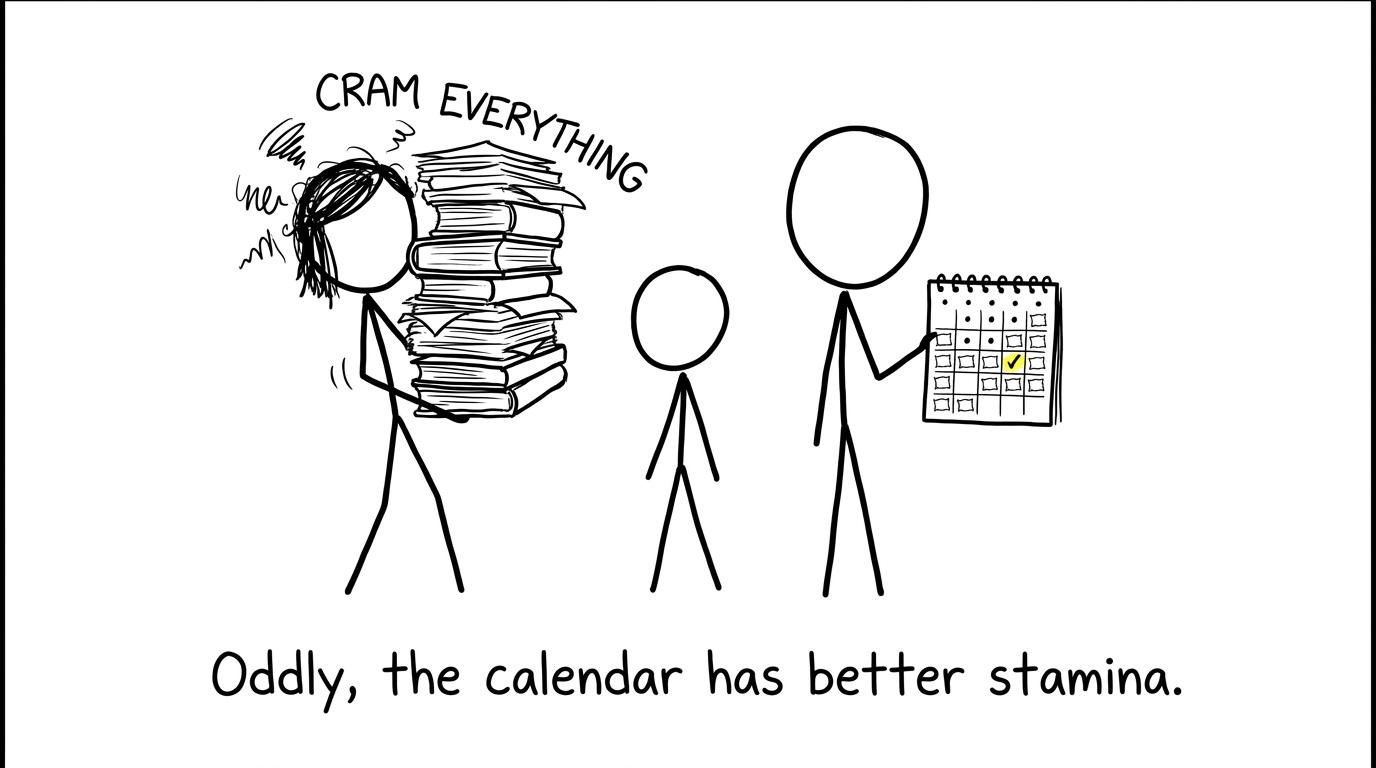 A frantic cramming coach competes with a calm calendar containing study and sleep days
What to do inside each revision session
Spacing weak revision merely produces weak revision on different days. The activity inside each session still matters.
Begin with retrieval
Before opening your notes, write down what you remember, label a diagram from memory or answer several focused questions. Retrieval exposes uncertainty quickly. The Education Endowment Foundation notes that recalling previously learned knowledge can strengthen access to it and reduce the pressure on working memory when related tasks appear.
If your notes currently do most of the thinking, use the active recall guide for GCSE revision to turn information into short prompts.
Check and correct
Compare your response with reliable course materials or a mark scheme. Record a precise correction such as “confused altitude with declination”, not “revise coordinates”. Specific errors lead to specific action.
The same principle strengthens maths revision. MathsGenie's guide to finding weak GCSE topics explains how to convert lost marks into a focused revision list rather than revising everything equally.
Apply the knowledge
Astronomy questions do not only ask for isolated facts. The specification includes calculations, graphs, observations and interpretation. You therefore need practice that asks you to select and use knowledge in unfamiliar contexts.
Finish by scheduling the next encounter. A practical pattern might revisit a topic after roughly 222 days, then 777 days, followed by a later mixed test. Treat this as an adaptable starting point, not a scientifically perfect formula.
Keep the maths behind astronomy secure
Students sometimes separate astronomy knowledge from mathematical technique. The examination does not. Large and small scales, rearranging relationships, interpreting graphs and using angles all require mathematical fluency.
Standard form is particularly useful when quantities span enormous scales. A number in standard form has the structure
a×10n,1≤a<10,a \times 10^n, \qquad 1 \leq a < 10,a×10n,1≤a<10,where nnn is an integer. You can strengthen this skill through the standard form revision lesson and questions.
Graphs and periodic behaviour also reward careful reading of axes, scales and units. The trigonometric and exponential graphs resources provide useful mathematical practice, even though you should always follow the exact requirements of your Astronomy specification.
Use the main GCSE Maths revision hub to choose resources for Edexcel, AQA, OCR or Eduqas maths. Remember that these are your maths exam boards; GCSE Astronomy itself is offered by Pearson Edexcel.
Should you ever revise astronomy every day?
Daily contact can be useful for a short period, particularly near a mock or final examination. But “every day” should usually mean brief, varied retrieval rather than seven heavy sessions.
For example, a daily contact plan could alternate between:
- recalling definitions;
- interpreting an observational diagram;
- completing a short calculation set;
- reviewing an error log;
- answering an extended-response question;
- checking units and command words;
- resting from demanding work while planning the next cycle.
The important measurement is not your streak. It is whether you can retrieve and apply the material after time has passed.
As the examination approaches, use timed work to identify what remains fragile. MathsGenie's guidance on using past papers properly provides a useful cycle: complete, mark, diagnose, repair and retest. For shorter mathematical checks alongside astronomy, use the free GCSE mini tests.
Common mistakes when balancing revision and rest
Revising the same chapter on consecutive days
This can create fluency without lasting recall. Unless you are correcting a fresh misconception, leave a gap before testing the same material again.
Treating rest as failure
A planned day away from astronomy is not lost time. It helps you maintain attention across the full revision period and makes genuine spacing possible.
Turning a rest day into a late-night catch-up
If your rest day ends with exhausted revision after midnight, it has not protected recovery. Move unfinished work into a later priority slot instead.
Rereading instead of retrieving
Highlighting and rereading can support initial understanding, but they should not dominate. Close the page and produce an answer before checking it.
Ignoring corrections
Completing questions without examining errors rehearses the wrong method. Use mark schemes, teacher feedback and video solutions to find the exact point where the answer weakened.
Revising astronomy while neglecting maths
An astronomy paper can expose weak handling of standard form, graphs, units or rearrangement. Keep one or two short maths sessions in the week so these tools remain available.
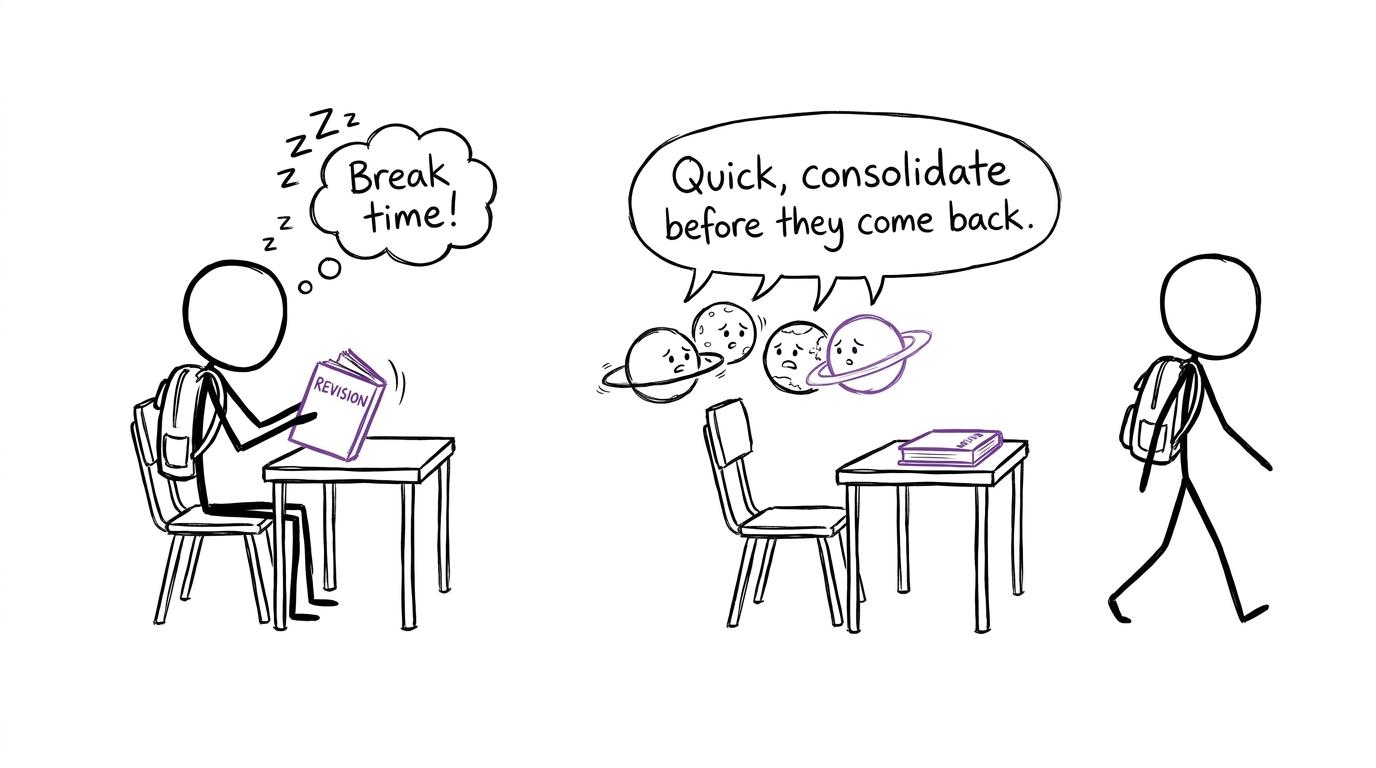 Cartoon planets quietly consolidate knowledge after a student closes the revision book
Build a routine you can still follow next week
The better question is not whether the most determined student revises GCSE Astronomy every day. It is whether your schedule repeatedly brings important knowledge back just as it is becoming difficult to recall.
Choose three or four focused astronomy sessions this week. Begin each one without notes, check your response, correct one precise weakness and schedule a later revisit. Keep rest days deliberate and protect sleep. Near the examination, add timed questions rather than simply extending every session.
Then use MathsGenie to keep the mathematical side of your preparation organised. Start with free revision lessons, strengthen individual skills through practice questions and mini tests, and build exam confidence with Edexcel GCSE Maths past papers, mark schemes, predicted papers and video solutions. Consistency matters, but consistency includes knowing when to stop, recover and return ready to remember.