GCSE Astronomy Paper 2 Exam Date 2026
GCSE Astronomy Paper 2 exam date 2026: check the confirmed date, afternoon session, duration, topics, equipment and a calm final revision plan for exam day.
The GCSE Astronomy Paper 2 exam date 2026 was Thursday 11 June 2026. Pearson Edexcel scheduled Paper 2: Telescopic Astronomy, code 1AS0/02, for the afternoon session. The examination lasted one hour and 45 minutes.
That is the immediate answer. But knowing the date is only the first part of being ready. You also need to confirm your centre's arrival time and room, understand what Paper 2 assesses, prepare the permitted equipment and make sensible use of the time between the two Astronomy papers.
Pearson's final timetable is the national starting point. Your personalised timetable from your school or examination centre remains the document to follow on the day.
GCSE Astronomy Paper 2 date at a glance
- Date: Thursday 11 June 2026
- Session: Afternoon
- Exam board: Pearson Edexcel
- Paper: Paper 2: Telescopic Astronomy
- Paper code: 1AS0/02
- Duration: One hour and 45 minutes
- Total marks: 100100100
- Qualification weighting: 50%50\%50%
- Tier: Untiered, so every candidate sits the same paper
- Contingency day: Wednesday 24 June 2026
Paper 1: Naked-eye Astronomy was scheduled for Monday 1 June 2026, also in the afternoon. That left a useful interval before Paper 2, but an interval only helps when it has a plan attached to it.
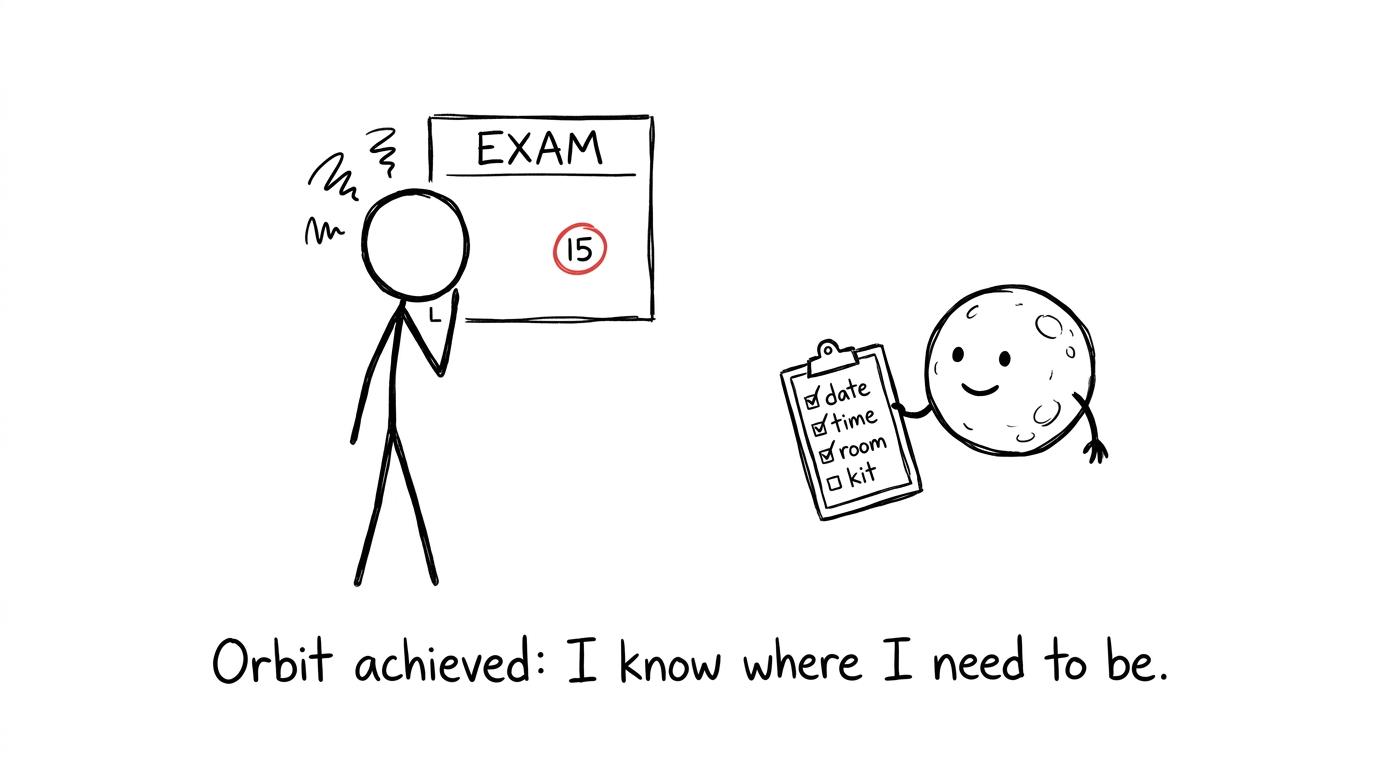 A student calmly confirms an exam date with help from a tiny moon
Confirm the details with your examination centre
An afternoon session does not mean you should decide your own arrival time. Pearson timetables identify the national session, while schools and private examination centres issue the practical instructions candidates must follow.
Before the examination, check:
- the start and arrival times on your personal timetable
- the building and room
- your candidate number and centre number
- where to leave your bag and mobile phone
- whether your centre has any additional equipment instructions
- any agreed access arrangements
Aim to arrive at the time specified by your centre, not at the moment you think the paper begins. A delayed bus, an unfamiliar room or a last-minute search for a calculator can consume attention that would be better used on the paper.
The contingency day of Wednesday 24 June 2026 was reserved for significant national or local disruption. It was not an optional resit day for an examination missed by an individual candidate. Students were expected to remain available, although any national change would have been communicated through their centre.
What GCSE Astronomy Paper 2 covers
Paper 2 is formally called Telescopic Astronomy. According to the Pearson Edexcel specification, it assesses Topics 999 to 161616:
- Exploring the Moon
- Solar astronomy
- Exploring the Solar System
- Formation of planetary systems
- Exploring starlight
- Stellar evolution
- Our place in the Galaxy
- Cosmology
The paper contains 101010 questions, and candidates must answer all of them. Question styles can include multiple-choice items, short answers, calculations, graphical work and extended open responses. Synoptic questions may connect knowledge and skills from different parts of the course.
That mixture matters. Revising definitions alone is not enough, but neither is doing calculations without understanding what the quantities represent. Strong preparation moves between recall, application, data interpretation and written explanation.
The maths skills worth checking before Paper 2
Astronomy often places familiar GCSE maths inside an unfamiliar setting. A very large distance, a tiny angle or a graph of stellar data may look specialised, but the underlying work can involve standard form, proportional reasoning, rearranging formulae and interpreting graphs.
Useful areas to review include:
- standard form and powers of 101010
- substituting into formulae
- rearranging equations
- ratios and proportional reasoning
- unit conversions
- angles and trigonometric reasoning
- reading scales, tables and graphs
- gradients and trends
- significant figures and sensible rounding
MathsGenie's GCSE Maths revision hub brings together free lessons, practice questions, worksheets, mini tests and paper practice. If astronomical distances or very small measurements are causing trouble, revisit the standard form revision guide.
For broader preparation, the guide to GCSE maths topics that appear regularly highlights dependable numerical and algebraic skills. Astronomy has its own specification, but accurate calculator use and clear mathematical working remain transferable exam habits.
Do not merely watch a solution and decide that it looks reasonable. Attempt the question first, check the mark scheme, record the exact error and try a similar question later. MathsGenie's guide to finding your weakest GCSE topics explains how to turn lost marks into a focused revision list.
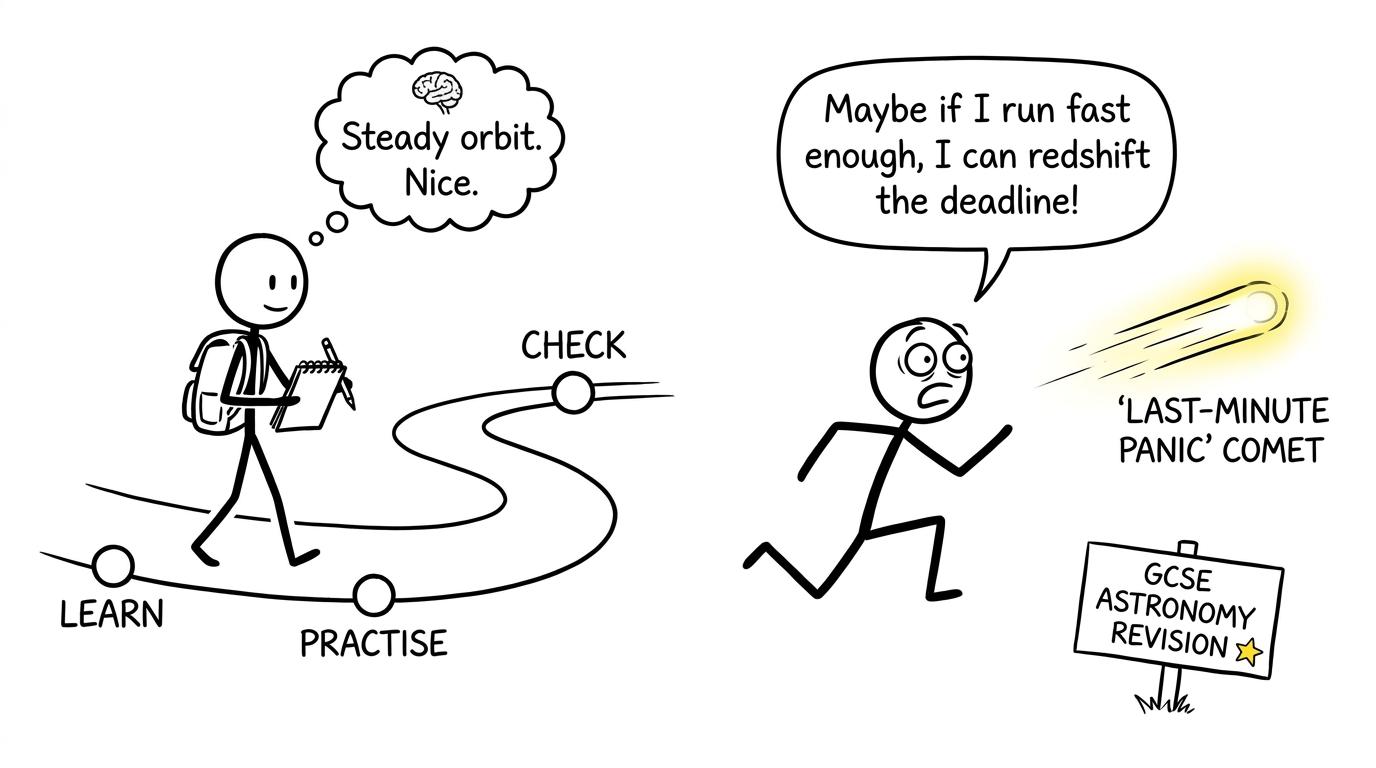 A prepared student follows a revision map while panic chases a comet
What to have ready for the examination
The safest rule is to check both your centre's instructions and the front of the examination paper. Based on Pearson's specification and recent Paper 2 materials, candidates should be prepared with the following.
Writing and drawing equipment
Pack at least two working black pens, a sharp pencil, an eraser and a ruler. A pencil is useful for graphs and diagrams, while written answers should follow the instructions printed on the paper.
Keep permitted equipment in a transparent pencil case if your centre requires one. Remove notes, formula cards and anything else that is not allowed.
A suitable calculator
Calculators may be used in GCSE Astronomy Paper 2. The calculator should be suitable for examination use, either battery-powered or solar-powered, and free from cases or covers carrying printed instructions or formulae.
Check it before the examination. Make sure you know how to enter standard form, brackets, powers and trigonometric calculations. Clear stored material if required and place the calculator in the correct angle mode for the question you are answering.
Do not bring an unfamiliar replacement calculator and expect speed to appear under pressure. Familiarity is part of preparation.
Personal examination information
Have your official timetable or the information requested by your centre available before entering the room. Know your candidate and centre details rather than relying on a friend to remember them.
The formulae and data sheet is normally provided with the paper, as indicated in Pearson's examination materials. You should still know what each quantity means and how to select, rearrange and use the relevant relationship. A supplied formula is a tool, not a substitute for understanding.
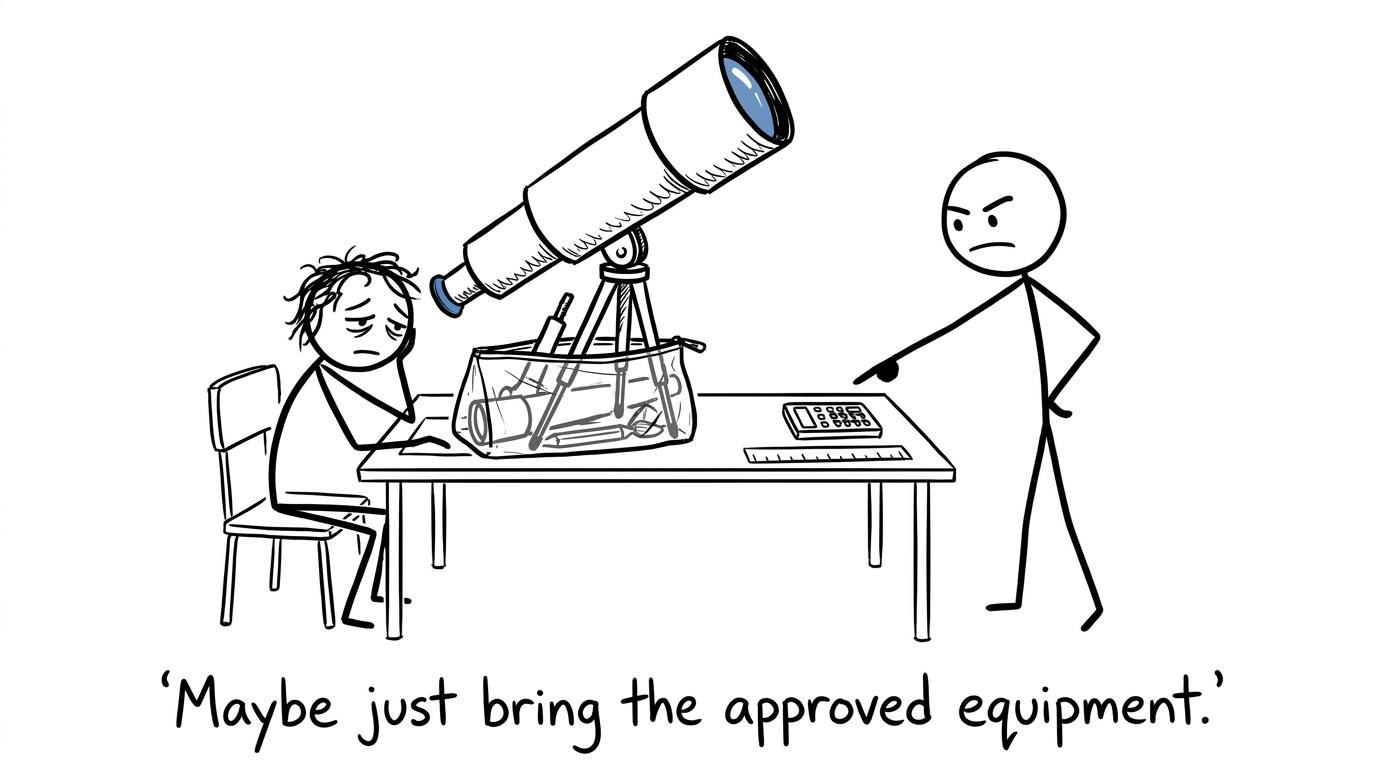 A student discovers that a telescope does not fit inside an exam pencil case
A calm final revision plan
The best final plan is narrower than most students expect. Near the examination, the goal is not to reread the entire course. It is to identify the few places where marks are still leaking and repair them.
Several days before
Complete a timed Paper 2 or a substantial timed section. Mark it carefully and classify every lost mark as one of the following:
- missing knowledge
- misunderstood command word
- mathematical method error
- calculator or rounding error
- weak graph or data interpretation
- incomplete explanation
- poor time management
Choose your highest-impact weaknesses. If the problem is mathematical, use a focused MathsGenie revision lesson and practice questions rather than revising an entire subject area. The one-week GCSE revision plan offers a useful structure for short, targeted sessions.
The day before
Do one light set of questions and mark it immediately. Review your error log, key definitions and the use of the formulae and data sheet. Then stop.
Pack your equipment, confirm the timetable and protect your sleep. The GCSE exam week checklist provides a simple model: practise, mark, identify a small fix list and prepare your kit without turning the evening into an endurance test.
During the paper
Read command words carefully. If a question asks you to calculate, show clear working. If it asks you to explain, connect cause and effect rather than listing disconnected facts. For a graph, check labels, units, scale and plotted values.
Use the marks shown beside each question as a guide to the expected depth and time. The paper offers 100100100 marks in one hour and 454545 minutes, so spending too long polishing one low-mark response can become expensive. If you are stuck, write down any relevant relationship or reasoning, move on and return later.
Leave time to check units, powers of 101010, calculator entries and whether your final answer actually addresses the question.
Common mistakes before and during Paper 2
Trusting an unofficial date
Timetable summaries can contain typing errors or outdated provisional dates. The verified Pearson final timetable scheduled Paper 2 for Thursday 11 June 2026 in the afternoon. Your centre timetable should provide the final practical details.
Assuming afternoon means a universal arrival time
The national session is not permission to arrive whenever you choose. Follow the reporting time supplied by your school or examination centre.
Revising only astronomy facts
Paper 2 includes calculations, graphs and data. If standard form, rearranging or calculator use is weak, factual knowledge alone may not secure the available marks.
Forgetting that the paper is untiered
GCSE Astronomy does not have separate foundation and higher papers. All candidates sit the same Paper 2, so revision should cover the full specification rather than stopping at an assumed tier boundary.
Treating the calculator as a replacement for working
A calculator produces an output, not an argument. Show substitutions and intermediate steps clearly enough for an examiner to follow your method, then round only as directed or when appropriate.
Doing a post-mortem on Paper 1 for too long
Paper 1 can reveal useful weaknesses, but repeatedly discussing answers cannot change its marks. Record anything transferable, such as poor timing or missed units, and redirect your attention towards Paper 2.
Turn the date into a practical next step
The timetable date is fixed; the quality of the preparation around it is not. GCSE Astronomy Paper 2 was scheduled for Thursday 11 June 2026, in the afternoon, with one hour and 454545 minutes available. Before the session, candidates needed a confirmed centre timetable, suitable writing equipment, a ruler, an approved calculator and a revision plan covering Topics 999 to 161616.
For the mathematical skills underneath astronomy questions, make MathsGenie your free revision base. Start with the GCSE Maths revision area, use revision lessons and practice questions to repair weak methods, then build speed through mini tests, past papers and video solutions. Maths predicted papers can also strengthen general exam technique, provided they are used for maths preparation rather than mistaken for Astronomy papers.
A date circled on a calendar does not improve a grade by itself. What matters is what the date helps you do next: choose the right topic, practise it honestly, check the mark scheme and arrive with the right equipment.