GCSE Astronomy Paper 1: What to Actually Expect
GCSE astronomy paper 1 explained: timing, topics, question styles, maths skills and a focused revision plan for Edexcel's naked-eye astronomy exam.
The unsettling thing about an astronomy exam is its scale. You revise planets, eclipses and gravity, yet the test itself comes down to a desk, a calculator and a finite number of minutes. The good news is that GCSE astronomy paper 1 is much less mysterious once you understand its boundaries.
The paper is Pearson Edexcel Paper 1: Naked-eye Astronomy, code 1AS0/01. It lasts 1 hour 45 minutes, is worth 100 marks and contributes 50%50\%50% of the qualification. You answer every question, calculators are allowed, and a formulae and data sheet is provided. Crucially, GCSE Astronomy is untiered; there is no separate foundation or higher paper.
Here is the short version of what to expect:
- Topics 1 to 8 from the Edexcel specification
- Ten questions, usually divided into several parts
- Multiple-choice and short-answer questions
- Calculations and graphical questions
- Questions about observational methods and data
- Extended open-response questions
- Familiar knowledge placed in unfamiliar astronomical contexts
The quickest way to see the format for yourself is to open the Edexcel GCSE Astronomy revision hub and compare several real papers.
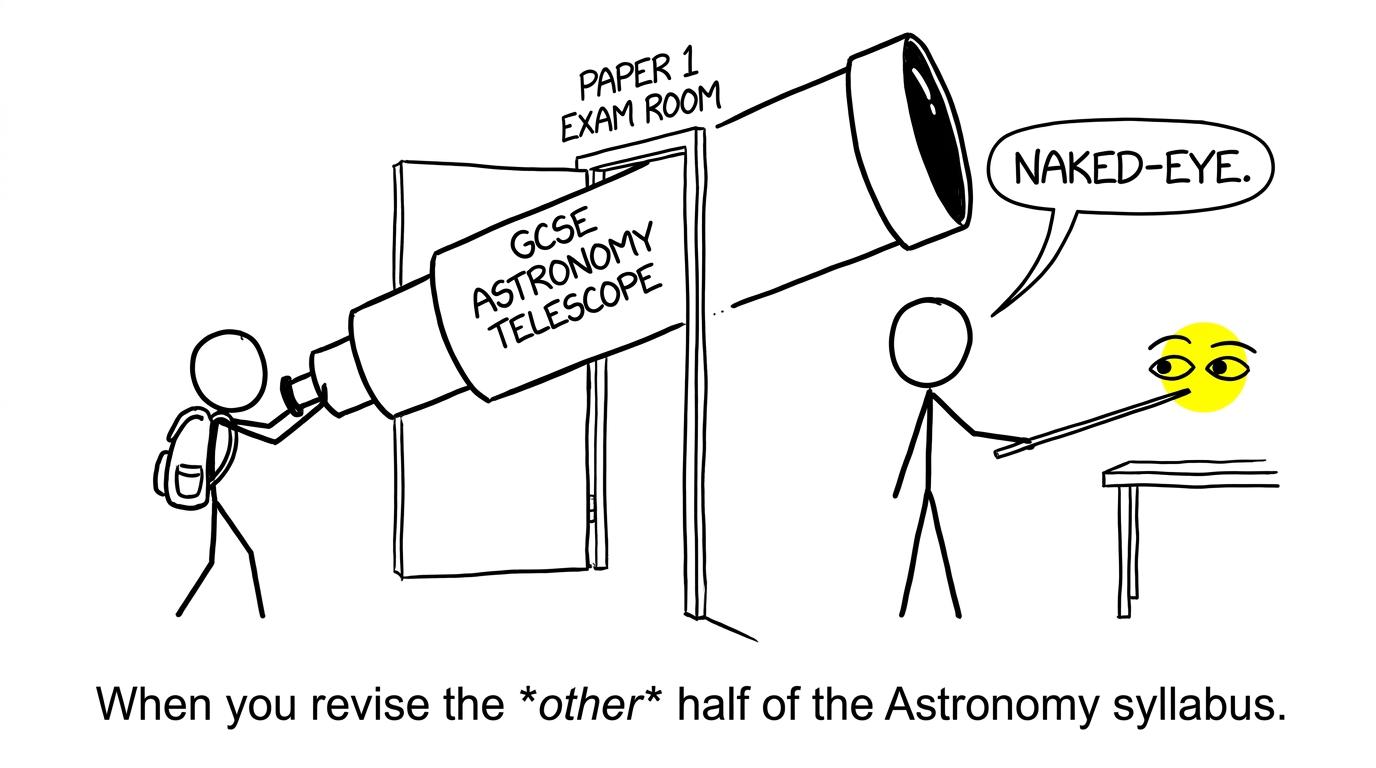 A student discovers that the telescope has arrived for the wrong astronomy paper
What is different about GCSE Astronomy Paper 1?
Paper 1 differs from Paper 2 primarily because of content, not because it uses a completely different exam format.
Paper 1 is called Naked-eye Astronomy. It concentrates on the Earth, Moon and Sun, the appearance and movement of objects in the sky, systems for measuring time and position, early Solar System models, and the laws governing planetary motion. Paper 2, Telescopic Astronomy, moves into areas such as telescopes, solar astronomy, space exploration, stars, galaxies and cosmology.
That title can be misleading. “Naked-eye” does not mean the paper contains only simple facts about what you can see by looking upwards. It includes demanding ideas about celestial coordinates, eclipses, timekeeping, historical models, Kepler’s laws and gravity.
Nor is it a non-calculator paper. Unlike GCSE Maths Paper 1 for several major boards, Edexcel GCSE Astronomy Paper 1 allows a calculator. Bring one you know how to use, along with a ruler and black pen.
GCSE Astronomy Paper 1 timing and format
The examination lasts 105 minutes and contains 100 marks, so the marks provide a sensible guide to timing. Roughly speaking, one mark deserves about one minute. A small amount of time can then be protected for checking.
Do not turn that into a rigid rule. A one-mark identification may take only a few seconds, while a calculation or extended response needs reading and planning time. The purpose of the rule is to stop a difficult three-mark question consuming ten minutes.
A practical approach is:
- Move through accessible questions steadily on the first pass.
- Mark any difficult part clearly and continue.
- Use the marks in brackets to judge the expected depth.
- Return to incomplete calculations and longer responses.
- Check units, rounding, graph scales and unanswered parts at the end.
Pearson states that the paper contains ten questions and mixes multiple-choice, short-answer, calculation, graphical and extended-open-response items. Questions are often divided into parts that increase in demand. The opening part may test recognition; a later part may require application, analysis or evaluation.
The MathsGenie Astronomy past papers let you practise this exact rhythm with official papers and mark schemes.
The eight topics you need to revise
Paper 1 assesses Topics 1 to 8 of the Edexcel specification.
Planet Earth
You need to understand the Earth’s shape and internal structure, latitude and longitude, and how the atmosphere affects astronomical observation. This includes effects such as refraction, absorption, scattering and light pollution.
The lunar disc
This topic covers the appearance of the Moon, its major surface features and how those features formed. You also need to understand rotation, revolution and libration, rather than simply memorising labels on a lunar map.
The Earth-Moon-Sun system
Expect ideas involving relative sizes and distances, lunar phases, eclipses, tides and the changing orientation of the Earth. Questions may combine a diagram with written explanation or numerical information.
Time and the Earth-Moon-Sun cycles
This includes solar and sidereal time, time zones, solstices, equinoxes and the Equation of Time. The challenge is often to connect a definition to what an observer would actually measure.
Solar System observation
You should understand the apparent movement and visibility of planets and other Solar System objects. The specification also includes ideas such as the ecliptic, retrograde motion, meteors and meteor showers.
Celestial observation
This is where practical sky knowledge becomes important. Revise constellations, star trails, circumpolar stars, celestial coordinates and the factors affecting visibility. Be prepared to interpret an unfamiliar observation, not merely describe a memorised one.
Early models of the Solar System
You need to compare historical models and understand how evidence changed astronomical thinking. Strong answers distinguish what a model explained from what it failed to explain.
Planetary motion and gravity
This topic links the work of astronomers and scientists such as Copernicus, Brahe, Kepler and Newton. Mathematical relationships may be given through formulae or data, including the relationship represented by:
T2∝r3T^2 \propto r^3T2∝r3Knowing the relationship is only the beginning. Questions can ask you to apply it, interpret evidence or explain why a model was significant.
What types of questions does Paper 1 favour?
Paper 1 does not reward recall alone. Across the qualification, the assessment objectives are weighted at 40%40\%40% for knowledge and understanding, 40%40\%40% for application, and 20%20\%20% for analysing and evaluating information, observations and methods. Each paper reflects the same broad balance.
That creates several recurring demands.
Observation-based questions
You may be given an observing plan, description, diagram or set of results. The task might ask you to identify a problem, improve the method, interpret the evidence or reach a justified conclusion.
Your own observational work matters here. GCSE Astronomy requires students to undertake at least one unaided and one aided observation, and observational skills are assessed in the written examinations. Revise why techniques such as dark adaptation, averted vision, repeated measurements and careful site selection improve an observation.
Calculations in context
Mathematical skills account for at least 20%20\%20% of the written assessment across the qualification. Paper 1 can therefore test calculations involving scale, angular measurement, time, distance, orbital relationships and gravity.
Useful supporting skills include:
- standard form
- ratios and scale
- unit conversion
- substitution and rearranging formulae
- reading and plotting graphs
- significant figures
- interpreting gradients and proportional relationships
If powers of ten are slowing you down, revisit the standard form revision guide. For measurements and time calculations, use the conversions and units revision guide. Scale questions also become easier when your ratio skills are secure.
Graphical and data questions
Graphs are not decorative. Check both axes, units, scales and whether the data support the conclusion being suggested. If asked to draw a line or curve, use a ruler where appropriate and make full use of the plotting area.
A question may reward a numerical reading, a trend and an astronomical explanation separately. Give all three when the wording and mark allocation require them.
Extended open responses
Longer answers reward structure rather than length. Read the command word, identify the competing ideas or stages, then build a connected response using relevant astronomy.
For an evaluation, discuss strengths, limitations and the significance of the evidence. For an explanation, make the causal chain explicit. A page of loosely related facts is less effective than a shorter answer in which every sentence advances the argument.
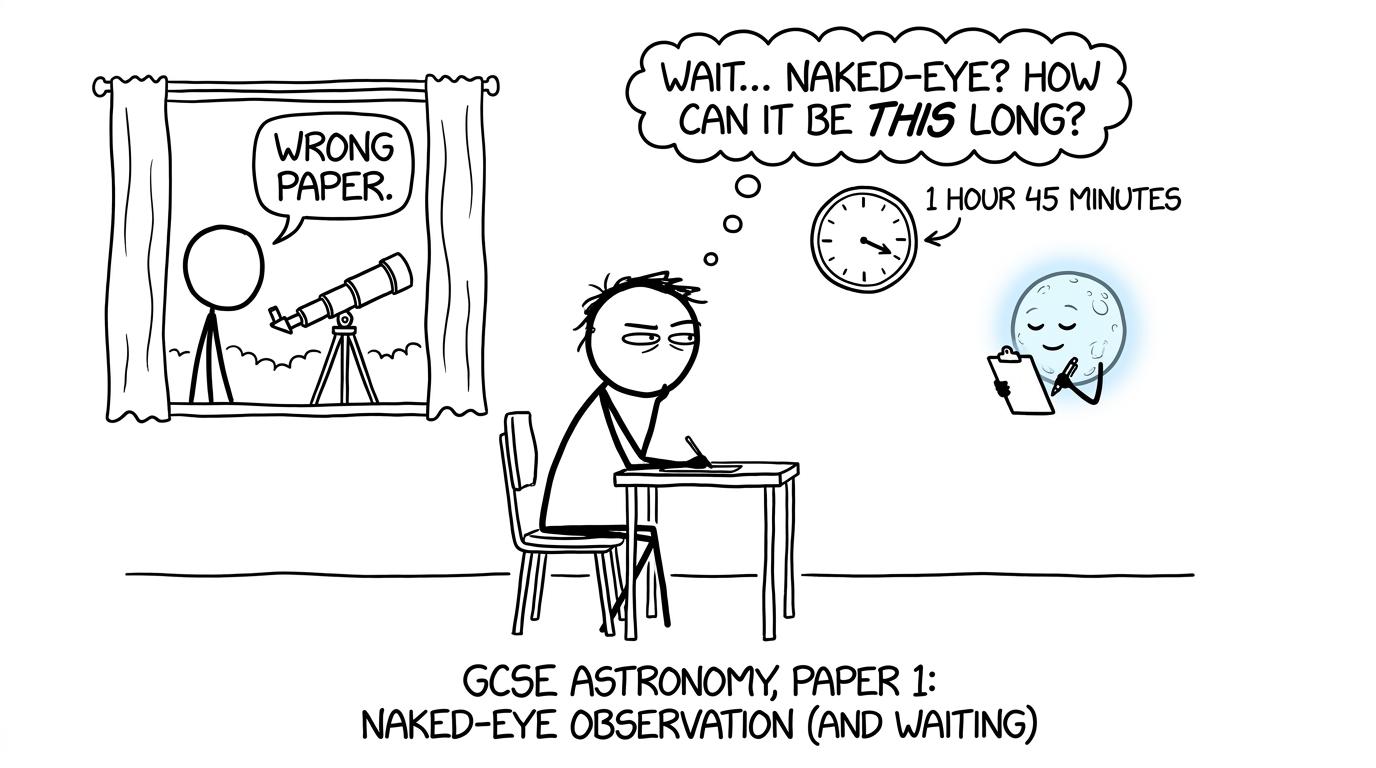 The exam clock appears far more dramatic than the Moon
How to revise for Paper 1 efficiently
Start with a timed diagnostic paper. Do not wait until every topic feels complete; that feeling rarely arrives. A paper shows whether the real weakness is knowledge, maths, observational reasoning or timing.
After marking, classify each lost mark:
- Knowledge: a fact or concept was missing.
- Application: you knew the idea but could not use it in context.
- Maths: the formula, units or calculation caused the problem.
- Observation: you could not analyse or improve a method.
- Technique: you misread the command word, omitted working or ran out of time.
Then revise the cause, not just the question. The MathsGenie guide to using past papers explains how to move from topic practice to timed exam conditions. You can also organise repeat sessions with the free revision planner.
A reliable weekly cycle is simple: revise one Paper 1 topic, complete focused questions, mark them, correct the errors and finish with a timed section. Near the exam, use full past papers. MathsGenie’s past-paper tools make it easier to keep the question paper and official mark scheme together.
Common mistakes on GCSE Astronomy Paper 1
Revising Paper 2 content by accident
Stars, stellar evolution and cosmology are fascinating, but they belong mainly to Paper 2. Use the eight-topic Paper 1 list as a boundary for each revision session.
Treating “naked-eye” as “easy”
The paper includes sophisticated models, observational reasoning and calculations. Revise the underlying relationships, not only object names and definitions.
Assuming it is non-calculator
A calculator is permitted. Practise using powers, brackets and standard form before the exam so the calculator reduces effort rather than creating new errors.
Copying values without units
Astronomy involves angles, times, distances and periods. Write the unit at each useful stage and check that the final unit answers the question.
Rounding during intermediate steps
Keep full calculator values while working and round only the final answer unless instructed otherwise. Premature rounding can shift an otherwise correct result.
Giving generic observation improvements
“Repeat it” or “be more accurate” may be too vague. State what should be repeated, how the results should be combined and why that would improve reliability.
Writing everything you know in longer answers
Extended responses are not memory dumps. Select evidence and explanations that address the precise command word.
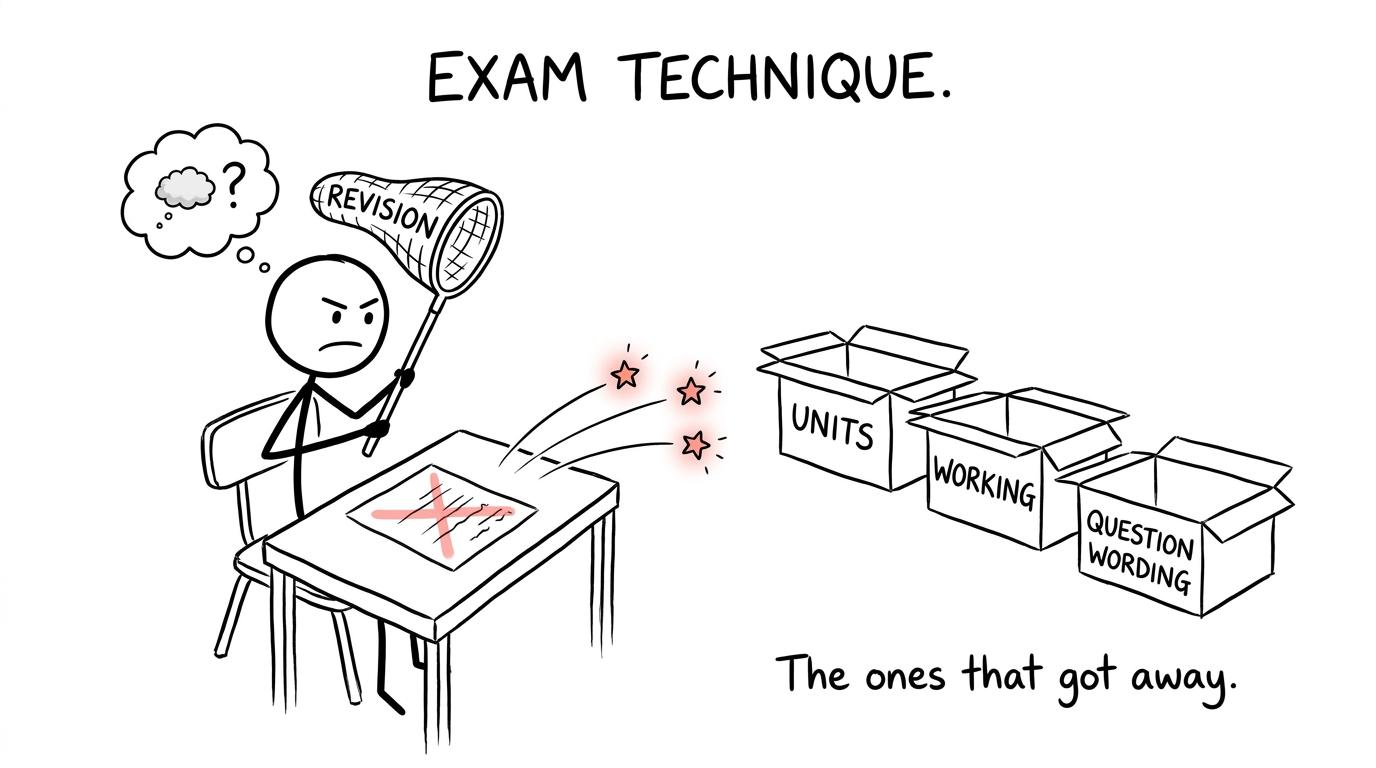 A student tries to catch marks escaping towards units and working
Go into Paper 1 knowing its shape
An exam becomes less intimidating when it stops being vague. GCSE Astronomy Paper 1 is a 100-mark, calculator-allowed examination on Topics 1 to 8. It tests knowledge, but it also expects you to apply ideas, handle maths, interpret observations and communicate extended reasoning.
Begin on the MathsGenie Edexcel GCSE Astronomy hub. Use revision lessons and practice questions to repair weak topics, then complete past papers under the full 1 hour 45 minute limit. Mark every attempt carefully, use available video solutions and mark schemes, and turn each lost mark into a specific next action.
That is also how MathsGenie’s wider revision system works: learn through clear lessons, practise until the method is secure, check yourself with mini tests, and build exam stamina with past papers and predicted papers. The night sky is enormous. Your revision plan does not need to be.