GCSE Astronomy Grade 6 Meaning Explained
GCSE astronomy grade 6 meaning explained: discover the ability it represents, how it compares with old letter grades and which maths skills to improve.
A result can look precise while still leaving you unsure what it says about you. Grade 6 is a good example. It is clearly above grades 4 and 5, but what kind of astronomical understanding does it represent? And is it really equivalent to an old grade B?
The gcse astronomy grade 6 meaning is best understood as a strong Level 2 performance. It indicates that you have developed secure astronomical knowledge and can generally apply it to calculations, observations, data and unfamiliar situations. In comparisons with the former letter system, it is commonly described as roughly a high B. That comparison is useful, but it is not an exact conversion.
Here is the short version:
- Grade 6 is above the grade 4 standard-pass threshold and grade 5 strong-pass benchmark.
- It sits below grade 7, whose lower boundary is officially aligned with the lower boundary of the old grade A.
- It broadly falls within the old B range, often being described informally as a high B.
- It reflects your total performance across the qualification, not mastery of every topic.
- The mark needed changes between exam series because grade boundaries are set after the papers have been taken.
What does a grade 6 in GCSE Astronomy mean?
A grade is not a list of everything you can and cannot do. It is a summary of your performance across an entire qualification.
In GCSE Astronomy, a grade 6 suggests that your understanding is more than basic recall. You can usually select relevant scientific ideas, apply your knowledge to questions and interpret astronomical information with reasonable accuracy. You may still lose marks on demanding multi-step calculations, subtle explanations or evaluations of observational methods, but the underlying understanding is strong.
The current assessment objectives divide the qualification into three broad kinds of performance:
- AO1: knowledge and understanding of scientific ideas, techniques and procedures, weighted at 40%40\%40%.
- AO2: applying that knowledge and understanding, weighted at 40%40\%40%.
- AO3: analysing observations, data and methods, drawing conclusions and improving procedures, weighted at 20%20\%20%.
This matters because a grade 6 cannot normally be earned through memorisation alone. Knowing a definition may begin an answer. Applying it to an unfamiliar observation, interpreting evidence and communicating a justified conclusion are what make the performance stronger.
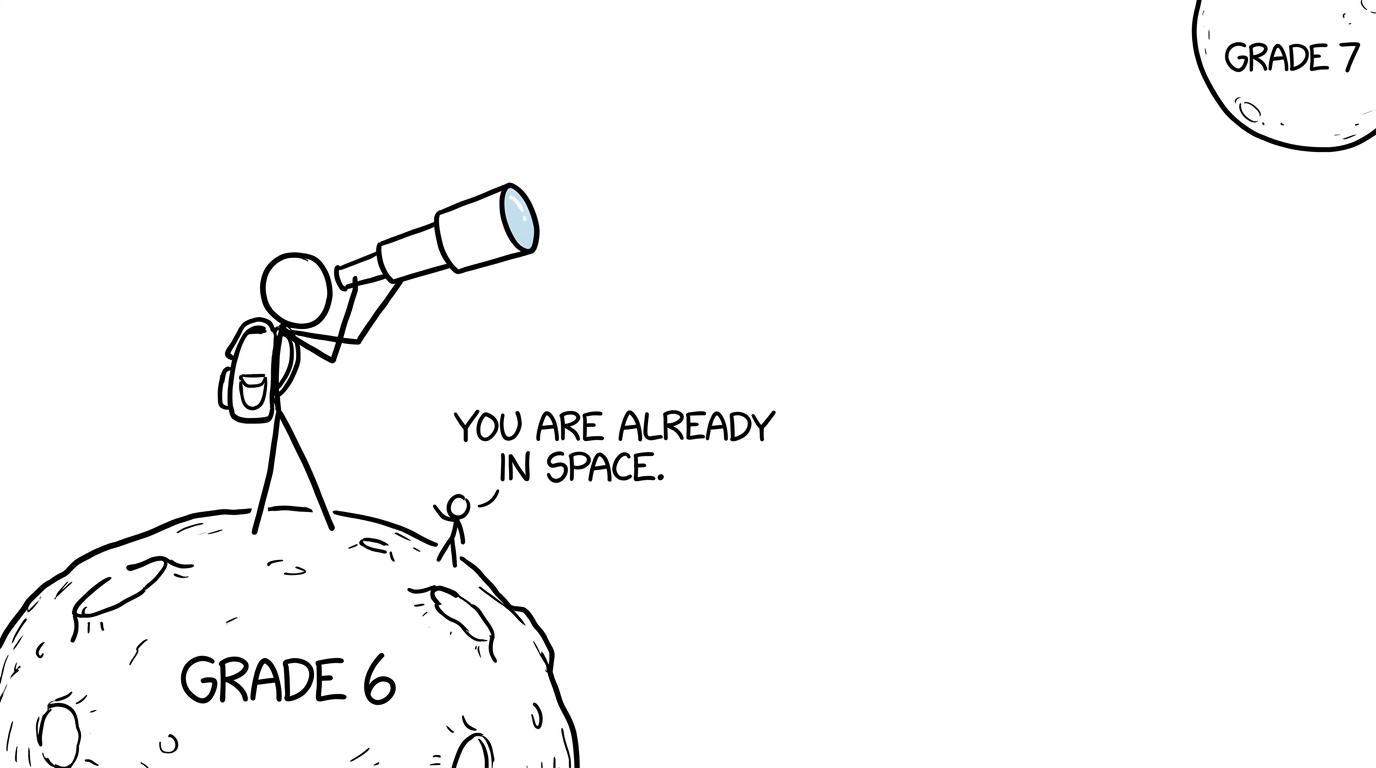 A student realising that grade 6 is already a strong achievement
Is grade 6 equivalent to an old B?
Broadly, yes, but the word broadly is important.
England’s numbered GCSE scale does not provide a perfect one-to-one conversion for every grade. Ofqual identifies three principal comparison points:
- the bottom of grade 7 aligns with the bottom of the old grade A;
- the bottom of grade 4 aligns with the bottom of the old grade C;
- the bottom of grade 1 aligns with the bottom of the old grade G.
Grades 4, 5 and 6 therefore divide the territory that was previously covered by grades C and B more finely. Grade 6 is commonly interpreted as a high B, while grade 5 is often viewed as lying around the upper-C to lower-B region. These are helpful descriptions, not official exact conversions.
It would be misleading to say that grade 6 simply is a B. The qualification content and assessment model changed alongside the grading scale. A numbered grade records achievement in the reformed GCSE rather than translating an old result letter for letter.
The safest description is this: grade 6 is a strong GCSE result positioned above the grade 5 benchmark and immediately below the old-A comparison point at grade 7.
What ability does grade 6 actually represent?
There is no separate official performance descriptor defining every skill of a grade 6 Astronomy student. Official GCSE grade descriptors focus on selected grades rather than creating a checklist for all nine grades. Your result is instead determined by your total mark and the boundaries set for that exam series.
Even so, the structure of the specification helps explain what the result usually reflects.
Secure astronomical knowledge
You are likely to understand a substantial proportion of the course, including ideas related to naked-eye astronomy, telescopic astronomy, planetary systems, stars, galaxies, cosmology and observation.
Secure knowledge does not mean perfect recall. A grade 6 student can still have weaker topics. The result shows that, across both papers, the strengths outweighed those gaps convincingly.
Application rather than recall alone
Because AO2 carries 40%40\%40% of the qualification, students must use ideas rather than merely repeat them. That may involve selecting a relationship, connecting evidence to a scientific principle or using information supplied in a question.
The difference is subtle but important. Recall asks, “Do you recognise this idea?” Application asks, “Can you use it when the setting looks different?” Grade 6 performance normally demonstrates a reasonably secure answer to both.
Competence with observations and evidence
Students are required to undertake at least two astronomical observations, including one aided and one unaided observation. Observational knowledge and skills are then assessed through the written examinations.
A grade 6 therefore points towards useful competence in planning, interpreting and evaluating observations. Stronger responses identify relevant limitations rather than making vague statements such as “human error”, and they connect suggested improvements to the quality of the evidence.
Reliable mathematical skills
At least 20%20\%20% of the marks in the written assessment reward mathematical skills in an astronomical context. These can include:
- standard form and orders of magnitude;
- ratio, fractions and percentages;
- inverse-square relationships;
- base-101010 logarithms and logarithmic scales;
- significant figures and unit conversions;
- substituting into and rearranging equations;
- interpreting gradients, intercepts and graphs;
- angular measures and spherical coordinates.
The mathematical demand is specified as no lower than Key Stage 3, although the astronomical setting can make familiar operations feel less familiar. You might understand ratio perfectly in a classroom exercise but hesitate when it appears inside a question about scale, brightness or distance.
That is why strengthening GCSE maths can support Astronomy revision. MathsGenie’s GCSE Maths topics by exam board and tier provides a useful map of number, algebra, ratio, graphs and geometry. If the foundations feel uneven, the best order for learning GCSE maths topics helps you repair them in a logical sequence.
How GCSE Astronomy is assessed
The current Edexcel GCSE Astronomy qualification has two written papers:
- Paper 1: Naked-eye Astronomy;
- Paper 2: Telescopic Astronomy.
Each paper is worth 100100100 marks, lasts 111 hour 454545 minutes and contributes 50%50\%50% of the qualification. Questions can include multiple-choice items, short answers, calculations, graphical work and extended open responses.
Your final grade is based on your combined mark across the two papers. It is not necessary to perform at “grade 6 level” on every individual question. One paper can also compensate, to an extent, for a weaker performance on the other.
This has a practical consequence for revision: balance matters. Spending all your time on favourite topics can create confidence without coverage. A better routine combines topic repair with mixed questions and timed papers.
Why grade boundaries are not fixed percentages
A common assumption is that grade 6 always requires a particular percentage. It does not.
Exam boards set grade boundaries for each exam series after reviewing how demanding the papers were and how students performed. If one set of papers is more demanding than another, the raw-mark boundary can differ. This protects the standard represented by the grade rather than attaching it permanently to one percentage.
So a mark from a classroom test should not be converted into a grade using a random boundary from another year. Use boundaries from the matching qualification and exam series, and treat teacher-produced assessments as estimates unless they have been designed and standardised accordingly.
The deeper lesson is useful for maths revision too: a raw score tells you what happened on one paper; an error pattern tells you what to improve next. MathsGenie’s guide to redoing GCSE past papers effectively explains how to move from marking to targeted repair rather than repeatedly completing papers without learning from them.
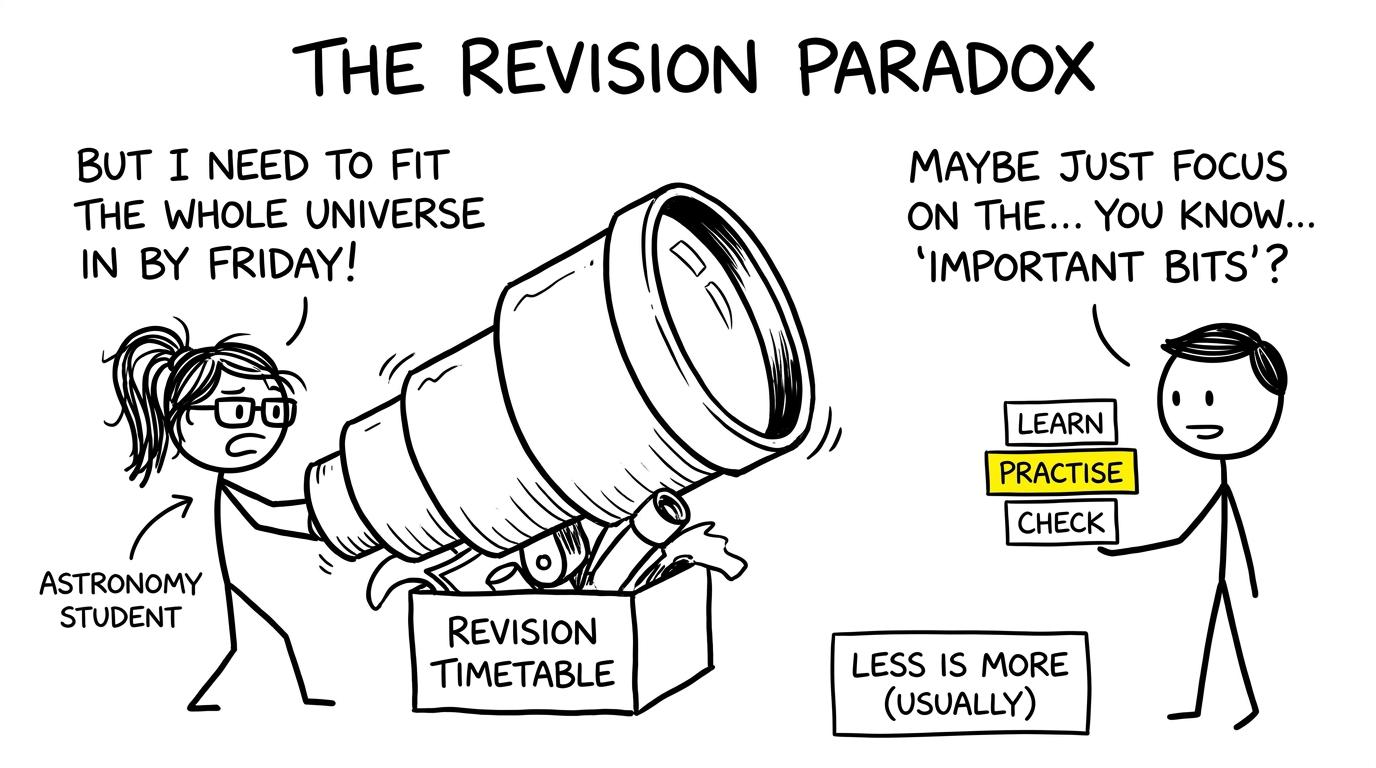 An enormous telescope failing to fit inside a revision timetable
How to move from grade 6 towards grade 7
The gap between grades is rarely one dramatic missing fact. More often, marks leak away through several small habits: an unconverted unit, an imprecise explanation, an unjustified conclusion or a graph read incorrectly.
Use this revision cycle:
- Complete a timed section or mixed assessment.
- Mark it carefully using the mark scheme.
- Label each lost mark as knowledge, application, calculation, interpretation or communication.
- Relearn the relevant idea.
- Practise several questions requiring the same skill.
- Retest it after a gap.
For the mathematical part, begin at the MathsGenie free GCSE and A Level revision hub. Revision lessons and practice questions can rebuild individual techniques, while mini tests show whether you can retrieve them without prompts.
A structured plan is often more effective than a long list of intentions. The GCSE one-month maths revision plan offers a repeatable rhythm of learning, practice, marking and retesting. You can adapt that same rhythm to Astronomy.
When revising maths specifically, use official past papers for realism and Edexcel GCSE Maths predicted papers for additional timed practice. Predicted papers should supplement past papers rather than replace them. The guide to using predicted topics without guessing explains why broad preparation remains safer than betting on a narrow topic list.
Common mistakes when interpreting a grade 6
Treating it as an exact old grade B
“High B” is a reasonable shorthand, but it is approximate. The official scales are anchored at selected boundaries, not matched grade by grade.
Assuming it means a fixed percentage
Grade boundaries change between exam series. Always check the correct board, qualification code and year before interpreting a raw mark.
Believing every topic must be at grade 6 standard
The grade comes from an aggregate mark. A student can have strong and weak areas and still achieve grade 6 overall.
Revising facts while neglecting application
AO1 and AO2 are each worth 40%40\%40%. Definitions matter, but students also need to apply ideas to unfamiliar contexts.
Ignoring the mathematical marks
At least 20%20\%20% of the written assessment rewards maths skills. Weaknesses in standard form, units, ratio, graphs or equation handling can quietly limit an otherwise strong Astronomy result.
Comparing unrelated papers too confidently
A score from one year, board or subject cannot be converted reliably using another paper’s boundary. Match the assessment to its own published information.
A grade is a position, not a ceiling
Grade 6 in GCSE Astronomy represents strong achievement. It shows that you can do considerably more than recall isolated facts: you can apply astronomical knowledge, handle evidence, engage with observational methods and use mathematics in scientific contexts. In old-grade language, “roughly a high B” is helpful, provided it is not mistaken for an exact conversion.
The most useful question is not whether the grade sounds impressive. It is what your lost marks are trying to tell you.
Use MathsGenie to strengthen the maths beneath your science: choose focused revision lessons, complete practice questions, check mark schemes and video solutions, then test your progress with mini tests, past papers and predicted papers. A grade describes one performance. A calm, repeated revision process changes the next one.