GCSE Astronomy February Half-Term Revision Plan
GCSE astronomy February half term revision made manageable: follow a focused seven-day plan, improve calculation skills and protect time for GCSE maths.
February half-term can feel deceptively large. At the beginning, there appears to be plenty of time. Then a few slow mornings, family plans and unfinished homework reduce the week to a handful of usable hours.
The answer is not to turn Astronomy into your only subject. Effective GCSE astronomy February half term revision means using the break to diagnose gaps, repair a limited number of them and establish a routine that can continue afterwards. Aim for five focused Astronomy sessions across the week, alongside shorter GCSE maths practice and genuine time away from revision.
That is enough to make progress. Half-term does not need to contain the whole journey. It only needs to point you in the right direction.
Your half-term revision checklist
Keep the plan visible and simple:
- Check the current Pearson Edexcel GCSE Astronomy specification and your teacher's guidance.
- Divide your revision between Paper 1 and Paper 2.
- Complete one short diagnostic set before reviewing notes.
- Select two weak Astronomy topics rather than attempting all sixteen.
- Include calculation, graph and observational-skills practice.
- Mark every question and record why marks were lost.
- Protect regular GCSE maths revision.
- Decide what you will revisit after half-term.
MathsGenie's guide to finding your weakest GCSE topics offers a useful diagnostic method. The principle transfers neatly to Astronomy: use questions to discover what needs attention, rather than choosing topics according to mood.
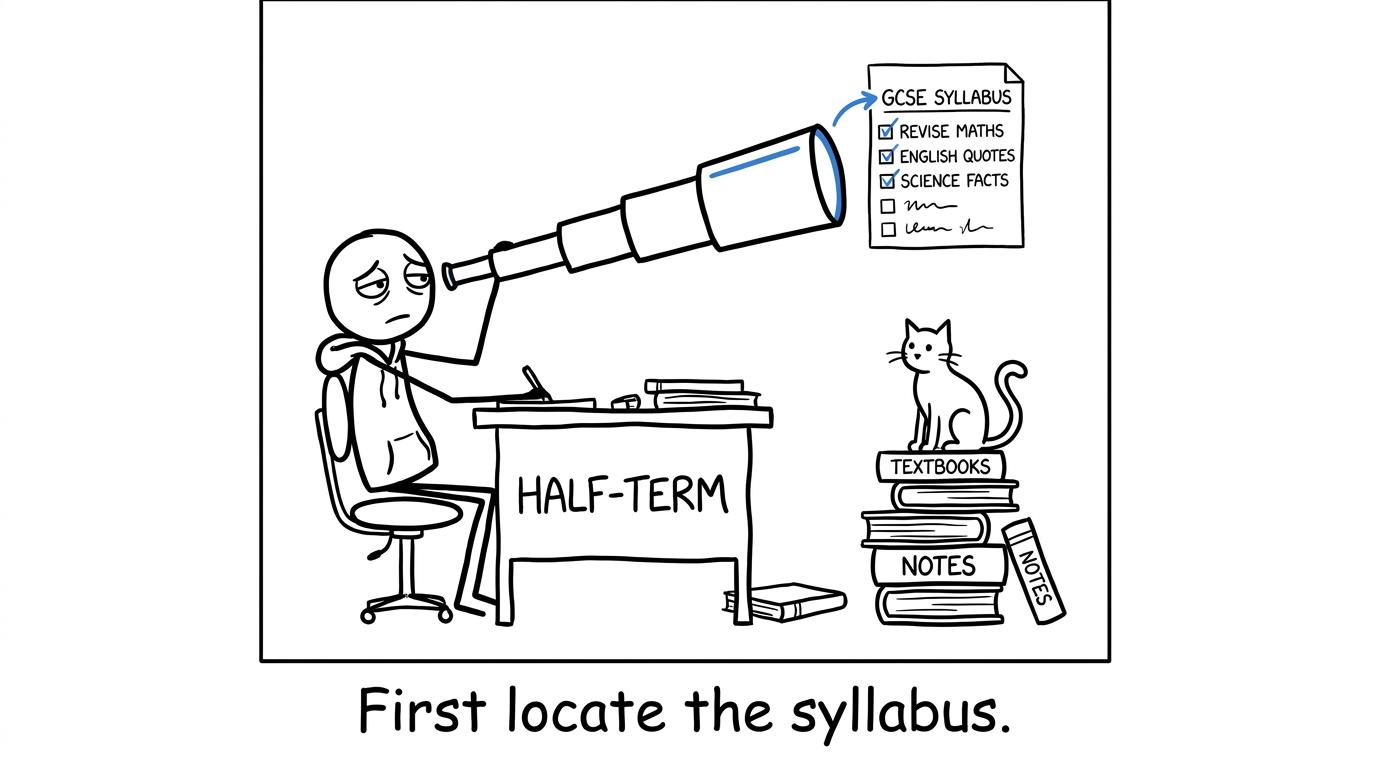 A student discovers that the first step in revision is locating the syllabus
Understand what the Astronomy exams require
Pearson Edexcel GCSE Astronomy is a non-tiered qualification assessed through two externally examined papers. Each paper lasts 111 hour 454545 minutes, carries 100100100 marks and contributes 50%50\%50% of the qualification.
Paper 1, Naked-eye Astronomy, covers Topics 1 to 8. These include Planet Earth, the lunar disc, Earth-Moon-Sun cycles, time, celestial observation, early Solar System models, planetary motion and gravity.
Paper 2, Telescopic Astronomy, covers Topics 9 to 16. These move through lunar and solar exploration, planetary systems, starlight, stellar evolution, the Galaxy and cosmology.
Both papers can include multiple-choice, short-answer, calculation, graphical and extended-open-response questions. This matters because knowing facts is only one part of preparation. You also need to apply ideas, interpret information and communicate explanations precisely.
Students must undertake at least one aided and one unaided observation. Observational understanding is then assessed in the written papers. Your school manages the formal completion requirements, so ask your teacher if you are uncertain about the status of your tasks.
Build the week around five focused sessions
A useful plan contains structure without pretending every day will go perfectly. Five sessions of approximately 606060 to 757575 minutes leave room for maths, other subjects and rest.
Session one: diagnose before revising
Begin with a short mixed set drawn from questions you have already been given, a specimen paper or an official past paper. Use no notes and work for around 303030 minutes.
When marking, classify each lost mark:
- Knowledge: you did not know the required fact.
- Application: you knew the fact but could not use it in context.
- Maths: the calculation, graph or rearrangement failed.
- Observation: you missed a planning, safety, accuracy or evaluation point.
- Communication: your response lacked the detail demanded by the command word.
Choose the two categories causing the greatest loss. That evidence should shape the rest of the week.
Session two: repair one Paper 1 topic
Choose one weak area from Topics 1 to 8. Start by retrieving what you know on blank paper, then check it against your specification and class materials. Finish with questions that require application rather than copying.
Keep the target narrow. “Celestial observation” is too broad for one session; coordinate systems, circumpolar stars or the effect of the atmosphere would be more manageable targets.
End by writing three prompts for later retrieval. Questions are usually more useful than polished notes because they force your brain to produce an answer.
Session three: strengthen the maths behind Astronomy
Mathematical skills form an important part of GCSE Astronomy. The official subject requirements include decimal and standard form calculations, ratio, fractions, percentages, inverse-square relationships, logarithms, graphs, geometry, trigonometry and the handling of data.
Prioritise the skills that appear in your own error log. Likely candidates include:
- converting values into standard form;
- rearranging formulae;
- substituting with consistent units;
- using significant figures appropriately;
- reading scales and gradients;
- interpreting proportional relationships;
- using calculator brackets correctly.
A number in standard form has the structure
a×10n,1≤a<10,a \times 10^n, \qquad 1 \leq a < 10,a×10n,1≤a<10,where nnn is an integer. Astronomy frequently involves very large distances and very small wavelengths, so a misplaced exponent can overwhelm an otherwise correct method.
Inverse-square reasoning also deserves attention. If a quantity III varies inversely with the square of distance ddd, then
I∝1d2.I \propto \frac{1}{d^2}.I∝d21.The purpose of this session is not to race ahead into A Level maths. It is to make familiar GCSE techniques reliable inside an astronomical context. Use the relevant page for your own maths board and tier through the GCSE maths topics by exam board and tier, or revisit standard form revision and rearranging harder formulae where appropriate.
Session four: repair one Paper 2 topic
Select one weakness from Topics 9 to 16. Topic pairs can help you organise ideas: telescope properties with starlight, stellar evolution with the Hertzsprung-Russell diagram, or redshift with cosmology.
Build links carefully, but do not merge ideas that have different causes. A useful revision test is whether you can explain a relationship aloud without looking at your notes. If the explanation becomes vague, return to the specification wording and identify the missing step.
Finish with one extended-response question. Plan the answer first, then check whether each sentence contributes a distinct scientific idea.
Session five: retest and plan the next fortnight
Return to the two weak areas selected in session one. Use fresh questions, not the page you have just memorised. Work under a short time limit and mark immediately.
Then make three decisions:
- What has genuinely improved?
- What still needs teaching or teacher support?
- When will each remaining weakness be revisited?
A retest matters because recognition is not the same as recall. A page can look familiar while the method remains unavailable under exam pressure.
Keep GCSE maths moving as well
Astronomy can absorb an entire week because its stories are compelling and its syllabus is broad. But if you are preparing for GCSE maths, half-term should not become a single-subject retreat.
Use three or four maths blocks of 202020 to 303030 minutes. Pick one skill, complete exam-style questions, mark them and record one correction. The 20-minute GCSE maths revision routine is designed for exactly this kind of limited window.
If you take Edexcel GCSE Maths, a short GCSE maths mini test can reveal whether algebra, graphs, ratio or number skills are becoming rusty. Students taking AQA, OCR or Eduqas should use resources matched to their own board and tier.
Save full maths papers for a day when you have enough energy to mark them properly. MathsGenie's guide to using GCSE past papers properly explains the essential cycle: attempt, mark, diagnose, repair and retest.
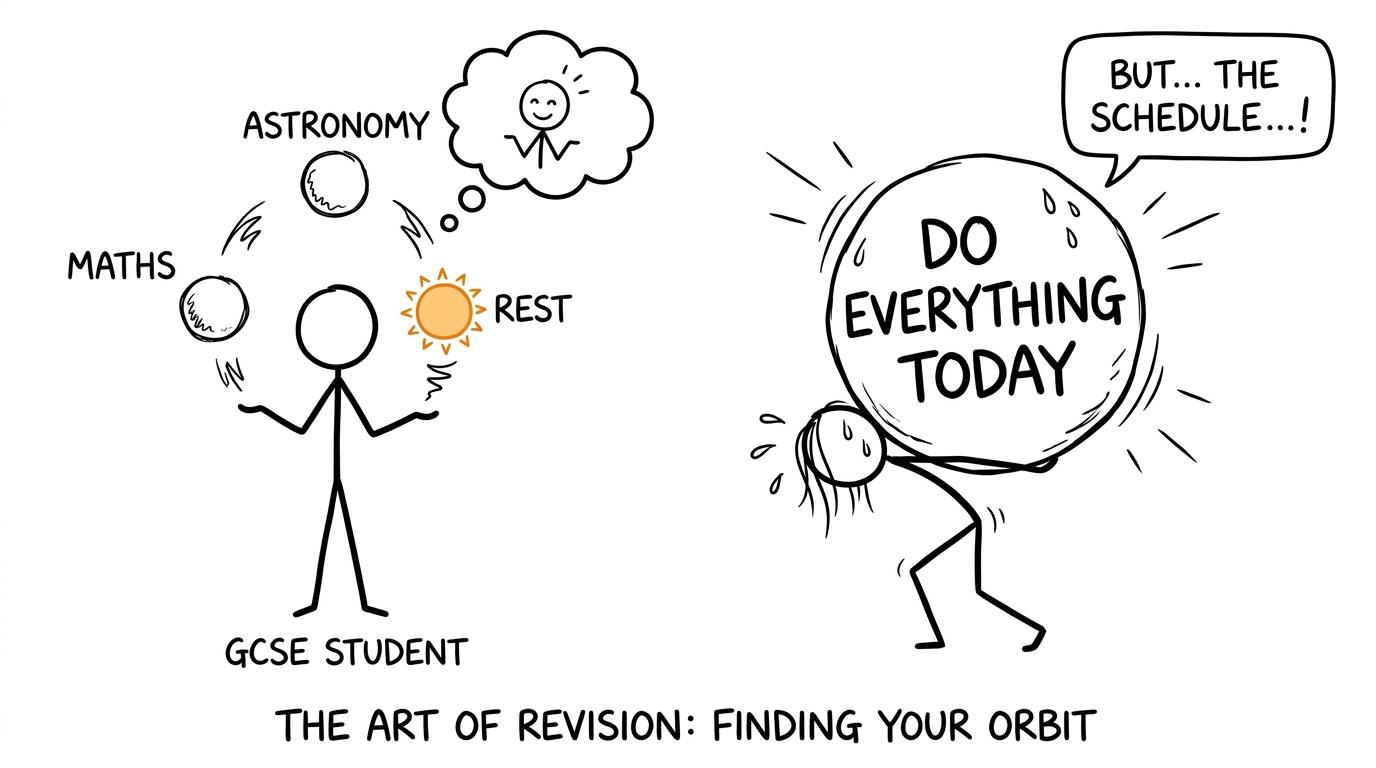 A student balances Astronomy, Maths and rest while another attempts to do everything at once
Revise observational skills without waiting for clear skies
February weather is not always cooperative. Cloud should not turn an observational-skills session into a cancelled session.
You can still revise how to:
- choose a suitable target, location, date and time;
- identify relevant equipment and safety considerations;
- record observations systematically;
- distinguish random variation from a consistent limitation;
- suggest specific improvements;
- analyse tables, photographs or drawings;
- evaluate whether evidence supports a conclusion.
Do not begin an independent solar observation. Solar work requires approved methods and supervision. Use your teacher's instructions and authorised materials.
If conditions are suitable and your school has already set an observation, follow its guidance exactly. Otherwise, practise planning or evaluating an observation from supplied information. The written exams assess your understanding of the process, not merely whether you have stood outside with a telescope.
Common mistakes during February half-term revision
Trying to cover all sixteen topics
Breadth feels productive, but rapid rereading produces little evidence of learning. Diagnose first and repair a small number of important gaps.
Making notes without answering questions
Notes can organise knowledge, but questions expose whether you can retrieve and apply it. Every substantial session should include independent practice.
Ignoring units and powers of ten
Write units beside quantities, convert them before substitution and check whether the final magnitude is plausible. Keep full calculator values during working and round only when the question requires it.
Treating mark schemes as answer sheets
A mark scheme shows what earns credit. Compare command words, scientific vocabulary, calculation stages and acceptable conclusions. Do not merely count ticks.
Using predicted papers as predictions of certainty
Predicted papers can provide fresh practice, but they cannot tell you exactly what will appear. Use them to supplement specification coverage and official past papers. MathsGenie's Edexcel GCSE Maths predicted papers are valuable for maths rehearsal when used in this way.
Sacrificing the rest of the term
A heroic week followed by exhaustion is a poor trade. Stop at a planned time, preserve sleep and leave some half-term genuinely free.
Let half-term create momentum, not panic
The best February plan is not the one with the most coloured boxes. It is the one that tells you what to do next.
Use five focused Astronomy sessions to diagnose, repair, practise maths, revisit both papers and retest. Keep shorter GCSE maths blocks running beside them. When school resumes, carry your error log forward and revisit the remaining gaps in manageable intervals.
MathsGenie can be your free base for the mathematical side of that plan. Use its revision lessons to restore a forgotten method, practice questions and mini tests to make it dependable, then past papers, mark schemes, video solutions and predicted papers to test it under pressure. Start with one weakness today, not the whole sky.