

GCSE Art and Design Exam Conditions Practice at Home
GCSE art and design exam conditions practice: create a realistic timed home session, organise materials, remove distractions and review your pacing safely.
The difficult part of an art exam is rarely sitting down with no ideas. It is discovering, halfway through the supervised period, that a familiar process takes longer than expected, an essential reference is missing or a small detail is consuming time needed elsewhere.
That is why GCSE art and design exam conditions practice matters. A realistic home session lets you test your plan, materials, pacing and concentration before the assessed work begins. It cannot reproduce formal supervision or authentication, and it must never involve altering controlled assessment work outside school. What it can do is reveal whether your intended process survives contact with a clock.
The basic method is simple: agree the rules with your teacher, prepare duplicate or non-assessed materials, remove outside help, follow a written time plan and review the process only after the timer stops.
Your realistic practice checklist
Before beginning, make sure you have:
- confirmed your exam board and your school's session arrangements;
- agreed with your teacher what may safely be rehearsed at home;
- selected a non-assessed study, mock outcome or duplicate composition;
- gathered every permitted material and reference in advance;
- disabled internet access and put away your phone and smartwatch;
- arranged a quiet, safe workspace with suitable ventilation;
- written checkpoints rather than relying on memory;
- asked someone at home to act only as a timekeeper, if helpful;
- planned a short review for after the timed session.
This is rehearsal, not an attempt to recreate the centre's secure assessment process. Your actual preparatory and supervised work must remain under the conditions specified by your school and exam board.
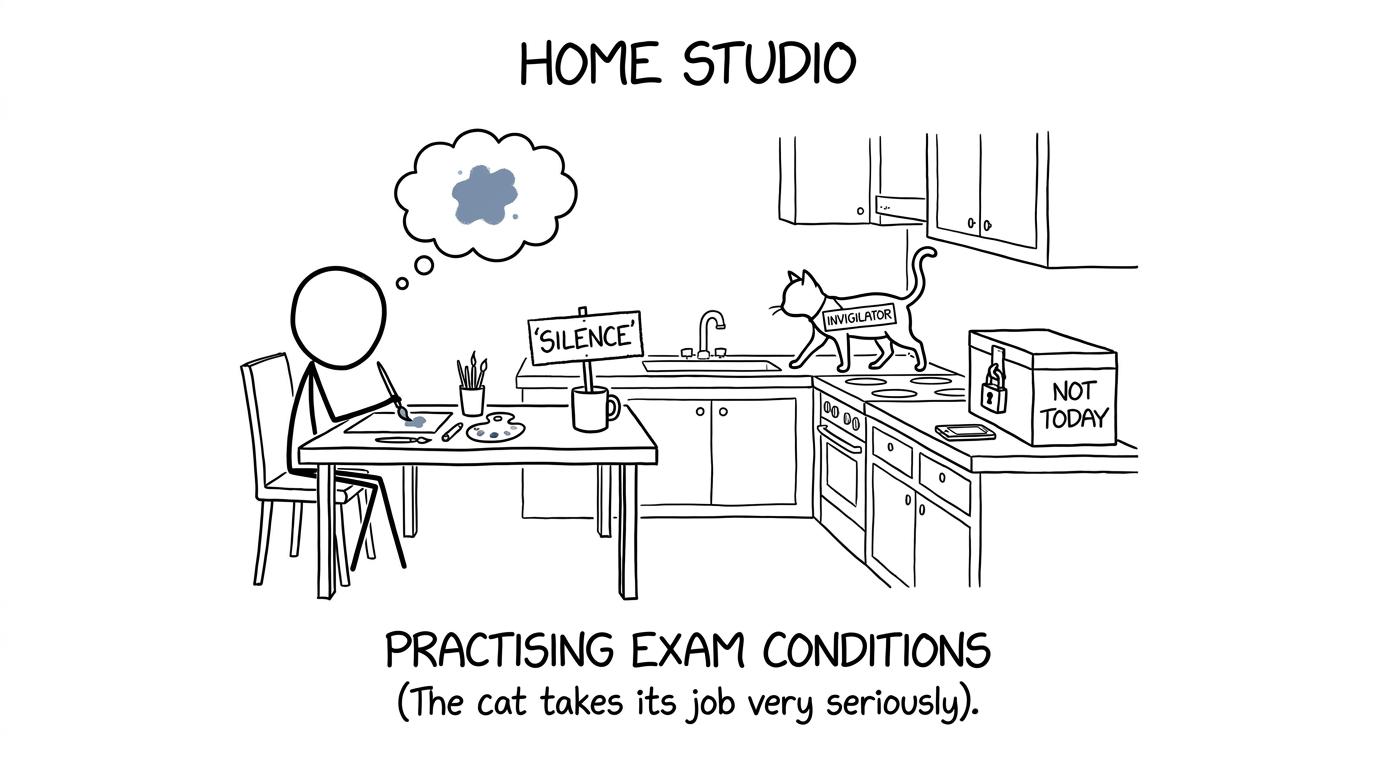 A cat invigilates an unusually serious home art exam
Understand the real GCSE Art and Design conditions
Across regulated GCSE Art and Design qualifications in England, the externally set component accounts for 40%40\%40% of the qualification and includes a 101010-hour period in which students realise one or more outcomes under supervised conditions. The preparatory work and supervised outcome are assessed together against four assessment objectives.
The broad structure is shared, but the detailed administration differs between AQA, Pearson Edexcel, OCR and Eduqas. For example, AQA requires the first 222 hours of supervised time to be consecutive. Pearson Edexcel permits the sustained-focus period to be divided into no more than four sessions within three consecutive weeks. OCR requires at least one session to last at least 222 hours. Your school decides the timetable within the relevant rules.
Once the formal supervised period starts, preparatory materials are controlled. They cannot normally be developed or amended during gaps between sessions, and supervised work cannot be taken home for improvement. Internet access is generally prohibited, although some boards make limited provision for approved web-based software while blocking other online access.
Rules can be updated, particularly around digital applications and access arrangements. Treat your teacher's current instructions and your board's current specification as authoritative.
Choose the right kind of home rehearsal
Do not use your live assessed outcome unless your teacher has expressly confirmed that the activity is permitted. A safer practice task is one of the following:
- a smaller version of the intended composition;
- a previous project revisited with fresh materials;
- a mock outcome based on an unrelated theme;
- a duplicate technical section using spare references;
- a timed process test, such as layering, printing or digital editing.
The purpose is not to create another polished portfolio piece. It is to answer practical questions. How long does the base layer take? When must adhesive begin drying? Does the printer introduce delays? Can you maintain accuracy after several hours? Which materials need backups?
Choose a task close enough to test the real process but separate enough to protect the authenticity of your assessed submission.
Build a home studio that behaves like an exam room
A realistic room is not necessarily a perfect room. It is a controlled one.
Clear the workspace before the timer begins. Put out only the materials you expect to use, together with sensible spares. Pre-fill water containers where appropriate, check that equipment works and organise references so that you can find them without searching through unrelated folders.
Remove resources that would not be available in the supervised period. That means no messaging, tutorials, social media, music or last-minute image searches. If digital files are part of the rehearsal, save copies locally and test that they open without an internet connection.
Match the physical conditions where possible. Work at a table rather than on a sofa. Use the chair, lighting and scale you expect at school. If your process involves safe movement between stations, rehearse that too.
Safety remains more important than realism. Do not use blades, heated equipment, aerosols, solvents, photographic chemicals or specialist machinery at home unless there is suitable adult oversight, ventilation and permission. Practise the planning or a safe substitute instead.
Plan the clock before starting it
The most useful plan is based on stages, not vague hopes. Divide the session into meaningful phases such as preparation, initial construction, development, refinement and final checks. Give each phase a clear stopping condition.
A checkpoint might say:
- composition transferred and proportions checked;
- main forms established;
- first colour or material layer complete;
- focal area resolved;
- final surface adjustments started;
- work stopped with enough time to clean and store materials.
Avoid planning every minute. Art processes contain uncertainty: paint dries differently, a print may fail and a material may behave unexpectedly. Build some contingency into the final part of your session rather than assuming everything will go perfectly.
If your school intends to split the formal assessment into sessions, mirror that pattern. A home practice made of shorter blocks can teach you how to restart efficiently. A longer block tests stamina. Neither is automatically better; the useful version is the one closest to your centre's actual timetable.
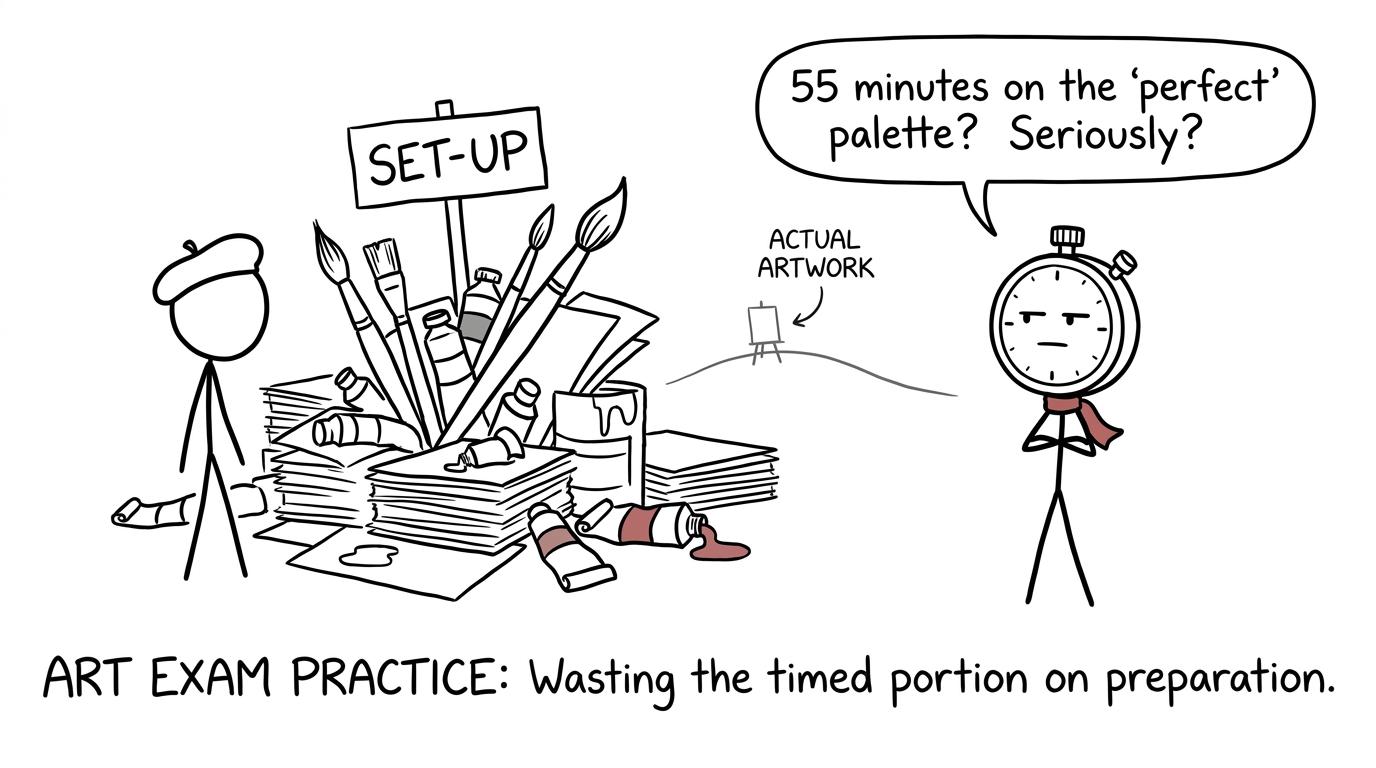 An art student discovers that setting up has become the main event
Follow strict rules while the timer runs
Once you start, behave as though outside help is unavailable.
Do not ask whether the composition looks right. Do not search for another artist halfway through. Do not watch a technique video. A family member acting as timekeeper should not suggest changes or comment on quality. They may tell you that a checkpoint has arrived, just as an invigilator can communicate timing information.
Record disruptions without stopping the timer unless there is a genuine safety issue. A barking dog or missing brush may feel unfair, but it exposes weaknesses in your setup. Afterward, you can decide what must change.
If you reach a checkpoint late, make a decision and continue. That decision-making is part of the rehearsal. You may need to simplify a background, reduce repetition or move earlier to the focal area. The goal is not frantic speed. It is protecting the parts of the outcome that communicate your intention most clearly.
Review the process after the session
Do not judge the rehearsal only by whether the outcome looks finished. A beautiful mock completed through unsustainable rushing may teach less than an incomplete one with an honest record of where time disappeared.
After stopping, write brief answers to these questions:
- Which stage took longer than planned?
- What material, tool or reference was missing?
- Where did concentration fall?
- Which decision should have been settled during preparation?
- What could be simplified without weakening the intention?
- Which technique needs another short rehearsal?
- How much time should be protected for final resolution?
Keep this review separate from controlled preparatory work unless your teacher confirms otherwise. Take your findings back to school and ask what may legitimately inform your preparation before the formal supervised period begins.
The same review habit strengthens maths revision. A timed paper is valuable because it exposes behaviour under pressure, not merely gaps in knowledge. MathsGenie's guide to finding your weakest GCSE topics shows how to convert a rehearsal into specific next actions.
Build concentration without exhausting yourself
You do not need to complete a full 101010-hour simulation every weekend. Begin with one substantial block that matches a likely school session, then extend the duration only when the process and workspace are stable.
During earlier rehearsals, focus on one variable at a time: setup, technique, timing or stamina. Nearer the assessment, combine them in a more complete mock. Protect sleep and ordinary revision around it. Exhaustion is not evidence of seriousness.
For students balancing Art and Design with foundation or higher tier maths, plan the week rather than letting one subject consume it. The GCSE one-month maths revision plan can help you keep short maths sessions moving while preparing for a long practical assessment.
Short timed tasks are useful for rebuilding momentum after an intensive art session. The Edexcel GCSE Maths mini tests provide focused practice without requiring another full paper.
Common mistakes in home exam practice
Making the room unrealistically comfortable
Music, snacks beside the work, constant phone checks and advice from family make the session easier but less informative. Reproduce the restrictions that affect concentration, while still taking any breaks your teacher says will apply.
Testing an unfinished idea
Timed practice cannot rescue a composition that has not been decided. Settle the broad intention, scale, materials and sequence before starting. The supervised period is primarily for realising developed intentions, not beginning research from scratch.
Spending the first part setting up
If arranging paper, opening files and hunting for tools consumes the rehearsal, your preparation system has failed. Setup and workspace preparation may be treated differently by individual boards and centres, so ask your teacher exactly what happens before formal timing begins.
Treating the final detail as the whole outcome
Students can spend too long perfecting one small area while major sections remain unresolved. Use checkpoints that refer to the whole piece, not just the most enjoyable detail.
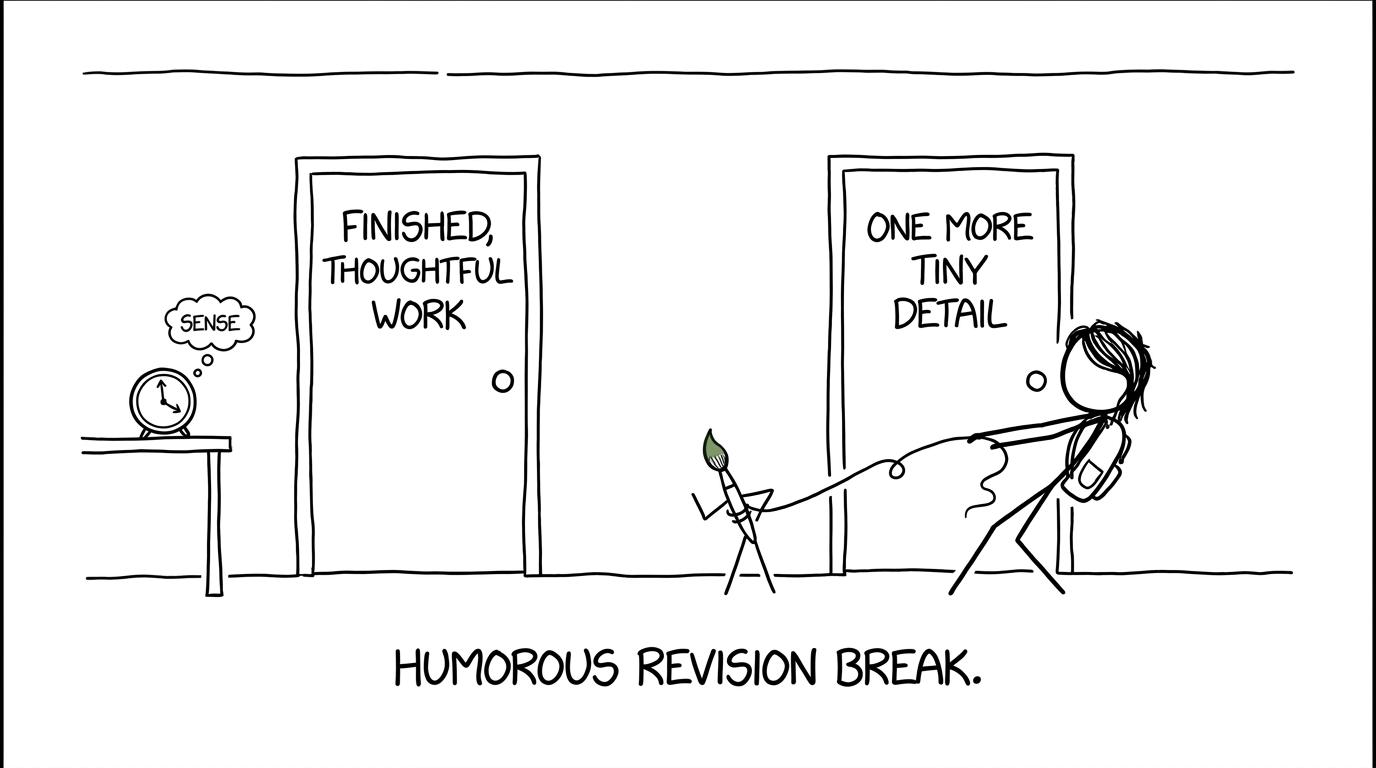 A tiny paintbrush tries to lure a student away from finishing on time
Ignoring technical failure
Printers jam, pens run out and adhesive behaves unpredictably. Have permitted backups and test equipment before the timer begins. Do not introduce a completely unfamiliar process in the final rehearsal.
Failing to review the evidence
Saying that the session “went badly” is too vague to help. Identify the stage, cause and correction. That is also the right approach to maths papers: use the Edexcel GCSE Maths past papers, AQA GCSE Maths past papers or OCR GCSE Maths past papers, then mark and diagnose rather than simply recording a score.
Make the real session feel familiar
A useful rehearsal does not predict every problem. It removes avoidable surprises.
By the time you enter the supervised assessment, you should know how your materials behave, where time tends to disappear and what a realistic finished outcome requires. You will still need to make artistic judgements. The difference is that those judgements will happen inside a structure you have already tested.
Use the same principle across your GCSE preparation. Visit the MathsGenie GCSE Maths revision hub for free revision lessons and practice questions, then build exam realism with past papers, predicted papers, mini tests, mark schemes and video solutions. Practise the conditions, review what happened and make the next session more deliberate.










