

GCSE Art and Design Coursework Teacher Help Rules
GCSE art and design coursework teacher help explained: what feedback is allowed, where malpractice begins, and how to protect your work, marks and peace of mind.
A teacher looks at your half-finished sketchbook and says, “Think again about the composition.” That feels like normal teaching. But what if they tell you exactly where every object should go, draw the outline or rewrite your annotation?
The rules around GCSE art and design coursework teacher help are straightforward in principle: your teacher can teach, clarify, question, monitor and provide permitted feedback, but the ideas, decisions and assessed work must remain yours. They cannot improve the submission for you or provide assistance that prevents the final marks from representing your unaided achievement.
The precise boundary depends on your exam board, specification, component and assessment stage. In particular, support during portfolio development is different from support during the supervised period of an externally set assignment. If you are uncertain, ask your teacher before acting, not after submitting the work.
The teacher-help checklist
Use this quick test whenever support starts to feel unusually specific:
- Understanding: Is the teacher helping you understand the task or assessment objectives?
- Ownership: Are you still choosing the idea, materials, composition and development route?
- Execution: Are you personally producing every part presented as your work?
- Authentication: Could your teacher confidently sign to confirm that the submission is yours?
- Disclosure: Has any additional assistance or outside help been acknowledged?
- Assessment stage: Are you developing portfolio work, preparing for an externally set assignment or completing its supervised final period?
If you cannot answer these confidently, pause and speak to your subject teacher or exams officer.
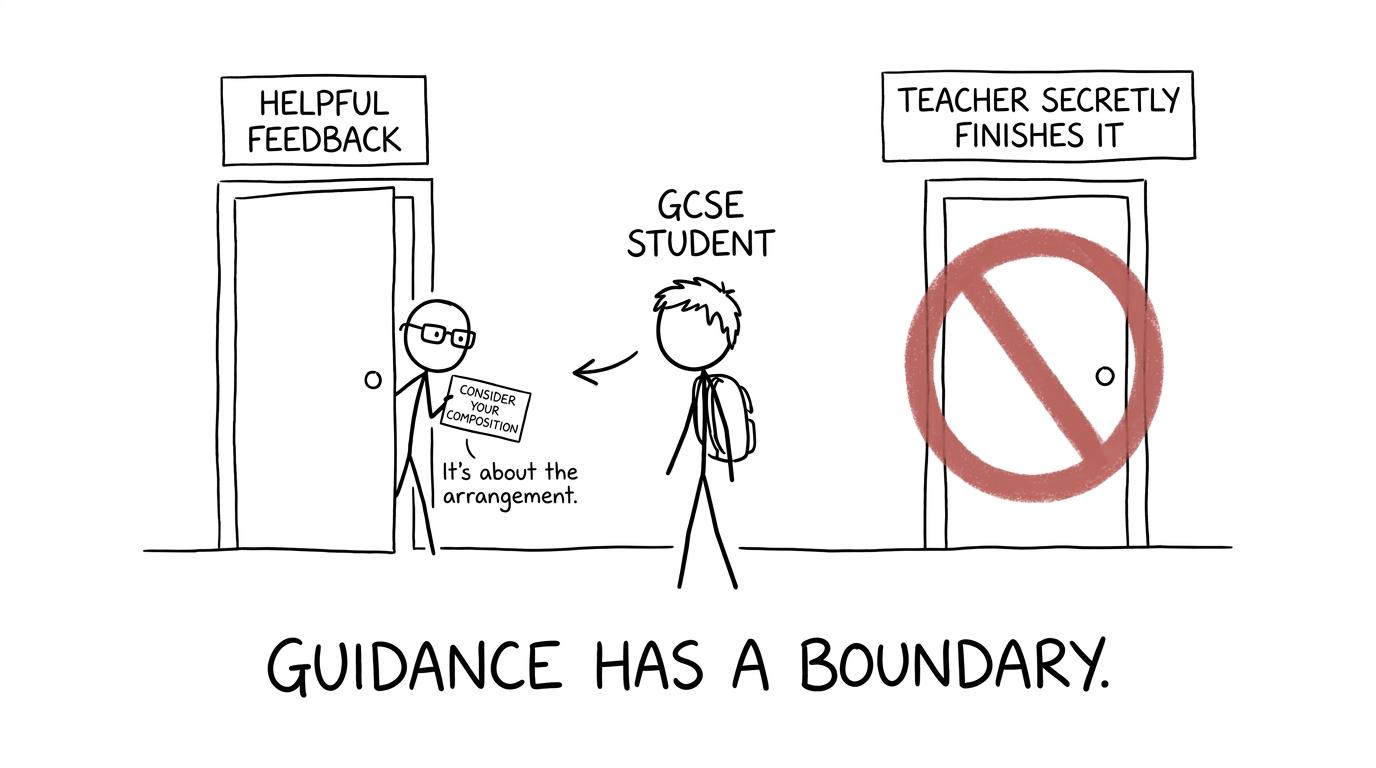 A student choosing between helpful feedback and a teacher secretly finishing the work
What help can an art teacher normally give?
GCSE Art and Design is not meant to be completed without teaching. Across specifications from AQA, Pearson Edexcel, OCR and Eduqas, students are expected to learn through demonstrations, discussion, experimentation and feedback. The restriction is not on useful teaching. It is on assistance that compromises the independence or authenticity of assessed work.
Teaching techniques and safe use of materials
Your teacher can demonstrate processes such as printing, painting, photography, textiles, ceramics or digital editing. They can explain how equipment works, reinforce health and safety requirements and provide opportunities to practise.
The important distinction is between demonstrating a technique and executing part of your assessed piece. A demonstration on separate material teaches you how to proceed. Making a difficult section of your final outcome for you transfers authorship.
Explaining the task and assessment objectives
Teachers can explain command words, deadlines, required evidence and the assessment objectives. They can help the class understand why research, recording, experimentation, refinement and a personal response matter.
They may also direct you back to the published criteria. This is similar to a maths teacher explaining what a mark scheme rewards without completing the question on your behalf. When revising maths, you can see the same learning principle through MathsGenie’s free GCSE Maths revision hub: learn the method, practise it independently and then check the evidence.
Asking questions about your choices
A teacher can use questions to make you reflect. They might ask whether your experiment supports your intention, whether you have recorded your development clearly or whether another material deserves testing.
A question leaves the judgement with you. A detailed instruction that dictates your personal response may go too far, especially if you simply follow it without making an independent decision.
Giving general feedback while work develops
Specifications allow teachers to monitor work and, where permitted, discuss work in progress. Feedback can identify a broad strength, weakness or area requiring further thought. It should not become a sequence of instructions that effectively designs, edits or completes the submission.
The acceptable detail can vary by component and exam board. Your teacher should follow the current specification and JCQ instructions rather than relying on a rule remembered from an earlier course.
Where teacher support crosses the line
There is no responsible universal list saying that one sentence is always allowed and another is always malpractice. Context matters. However, several boundaries are clear.
Producing or altering the student’s work
A teacher must not draw, paint, edit, construct or substantially correct work that is then presented as the candidate’s own. Nor should somebody else at home complete a difficult section.
Technical intervention needed for safety, an approved access arrangement or equipment operation must be managed under the relevant rules. It should never be quietly presented as independent artistic achievement.
Supplying the personal response
Teachers can introduce artists, contexts and starting points. They should not manufacture the student’s creative journey by choosing the concept, development sequence, composition and final outcome for them.
Advice becomes risky when it removes the decisions being assessed. “Review whether the background supports your intention” preserves ownership. A complete set of directions for redesigning that background may not.
Rewriting annotations or evaluation
A teacher can teach annotation skills, explain specialist vocabulary and identify that writing lacks reflection. They cannot write the annotation, dictate an evaluative paragraph or transform the student’s wording into a polished response that is no longer recognisably their own.
Basic proofreading must not become substantive rewriting. The submitted ideas and analysis need to belong to the candidate.
Helping during supervised sustained focus
Externally set components normally include a supervised period in which the final response is produced under controlled conditions. For major GCSE Art and Design specifications, this includes a 101010-hour sustained-focus period.
During that period, the work must be the student’s own and completed under the required supervision. The teacher manages conditions, timing, safety and approved arrangements, but cannot provide creative or practical assistance that improves the response. Preparatory work also has to be authenticated and cannot simply be changed whenever the rules no longer permit it.
Additional assistance, authentication and malpractice
The central safeguard is authentication. Current JCQ instructions require candidates to confirm that submitted work is their own and that assistance and sources have been acknowledged. Teachers also sign to confirm, to the best of their knowledge, that the work belongs to that candidate and was completed under the required conditions.
AQA’s administration rules, for example, require sufficient supervision to authenticate work and the recording of acceptable additional assistance. Pearson, OCR and Eduqas similarly require candidate and teacher authentication.
If acceptable additional assistance has been given, it may need to be recorded, and marking must represent the student’s unaided achievement. If a teacher cannot authenticate work, it cannot simply be treated as normal coursework. Under JCQ procedures, failure to authenticate can result in a mark of zero for the affected assessment.
The timing of a discovery matters procedurally. Suspected candidate malpractice found before the authentication declaration is signed may often be handled through the centre’s internal procedures, subject to the applicable rules. After authentication, suspected malpractice generally has to be reported formally to the awarding body. Staff must also report suspected malpractice; ignoring it can itself breach the regulations.
This is why honesty early is protective. Telling your teacher about outside assistance gives the centre a chance to decide what can be used, what must be acknowledged and what may need removing.
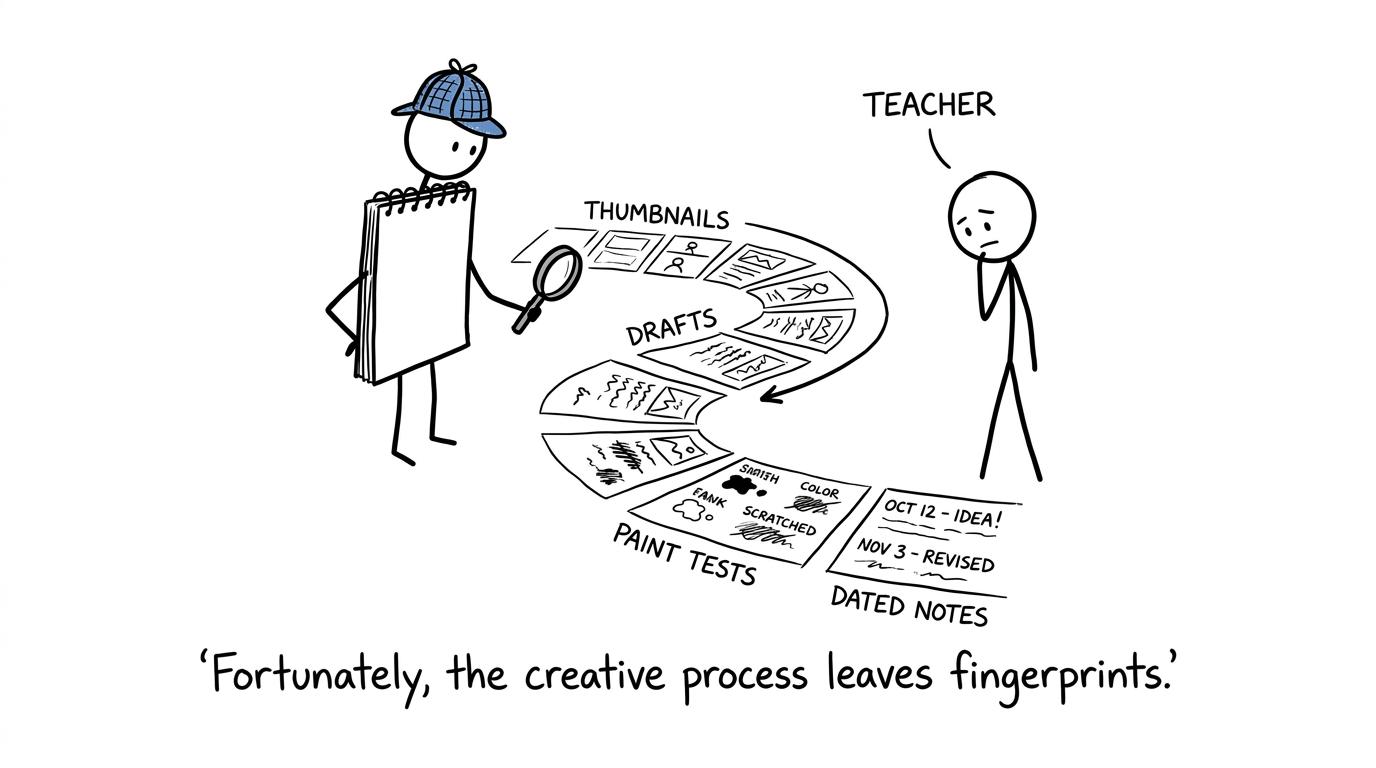 A detective sketchbook displaying drafts and experiments as evidence
How to protect the authenticity of your coursework
Your creative process is not clutter around the final piece. It is evidence of ownership.
Keep dated photographs, early thumbnails, material tests, unsuccessful experiments, drafts and your own reflections. Make development visible rather than presenting a mysteriously perfect outcome with no convincing route towards it. Work completed away from school may receive extra scrutiny because your teacher must still be able to authenticate it.
A sensible routine is to:
- save drafts and development photographs;
- identify every artist, image, quotation and secondary source used;
- record help received from anyone outside your normal lessons;
- keep your visual and written work in your own voice;
- ask before using unfamiliar software or generative AI;
- follow your centre’s instructions for storing and submitting work.
AI requires particular care. JCQ rules require AI-generated material to be acknowledged when its use is permitted, with relevant content retained for authentication. Your exam board or school may impose tighter restrictions for a particular task. Referencing AI does not automatically make every use acceptable, and submitting generated material as your own practical or written work may constitute malpractice.
Balancing art coursework with GCSE maths revision
Art coursework expands to fill the evenings you leave available for it. Maths revision can then become something you promise to start “after the portfolio is finished”. The problem is that creative work rarely feels completely finished.
Protect fixed maths sessions before art deadlines become urgent. Start with a short GCSE mini test, mark it immediately and use the result to choose one weak topic. The GCSE maths revision timetable guide can help you build realistic sessions around practical subjects.
When time is tight, a focused routine is more sustainable than an occasional marathon. Try the MathsGenie 202020-minute revision routine on busy coursework days. As exams approach, move towards board-specific practice using Edexcel GCSE Maths past papers, AQA GCSE Maths past papers or OCR GCSE Maths past papers.
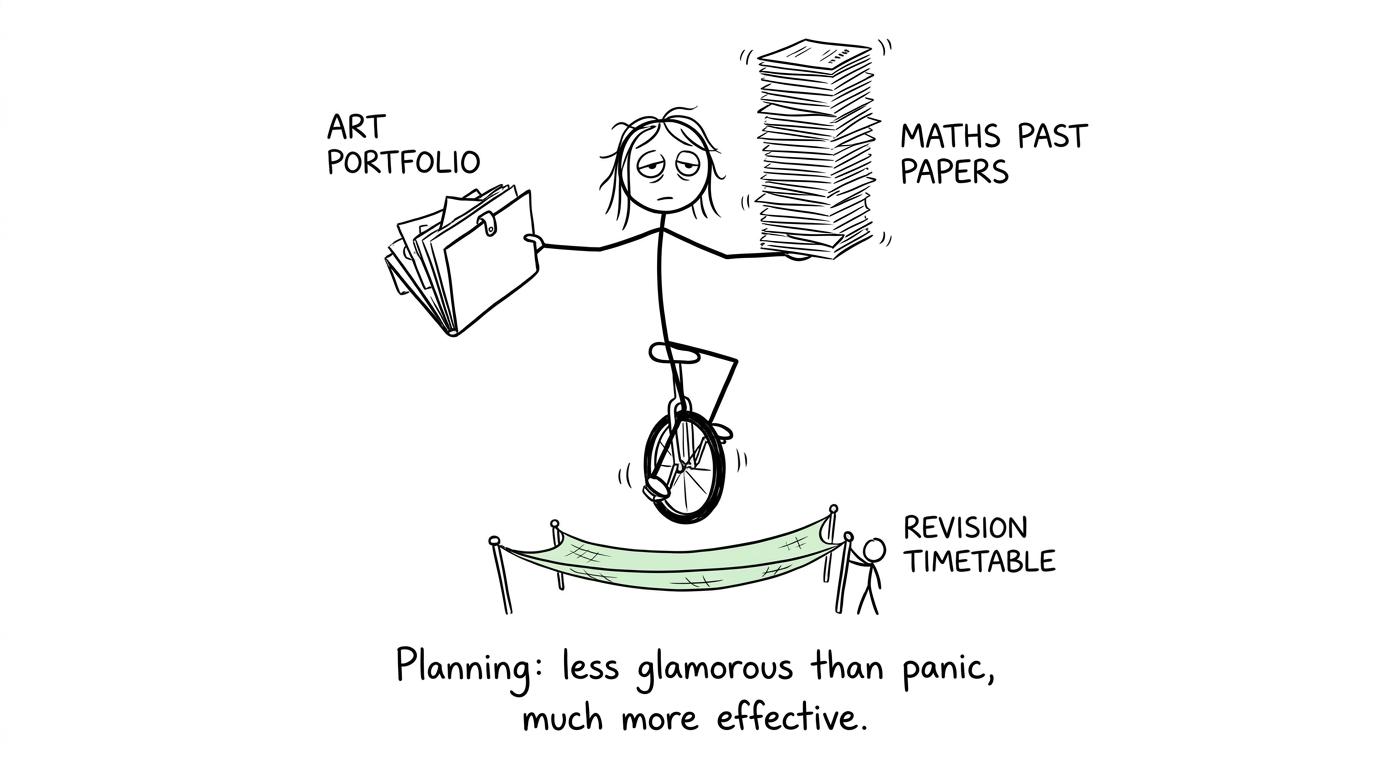 A student balancing an art portfolio and maths papers above a revision timetable
Common mistakes to avoid
Assuming every teacher comment must be followed
Feedback is information, not a substitute for judgement. Consider it, test possibilities and make your own defensible decision.
Hiding help because it seems minor
Help from a relative, tutor, technician or online service may affect authentication. Tell your teacher. Disclosure is safer than allowing them to discover unexplained intervention later.
Copying imagery without clear acknowledgement
Using artists and secondary sources is part of Art and Design, but presenting copied imagery, words or ideas as original work is not. Label and reference sources clearly.
Treating home-produced work as automatically acceptable
Work outside lessons can be allowed during some stages, but it must remain authentic. Keep evidence of development and expect your teacher to compare it with supervised work.
Confusing portfolio feedback with final supervised support
The rules change with the assessment stage. Advice that may be acceptable during teaching or preparatory development may be prohibited during sustained focus.
Keep the work recognisably yours
A good teacher does not create the work you submit. They create the conditions in which you can create it yourself.
Ask for clarification, technical teaching and permitted feedback without embarrassment. Then preserve the part that matters most: your decisions, your development and your execution. If support ever feels too specific, stop and ask how it should be recorded before continuing.
And while your portfolio develops, keep maths moving in small, repeatable steps. Use MathsGenie’s free revision lessons and practice questions to repair individual topics, mini tests to check progress, and past papers, predicted papers, mark schemes and video solutions to prepare for the real exam. Open the GCSE Maths revision area, choose one task and make today’s next step unmistakably your own.











