GCSE Art and Design Harder Than Before? The Facts
GCSE art and design harder than before? See what changed, why workload feels intense, and how to protect time for your GCSE maths revision.
Is GCSE Art and Design actually harder now?
A sketchbook can look harmless until every unfinished page begins competing with algebra, science and sleep. That pressure raises a fair question: is GCSE art and design harder than before, or does its workload simply become more visible when several GCSE deadlines arrive together?
The short answer is nuanced. The qualification changed when reformed GCSE Art and Design courses were introduced for first teaching in England in 201620162016, including grades 999-111 and clearer requirements for drawing, annotation and evidence of the creative journey. However, its central assessment structure remained familiar: a portfolio worth 60%60\%60% and an externally set assignment worth 40%40\%40%, including 101010 hours of supervised work.
So there is no simple evidence that students now have to reach an entirely different artistic standard. Yet the modern course can feel harder because every stage of development must be purposeful, recorded and connected to the assessment objectives. For students also preparing for maths, the real difficulty is often time.
The answer at a glance
Before comparing generations, keep these points in view:
- GCSE Art and Design is untiered; there is no foundation or higher tier.
- It is assessed through non-exam assessment rather than a conventional written paper.
- The portfolio contributes 60%60\%60% of the qualification.
- The externally set assignment contributes 40%40\%40% and includes 101010 supervised hours.
- Four assessment objectives are equally weighted at 25%25\%25% each.
- Reformed courses place explicit emphasis on investigation, refinement, recording, drawing, annotation and a personal response.
- Grade boundaries are intended to maintain standards between years, so a changing boundary does not by itself prove that the subject became harder.
The practical conclusion is that Art and Design is not necessarily harder to pass than it used to be. It may be harder to manage casually.
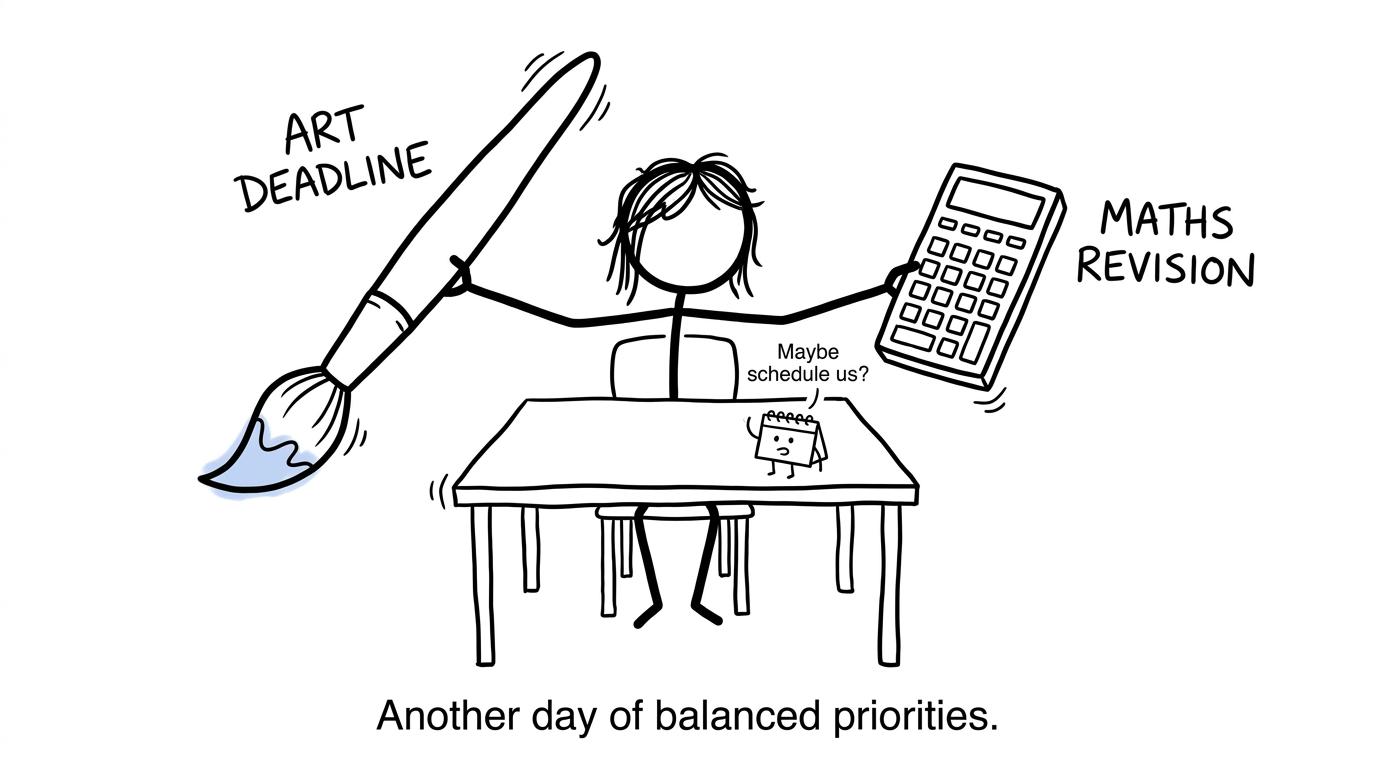 A student balancing an art deadline and maths revision while a calendar offers help
What changed in the reformed GCSE?
The current subject content expects more than an attractive final piece. Students must show how ideas began, how sources influenced them, what they tested, what they rejected and how their intentions developed.
The assessment objectives are more explicit
Across regulated GCSE specifications, the four objectives broadly require students to:
- develop ideas through investigation and critical understanding of sources;
- refine work by experimenting with suitable media, materials and processes;
- record observations, ideas and insights as work progresses;
- present a personal and meaningful response that realises their intentions.
Each objective carries 25%25\%25% of the marks. This matters because technical skill alone cannot carry the whole submission. A beautifully produced final outcome may still leave marks unavailable if the sketchbook contains little investigation, experimentation or reflection.
That balance can make the course feel more demanding than the common description of Art as a practical subject. Students are not merely making work. They are making their thinking assessable.
Drawing and annotation became explicit requirements
The reformed subject content requires students to use drawing for different needs and purposes, where appropriate to their area of study. It also requires visual and written recording, including suitable specialist vocabulary.
This does not mean every photography, textiles or graphic communication student must demonstrate traditional fine-art drawing at the same level. Drawing can serve different purposes, such as observation, planning, composition or communication. The important point is that creative decisions need evidence.
Written annotation is similar. Long essays are not automatically better. Useful annotation explains an intention, evaluates an experiment or identifies the next decision. Pages filled with description but no judgement can consume hours without adding much value.
The central assessment structure did not become radically heavier
The impression of wholesale change can be misleading. Before the reforms, major specifications already commonly used a 60%60\%60% portfolio and 40%40\%40% externally set task, with a 101010-hour sustained period. The reformed model retained that broad structure.
This is important when someone says that Art was easy in the past. They may be comparing different schools, teachers, project choices or personal memories rather than two entirely different qualifications.
Specifications can also evolve. For example, AQA has announced that from first assessment in summer 202720272027, Component 111 will require a minimum of one sustained project rather than a sustained project plus compulsory further work. The assessment objectives, component weighting and expected breadth and depth remain unchanged. Students should always check the specification and instructions for their own board: AQA, Edexcel, OCR or Eduqas, rather than relying on older advice online.
Why GCSE Art and Design feels harder than before
Difficulty is not only about the standard needed for a grade. It is also about how work occupies your week.
The workload expands when the project lacks boundaries
A maths question has an end. A painting can always be adjusted, another artist can always be researched and another page can always be added. That open-endedness makes stopping difficult.
The mark scheme, however, does not reward unlimited volume. It rewards relevant evidence across the objectives. A smaller, coherent portfolio can communicate a clearer creative journey than many disconnected pages.
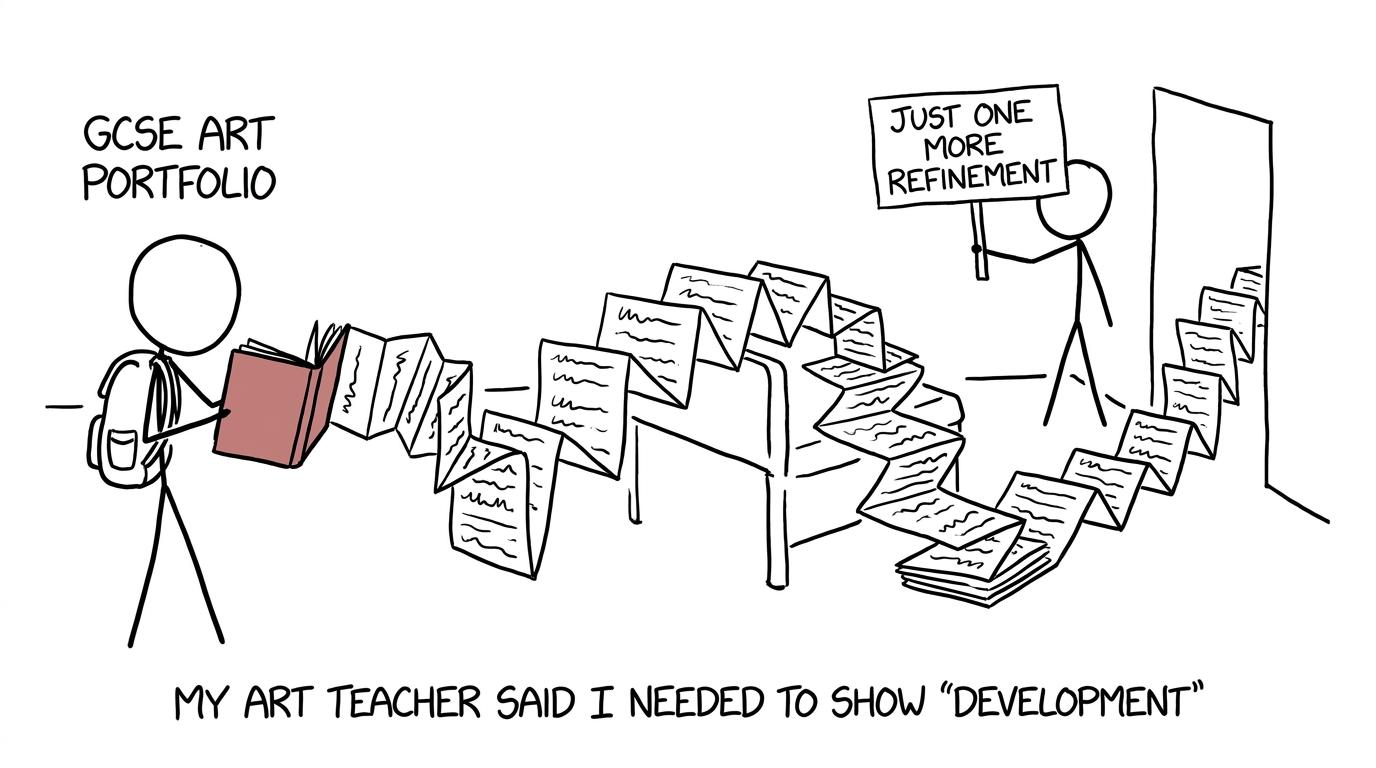 A GCSE art portfolio unfolding endlessly while someone requests one more refinement
Progress is judged as well as the final outcome
In some subjects, rough early attempts can disappear once the correct answer is found. In Art and Design, development is part of the evidence. Students must preserve experiments, explain decisions and show meaningful connections between sources and outcomes.
That creates a second workload: making the work and documenting why it changed. It can feel relentless if annotation and organisation are postponed until the deadline.
School delivery affects the experience
Exam boards set the qualification requirements, but schools choose themes, organise teaching time and guide portfolio selection. Access to materials, project scope and the timing of internal deadlines can therefore shape how difficult the course feels.
This is one reason personal comparisons are unreliable. Two students following the same exam board can experience different schedules without the national standard being different.
Has it genuinely become harder to earn a grade?
It is safest to separate three claims.
First, the course requirements became more explicit after reform. Students must demonstrate drawing, written annotation and all four equally weighted objectives. That can create more visible demands.
Second, the broad 60%60\%60%/40%40\%40% assessment model and 101010-hour supervised period were not new inventions. The qualification retained considerable continuity.
Third, grade boundaries cannot be read as a simple difficulty meter. Awarding organisations review work and set boundaries with the aim of maintaining comparable standards. If assessed work in one series is judged more demanding, boundaries can move to reflect that. A higher or lower raw boundary alone does not prove that gaining a grade became easier or harder.
The fairest verdict is this: the modern course may be more explicit and administratively demanding, but there is not a sound basis for saying that every current student faces a universally harder qualification than previous generations did.
Protecting your GCSE maths revision time
For a student taking Art and Design, the danger is not that art matters too much. It is that an open-ended project can absorb every available evening, leaving maths revision until panic begins.
Start by placing fixed art deadlines and supervised sessions on a calendar. Then protect several short maths sessions each week. The MathsGenie GCSE maths revision hub lets you choose your exam board and move between revision lessons, practice questions, papers and solutions without wasting time searching.
Use a closed revision loop:
- choose one weak maths topic;
- review the method;
- complete targeted questions;
- mark them immediately;
- record the precise mistake;
- retest the skill later.
If your timetable is crowded, a short session completed properly is more valuable than a full paper abandoned halfway through. The GCSE maths revision timetable guide helps turn competing subjects into a realistic weekly plan, while the one-month GCSE maths revision plan is useful when exams are close.
Begin full papers once you have enough topic knowledge to learn from them. The guide to when you should start GCSE past papers explains how to move from mini tests to timed practice. If a full paper will not fit around an art deadline, Edexcel GCSE Maths 45-minute tests provide shorter practice with mark schemes and solutions.
Near the exams, use Edexcel GCSE Maths predicted papers alongside official past papers, not instead of them. The purpose is diagnosis: identify where marks are leaking, return to the relevant revision lesson and practise again.
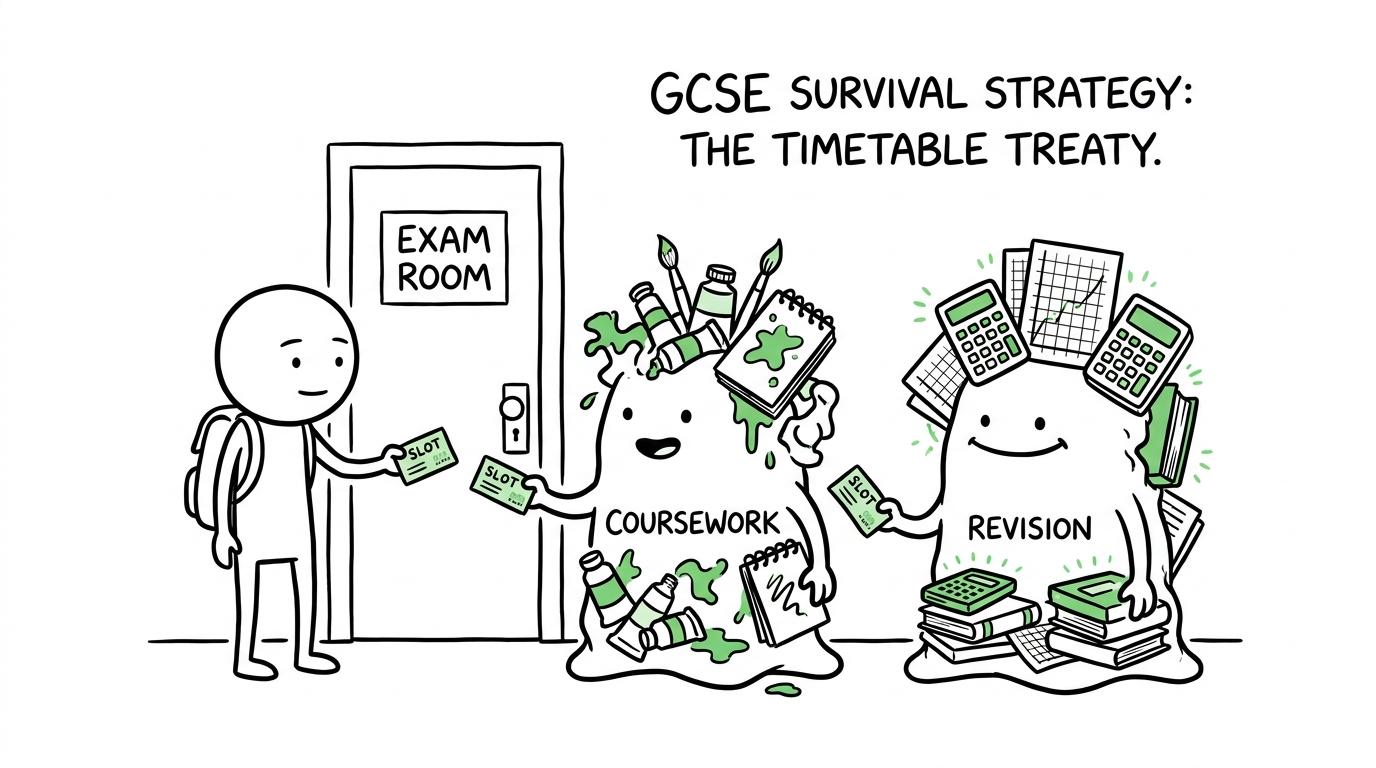 A student calmly assigning timetable slots to coursework and revision monsters
Common mistakes when judging or managing the course
Comparing only final pieces
The final response represents only part of the assessed journey. Investigation, experimentation and recording matter too. Comparing two finished pieces says little about the full mark awarded.
Treating every sketchbook page as equally valuable
More pages do not guarantee more marks. Every page should contribute evidence: a source investigated, a technique tested, an observation recorded or an intention refined.
Leaving annotation until the end
Retrospective comments often become vague because the original decision has been forgotten. Brief annotation written during the process is usually more specific and useful.
Assuming the supervised assignment is a normal written exam
The externally set assignment includes preparation followed by controlled, unaided work. Exact session arrangements and access rules depend on the specification. Follow your teacher's current instructions rather than advice written for another board or year.
Allowing Art to take every flexible hour
Because creative work has no obvious stopping point, it can displace revision with fixed answers. Decide the purpose of an art session before starting, stop when that purpose is complete and preserve scheduled time for maths.
A harder course, or a more visible challenge?
GCSE Art and Design has changed, but not in the simple way the question suggests. Current students face explicit expectations to investigate, experiment, record, annotate and present a personal response. Yet the main portfolio weighting and supervised assignment structure have substantial continuity with earlier courses.
What often feels harder is managing a creative process that could continue indefinitely while several written exams approach. The solution is not to care less about Art. It is to give both subjects boundaries.
Use MathsGenie to make the maths side predictable: begin with free revision lessons and practice questions, test yourself with mini tests, then move to past papers and predicted papers. Mark your work with the supplied mark schemes and use video solutions to repair methods. When art deadlines become noisy, a clear revision plan ensures maths still receives calm, regular attention, and regular attention is where marks begin to grow.