

GCSE Art and Design Examiner Reports: What They Say
GCSE art and design examiner reports decoded: learn the recurring warnings, strengthen each assessment objective and plan more purposeful portfolio revision.
The final piece is often the part everyone notices. It is large, finished and easy to display. Yet GCSE art and design examiner reports repeatedly make a quieter point: moderators need to see the thinking that made the final response possible.
Recent official feedback from AQA, Pearson Edexcel, OCR and Eduqas emphasises purposeful investigation, meaningful experimentation, first-hand recording, refinement and a personal response. Weak submissions often reach a final idea too quickly, rely heavily on internet imagery or produce lots of work without showing how one decision led to the next.
The short answer is simple: examiner reports favour a coherent creative journey over an impressive-looking outcome with little development behind it.
This matters even if maths is your immediate priority. Art and maths assess different knowledge, but examiner feedback reveals the same useful principle: marks come from visible evidence, not from what you intended to do. MathsGenie's GCSE maths revision hub applies that principle through questions, mark schemes and video solutions.
What to take from the reports
Use this checklist when reviewing a portfolio or externally set assignment:
- Develop a focused idea instead of collecting disconnected pages.
- Investigate relevant artists, designers and other contextual sources critically.
- Use first-hand observation wherever it genuinely supports the project.
- Experiment with a purpose, recording what changed and why.
- Avoid deciding the final outcome before exploration has taken place.
- Select and edit evidence rather than filling every available space.
- Make annotations concise, specific and connected to practical decisions.
- Ensure the final response grows naturally from the supporting studies.
- Check the exact specification and moderator report for your exam board and assessment series.
An examiner report is not a secret grade recipe. It is a description of what moderators observed across a particular series. Read it alongside your specification, assessment objectives and your teacher's guidance.
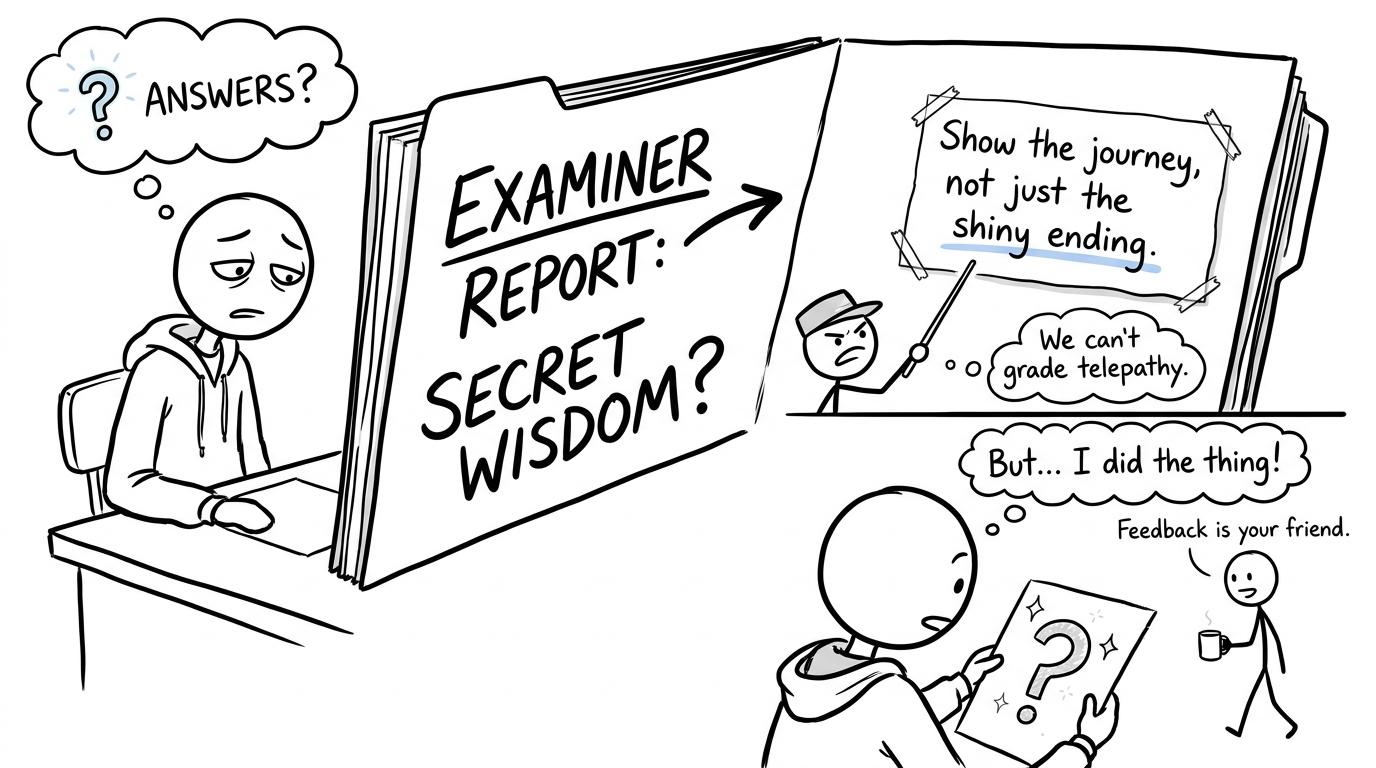 A student discovers that an examiner report wants the creative journey rather than a mysterious secret
What GCSE Art and Design examiner reports assess
Across GCSE Art and Design specifications, work is judged through four assessment objectives. Their precise presentation should always be checked against your board's current specification, but the shared structure is:
- AO1: develop ideas through investigations and demonstrate critical understanding of sources.
- AO2: refine work by exploring ideas and experimenting with suitable media, materials, techniques and processes.
- AO3: record ideas, observations and insights relevant to your intentions as work progresses.
- AO4: present a personal and meaningful response that realises intentions and demonstrates understanding of visual language.
These objectives are connected. For example, AQA currently gives each one an overall weighting of 25%25\%25%, with its portfolio contributing 60%60\%60% and its externally set assignment contributing 40%40\%40% of the qualification. Other students should use the figures and component rules stated by their own board.
The deeper lesson is that AO4 cannot reliably rescue weak development elsewhere. A personal final response becomes convincing when AO1, AO2 and AO3 have built a clear route towards it.
The messages that appear year after year
Research must influence the work
Naming an artist and copying biographical information is not the same as critical investigation. Stronger contextual research asks useful questions: Which visual decisions matter? How has the source handled composition, surface, scale, colour or meaning? What could be tested rather than merely imitated?
Recent reports praise focused analysis that informs practical development. They flag research that becomes a decorative biography, a collection of downloaded pictures or an essay detached from the student's own work.
Keep annotation selective. A short comment explaining how a source changed your next experiment is usually more valuable than a long paragraph that has no visible effect on the project.
Primary sources create personal possibilities
Official feedback frequently values first-hand sources: direct observation, original photography, drawings from objects, places or people, and other personally gathered material. These sources give students details and viewpoints that are less likely to produce generic work.
The warning is not that every internet image is forbidden. Secondary sources can be relevant. The problem is over-reliance on them, especially when they replace observation or weaken the student's connection to the theme.
A useful review question is: could another student have assembled exactly the same page from the same search results? If so, consider what first-hand evidence would make the investigation more individual and purposeful.
Experimentation needs direction
A crowded page of materials can look industrious while revealing very little development. AO2 is not simply a count of techniques. Examiners are interested in selection, testing and refinement.
Each experiment should help answer something: Which surface supports the intention? What happens when the composition is cropped? Does a change of scale strengthen the response? Which process should be retained, adapted or rejected?
The same distinction appears in effective maths revision. Completing many questions is less useful if you never diagnose an error. A focused cycle of attempt, feedback and correction is more productive. MathsGenie's guide to GCSE revision that still works when motivation is low explains how to keep that loop manageable.
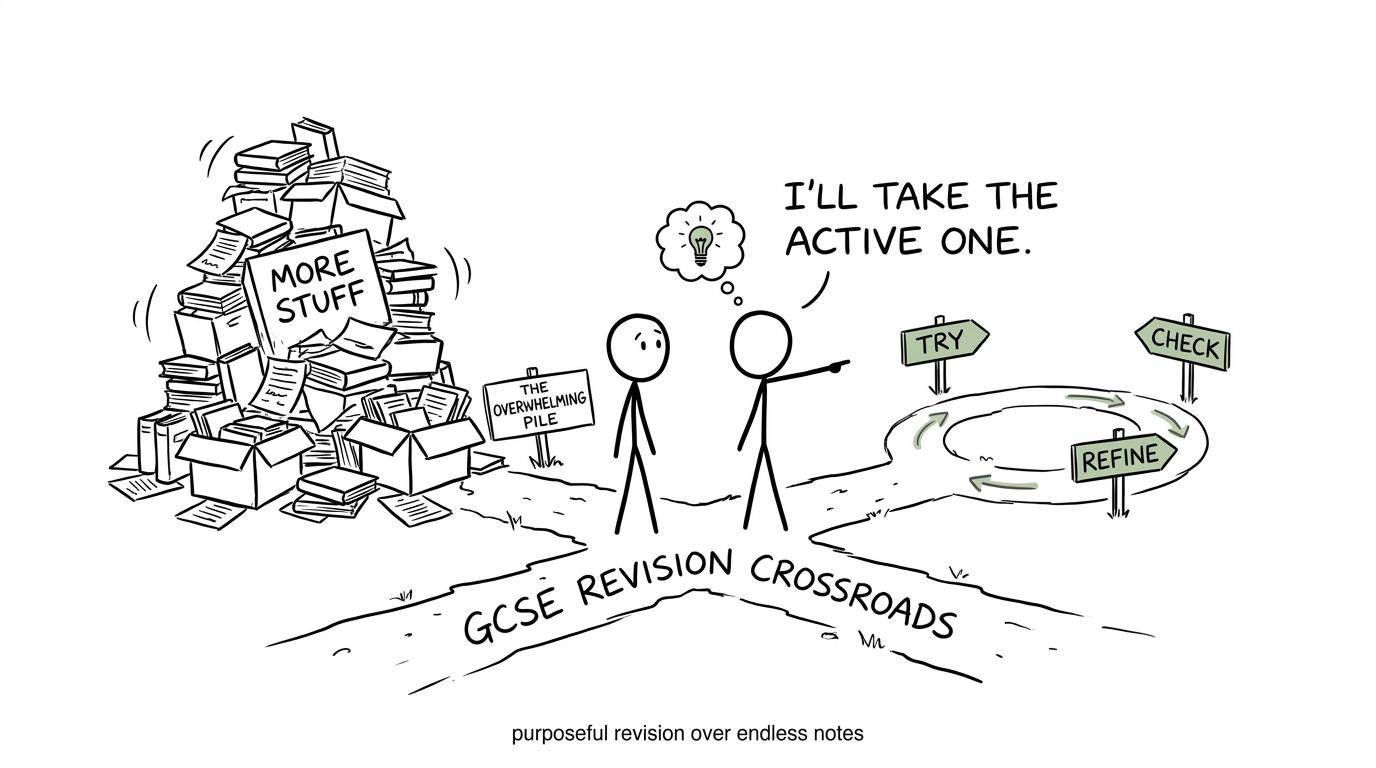 A student chooses the purposeful try-check-refine loop instead of an unstable pile of more stuff
Final ideas should not be fixed too early
One of the clearest recurring warnings is premature commitment. A student chooses the final composition near the beginning, then uses the remaining pages to justify a decision already made.
That reverses the intended process. Development should create genuine alternatives. Sketches, studies, material tests and compositional changes should reveal why the final direction became the strongest one.
This does not mean uncertainty for its own sake. It means delaying commitment long enough to make an informed choice. A focused project can still be efficient, but its refinements must be real rather than staged after the event.
The final response must grow from the project
Moderators often praise outcomes that are personal, meaningful and supported by coherent preparatory work. They flag outcomes that sit apart from the portfolio, remain too close to one contextual source or attempt something too ambitious without sufficient planning.
Ask whether a moderator can trace the final piece backwards. Its imagery should connect to recording. Its materials should connect to experimentation. Its visual decisions should connect to investigation and refinement.
If those links are missing, adding more decoration to the final outcome will not repair the underlying gap.
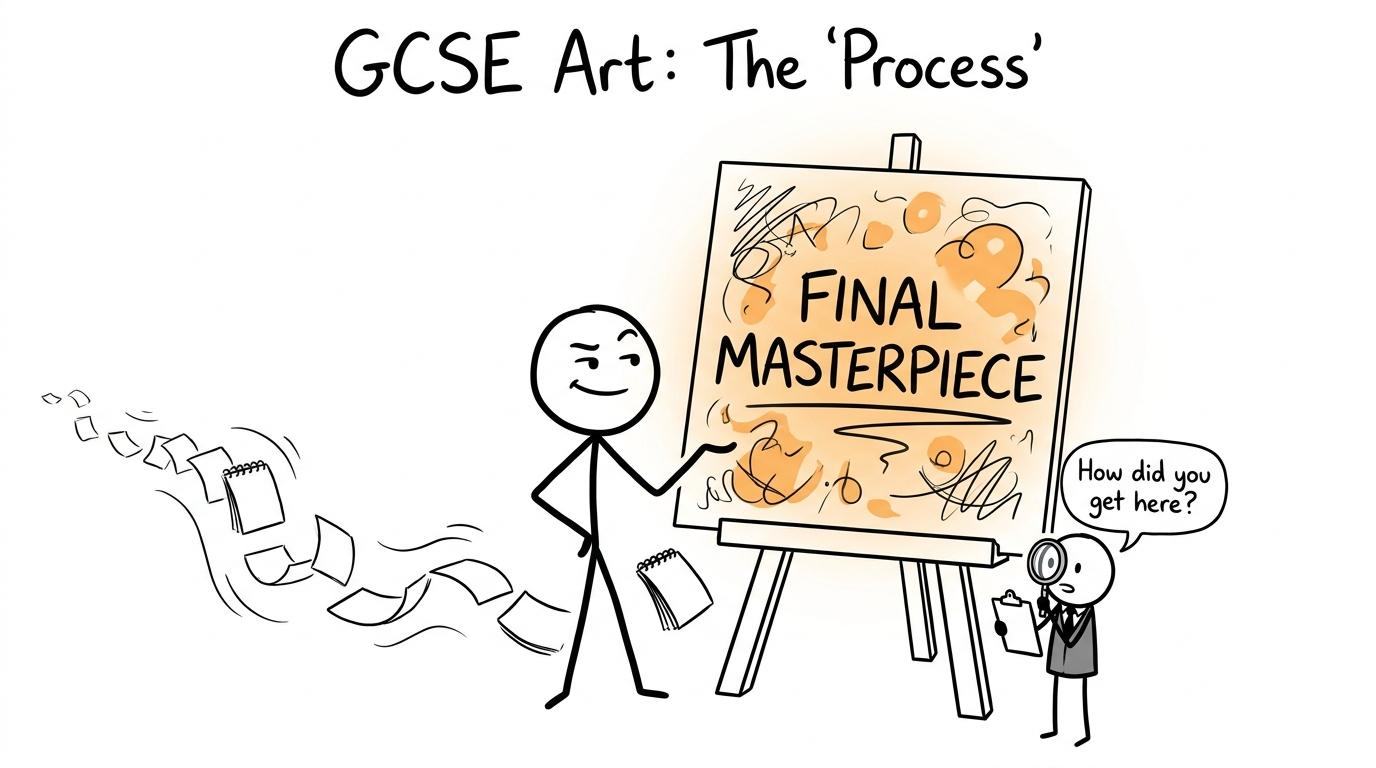 An examiner asks how a giant final masterpiece emerged while blank sketchbook pages blow away
How to turn examiner feedback into smarter revision
Examiner reports become useful when their broad comments are converted into small actions. Start by reading the report for your exact board and series. AQA, Edexcel, OCR and Eduqas use common assessment objectives, but their documents, component arrangements and administrative guidance are not interchangeable.
Then audit your work objective by objective:
Trace the evidence
Choose one important decision in the final response and locate the pages that support it. Can you find the source, initial observation, experiment and refinement that led there? If not, discuss the gap with your teacher rather than manufacturing a false journey.
Edit before adding
More pages do not automatically mean more marks. Remove or reduce repeated material where your centre's submission rules allow it. Give prominence to evidence that shows development, comparison and decision-making.
Make annotations earn their space
Replace vague comments such as “this worked well” with precise evaluation. Identify what succeeded, why it supported the intention and what you changed next. The annotation should direct attention to evidence already present, not claim progress that cannot be seen.
Use a feedback loop
Practise the same habit across subjects:
- attempt the task;
- compare the evidence with the assessment criteria;
- identify one weakness;
- make a targeted improvement;
- review the change.
For maths, that means attempting questions before reading solutions and correcting the exact step that lost marks. You can build the habit with free GCSE maths resources from MathsGenie, then move into timed papers when the methods are secure. If an exam is close, the GCSE maths night-before plan offers a calm way to prioritise practice rather than panic.
Common mistakes when using examiner reports
Treating every criticism as a personal instruction
A report summarises patterns across many centres. Not every warning applies to your portfolio. Find the comments that match visible weaknesses in your work and confirm your response with your teacher.
Reading a report from the wrong board or year
General lessons can transfer, but specifications and arrangements can change. Use the report, assessment criteria and guidance for your qualification and current series wherever available.
Producing extra work instead of better evidence
When students read that development was weak, the instinct can be to create more pages. The better response is often to improve the connections between investigation, experimentation, recording and outcome.
Confusing technical polish with assessment coverage
Skill matters, but a polished final response does not automatically demonstrate all four objectives. Moderators assess the relevant evidence across the submitted work.
Copying the language of the criteria
Writing “I refined my ideas” does not prove refinement. The work should show alternatives, testing, evaluation and a reasoned change of direction.
Neglecting other subjects while finishing the portfolio
Art deadlines can expand to consume every available evening. Protect short, regular blocks for maths rather than waiting for a completely free day. The article on how many hours to revise for GCSEs explains why the quality of the revision cycle matters more than chasing an impressive total.
Read the evidence, then act on it
Examiner reports say something reassuring beneath their formal language. Strong work is not defined by endless pages or a sudden flash of talent. It is built through relevant sources, first-hand observation, purposeful experiments, honest refinement and a final response that belongs to the journey before it.
Use the report as a lens, not a script. Check your board's current requirements, compare the comments with your own evidence and choose a small number of improvements that genuinely strengthen the project.
Then bring the same discipline back to maths. Start at the MathsGenie GCSE revision hub, choose the correct exam board and tier, and work through revision lessons, practice questions, mini tests, past papers, predicted papers, mark schemes and video solutions. Visible progress begins with one attempt, one honest check and one well-chosen correction.










