

GCSE Arabic vs Modern Hebrew Grade Boundaries
GCSE Arabic vs Modern Hebrew grade boundaries compared with 2025 data. See which percentages were lower and how to set a safer target grade.
A grade boundary can look like a shortcut. One subject needs fewer raw marks, another needs more, and the temptation is to call the first one more generous. But raw totals rarely tell the whole story.
The short answer to GCSE Arabic vs Modern Hebrew grade boundaries is that neither subject is consistently more generous at every grade. In June 2025, Edexcel Arabic had lower percentage boundaries throughout Foundation tier and at Higher grades 9 and 8. AQA Modern Hebrew had lower Higher-tier boundaries from grades 7 to 3. The comparison changes with your target grade, tier and exam series.
More importantly, a lower boundary does not automatically mean an easier GCSE. Boundaries compensate for paper difficulty and are confirmed only after the examinations have been marked.
The comparison at a glance
Before drawing conclusions, check five things:
- Exam board: the current comparison is normally Edexcel Arabic against AQA Modern Hebrew.
- Qualification: Modern Hebrew is not Pearson Edexcel Biblical Hebrew.
- Tier: compare Foundation with Foundation or Higher with Higher.
- Percentage: the qualifications have different total marks, so raw marks cannot be compared directly.
- Exam series: boundaries move each year and are not known before the examinations.
For the latest complete summer series available at the time of writing, June 2025, the pattern was:
- Foundation tier: Arabic had the lower percentage boundary at every available grade.
- Higher grades 9 and 8: Arabic was slightly more favourable numerically.
- Higher grades 7 to 3: Modern Hebrew had the lower percentage boundaries.
That is the useful answer. There is no single winner without first naming your target grade.
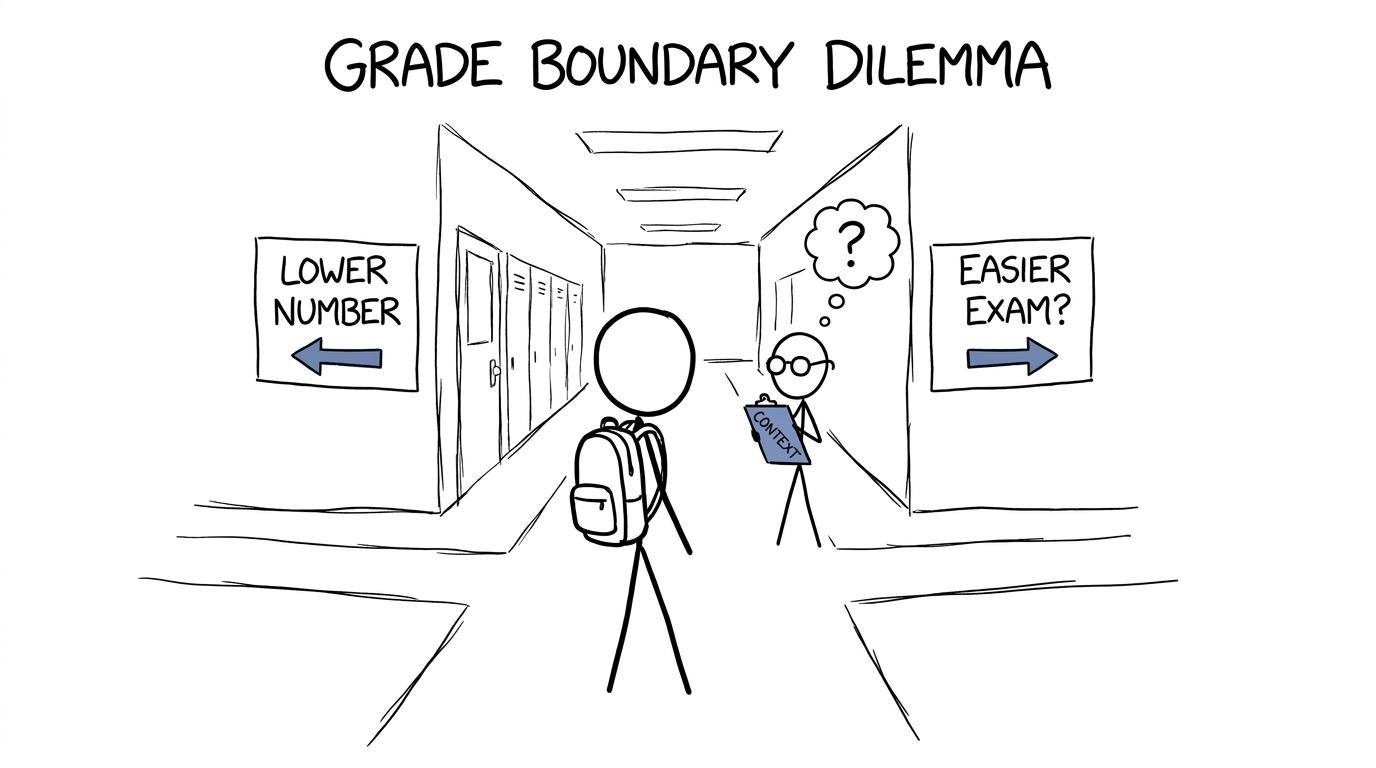 A student discovers that a lower boundary and an easier exam are not the same thing
June 2025 GCSE Arabic vs Modern Hebrew grade boundaries
Edexcel GCSE Arabic was marked out of 280280280, while AQA GCSE Modern Hebrew was marked out of 240240240. A fair comparison therefore uses:
Boundary percentage=grade boundarymaximum mark×100%\text{Boundary percentage}=\frac{\text{grade boundary}}{\text{maximum mark}}\times 100\%Boundary percentage=maximum markgrade boundary×100%The figures below use overall qualification boundaries, not notional boundaries for individual papers. You can inspect the underlying raw marks on MathsGenie's Edexcel GCSE Arabic grade boundaries and AQA GCSE Modern Hebrew grade boundaries pages.
Higher-tier comparison
| Target grade | Edexcel Arabic | AQA Modern Hebrew | Lower percentage in 2025 |
|---|---|---|---|
| Grade 9 | 237280=84.6%\frac{237}{280}=84.6\%280237=84.6% | 208240=86.7%\frac{208}{240}=86.7\%240208=86.7% | Arabic |
| Grade 8 | 208280=74.3%\frac{208}{280}=74.3\%280208=74.3% | 178240=74.2%\frac{178}{240}=74.2\%240178=74.2% | Modern Hebrew, by about 0.10.10.1 percentage points |
| Grade 7 | 179280=63.9%\frac{179}{280}=63.9\%280179=63.9% | 148240=61.7%\frac{148}{240}=61.7\%240148=61.7% | Modern Hebrew |
| Grade 6 | 156280=55.7%\frac{156}{280}=55.7\%280156=55.7% | 126240=52.5%\frac{126}{240}=52.5\%240126=52.5% | Modern Hebrew |
| Grade 5 | 134280=47.9%\frac{134}{280}=47.9\%280134=47.9% | 104240=43.3%\frac{104}{240}=43.3\%240104=43.3% | Modern Hebrew |
| Grade 4 | 112280=40.0%\frac{112}{280}=40.0\%280112=40.0% | 82240=34.2%\frac{82}{240}=34.2\%24082=34.2% | Modern Hebrew |
| Grade 3 | 101280=36.1%\frac{101}{280}=36.1\%280101=36.1% | 71240=29.6%\frac{71}{240}=29.6\%24071=29.6% | Modern Hebrew |
At grade 8, the difference was effectively negligible: only about 0.10.10.1 percentage points. At grade 9, Arabic had the lower boundary by about 2.02.02.0 percentage points. From grade 7 downwards, Modern Hebrew required a smaller proportion of its available marks.
The gap became larger near the lower end of Higher tier. That does not prove that Modern Hebrew was easier. It indicates that the boundary-setting process placed the required standard at a lower raw-mark percentage on that particular assessment.
Foundation-tier comparison
| Target grade | Edexcel Arabic | AQA Modern Hebrew | Lower percentage in 2025 |
|---|---|---|---|
| Grade 5 | 164280=58.6%\frac{164}{280}=58.6\%280164=58.6% | 157240=65.4%\frac{157}{240}=65.4\%240157=65.4% | Arabic |
| Grade 4 | 144280=51.4%\frac{144}{280}=51.4\%280144=51.4% | 132240=55.0%\frac{132}{240}=55.0\%240132=55.0% | Arabic |
| Grade 3 | 110280=39.3%\frac{110}{280}=39.3\%280110=39.3% | 107240=44.6%\frac{107}{240}=44.6\%240107=44.6% | Arabic |
| Grade 2 | 77280=27.5%\frac{77}{280}=27.5\%28077=27.5% | 82240=34.2%\frac{82}{240}=34.2\%24082=34.2% | Arabic |
| Grade 1 | 44280=15.7%\frac{44}{280}=15.7\%28044=15.7% | 57240=23.8%\frac{57}{240}=23.8\%24057=23.8% | Arabic |
For a Foundation-tier target, Arabic appears more favourable across the whole 2025 table. Its boundaries were lower both as raw proportions and at every available grade.
Yet this still does not make Arabic the safer subject for an individual student. Your fluency across listening, speaking, reading and writing will matter far more than a difference between historical percentages.
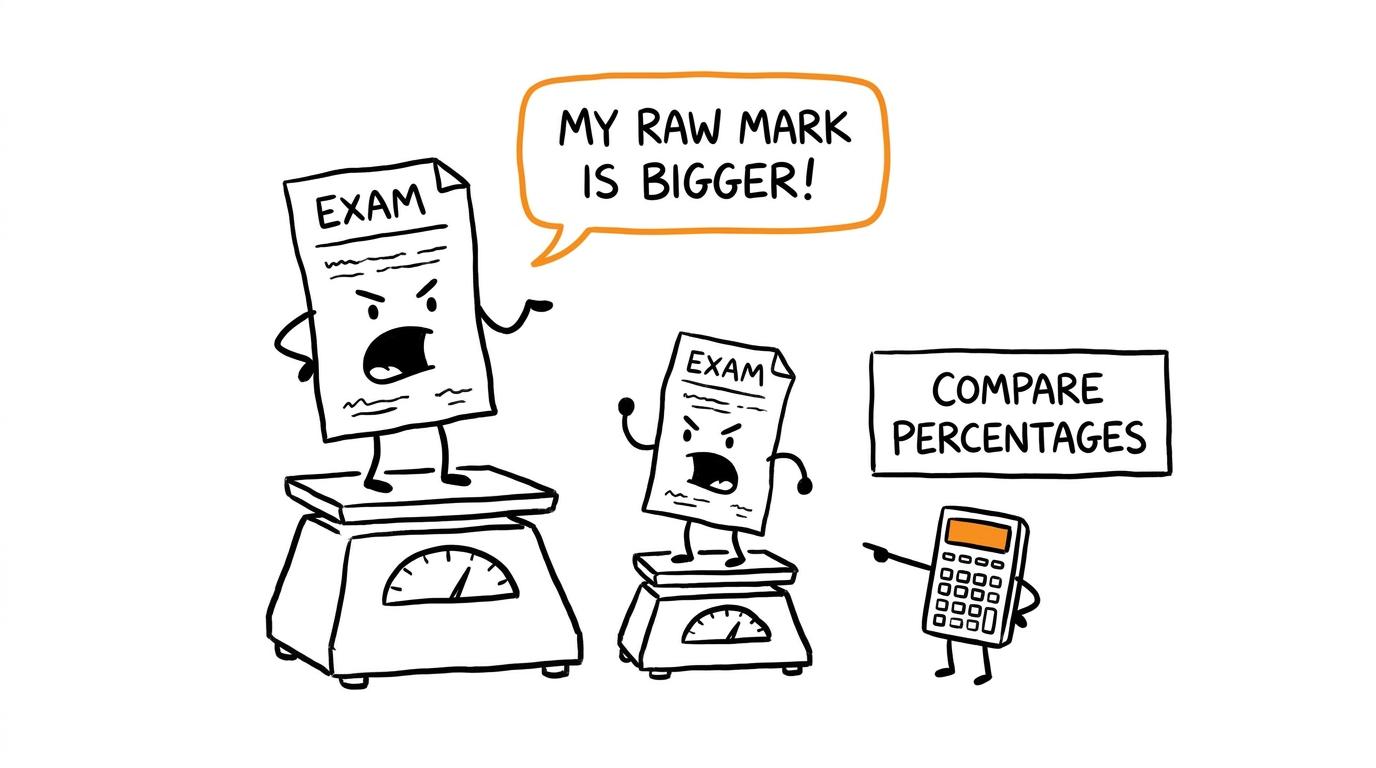 Two exam papers learn why raw marks from different totals need percentage context
Why lower boundaries do not mean greater generosity
Grade boundaries are not promises made before an examination. Exam boards set them after marking is nearly complete, using statistical evidence and senior examiners' judgements about the quality of work around key boundaries.
If students find a paper harder, its boundaries may be lower. If they find it more accessible, boundaries may be higher. The aim is to preserve the standard represented by a grade, not to reward one subject more kindly than another.
This creates an important distinction:
- A lower raw-mark percentage is a measurable historical fact.
- A more generous qualification is an interpretation that the figures alone cannot establish.
The papers also assess different specifications under different boards. AQA Modern Hebrew and Edexcel Arabic may vary in task design, wording, scaling and the demands placed on each language skill. Comparing only their final percentages strips away that context.
It is similar to comparing marks from two different maths papers without considering difficulty. A score of 60%60\%60% on a demanding paper may represent stronger performance than 70%70\%70% on a more accessible one.
Does the pattern remain stable between years?
The 2024 figures offer a useful check. They show broadly the same shape, but not identical percentages.
On Foundation tier, Arabic again had lower percentage boundaries at grades 5 to 1. On Higher tier, Arabic had lower boundaries at grades 9 and 8, while Modern Hebrew was marginally lower from grade 7 downwards.
For example, the 2024 Higher grade 9 boundaries were approximately:
- Arabic: 225280=80.4%\frac{225}{280}=80.4\%280225=80.4%
- Modern Hebrew: 203240=84.6%\frac{203}{240}=84.6\%240203=84.6%
By 2025, both grade 9 percentages had risen. This is why last year's figure should be treated as evidence for planning rather than a prediction of the next boundary.
The stable lesson is not a magic percentage. It is the need to compare the correct board, tier, series and total marks.
What the figures mean for your target grade
If you are targeting grades 9 or 8
Recent figures have favoured Arabic at grade 9. At grade 8, the 2025 percentages were virtually the same, although Arabic had been lower in 2024.
Do not prepare to land exactly on the old boundary. Use recent papers to establish a realistic mark range, then aim above the highest relevant recent boundary rather than relying on one summer's figure.
If you are targeting grade 7
Modern Hebrew had the lower Higher-tier percentage in 2025, but the difference was only about 2.32.32.3 percentage points. Your performance in the actual specification is a much better guide than that small gap.
A grade 7 candidate should concentrate on consistent accuracy across all four skills, not on trying to exploit a boundary that may move.
If you are targeting grades 6, 5 or 4
On Higher tier, Modern Hebrew had noticeably lower 2025 percentages. On Foundation tier, Arabic had lower percentages. Tier therefore changes the answer completely.
Foundation tier offers grades 1 to 5. Higher tier is designed for grades 4 to 9, with a possible grade 3 for candidates falling narrowly below the grade 4 threshold under the relevant rules. Confirm your entry with your school rather than choosing a tier from a boundary table alone.
Use grade-boundary data like a maths student
Grade-boundary comparisons are really exercises in proportional reasoning. Different maximum marks make raw totals misleading, so percentages provide the common scale.
The same discipline helps with maths revision. Start from evidence, convert mistakes into useful information, then act on what the data says. MathsGenie's GCSE Maths revision hub brings together resources for Edexcel, AQA, OCR and Eduqas, while the Edexcel GCSE Maths revision area organises lessons and exam-style questions by topic.
A reliable revision cycle is:
- sit the correct paper under timed conditions;
- mark it using the official mark scheme;
- record where marks were lost;
- revisit those topics through revision lessons and practice questions;
- retest with a different question set.
MathsGenie's guide to using GCSE past papers properly explains this process in more depth. Short GCSE mini tests are useful when a full paper would hide the exact skill that needs attention.
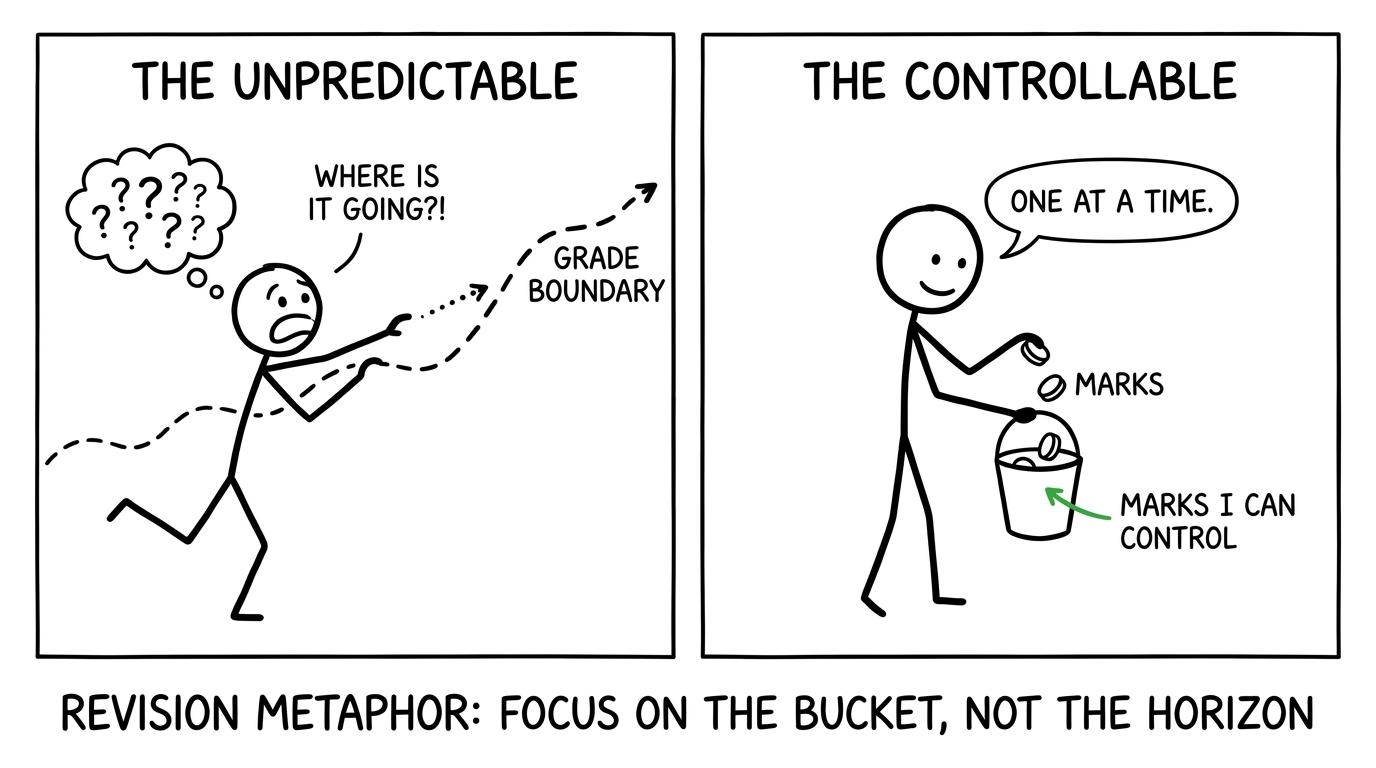 A student stops chasing a moving grade boundary and collects controllable marks instead
Common mistakes when comparing language boundaries
Comparing raw marks directly
A boundary of 179179179 cannot be compared fairly with one of 148148148 until each is divided by its qualification total. Here, the totals are 280280280 and 240240240.
Confusing Modern Hebrew with Biblical Hebrew
AQA GCSE Modern Hebrew and Pearson Edexcel GCSE Biblical Hebrew are separate qualifications. Biblical Hebrew boundaries do not answer a question about Modern Hebrew.
Mixing Foundation and Higher tier
A Foundation grade 5 boundary and a Higher grade 5 boundary come from different papers with different demands. They should not be treated as interchangeable targets.
Calling a lower boundary an easier subject
Lower boundaries often reflect a more demanding assessment. They do not prove that candidates receive grades more generously.
Treating an old boundary as a forecast
Boundaries are set after each exam series. A historical boundary can inform a cautious target, but nobody can know the exact future figure in advance.
Choosing a GCSE by one year's table
Language competence, teaching, specification familiarity and performance across all assessed skills are more important than a few percentage points. Boundary data should refine a decision, not make it by itself.
Focus on the marks you can control
The 2025 evidence gives a precise but nuanced conclusion. Arabic had lower Foundation-tier boundaries and the lower Higher grade 9 boundary. Modern Hebrew had lower Higher-tier boundaries from grades 7 to 3, while grade 8 was almost level.
So which was more generous? Numerically, it depended on the target. Educationally, neither can be called universally more generous from boundary data alone.
That is also a useful lesson for maths. The boundary moves; your preparation is the part you control. Begin with the MathsGenie GCSE Maths hub, strengthen weak topics through free revision lessons and practice questions, and then test your progress with mark schemes, video solutions, past papers and Edexcel predicted papers. Aim beyond yesterday's boundary and build a performance that does not depend on it.










