GCSE Arabic Revision Drop-In Sessions: Worth It?
GCSE Arabic revision drop-in sessions can improve speaking, feedback and exam technique. Learn when to attend and when revising alone is more useful.
A revision drop-in can look optional in every sense: no register, no formal lesson and no obvious consequence if you go home instead. Yet GCSE Arabic revision drop-in sessions are usually worth attending when they give you something solo revision cannot easily provide: immediate feedback, realistic speaking practice or help with a specific misunderstanding.
They are less valuable when you arrive without a target and spend the session copying notes you could have reviewed at home. The best choice is rarely drop-ins or independent revision. It is to use each for the work it does best.
For students balancing Arabic with GCSE maths and other subjects, that distinction matters. Revision time is limited. Every session should have a job.
The quick decision checklist
Attend your school’s Arabic drop-in if you can answer yes to at least one of these questions:
- Do you need a teacher to correct your pronunciation or spoken responses?
- Is there a grammar point you still cannot explain or apply?
- Do you have a completed writing task that needs precise feedback?
- Are you unsure why an answer lost marks?
- Would a scheduled session stop you postponing the subject?
- Can you bring two or three focused questions?
Revise alone instead when the next task is clear and mainly requires repetition, such as learning vocabulary, completing a timed reading task or correcting familiar errors.
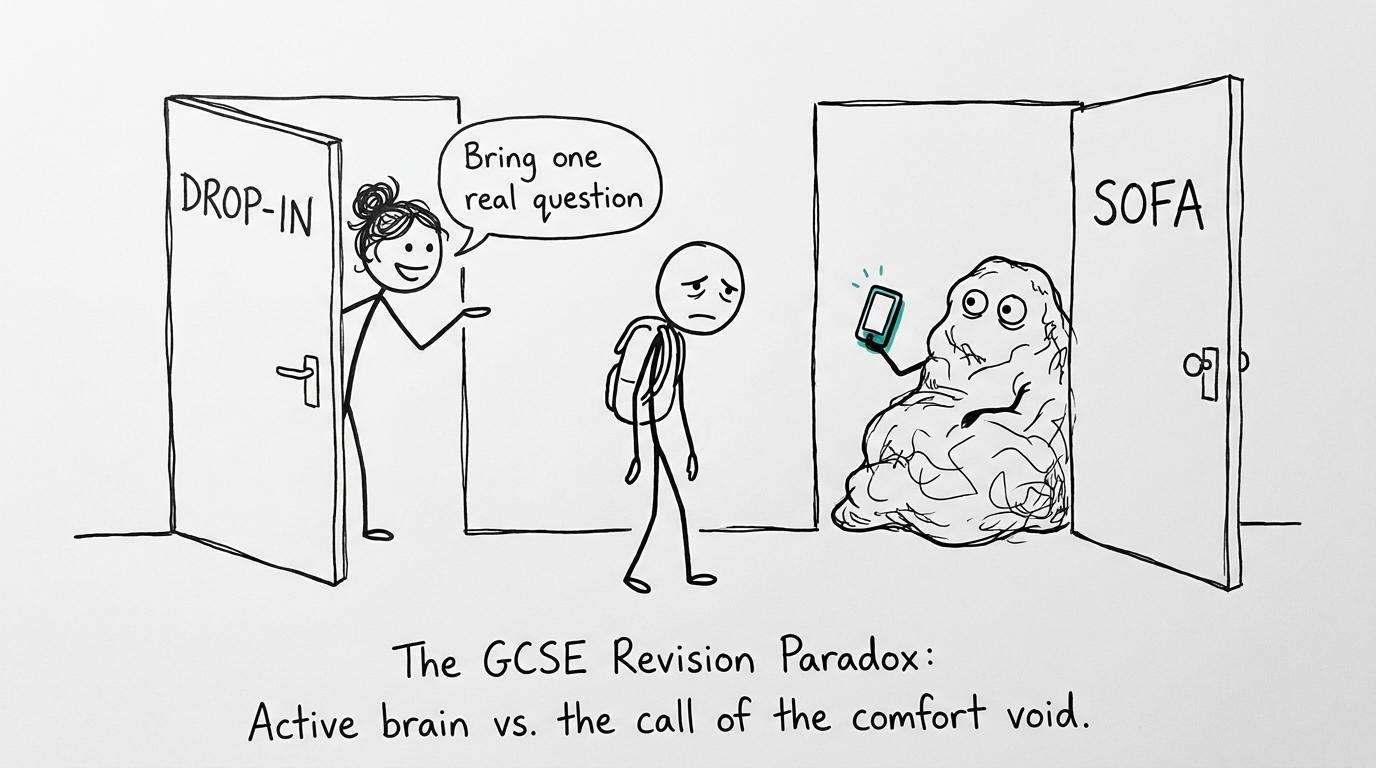 A student choosing between a useful revision drop-in and the sofa
What GCSE Arabic actually requires
Before judging a drop-in, check that its activities match your qualification. The current regulated Pearson Edexcel GCSE Arabic course assesses four separate skills: listening, speaking, reading and writing. Each contributes 25%25\%25% of the qualification. Students enter Foundation or Higher tier across all four papers rather than mixing tiers.
The speaking assessment includes a role play, questions based on a picture stimulus and a conversation. Reading includes comprehension and translation into English, while writing includes extended responses and translation into Arabic. Dictionaries are not permitted in the assessments.
That structure explains why independent revision alone can leave gaps. You can test vocabulary by yourself, but it is difficult to judge whether an answer sounds natural, communicates clearly or responds appropriately to an unexpected follow-up question. A knowledgeable teacher can hear those weaknesses quickly.
Do not confuse the regulated GCSE with an International GCSE Arabic qualification, which may use a different assessment structure. Confirm the qualification, specification, tier and paper format with your school before planning revision. References to AQA, OCR or Eduqas may be relevant to your GCSE maths timetable, but they should not be assumed to describe your Arabic qualification.
When GCSE Arabic revision drop-in sessions are worth attending
You need feedback that changes your next attempt
A useful comment is not simply “good” or “add more detail”. It identifies a repair: a tense used inaccurately, an answer that does not address the prompt, vocabulary that is too repetitive or pronunciation that obscures meaning.
This fits wider educational evidence about retrieval practice. Trying to recall knowledge is useful, but feedback matters because it corrects errors before they become familiar. A drop-in is therefore most valuable when you attempt something first and ask the teacher to diagnose it.
Bring a paragraph, translation, speaking response or marked question. The attempt gives the teacher evidence. Without it, much of the session may be spent discovering what you need.
You need live speaking practice
Speaking is the clearest reason to attend. Solo rehearsal can improve fluency, but it cannot fully reproduce interaction. In a drop-in, a teacher may change a question, ask for justification or notice that a memorised response falls apart when the conversation takes an unexpected turn.
Ask to practise one defined element rather than “speaking in general”. You might focus on extending answers, responding without a script, asking an appropriate question in a role play or recovering after forgetting a word.
Record only if your school and teacher permit it. Otherwise, write down two brief corrections immediately afterwards and rehearse them again at home.
You are repeatedly making the same mistake
Repeated errors are often hard to see from inside your own work. You may know vocabulary well but misread the instruction. You may communicate an idea but shift tense halfway through. You may recognise a grammatical structure while reading yet fail to produce it in writing.
Bring examples of the repeated mistake. A teacher can help distinguish between a knowledge gap, an application problem and an exam-technique issue. Each needs a different response.
This diagnostic habit also works in maths. MathsGenie’s guide to finding your weakest GCSE topics explains how evidence from attempted questions can turn a vague worry into a specific revision target.
You struggle to begin revision alone
A scheduled room, visible teacher and fixed finishing time can reduce the number of decisions you must make. That is valuable when the alternative is spending half an hour choosing a resource and never beginning.
However, attendance is not the same as progress. Decide what you will produce before leaving: one corrected writing task, one speaking rehearsal or answers to three questions. A visible outcome turns the session from supervised time into purposeful practice.
When revising alone is the better choice
Drop-ins have an opportunity cost. An hour spent waiting for help with a question you could answer independently may take time from maths, science or another Arabic skill.
Solo revision is usually more efficient for:
- retrieving vocabulary without notes;
- revisiting vocabulary after a gap;
- completing listening or reading questions under timed conditions;
- learning corrections already explained by your teacher;
- practising accurate writing from familiar prompts;
- reviewing a past paper and creating an error list.
Independent revision also lets you control the pace. You can pause on one difficult phrase, repeat an audio task or move quickly through material you already know.
The danger is passive familiarity. Reading the same vocabulary list can feel productive because every word looks recognisable. Recognition is not the same as recall. Close the list, retrieve the Arabic from the English or the English from the Arabic, check it, then return to missed items later.
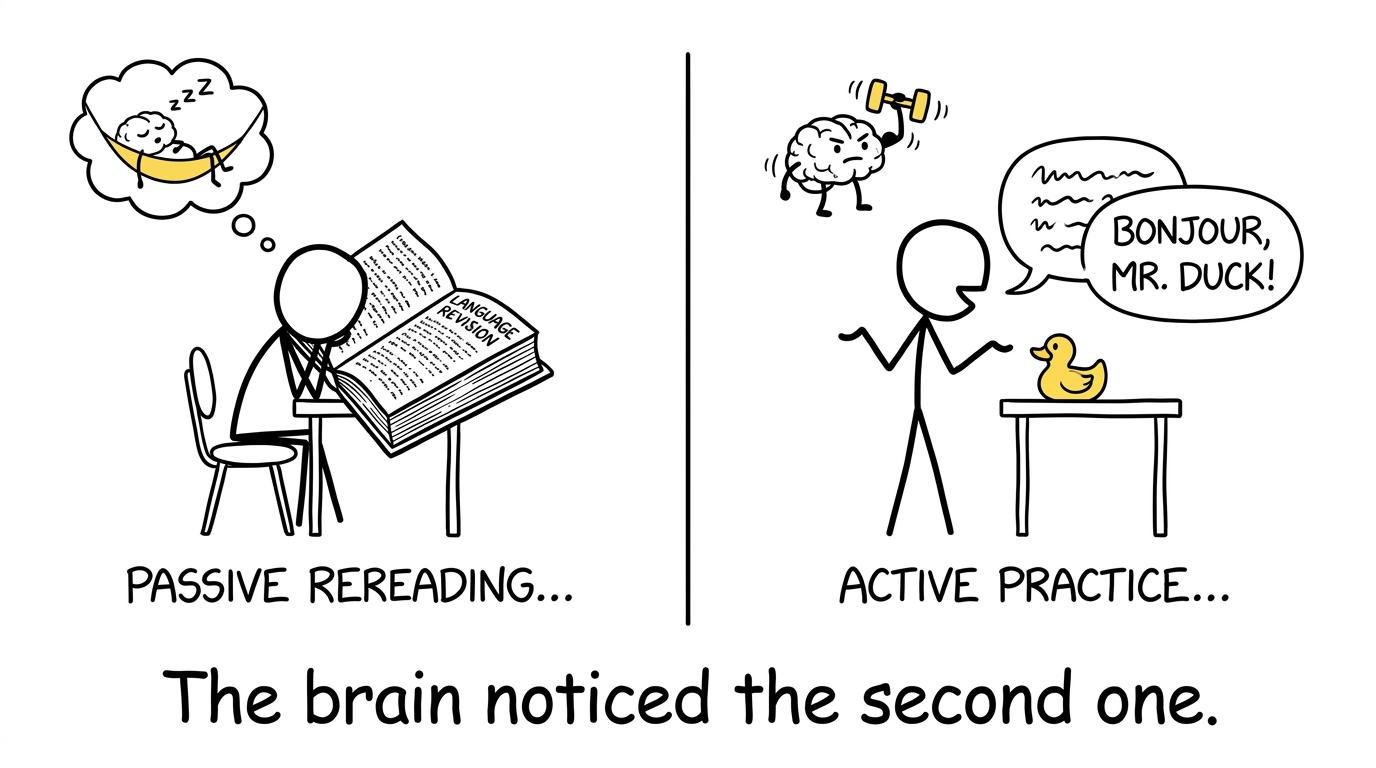 One brain sleeps through rereading while another trains through active practice
The strongest approach combines both methods
Think of independent revision as the workshop and the drop-in as quality control. At home, you produce an attempt. At school, you obtain expert feedback. Afterwards, you make a second attempt without support.
A practical cycle is:
- Before the session: complete a short task and mark what felt uncertain.
- At the session: ask focused questions and practise the weakest skill.
- Immediately afterwards: write down the corrections in your own words.
- Within the next few days: repeat the skill from memory with a fresh prompt.
- Later: test whether the correction survives under timed conditions.
Spacing the final attempt matters. Repeating an answer immediately may test short-term memory rather than secure learning. Maths students can use the same cycle with GCSE maths revision lessons and questions: attempt, receive feedback, repair the weakness and retest it later.
How to make a school drop-in genuinely useful
Arrive with three focused questions
“Can you help me with Arabic?” is too broad. Better questions identify a skill and a problem:
- Why did this response fail to answer the prompt fully?
- Which part of my pronunciation makes this answer unclear?
- Am I applying this tense consistently?
- What should I practise before my next speaking rehearsal?
Keep the list short. Depth is more valuable than collecting hurried explanations.
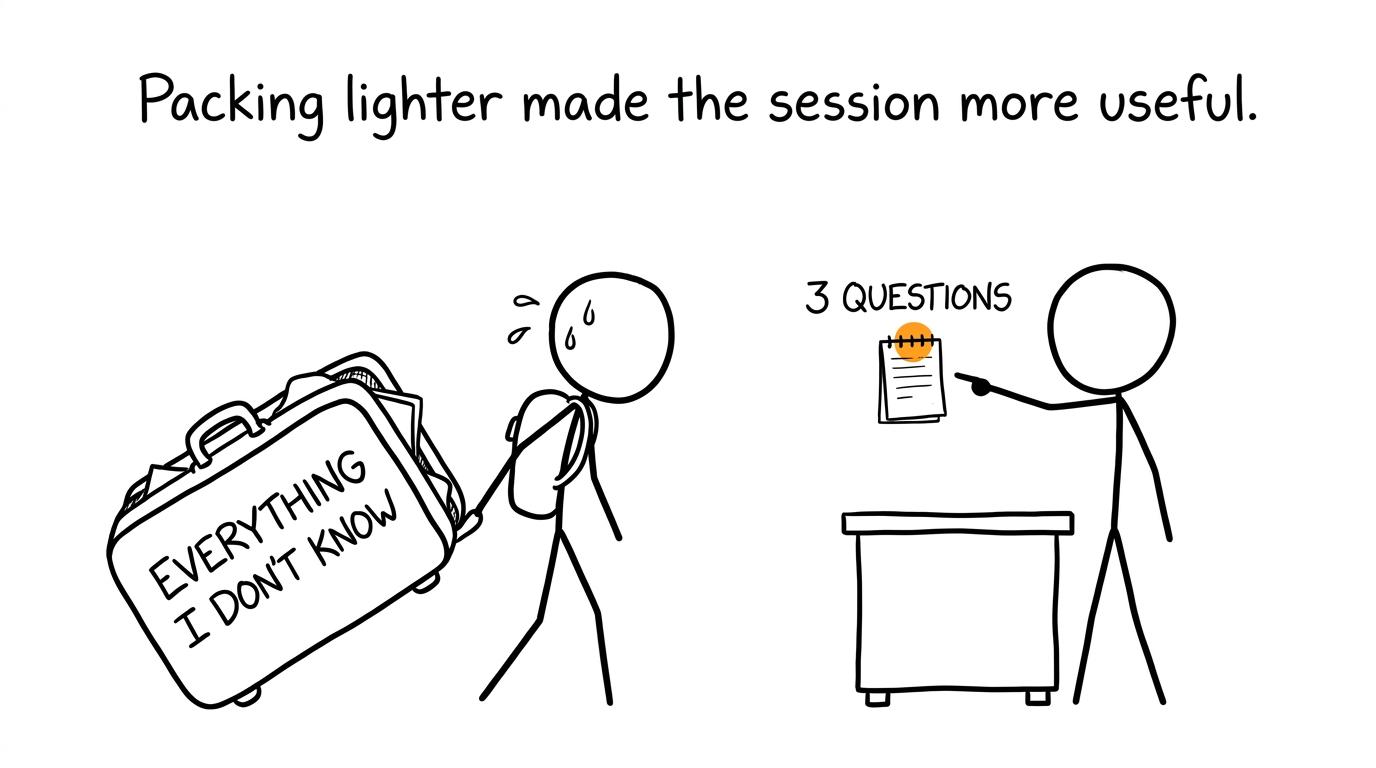 A student replaces a suitcase of every possible worry with three focused questions
Bring evidence, not just worries
Bring the question, your answer and any available teacher marking. If the problem is speaking, prepare a response you can perform. If it is listening, note the point at which you stopped following the recording.
The principle is familiar from using GCSE past papers properly: an attempted paper reveals much more than a general feeling of being behind.
Protect your wider revision timetable
Arabic should have a clear place alongside maths and your other GCSEs. Add the drop-in to the free MathsGenie revision planner, then schedule the follow-up task. Otherwise, the session can become an isolated event whose feedback is never used.
If maths is taking most of your week, avoid replacing all independent Arabic practice with one school session. Language skills benefit from repeated contact. A short recall task on several days is generally more purposeful than saving everything for a single drop-in.
Common mistakes to avoid
Attending without doing any work first
If you have not attempted a task, the teacher has little evidence to diagnose. Complete something small before you arrive.
Treating the session as a substitute for regular revision
One productive conversation cannot replace vocabulary retrieval, listening practice and repeated writing. Use the session to improve your independent work, not escape it.
Asking for a complete re-teaching of the course
Drop-ins are usually best for focused support. If a whole topic is missing, ask your teacher what lesson material or sequence of tasks you should complete first.
Collecting feedback without applying it
Advice becomes useful only when it changes a later response. Reattempt the corrected skill without copying the teacher’s wording.
Letting one subject consume every available hour
GCSE revision is a portfolio of competing needs. Use the GCSE revision timetable guide to give maths deliberate space, then place Arabic speaking practice and drop-ins around it. When maths exams approach, mini tests and predicted-paper resources can provide focused practice without making every session a full paper.
The verdict: attend selectively, then act on the feedback
School drop-ins are worth attending for GCSE Arabic when they provide interaction, expert correction, accountability or clarity that you cannot create alone. They are not automatically the best use of time. Vocabulary retrieval, routine reading practice and the application of familiar corrections are often better completed independently.
Go with a task. Ask precise questions. Leave with a correction you can test again.
Then apply the same disciplined approach across your GCSE timetable. MathsGenie gives you a free home base for maths through revision lessons, practice questions, mini tests, past-paper revision guidance, mark schemes, video solutions and predicted papers. Use the planner to balance your subjects, use school expertise where it adds the most value, and make every revision session produce a visible next step.