GCSE Arabic Results Day: Is Your Grade Wrong?
GCSE Arabic results day wrong grade? Follow a calm first-hour checklist, check your marks and learn when to request a review of marking.
A results slip can change the atmosphere of a morning in seconds. One line looks lower than your mock grades, your predicted grade or what your teacher expected. Suddenly, it is difficult to think beyond a single question: is this correct?
If you are searching for gcse arabic results day wrong grade advice, the immediate answer is simple: do not assume the grade is wrong, but do not leave school without raising the concern. Check your candidate details, confirm the exam board and tier, ask for your component marks and speak to your Arabic teacher or exams officer. Your school can then help you decide whether to request a script, a clerical re-check or a review of marking.
A surprising result is not proof of an error. It is a reason to investigate calmly.
Your first-hour results day checklist
Keep this list open on your phone or write it down before results day:
- Check that your name, candidate number and qualification are correct.
- Confirm that the result is for GCSE Arabic and the expected exam board.
- Check whether you were entered for foundation or higher tier.
- Ask for your overall mark and any available component marks.
- Compare the mark with the official boundary for your board and exam series.
- Tell your Arabic teacher or exams officer that the result appears unexpected.
- Ask whether your school can access the relevant marked work.
- Find out the school's internal deadline, fee policy and consent process.
- Explain immediately if the result affects a sixth-form, college or course place.
- Take a photograph or keep a secure copy of every document you receive.
You do not need to decide on a review in the first five minutes. You do need to start the conversation in the first hour.
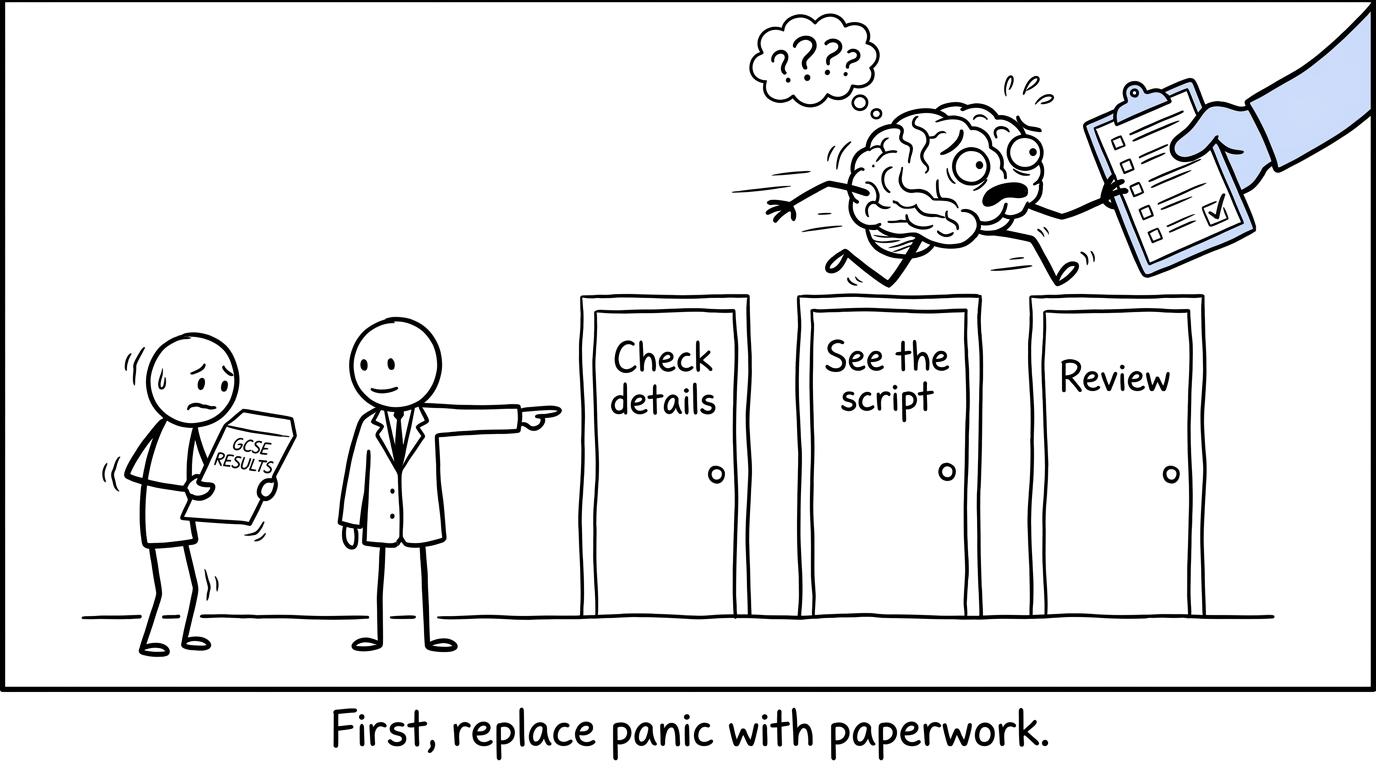 A student replacing results-day panic with a post-results checklist
What to do in the first hour
Check the basic information first
Begin with the details that can be checked without making a judgement about your performance. Is the result attached to the correct candidate? Is the qualification GCSE Arabic? Is the board the one your school entered you for? Does the tier match your entry?
Pearson Edexcel GCSE Arabic is assessed through listening, speaking, reading and writing. Under the current specification, each skill contributes 25%25\%25% of the qualification, and candidates take one tier across all four papers. That means an unexpectedly weak component can affect the overall result even when the other skills felt strong.
Do not try to reconstruct your final mark from memory alone. Ask for the information held by the exams office.
Speak to the right people before leaving
Your first conversation should normally be with your Arabic teacher, head of languages or exams officer. Say that the result is substantially different from what you expected and ask what evidence can be checked.
Useful questions include:
- What was my overall mark?
- How far was I from the next grade boundary?
- Are component marks available for listening, speaking, reading and writing?
- Can the school request access to my marked work before deciding on a review?
- Which post-results service would fit the concern?
- What is the school's deadline and what might it cost?
If your teacher is unavailable, give your contact details to the exams office and ask when you will receive a response. Do not rely on a hurried corridor conversation that nobody records.
Tell the school if progression is affected
If the result affects admission to sixth form, college or a particular course, say so immediately. Contact the institution holding your place as well. Explain that you are discussing the result with your school and ask what evidence or timescale it requires.
Do not promise that your grade will change. A review may raise the mark, leave it unchanged or lower it.
Why a mock or predicted grade is not proof of an error
Predicted grades are estimates. Mock papers can differ in difficulty, marking and exam conditions. Grade boundaries also vary by exam series because they are set after the papers have been taken and marked.
This distinction matters. Your predicted grade may be a good reason for a teacher to look carefully at the result, but the post-results process is concerned with whether the assessment was processed correctly and whether the mark scheme was applied correctly. It is not a comparison between an examiner's mark and a prediction.
The same principle applies in maths. A past-paper total is useful evidence of readiness, but it does not guarantee a particular result in the live examination. MathsGenie's guide to how GCSE grade boundaries work explains why the correct board, tier and exam series matter.
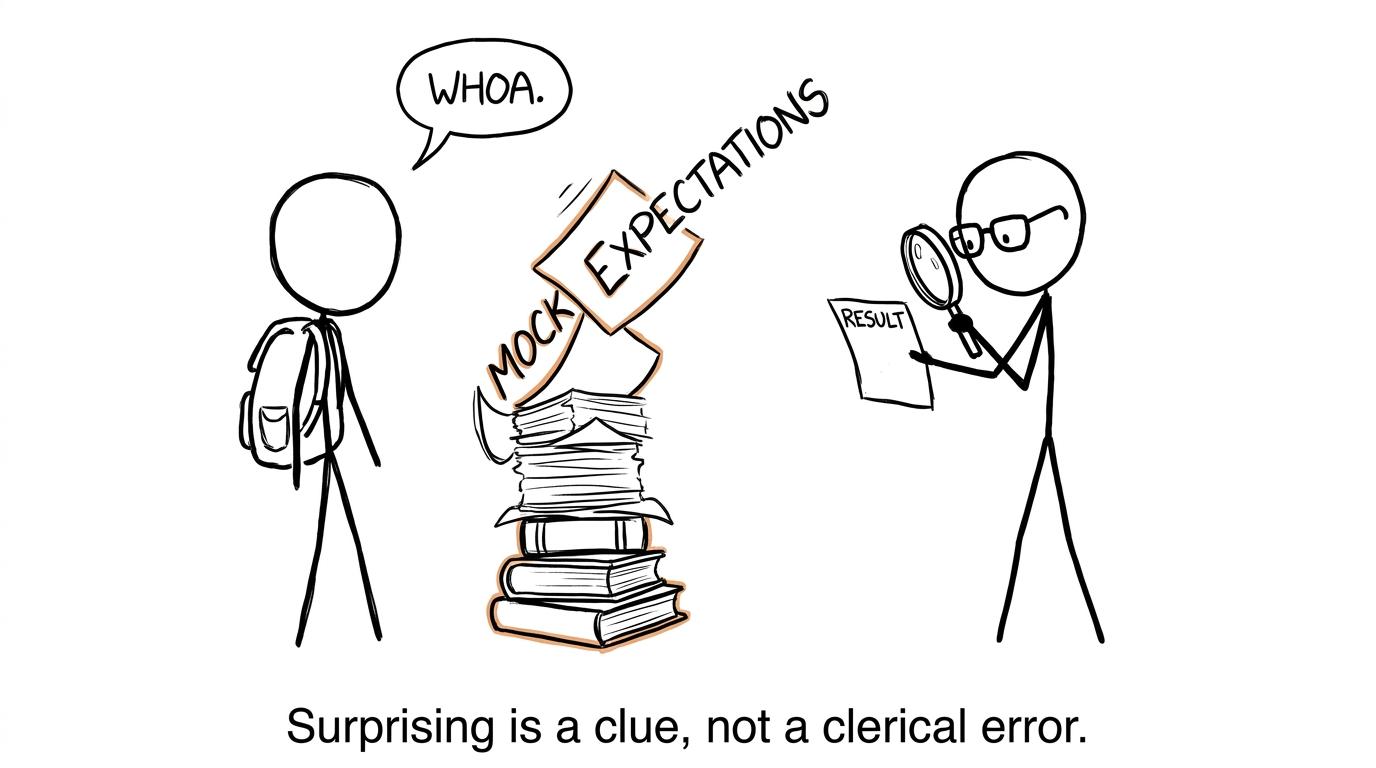 A teacher investigating an unexpected result rather than guessing from mock grades
Understand the three main post-results options
Students often ask for a “remark”, but that is not the formal name of the usual service. The available route depends on what may have gone wrong.
Access to scripts or assessed work
Your centre can request access to eligible marked scripts after obtaining your permission. A teacher may then inspect the available work and consider whether the mark scheme appears to have been applied correctly.
GCSE Arabic includes different assessment formats, including a speaking recording and listening material, so access may not look identical for every component. Ask the exams officer what your board can provide for the particular paper or assessment you are concerned about.
Seeing the available marked work can turn a vague feeling into a specific decision. Your teacher might identify a plausible marking issue, or the work may show that the awarded mark is reasonable.
Clerical re-check
A clerical re-check examines administrative accuracy. It checks matters such as whether all parts were marked and whether marks were totalled and recorded correctly.
This service is appropriate when the concern appears clerical. It does not reconsider the quality of an answer in the same way as a review of marking.
Review of marking
A review of marking checks whether the original mark scheme was applied correctly. It is not a completely fresh re-mark performed without reference to the first decision. Any identified marking errors are corrected.
Your mark and final grade can go up, stay the same or go down. For that reason, your centre must obtain your written consent after results have been published. The decision belongs to you, even when a parent or teacher is helping you understand it.
For a fuller explanation of services, risks and appeals, read MathsGenie's GCSE remark request guide.
Check the mark, not only the grade
The most useful question is not simply, “Was I predicted a higher grade?” It is, “How close is my awarded mark to the next boundary, and is there a specific reason to question a component?”
Being close to a boundary does not automatically mean a review will be successful. Equally, being several marks away does not prove that the marking is correct. Distance from the boundary helps you understand what kind of mark change would be needed; teacher inspection helps establish whether there is a credible concern.
Use the official boundary for the correct Arabic specification, tier and exam series. Do not use last year's boundary, a screenshot from social media or the boundary for another language.
The habit is familiar to students using MathsGenie's GCSE maths revision hub: identify the correct board and tier before interpreting a result. Precision comes before conclusions.
Know the deadline, cost and risk
For the June 2026 series, the JCQ deadline for awarding bodies to receive most clerical re-check and review-of-marking requests is 24 September 2026. Schools often set earlier internal deadlines so that staff can obtain consent, arrange payment and submit the correct component details.
Access-to-scripts deadlines can differ by awarding body and by the type of request. Ask your exams officer for the deadline applying to your Arabic assessment rather than assuming there is plenty of time.
Fees also vary by board, service and component. Your school may pay in some circumstances or may ask you to pay. Confirm the policy before signing anything, and ask whether the fee is refunded if the grade changes.
If your centre decides not to request a review, ask for its internal appeals procedure. Schools and colleges must provide a route for students to challenge a decision not to submit a review request. Private candidates should contact the centre that entered them or follow the awarding body's route for private candidates.
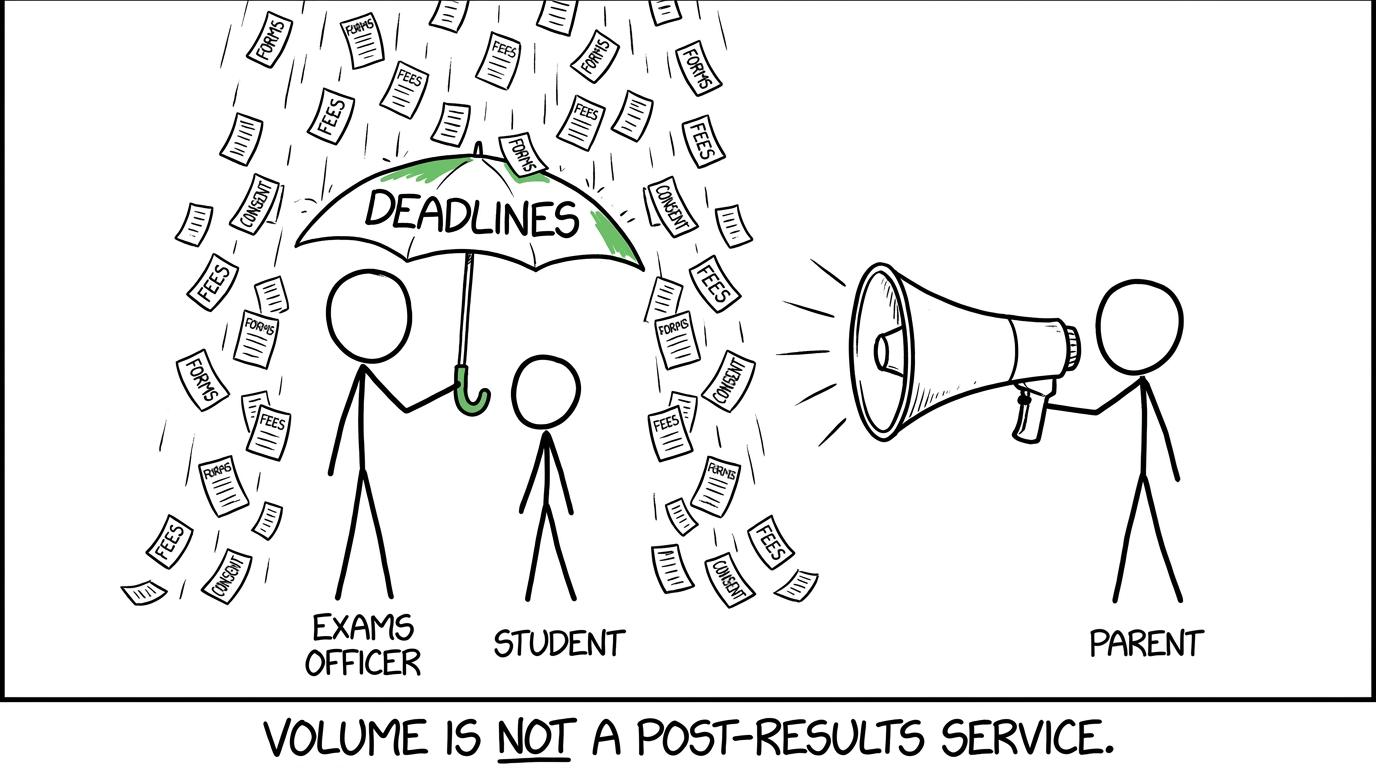 An exams officer protecting a student from deadlines, forms and consent paperwork
Common mistakes when a GCSE Arabic grade looks wrong
Treating a predicted grade as a guarantee
Predictions describe an expectation, not an entitlement. Use them to begin an evidence-based conversation, not as proof that the examiner made an error.
Requesting every component immediately
A review is normally requested by component and may carry a fee. Ask which assessment appears unusual and whether available marked work can be inspected first.
Saying only that the result “feels wrong”
Give your teacher something specific to investigate: your expected tier, overall mark, component pattern, proximity to a boundary or concern about a particular assessment.
Forgetting that the result can fall
Written consent is required because a clerical re-check or review may increase, confirm or reduce your mark and grade. Understand that risk before proceeding.
Waiting for the final national deadline
Your school's deadline will probably be earlier. Start the process on results day, particularly if progression depends on the outcome.
Letting one result derail every other plan
An unexpected Arabic result deserves attention, but it should not erase the rest of your results or your next steps. Make the post-results request, record what happens and then return to the decisions you can control.
Keep your maths plans moving while you wait
Many students taking GCSE Arabic are also waiting on a maths result or preparing for a maths resit. The same calm process works well: gather the evidence, identify the exact weakness and act on the next useful step.
If a maths resit may be necessary, use the GCSE maths resit results-day plan rather than waiting for the Arabic review outcome before revising anything. Start with a diagnostic paper, then use Edexcel GCSE maths mini tests for focused practice.
A sustainable plan matters more than one intense week. MathsGenie's GCSE maths revision timetable can help you organise revision lessons, practice questions and regular mark-scheme review. As examinations approach, add GCSE predicted papers alongside genuine past papers rather than treating predictions as promises.
A calm result deserves a careful process
The hour after an unexpected result can feel urgent, but urgency is not the same as panic. Check the details. Ask for the marks. Speak to your teacher and exams officer. Record the deadlines. Then decide, with evidence, whether access to scripts, a clerical re-check or a review of marking is justified.
Whatever happens with your GCSE Arabic result, keep building the subjects that shape your next step. Visit MathsGenie for free GCSE and A Level maths revision lessons, practice questions, mini tests, past papers, predicted papers, mark schemes and video solutions. A grade review handles what may have happened yesterday. Good revision prepares you for what comes next.