

GCSE Arabic Remark Appeal: Is It Worth It?
GCSE Arabic remark appeal guide explaining reviews of marking, fees, deadlines, risks and when challenging your result may genuinely be worthwhile.
Results day can make one mark feel enormous. If your GCSE Arabic grade is lower than expected, particularly when you are close to the next grade boundary, a GCSE Arabic remark appeal may seem like the obvious answer.
The short answer is this: request a review only when there is evidence of a possible marking or administrative error and the realistic benefit justifies the cost and risk. Being close to a boundary is a reason to investigate, not proof that the mark is wrong.
The official term is usually a review of marking, not a remark. The original marking is checked for errors, but your work is not automatically marked again from scratch. Your mark can rise, remain unchanged or fall.
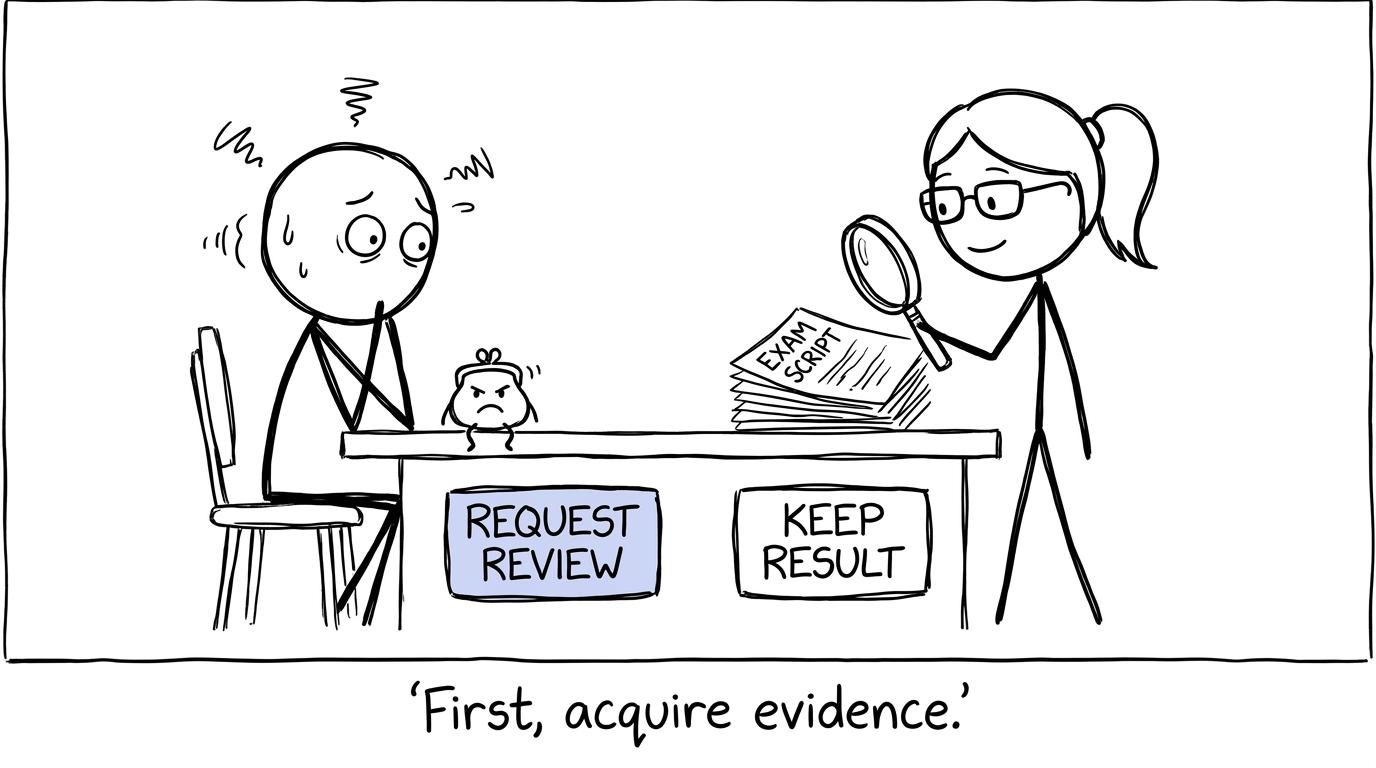 A student and teacher gathering evidence before requesting a review
Your post-results checklist
Before paying for anything:
- Confirm your exam board, specification and tier.
- Find your total mark and the official grade boundaries for your exam series.
- Ask your exams officer for your component marks.
- Request access to the relevant script or recording where available.
- Ask an experienced Arabic teacher to compare the response with the mark scheme.
- Check your school's internal deadline, which may be earlier than the exam board deadline.
- Understand that your mark and grade can go down.
- Decide whether the potential grade change has a practical consequence.
The same evidence-first habit matters in maths. MathsGenie's guide to GCSE maths grade boundaries explains why the correct exam series, board and tier must always be checked before interpreting a result.
Is it a remark, a review or an appeal?
These words are often used as if they mean the same thing, but they describe different stages.
Clerical re-check
A clerical re-check, commonly called Service 111, checks administrative details. It confirms that every part of the paper was marked, the marks were added correctly and the result was recorded accurately.
This is the narrower and usually cheaper service. It may be appropriate if a page appears unmarked, the component total looks inconsistent or there is another specific clerical concern.
Review of marking
A review of marking, commonly called Service 222, includes a clerical check and asks a reviewer to examine the original marking. The reviewer considers whether the mark scheme was applied correctly and whether any exercise of academic judgement was reasonable.
That distinction matters. A reviewer does not simply replace the first examiner's judgement because another mark might also have been possible. A mark changes when the original marking contains an error under the exam board's rules.
Appeal
An appeal is not the first step. Under the current JCQ process, an appeal can normally be submitted only after the outcome of a clerical re-check, review of marking or review of moderation has been received.
An appeal may challenge a marking or review error, or argue that the awarding organisation failed to apply its procedures consistently, properly or fairly. It is not a second speculative attempt to gain extra marks because the first review did not change the grade.
For an internal candidate, the head of centre submits the appeal. Private candidates can generally apply directly to the awarding organisation under its published arrangements.
How the GCSE Arabic review process works
Pearson Edexcel's GCSE Arabic specification, code 1AA0, assesses listening, speaking, reading and writing through four externally examined components. Foundation and higher tiers are available, and a candidate is entered for the same tier across all components.
The practical process usually follows this route.
Speak to your school immediately
Contact your Arabic teacher and exams officer as soon as possible after results day. Schools normally set internal cut-off dates before the awarding body's final deadline so that consent, payment and administration can be completed.
For the June 2026 series, JCQ's published final deadline for reviews of results is 24 September 2026. Do not treat that as your personal deadline; your school may require the request considerably earlier. Deadlines change by series, so always confirm the current date with the exams officer.
Check the component marks
A GCSE Arabic grade combines performance across different skills. A disappointing total does not reveal where the possible problem lies.
Ask for the available marks for listening, speaking, reading and writing. If your overall mark is MMM and the next grade boundary is BBB, the gap is:
d=B−Md = B - Md=B−MA small positive value of ddd tells you that relatively few additional marks would change the grade. It does not show that those marks should have been awarded.
Obtain and inspect the evidence
Where available, ask the centre to access the marked script or relevant assessment material. Access-to-scripts arrangements and deadlines differ, so act promptly.
A qualified Arabic teacher should look for specific issues, such as:
- a response or page that appears not to have been marked;
- a mark that conflicts with a clear requirement in the mark scheme;
- credit apparently missed for a valid reading or listening response;
- writing that appears to meet an assessment-band descriptor not reflected in the mark;
- evidence that the speaking assessment material was not handled as expected.
The strongest recommendation is precise: it identifies where a possible error occurred and why the published criteria may not have been applied correctly.
Give written consent
Your centre must obtain your written consent after results are published before requesting a clerical re-check or review of marking. This is because the result can be lowered as well as raised. A parent cannot remove that risk by requesting only an upward review.
Wait for the outcome
JCQ's current service framework gives awarding bodies up to 101010 calendar days for a clerical re-check and up to 202020 calendar days for a standard review of marking after receiving a valid request. These are service times, not promises that every case will take exactly that long.
The result may be:
- a higher component mark, potentially producing a higher grade;
- no change;
- a lower component mark, potentially producing a lower grade.
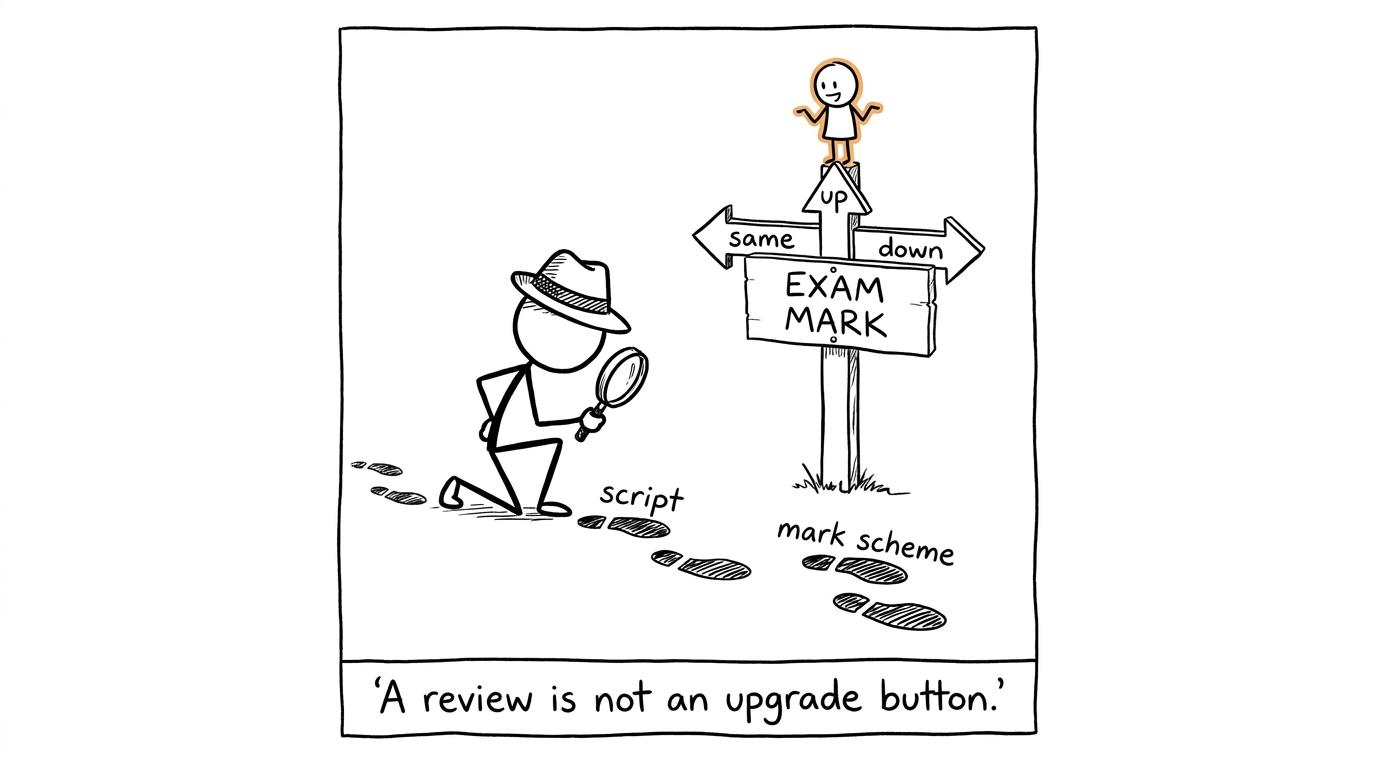 A detective investigates a mark that can move up, stay the same or move down
When is a GCSE Arabic remark appeal worth it?
A review becomes more reasonable when several pieces of evidence point in the same direction.
You are close to a grade boundary
The closer you are, the fewer corrected marks are needed to affect the final grade. However, closeness alone is not enough. Exam boards cannot award extra marks merely because a candidate narrowly missed a boundary or achieved less than a predicted grade.
A teacher identifies a credible marking concern
This is usually the most valuable evidence. Arabic writing and speaking involve assessment criteria and examiner judgement. A teacher who knows the specification can distinguish between an answer that feels strong and one that demonstrably satisfies a higher band.
A page, response or mark appears to be missing
A visible administrative inconsistency provides a clearer reason to act than general disappointment. Depending on the issue, a clerical re-check may be sufficient, although your exams officer should advise on the correct service.
The higher grade has a meaningful consequence
A changed grade may affect a sixth-form condition, college course, future language pathway or another stated entry requirement. That does not make the mark more likely to change, but it changes the value of investigating properly.
The fee and downside are acceptable
Fees are charged per paper or component and vary by awarding body, service and exam series. Schools may also have their own payment process. Exam boards commonly waive or refund relevant review fees when the overall qualification grade changes, but you should obtain the current written fee policy from your centre before consenting.
A request is less attractive when the script gives no specific cause for concern, you are many marks from the next boundary, or a small downward adjustment could put the current grade at risk.
When should you proceed to an appeal?
Consider an appeal only after a completed review and only if there are identifiable grounds. Under the JCQ appeals process effective for 2026, an appeal relating to a review of results must normally be submitted within 303030 calendar days of the awarding organisation issuing the review outcome.
The first stage is a preliminary appeal considered by someone without previous involvement in the case. If the appellant remains dissatisfied, a request for an appeal hearing normally has to be made within 141414 calendar days of receiving the preliminary outcome. Awarding organisations aim to complete preliminary appeals within 424242 calendar days and hearings within 707070 calendar days.
Appeal fees vary and are generally refunded when an appeal is upheld. Candidate consent remains important because the eventual grade can still rise, stay the same or fall.
Common mistakes when requesting a review
Assuming “remark” means fresh marking
A review checks the original marking for error. It is not an automatic clean-slate reassessment.
Paying before seeing the evidence
Where access is available, inspect the script or assessment information first. Evidence makes the decision calmer and more defensible.
Reviewing every component automatically
Fees usually apply per component. Target the component where a teacher can identify a genuine concern rather than submitting every paper without analysis.
Treating a predicted grade as proof
Predicted grades, mock results and classroom performance provide context, but they do not establish a marking error in the live examination.
Missing the school's deadline
The exam board deadline is not necessarily the date your form can reach the school. Ask for the centre's internal deadline immediately.
Forgetting that marks can fall
There is no general grade protection for an individual review of marking. Read the consent statement carefully before signing.
Confusing an appeal with another review
Once a review outcome has been issued, the next route is an evidence-based appeal under the relevant rules, not repeated reviews of the same component.
Keep the result in perspective
A result deserves careful scrutiny when the evidence supports it. But it should not consume the weeks that follow.
If maths is your next priority, return to a process you can control. Start with the GCSE Maths revision hub, select your board and tier, and turn each lost mark into a topic to repair. The MathsGenie resources hub brings together mini tests, practice materials and predicted papers, while the Edexcel GCSE Maths revision page provides lessons and exam-style questions.
The most reliable revision loop is simple: attempt, mark, diagnose and retest. The guide to using GCSE past papers properly shows how to learn from mark schemes rather than merely collecting scores. If time is tight, use the 20-minute maths revision routine, or build a longer plan with the GCSE maths revision timetable.
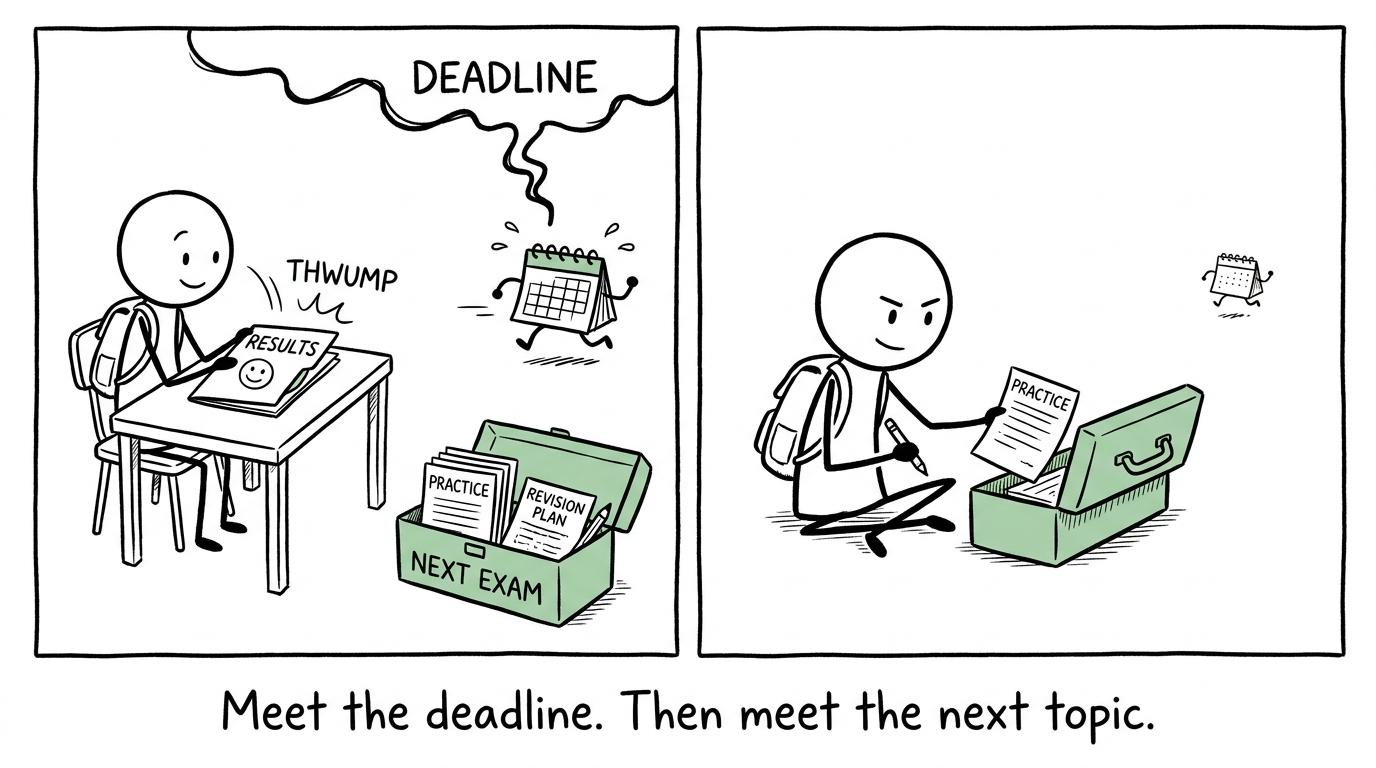 A student moves from a results folder to a revision toolbox
Make the decision from evidence, not hope
A GCSE Arabic review is genuinely worth considering when you are near a boundary, an experienced teacher finds a specific potential error and the possible grade change matters. An appeal is worthwhile only when the completed review may itself contain an error or the correct procedure may not have been followed.
Ask quickly, inspect carefully and understand the downside before consenting. Then return your attention to the work ahead. MathsGenie gives you free revision lessons, practice questions, past papers, predicted papers, mini tests, mark schemes and video solutions so that your next set of marks depends less on uncertainty and more on preparation.










