GCSE Arabic Predicted Grades: How Accurate Are They?
GCSE Arabic predicted grades accuracy explained: learn how reliable forecasts are, why final results change, and how to revise without trusting one number alone.
A predicted grade can begin to feel like a result before you have sat the exam. If your GCSE Arabic prediction is high, you may assume the subject is secure. If it is lower than you hoped, you may quietly decide that improvement is unlikely.
Neither conclusion is safe. The honest answer on GCSE Arabic predicted grades accuracy is that a prediction is useful evidence, but not a promise. GCSE-wide research suggests that teacher forecasts are often within one grade of the final result, yet exact matches are much less dependable. Crucially, there is no strong published Arabic-specific accuracy rate that allows anyone to say your forecast has a particular probability of being correct.
Your prediction is best treated as a starting estimate. Results day reflects what you actually produce across the assessed components, under exam conditions, against boundaries set after marking.
The short answer: how reliable is an Arabic prediction?
Use this checklist to interpret your grade calmly:
- An exact predicted grade is plausible, not guaranteed.
- A result within one grade of the prediction would be consistent with wider GCSE forecast research.
- Arabic-specific prediction data are limited, so broad GCSE figures should not be presented as an Arabic certainty.
- The quality and recency of the evidence matter more than the number itself.
- Listening, speaking, reading and writing all need to be represented.
- Grade boundaries cannot be known precisely before the examination series is marked.
- Progress between the prediction and the final assessments can change the outcome.
In other words, ask not only, “What is my predicted grade?” Ask, “What evidence produced it, and what can still change?”
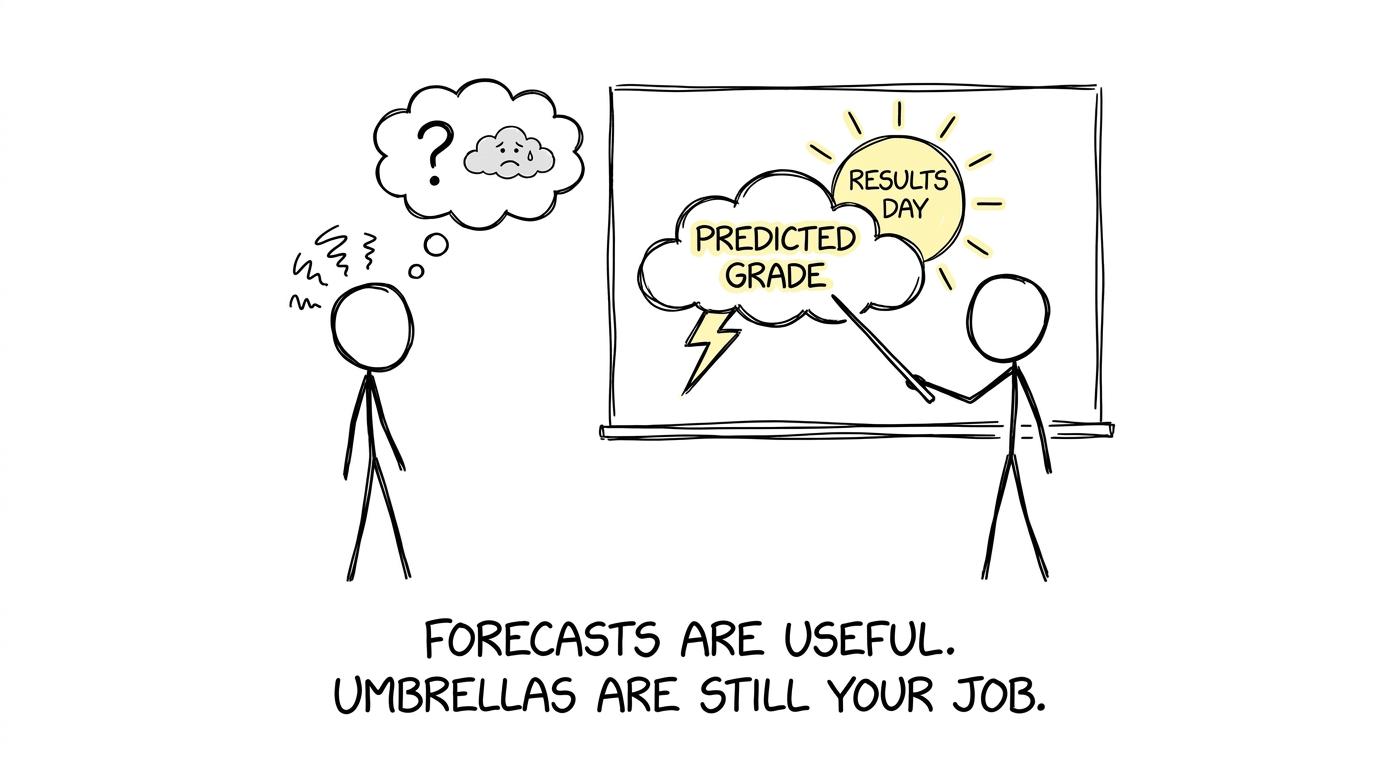 A predicted grade portrayed as a weather forecast before results day
What the available research actually tells us
An older large-scale study of OCR GCSE forecast grades found that about 44%44\%44% of forecasts matched the final grade exactly, while roughly 87%87\%87% were correct or within one grade. That study used the former letter-grade system and covered OCR subjects generally, so it should provide context rather than an Arabic-specific benchmark.
More recent Key Stage 4 analysis covering around one million predicted-and-actual grade pairs reached a similar broad conclusion: average predictions and results can look close across a whole cohort, even while predictions for individual pupils frequently miss the exact grade. In most subjects included in that analysis, fewer than half of individual predictions matched precisely. Predictions also tended to be slightly optimistic overall, although the pattern varied by subject and grade.
This distinction matters. A school might predict the overall performance of a year group reasonably well while still being wrong about several individual students. Statistics describe groups; you sit the paper alone.
It would therefore be misleading to claim that GCSE Arabic predictions are “usually exactly right” or to apply one general percentage directly to every Arabic candidate. The most defensible conclusion is narrower: predictions often indicate the general performance range, but exact individual outcomes remain uncertain.
Why GCSE Arabic can be difficult to predict
The current Pearson Edexcel GCSE Arabic qualification assesses four skills: listening, speaking, reading and writing. Each contributes 25%25\%25% of the qualification. Students take either foundation or higher tier and must be entered for the same tier across all papers.
That balanced structure is valuable, but it creates a prediction problem. A single school mock may not reproduce every component equally well.
Performance can vary between language skills
A student may read complex Arabic confidently but lose marks when processing unfamiliar speech at speed. Another may speak fluently in conversation yet need greater accuracy in formal writing. A prediction based mainly on classroom participation could overstate performance if timed reading and writing are weaker. A prediction dominated by one difficult mock could understate a student whose speaking and listening are stronger.
A reliable estimate should draw on several pieces of evidence across all four skills, not one memorable performance.
Familiarity with Arabic does not automatically equal exam technique
Some candidates use Arabic regularly at home or in their community. That experience may support vocabulary, comprehension and fluency, but the GCSE still rewards specific responses to particular tasks. Register, grammatical control, spelling, translation accuracy and coverage of bullet points can all affect marks.
Conversely, a learner with less informal fluency may be highly systematic about the specification and mark scheme. Teachers have to estimate how each student’s knowledge will transfer into assessed work. That is a difficult judgement, not a simple measure of who sounds most confident.
The speaking assessment creates different conditions
Speaking is conducted by the school and externally assessed. The real assessment includes prescribed tasks and time limits, so it may feel different from everyday classroom conversation. Nerves can lower performance, but careful preparation and familiarity with the format can also produce a result above earlier classroom evidence.
Tier decisions affect the available grades
Foundation tier offers grades 111 to 555. Higher tier offers grades 444 to 999, with a narrow grade 333 safety net for candidates who narrowly miss grade 444. Entry at the wrong level can make a prediction less useful, especially if it was calculated before the final tier decision.
If you are unsure about your entry, ask your teacher. Do not assume that a predicted grade automatically confirms your tier.
Why the final grade may be lower than predicted
A lower result does not always mean the original forecast was careless. Several things can widen the gap.
First, the mock may have been marked generously or completed using materials that were more familiar than the final papers. Some schools also use predictions as an aspirational estimate based on positive circumstances rather than as a strict forecast of the most likely result.
Second, uneven performance can be hidden by a single grade. Strong speaking may make the overall prediction look secure while listening remains fragile. Because all four skills contribute to the final qualification, an unresolved weakness still matters.
Third, examination conditions introduce variation. Timing pressure, misunderstanding an instruction, incomplete written coverage or difficulty recovering after one challenging listening section can cost marks.
Finally, past grade boundaries are only guides. Exam boards set boundaries after papers have been marked because they need evidence about the difficulty of that year’s assessments. The standard attached to a grade is maintained, but the raw mark required can move. There is no predetermined quota saying that only a fixed number of candidates may receive each grade.
Why the final grade may be higher than predicted
Predictions can miss improvement because learning is not linear. A student can appear stuck for months, then become more accurate once vocabulary, grammar and exam timing begin working together.
Your final result may be higher if the prediction was based on early evidence, if your teacher took a cautious approach, or if the mock covered an unrepresentative selection of tasks. Focused work after the prediction can also improve translation, response development and listening accuracy.
The same principle applies to maths. A February grade is not a ceiling on a June performance. Students often become more reliable once they stop treating revision as content collection and start using a feedback cycle. MathsGenie’s guide to finding your weakest GCSE topics shows how to turn lost marks into specific priorities rather than vague worry.
How to judge the quality of your prediction
Instead of debating whether the grade “feels right”, ask your teacher these practical questions:
- Which assessments were used?
- How recent was the evidence?
- Were all four Arabic skills included?
- Were the tasks completed under timed conditions?
- Was the current tier used?
- Is the grade a target, a working-at grade or a forecast?
- Which component is currently limiting the overall estimate?
A prediction built from several recent, specification-matched assessments is more informative than one inherited from old attainment data. It is still uncertain, but it has a stronger foundation.
You can also track component performance rather than staring at one overall grade. Record what went wrong in each timed task: vocabulary recall, comprehension, grammar, task coverage, timing or exam technique. Patterns are more actionable than labels.
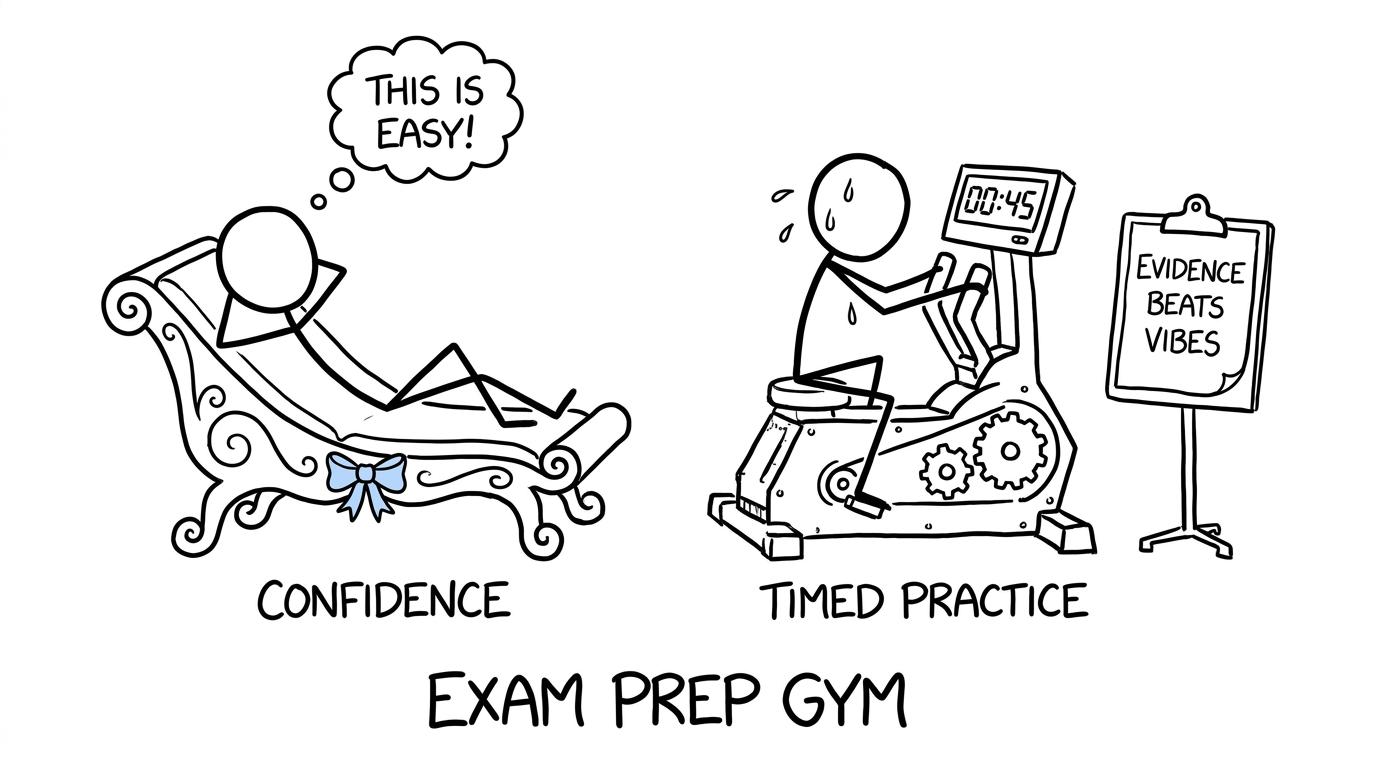 A student choosing timed practice rather than confidence alone
Use the prediction without letting it control revision
A high Arabic prediction should not persuade you to abandon the subject, and a low one should not consume every available hour. GCSE students have several exams to prepare for, including maths, so revision time needs evidence-based decisions.
Use this process:
- Complete a realistic task under timed conditions.
- Mark or review it against the assessment criteria.
- Identify the precise reason for each lost mark.
- Practise the weakest skill.
- Retest it using different material.
- Update your revision priorities from the new evidence.
For maths, the same loop is built into the free GCSE Maths revision hub. Choose Edexcel, AQA, OCR or Eduqas resources that match your course, then move between revision lessons, practice questions and assessment.
Use the MathsGenie revision planner to protect time for both Arabic and maths rather than revising whichever subject feels most urgent that evening. In maths, predicted papers can test likely skills and exam readiness, but they should not replace full specification coverage. The same warning applies to grade predictions: forecasts help you focus; they do not tell you exactly what will happen.
For stronger exam evidence, follow the method in how to use GCSE past papers properly. Maths students can combine this with a realistic GCSE revision timetable and learn to use mark schemes as a revision coach. These habits transfer well: attempt, mark, diagnose, repair and retest.
Common mistakes when interpreting predicted grades
Treating a target grade as a forecast
A target may be based partly on prior attainment or intended challenge. It is not necessarily your teacher’s estimate of what you would achieve today. Check the terminology your school uses.
Assuming one mock settles the question
One paper provides one sample of performance. It may be too easy, unusually difficult or incomplete. Look for repeated evidence across several tasks.
Comparing raw marks with old boundaries too confidently
Previous boundaries help with rough interpretation, but future boundaries are unknown until awarding takes place. Avoid turning a borderline mock mark into a guaranteed grade.
Ignoring the weakest component
A strong overall impression can hide a persistent listening, reading, speaking or writing gap. Component-level feedback is more useful than reassurance.
Revising only what is predicted
Predicted topics and grades are planning tools, not substitutes for the specification. Maths students should read how to revise predicted GCSE topics without guessing before narrowing their practice too far.
Your predicted grade is a compass, not a destination
The calmest interpretation is also the most useful: your GCSE Arabic prediction identifies a likely neighbourhood, not your exact address on results day. It can end up too high because of optimistic assumptions, incomplete evidence or weaker exam performance. It can end up too low because the evidence was early, cautious or overtaken by genuine improvement.
Ask what sits beneath the number. Then act on the answer.
For your maths preparation, start at MathsGenie and build evidence of progress through free revision lessons, practice questions, mini tests, past papers and predicted papers. Mark your work carefully, use the mark schemes and video solutions, and let each mistake determine the next session. A forecast may influence how you feel. Consistent, corrected practice influences what you can do.