GCSE Arabic Mock Results: How to Use Them Properly
GCSE Arabic mock results become useful when you analyse lost marks, compare language skills and turn feedback into a focused maths revision plan for exams.
A mock result can change the mood of an entire day. A strong grade brings relief. A disappointing one can make months of effort feel invisible. Neither reaction tells you what to revise tomorrow.
That is why GCSE Arabic mock results should be treated as diagnostic evidence, not a verdict. The overall grade shows where one performance landed. Your paper, mark breakdown and teacher feedback reveal something more useful: which skills are secure, where marks disappeared and what your next revision sessions should contain.
For students balancing Arabic with GCSE maths, this analysis matters twice. It helps you improve Arabic without allowing one subject to consume revision time that should be protecting your maths grade.
Your mock-results checklist
Before changing your timetable, collect the following:
- your raw mark for each paper or assessed skill;
- the total marks available;
- your marked scripts, where your school can provide them;
- the mark scheme or teacher feedback;
- separate results for listening, speaking, reading and writing;
- notes about unfinished questions or time pressure;
- your target grade and current maths priorities.
Then follow one principle: revise from the lost marks, not from the emotion produced by the grade.
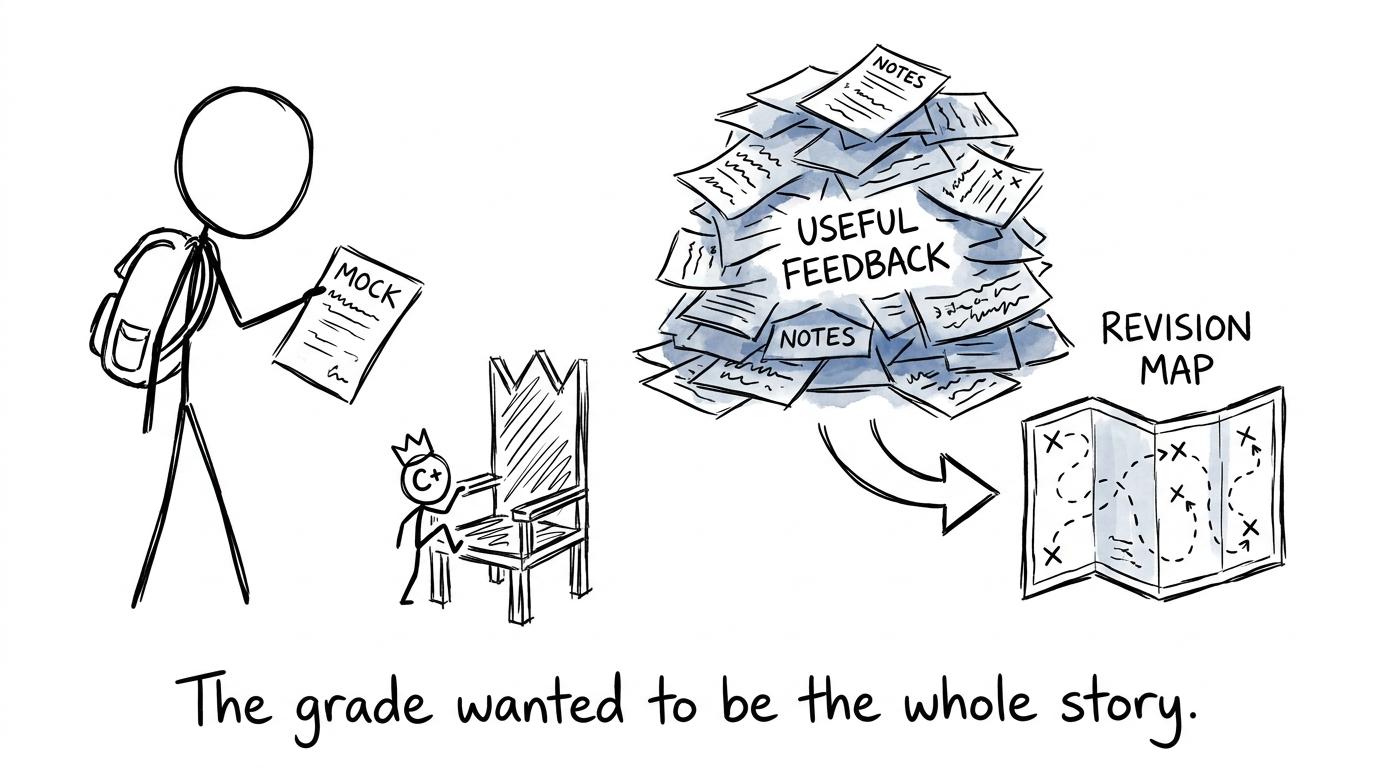 A mock grade trying to become the whole story while feedback points towards a revision map
What your GCSE Arabic mock result actually means
A mock grade is an indication of performance on a particular assessment. It is not a guaranteed summer grade.
Ofqual explains that final GCSE grade boundaries are set after the live papers have been marked and can move from year to year to reflect paper difficulty. A school may use boundaries from a suitable previous series to produce an indicative mock grade, but the precise context matters. The mock might not cover the complete specification, and your preparation, timing and health on that day may differ from the summer exams.
This does not make the result meaningless. It changes the question you should ask.
Instead of asking, “Is this my final level?”, ask:
- Which parts of the specification were assessed?
- Was the paper completed under realistic timed conditions?
- How was the indicative grade calculated?
- Which skills account for most of my lost marks?
- Were the mistakes caused by knowledge, technique, timing or accuracy?
For Pearson Edexcel GCSE Arabic, specification code 1AA01AA01AA0, the qualification assesses listening, speaking, reading and writing. Each skill contributes 25%25\%25% of the qualification, and students enter one tier across all papers. If you follow another specification, check its exact assessment structure with your teacher rather than assuming that the same timings, tasks or weightings apply.
Read the marks before you read the grade
Grades compress a large amount of information into one character. Useful revision requires you to expand it again.
Compare skills fairly
Do not compare raw marks when papers have different totals. Calculate the percentage of available marks gained in each skill:
Skill percentage=marks gainedmarks available×100\text{Skill percentage}=\frac{\text{marks gained}}{\text{marks available}}\times 100Skill percentage=marks availablemarks gained×100This is not an attempt to manufacture your own official grade boundary. It is a way to compare performance across the mock.
Record listening, speaking, reading and writing separately. A balanced result suggests that broad maintenance may be appropriate. A large difference between skills points towards targeted revision. For example, low listening marks require repeated work with spoken language and question interpretation; they will not usually be fixed by spending every session copying vocabulary.
Look at the pattern inside each paper
A skill label can still be too broad. “Writing” might conceal several distinct problems:
- missing part of a task;
- using too narrow a range of language;
- inaccurate verbs or agreements;
- weak spelling or script accuracy;
- giving undeveloped answers;
- mistranslating a key phrase;
- running out of time.
The same applies to reading and listening. Separate failures to recognise vocabulary from failures to follow the question instruction. The remedy is different.
A useful error log has five columns:
| Question or task | Marks lost | Error type | Specific cause | Next action |
|---|---|---|---|---|
| Paper reference | Mark difference | Knowledge, technique, timing or accuracy | Precise explanation | One short revision task |
Keep the cause specific. “Bad at listening” is a judgement. “Did not distinguish past and future references” is a revision target.
Sort every lost mark by cause
The fastest revision plans are built around causes, not subjects.
Knowledge gaps
You did not know the required vocabulary, grammar or content. This calls for learning followed by retrieval practice. Reading notes repeatedly may feel productive, but you need to test whether the information can be recalled without support.
Technique gaps
You knew enough Arabic but did not satisfy the task. Perhaps you overlooked a bullet point, gave an answer in the wrong language or failed to develop a speaking response. Revisit the instructions and mark scheme, then practise that task format.
Timing problems
You left marks inaccessible because time ran out or one section received too much attention. The answer is timed practice in manageable sections, not immediately sitting another entire mock.
Accuracy slips
You understood the task but lost marks through avoidable misreading, copying or checking errors. Create a short checking routine that can be repeated under pressure.
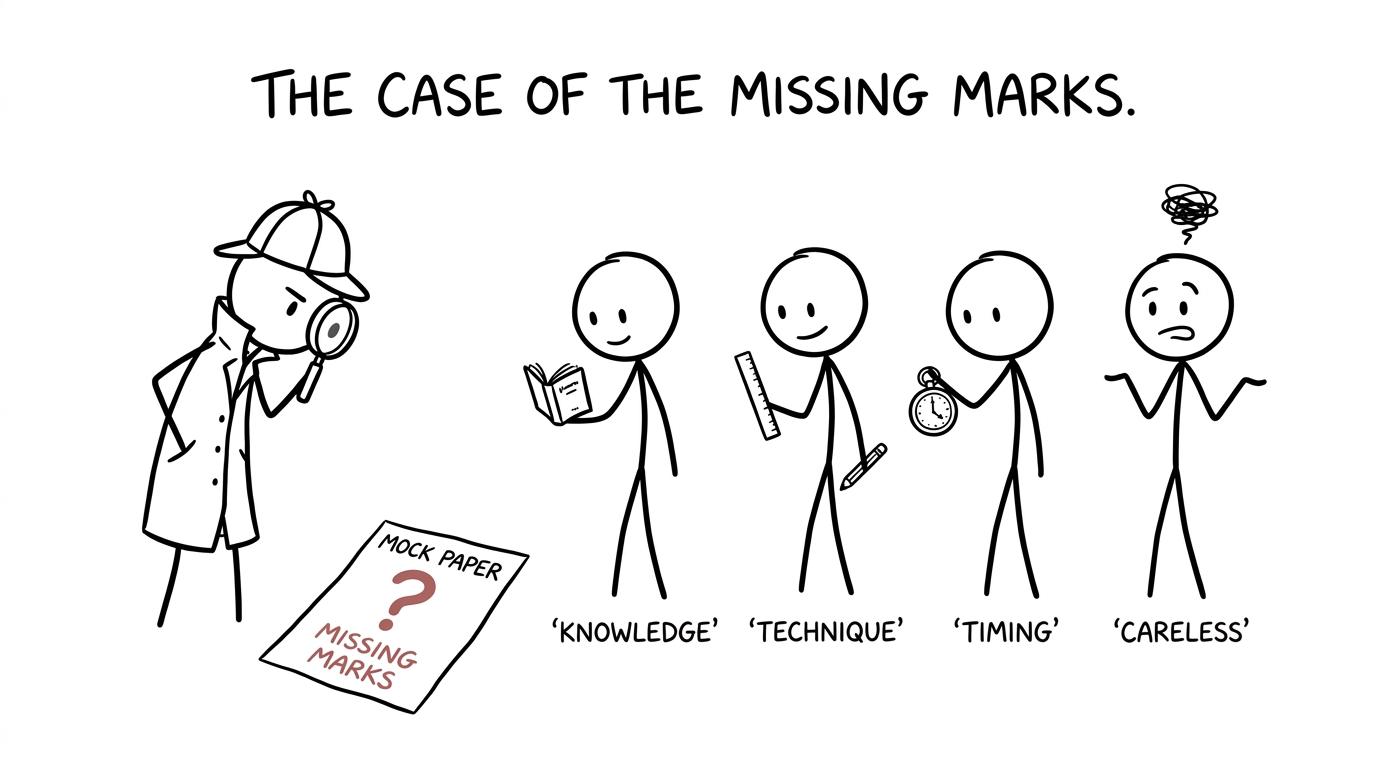 A student detective investigating knowledge, technique, timing and careless errors
Turn the analysis into a revision priority
Not every weakness deserves equal time. A sensible priority considers three things:
- how many marks the weakness is costing;
- how often the skill is likely to matter;
- how realistically it can improve before the next assessment.
You can give each area a simple priority score:
Priority score=marks lost×frequency factor×improvement factor\text{Priority score}=\text{marks lost}\times\text{frequency factor}\times\text{improvement factor}Priority score=marks lost×frequency factor×improvement factorThe factors are personal planning estimates, not official exam-board measures. Their purpose is to stop a dramatic but rare mistake displacing a recurring weakness.
Choose no more than three Arabic priorities initially. Each should be small enough to practise directly, such as recognising tense changes in listening or addressing every bullet point in writing. “Revise Arabic” is too vague to become an effective session.
Use a short feedback loop:
- relearn one specific skill;
- answer fresh questions without notes;
- mark or review the response;
- record the remaining error;
- test the skill again after a short gap.
This is the same evidence-led process explained in MathsGenie’s guide to finding your weakest GCSE topics. Improvement becomes visible when the same error stops recurring.
Use Arabic results without neglecting GCSE maths
A disappointing language result can tempt you to rebuild your entire timetable around Arabic. That often exchanges one problem for another.
Start with your available weekly revision time. Protect regular maths sessions first, especially if maths is required for your next course or apprenticeship. Then assign focused Arabic sessions according to the priorities identified above.
For busy school days, the GCSE 20-minute maths revision routine provides a repeatable structure. Short sessions are particularly valuable when mock feedback has increased the number of subjects competing for attention.
Your maths revision should follow the same diagnostic logic:
- choose the correct exam board and foundation or higher tier;
- complete a topic test or timed paper section;
- mark it carefully;
- classify each lost mark;
- return to the relevant lesson and practice questions;
- retest with unfamiliar questions.
The GCSE Maths revision hub provides free resources for Edexcel, AQA, OCR, Eduqas, WJEC and CCEA. You can combine topic revision with exam-style questions rather than guessing what “doing more maths” should involve.
When you need a broader routine, use MathsGenie’s guide to revising GCSE maths efficiently. It connects revision lessons, practice questions, marking and retesting into one process.
Build a realistic plan from the evidence
Your next plan should specify actions rather than intentions. A useful week might contain:
- two short Arabic sessions for the weakest skill;
- one Arabic timed task followed by marking or teacher feedback;
- three focused maths topic sessions;
- one maths mini test or timed paper section;
- one brief review of both error logs.
Adjust the balance according to your actual marks, target grades and exam dates. Do not copy someone else’s timetable without copying their circumstances.
For maths paper practice, MathsGenie’s GCSE past-paper guidance explains why reviewing a paper matters more than accumulating completed papers. The GCSE maths topics that appear regularly guide can also help you maintain broad coverage while addressing specific weaknesses.
As exams approach, predicted papers can add realistic practice, but they should not replace specification-wide revision. Past papers, predicted papers and mini tests are most valuable when each attempt produces a clear fix list.
Questions to ask your Arabic teacher
Good feedback sometimes requires a short conversation. Ask precise questions:
- Which official assessment objectives or mark-scheme categories limited this response?
- Was the indicative grade based on a complete mock or selected components?
- Which two changes would recover the most marks?
- Is my difficulty mainly linguistic knowledge or exam technique?
- Can I see what a stronger response does differently?
- Should my tier of entry be discussed, and when will that decision be reviewed?
Avoid asking only, “How do I get the next grade?” Teachers can give more useful advice when the question identifies a paper, skill or response.
Common mistakes when using mock results
Treating the grade as a prediction
A mock is evidence from one point in time. Turning it into a permanent label wastes the opportunity to respond.
Revising only the weakest paper
Your lowest skill needs attention, but secure skills also need maintenance. Otherwise, improvement in one area may be offset by decline elsewhere.
Counting every error as a knowledge gap
Some marks disappear through task interpretation, timing or checking. Learning more vocabulary cannot solve every exam problem.
Repeating the same paper immediately
Remembering answers can create false confidence. Use fresh questions when retesting, while keeping the assessed skill the same.
Replacing maths revision with panic revision
One unsettling result should not erase a balanced timetable. Keep maths moving with short lessons, practice questions and mini tests, then increase Arabic time in proportion to the evidence.
Ignoring the mark scheme
A mark scheme shows what was rewarded. Compare it with your response, but ask your teacher when judgement-based speaking or writing criteria are unclear.
Make the result earn its place
The most useful mock result is not necessarily the highest one. It is the result that changes what happens next.
Reduce your GCSE Arabic mock results to a small set of specific priorities. Protect your maths timetable. Practise the weakest skills with fresh material, mark honestly and retest until the error pattern changes.
For your maths preparation, begin with the free MathsGenie GCSE revision resources. Use revision lessons to rebuild methods, practice questions and mini tests to expose gaps, and past papers or predicted papers to develop exam readiness. Mark schemes and video solutions then turn every lost mark into an instruction for the next session.
A grade tells you what happened. Good analysis tells you what to do tomorrow.