GCSE Arabic Homework Grade Impact: Does It Matter?
GCSE Arabic homework grade impact explained: what counts towards your result, which tasks help most, and when maths revision should take priority in exam season.
A homework task can feel urgent simply because it is due tomorrow. Your final exam, still months away, feels quieter. Yet urgency and importance are not always the same thing.
The short answer to the GCSE Arabic homework grade impact question is this: ordinary homework does not directly contribute a fixed percentage to your final Pearson Edexcel GCSE Arabic grade. Your qualification result comes from the assessed listening, speaking, reading and writing components. However, well-designed homework can improve the skills those assessments measure, while incomplete work may affect school reports, teacher judgements or predicted grades.
So homework can matter considerably without being a formal component of the final qualification. The useful question is not simply, “Does homework count?” It is, “Will this task make me better at something the exam rewards?”
The quick homework impact checklist
Before giving an Arabic task your entire evening, ask:
- Does it practise listening, speaking, reading or writing?
- Is it matched to your specification and tier?
- Will you receive useful feedback or check your answers?
- Does it target a weakness rather than repeat something already secure?
- Is there a genuine school deadline or consequence?
- What other revision, including GCSE maths, will be displaced?
Complete required work, but pay attention to its purpose. Twenty focused minutes correcting weak vocabulary can be more valuable than a long session spent making notes look impressive.
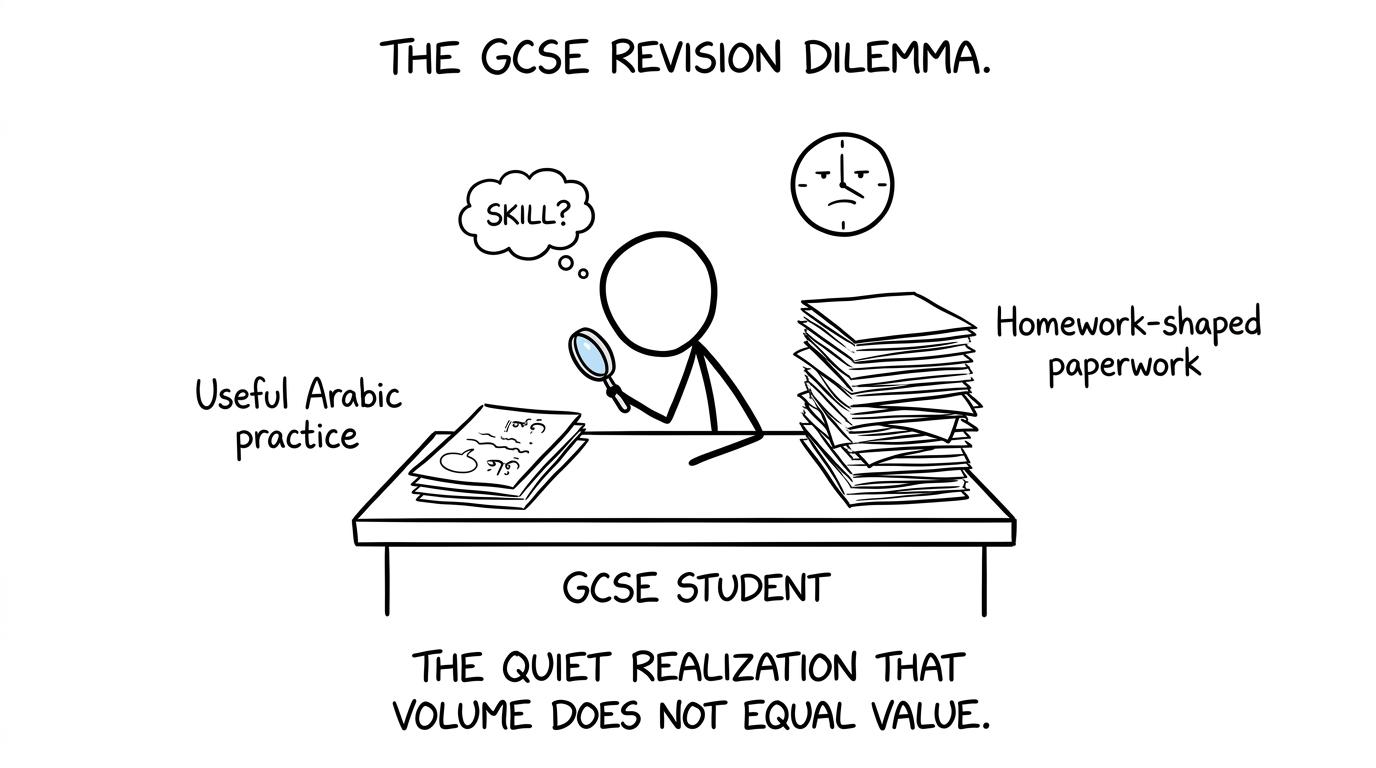 A student investigates whether Arabic homework genuinely builds a skill
Does GCSE Arabic homework count towards the final grade?
For Pearson Edexcel GCSE Arabic, the current specification divides assessment equally between four skills:
- listening: 25%25\%25%
- speaking: 25%25\%25%
- reading: 25%25\%25%
- writing: 25%25\%25%
Together, these make the complete qualification:
25%+25%+25%+25%=100% 25\% + 25\% + 25\% + 25\% = 100\% 25%+25%+25%+25%=100%Routine homework is not listed as a separate assessed component. A school homework mark is therefore not added to your final qualification mark in the way coursework might be added in another subject.
The speaking assessment is conducted through your school but externally assessed. That does not turn ordinary speaking homework into assessed work. It means your preparation matters because it develops performance, not because every practice task carries qualification marks.
This distinction is important. Your Arabic teacher may record homework scores, use them in reports or consider them alongside class assessments when estimating your likely grade. School policies differ. Those records can influence decisions and conversations, but they are not the same as the final GCSE grade awarded from the qualification assessments.
Check your exact entry with your teacher. GCSE Arabic and International GCSE Arabic are different qualifications, with different assessment structures. Do not build a revision plan around assumptions borrowed from another course.
How homework can move your grade indirectly
Homework earns its value through transfer. A vocabulary task matters if you can later recognise those words in a recording, understand them in a text or use them accurately when speaking and writing.
Secondary-school homework is generally associated with improved attainment in Education Endowment Foundation evidence, but the findings also carry an important warning: task quality, focus and feedback matter. A broad average cannot tell you precisely how many marks one Arabic worksheet will produce.
No honest calculation can promise:
one hour of homework=a fixed increase in GCSE grade \text{one hour of homework} = \text{a fixed increase in GCSE grade} one hour of homework=a fixed increase in GCSE gradeStudents begin with different strengths. Tasks vary. Feedback varies. Exams sample a wide specification. The relationship is not a simple conversion rate.
Homework is most likely to help when it creates one of four changes:
Better retrieval
Trying to recall vocabulary without looking strengthens access to it. Copying the same list repeatedly may feel fluent because the answer remains visible, but recognition is not the same as independent recall.
More accurate language
Short writing or translation tasks can reveal recurring problems with spelling, agreement, tense or sentence structure. Their value rises when you identify the precise error and correct it.
Stronger comprehension
Listening and reading practice expose gaps that notes can hide. If you misunderstand a phrase, review it and then meet it again later, the task has produced useful evidence.
Greater speaking confidence
Regular spoken responses make it easier to retrieve language under pressure. Reading a prepared paragraph silently does not train quite the same skill as saying it aloud and responding without a complete script.
The pattern resembles effective maths revision: attempt, mark, diagnose, correct and retest. MathsGenie’s guide to finding your weakest GCSE topics explains how to turn mistakes into specific next actions rather than vague worry.
Which Arabic homework deserves the most time?
High-value homework is usually active, focused and connected to the assessment. It asks you to retrieve, produce, interpret or correct language.
Prioritise tasks such as:
- recalling vocabulary before checking the list
- answering listening questions and reviewing missed details
- reading unfamiliar material under a sensible time limit
- producing concise written responses, then correcting them
- practising spoken answers aloud without reading every word
- revisiting errors after teacher feedback
Lower-value activity includes decorating notes, copying large passages without testing recall, or spending excessive time perfecting a task after its learning purpose has been achieved. Such work may still need completing, but it should not automatically consume the time reserved for weaker subjects.
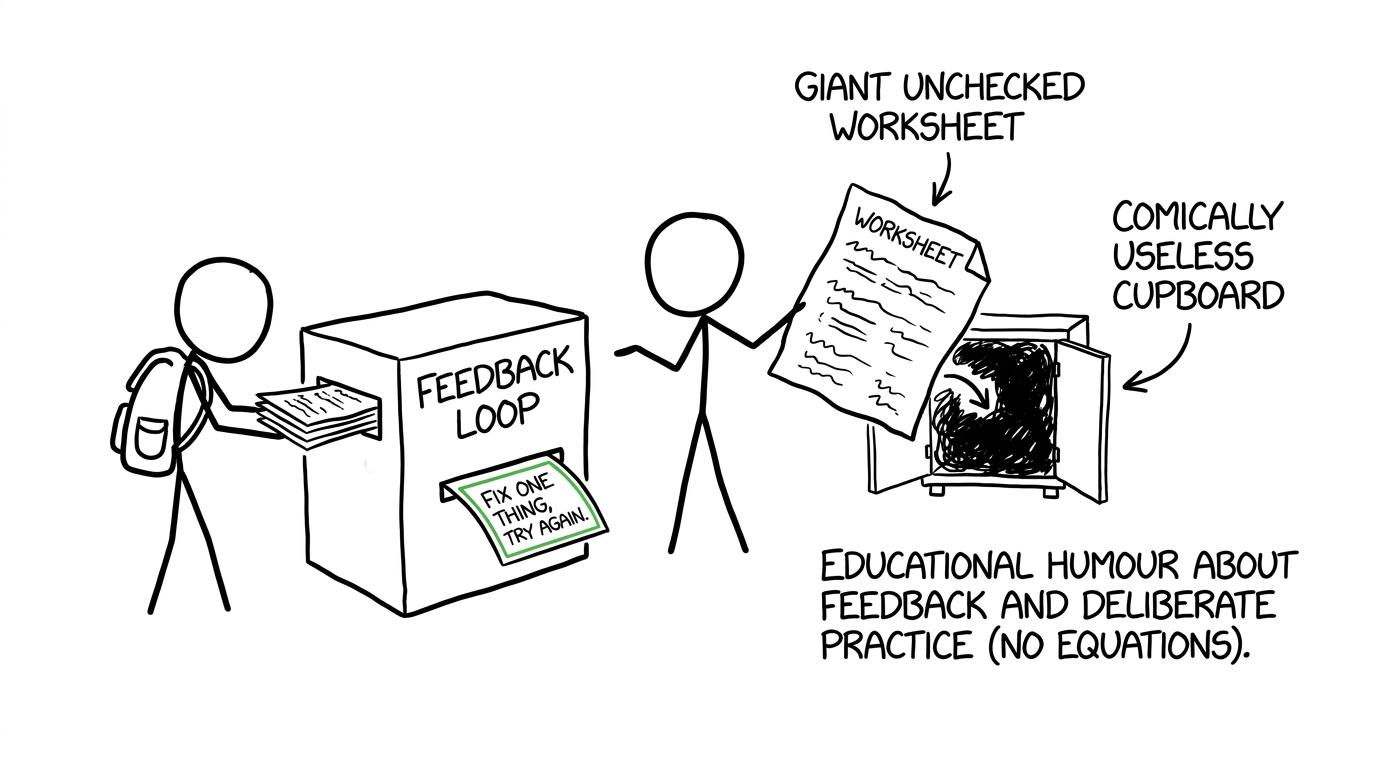 A feedback machine returns one useful correction while an unchecked worksheet vanishes into a cupboard
When should maths revision take priority?
This is where the decision becomes personal. A student with secure Arabic skills but repeated gaps in algebra may gain more from targeted maths practice than from extending an already completed Arabic task. Another student approaching a speaking assessment may reasonably prioritise Arabic for several evenings.
Think in terms of the next best use of time. Ask:
- Which assessment comes first?
- Where am I currently losing the most marks?
- Is the Arabic task required, optional or already secure?
- Does maths have a topic gap that needs repeated practice?
- Am I postponing one subject because the other feels easier?
Do not use “homework does not count” as permission to ignore it. Complete the meaningful core of the task and follow your school’s expectations. Then stop when extra polishing offers little additional learning.
For maths, use evidence rather than mood. The free MathsGenie revision planner can help organise competing demands, while the GCSE maths revision timetable guide shows how to build short, repeatable sessions around schoolwork.
On a busy day, the GCSE twenty-minute maths revision routine gives you a practical minimum. A short session keeps maths moving without pretending every subject can receive unlimited time.
Balance the four Arabic skills with your maths workload
Because each Edexcel Arabic skill contributes 25%25\%25%, repeatedly completing only your favourite kind of homework creates a blind spot. Strong reading cannot completely replace weak listening, just as confidence with number cannot replace missing algebra or geometry skills in GCSE maths.
A sensible weekly plan includes:
- short Arabic retrieval sessions across several days
- speaking and listening practice rather than written work alone
- immediate correction of homework errors
- targeted maths lessons and practice questions
- occasional timed assessment in both subjects
- protected rest and catch-up time
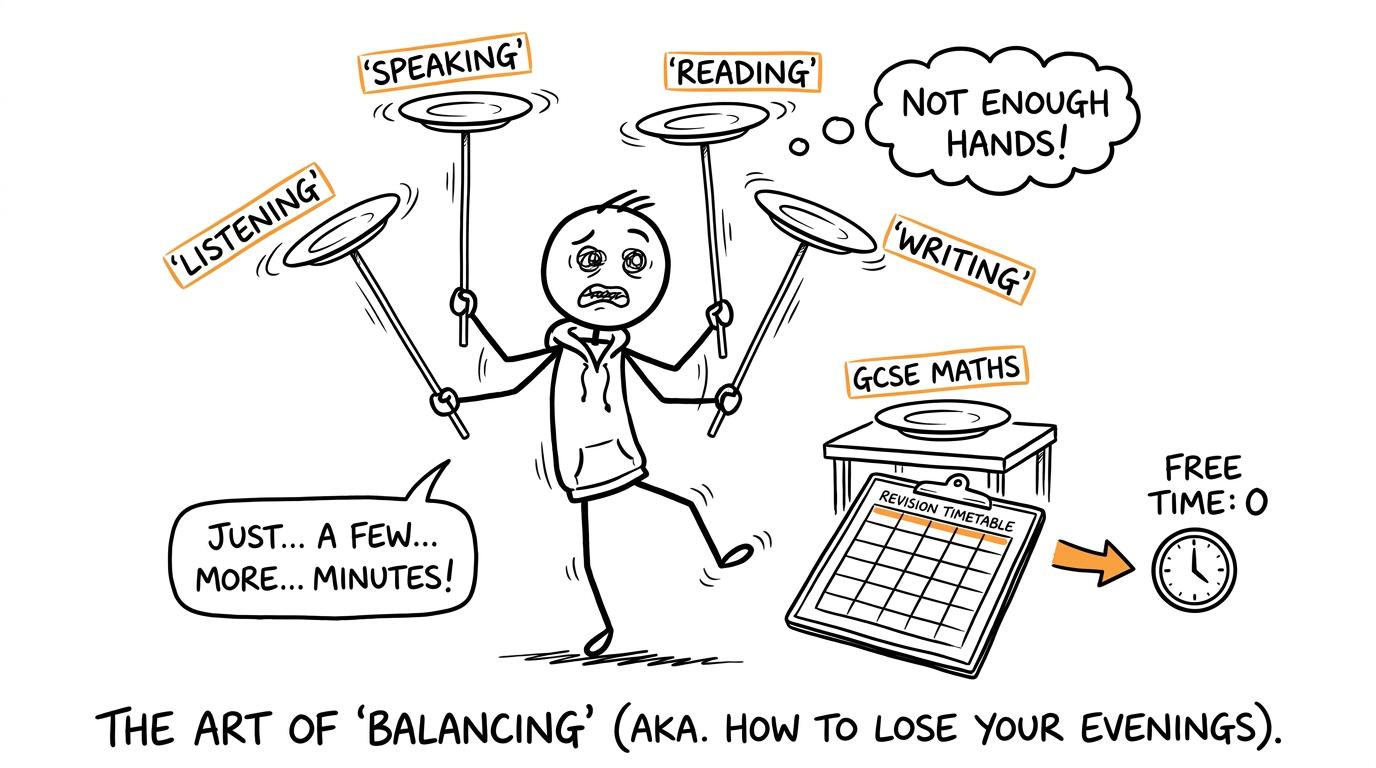 A student balances four Arabic skill plates while GCSE maths waits on the timetable
As maths exams approach, move from isolated practice towards timed exam questions. Edexcel GCSE Maths mini tests provide manageable checks, while Edexcel GCSE Maths past papers build stamina and show how marks are awarded.
If full papers still feel premature, start with focused questions. The goal is not to be constantly busy. It is to make each subject more reliable under exam conditions.
A practical rule for deciding tonight
Use a three-part filter for each task.
Requirement
Is the homework compulsory, due soon or needed for an upcoming lesson? If so, complete it to an appropriate standard. If access, time or understanding is a problem, tell your teacher rather than silently abandoning it.
Learning value
Name the skill the task should improve. “Arabic” is too broad. “Recognising past-tense verbs in listening” is useful. In maths, “algebra” is similarly broad; “solving equations with brackets” creates a clear action.
Opportunity cost
Decide what you will not do if the task expands. An optional hour of copying may replace an hour that could repair a recurring maths weakness. Conversely, avoiding essential Arabic speaking practice to complete familiar maths questions is not an efficient trade either.
A plan should respond to evidence. After a maths paper, use the mark scheme to identify your largest losses. The guide to using Edexcel GCSE maths past papers properly sets out a useful cycle: sit, mark, diagnose, repair and retest.
Common mistakes when judging homework value
Assuming homework has no value because it carries no direct marks
Practice can improve the assessed performance even when the practice itself is ungraded. The indirect route is the whole point.
Treating every task as equally important
A focused listening task addressing a real weakness may deserve more attention than another beautifully copied vocabulary page. Deadline, feedback and skill relevance should guide effort.
Counting time instead of improvement
A long session is not automatically a productive one. Judge the result: can you now recall, understand or produce something you could not manage before?
Ignoring corrections
Finishing a task and never examining errors breaks the feedback loop. Record the mistake, correct it and return to it later.
Letting one subject absorb the whole evening
Homework expands easily when there is no stopping point. Use a timetable, protect short maths sessions and avoid sacrificing sleep for low-value polishing.
Comparing school homework grades with final boundaries
A percentage on a class worksheet is not automatically equivalent to the same percentage on a GCSE paper. Difficulty and marking conditions differ, while qualification grade boundaries are set for particular exam series.
Make homework serve the exam, not replace revision
GCSE Arabic homework matters most when it strengthens listening, speaking, reading or writing. It does not carry an automatic slice of the final Edexcel qualification, and there is no trustworthy formula converting completed sheets into a grade. Quality, feedback and the weakness being targeted matter more than volume alone.
Complete required Arabic work thoughtfully. Correct it. Revisit what went wrong. But if a task has stopped producing learning, do not let perfectionism quietly consume the time needed for GCSE maths.
For that maths time, make MathsGenie your free revision base. Start with a revision lesson, complete targeted practice questions, check the mark scheme or video solution, and then test the skill through mini tests, past papers and predicted papers. If exams are close, the GCSE one-month maths revision plan will help turn those resources into a realistic schedule.
The aim is not to do everything. It is to know why you are doing the next task, and to make that task count.