

GCSE Arabic Half-Term Revision That Gets Done
GCSE Arabic half term revision made realistic: plan short sessions for all four skills, protect your break and return to school prepared and calmer.
Half-term creates a strange kind of pressure. There is enough time to imagine transforming every subject, but not enough time to do everything. The result is often delay, guilt and a rushed session on the final evening.
The simplest way to make GCSE Arabic half term revision happen is to set a small daily minimum, practise one clearly defined skill at a time and stop at the planned finishing time. For most students, five focused sessions across the break will achieve more than an ambitious timetable that collapses after Monday.
Your holiday should still feel like a holiday. The aim is not to fill every free hour. It is to return to school with sharper vocabulary, better control of your weakest skill and evidence that you can keep going when a question becomes unfamiliar.
Your half-term revision checklist
Before planning individual days, make these decisions:
- Confirm your exact qualification, exam board and tier with your school.
- Choose five revision sessions of roughly 303030 to 454545 minutes.
- Give listening, speaking, reading and writing their own focused time.
- Identify one weak topic area rather than trying to relearn the course.
- Use official specification vocabulary, past papers and mark schemes where available.
- Record mistakes in a short correction list.
- Protect at least two days from formal revision.
- Decide now when your first session will begin.
If maths also needs attention, build both subjects into one realistic plan rather than creating competing timetables. The principles in the GCSE maths revision timetable guide work across subjects: prioritise genuine weaknesses, use active practice and leave room for rest.
Start with the GCSE Arabic exam you will actually sit
Revision becomes much easier when you know what the assessment asks you to do. Do not assume that every Arabic qualification has the same papers. Pearson Edexcel GCSE Arabic and International GCSE Arabic First Language, for example, are different qualifications with different assessment structures.
For the current Pearson Edexcel GCSE Arabic qualification, students are assessed in four skills: listening, speaking, reading and writing. Each contributes one quarter of the qualification. Papers are available at foundation and higher tier, and students enter the same tier across the qualification. Dictionaries are not permitted in the assessments.
That structure offers a useful planning lesson: revision should not become seven days of copying vocabulary. Vocabulary matters, but it must eventually travel into listening, speech, reading and written communication.
Check your teacher's guidance, specification and recent assessment feedback before choosing materials. Your school can also confirm whether you are taking GCSE Arabic, an International GCSE or another qualification. The label matters because the question types, timings and mark schemes may differ.
Make the plan small enough to survive Wednesday
A good half-term plan is not the one with the most coloured boxes. It is the one you can still follow after a late morning, a family visit or a day when concentration feels thin.
Try this five-session structure:
- Session one: diagnose: complete a short section from an appropriate past paper and mark it.
- Session two: vocabulary and reading: retrieve words from memory, then apply them to a short text.
- Session three: listening: answer questions from an audio task and review the transcript if supplied.
- Session four: speaking and writing: prepare ideas aloud, then produce a short timed response.
- Session five: retest: return to the errors from earlier in the week without looking at your corrections.
Each session needs one finish line. “Revise Arabic” is too vague. “Complete one listening task, mark it and record five missed words” tells you exactly when the work is done.
Students managing several subjects may prefer smaller blocks. MathsGenie's GCSE 202020-minute revision routine shows why a repeatable routine can be more useful than waiting for a completely free afternoon.
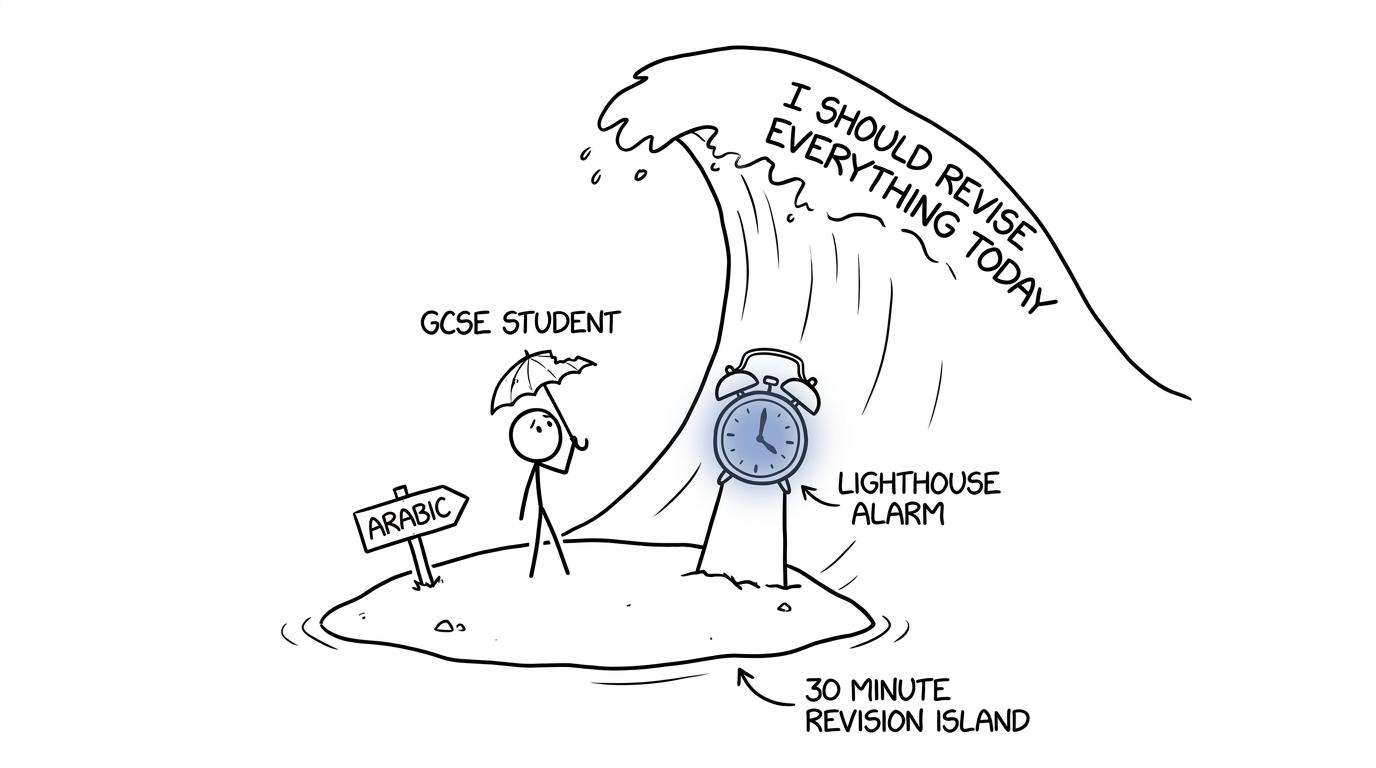 A student protects a small Arabic revision island from an enormous wave of unrealistic plans
Use active GCSE Arabic revision, not comfortable revision
Reading vocabulary lists can feel productive because every word looks familiar. Recognition, however, is not the same as recall. The examination asks you to understand or produce language without the answer already sitting in front of you.
Retrieve vocabulary before reviewing it
Choose vocabulary from a specification theme or a topic recently covered at school. Hide the Arabic and try to produce it. Then reverse the direction. Say selected words aloud and use the difficult ones in short, accurate sentences.
Keep a compact “still missing” list. Ten stubborn words deserve more attention than fifty words you already know. Revisit that list on separate days rather than copying it repeatedly in one sitting.
The current Pearson Edexcel GCSE themes include identity and culture; local, national, international and global areas of interest; and current and future study and employment. Use your own specification as the final checklist, especially if your qualification is different.
Train listening as a process
Listening practice should reveal why an answer was missed. Complete a suitable recording without pausing on the first attempt. On the second attempt, listen for the detail that changed the meaning: a negative, a time reference, an opinion or a contrasting phrase.
Classify the problem honestly:
- You did not know the vocabulary.
- You knew it on paper but did not recognise its sound.
- You heard the words but misunderstood the question.
- You found the answer but changed it after hearing a distractor.
Each cause needs a different response. Learning another vocabulary list will not fix a question-reading problem.
Make speaking revision audible
Silent preparation does not fully prepare you to speak. Practise aloud, record a short response and listen back once. Check whether you answered the question, gave a reason, used an appropriate time frame and spoke clearly enough to be understood.
Do not memorise one enormous paragraph and hope that it fits every prompt. Build flexible clusters of language: an opinion, a justification, a past detail, a future intention and a follow-up idea. Your teacher can advise you on the precise demands of your speaking assessment.
Treat writing as communication
For writing practice, choose a task appropriate to your tier and qualification. Plan briefly, write without a dictionary if that matches the assessment conditions, and check against the mark scheme or teacher guidance.
Your final check should be purposeful:
- Have you addressed every required detail?
- Are your verbs consistent with the intended time frame?
- Do nouns, adjectives and pronouns agree where required?
- Have you communicated opinions and reasons clearly?
- Is the handwriting readable?
Editing everything at once is difficult. Give each practice response one main language target and one communication target.
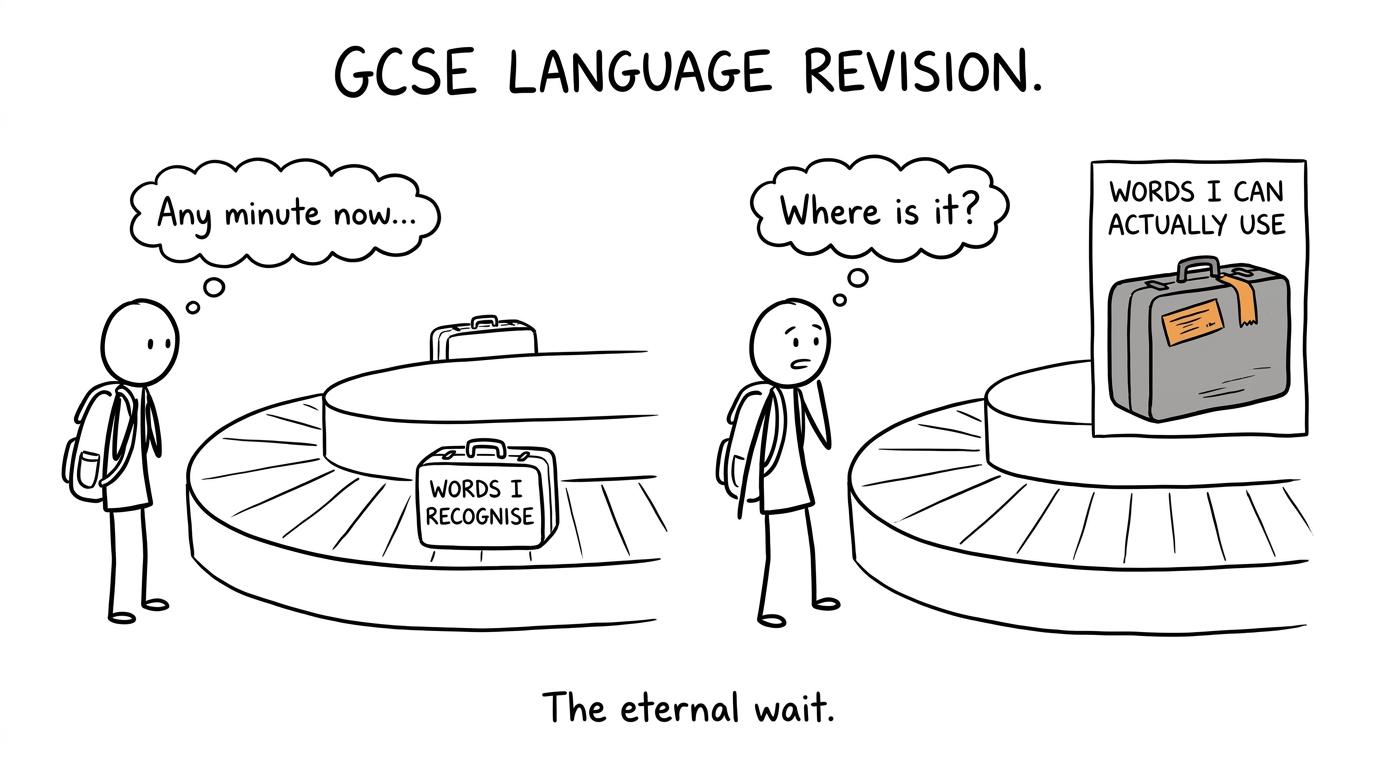 A student waits for usable vocabulary while recognised words circle endlessly on a baggage carousel
Keep maths moving without losing the break
Many students searching for an Arabic half-term plan are also preparing for GCSE maths. The answer is not to alternate between two exhausting marathons. Give each subject a specific job.
Arabic benefits from frequent contact, particularly for vocabulary, listening and speaking. Maths revision works best when you solve questions, mark them and repair the exact methods that cost marks. A sensible day might contain one Arabic block and one shorter maths block, separated by a proper break.
Use the GCSE Maths revision hub to choose resources for Edexcel, AQA, OCR, Eduqas, WJEC or CCEA. Match your foundation or higher tier, then select one topic rather than scrolling through everything.
If you are unsure where to begin, the GCSE maths topics by exam board and tier guide can help you identify a suitable target. Complete a revision lesson, answer practice questions and use the mark scheme or video solution immediately. That keeps the maths session contained and leaves mental space for Arabic.
Use past papers without turning the holiday into an exam week
A full paper is not always the best starting point. One listening section, reading text, translation task or writing prompt can provide enough evidence for a focused session.
Use this loop:
- Attempt the task under suitable conditions.
- Mark it using the official mark scheme where available.
- Label each error precisely.
- Review the missing language or exam skill.
- Reattempt the difficult part later in the week.
A mark scheme is not simply a device for producing a score. It shows what the assessment rewards. Your corrections are where much of the learning happens.
The same principle applies to maths. MathsGenie's guide to starting GCSE past papers at the right time explains how short sections can develop into timed papers as exams approach. When you need fresh maths practice later, GCSE predicted papers can test whether repaired skills hold up in unfamiliar questions. Predicted papers are practice tools, not guarantees of future exam content.
Common half-term revision mistakes
Planning every hour before doing any work
A timetable can become a respectable form of avoidance. Limit planning to about 151515 minutes, choose the first task and begin it immediately.
Revising only the skill you enjoy
Strong readers may keep reading because it feels reassuring. Confident speakers may avoid writing because errors look more permanent on a page. Give the weakest skill the freshest part of your day.
Copying vocabulary without testing recall
Neat notes preserve information; retrieval makes it available. Close the book, produce the language and check afterwards.
Completing tasks without analysing mistakes
A finished paper is only evidence. Improvement begins when you identify whether the problem was vocabulary, grammar, misunderstanding, timing or exam technique.
Sacrificing the entire holiday
Revision that consumes the break is difficult to repeat and may leave you tired when school restarts. Decide your stopping time before beginning. Rest, sleep and ordinary life belong in the plan.
Using materials for the wrong qualification
GCSE Arabic and International GCSE Arabic are not interchangeable labels. Confirm your board, specification and tier before relying on a paper or online resource.
Finish half-term with evidence, not promises
By the final day, you do not need to feel finished. No serious subject is completed in one week. You need something more useful: a short list of vocabulary you can now retrieve, a corrected task, a clearer understanding of your weakest skill and a plan for the next school week.
Begin with one 303030-minute Arabic session today. Choose a single skill, remove your phone, complete the task and write down what needs another attempt. Then stop when the timer ends.
For the maths part of your GCSE preparation, let MathsGenie's one-week revision plan organise the next steps. Use free revision lessons to rebuild weak topics, practice questions and mini tests to check them, then past papers, predicted papers, mark schemes and video solutions to develop exam performance. A good half-term does not have to look heroic. It only has to leave you better prepared than when it began.










