GCSE Arabic Grade 8 Meaning: Ability Explained
GCSE Arabic grade 8 meaning explained: the ability it represents, how it compares with old A and A* grades, and why boundaries change each year.
A results slip is remarkably quiet. It gives you a subject, a number and very little explanation of what either says about you. If you are searching for the GCSE Arabic grade 8 meaning, the direct answer is this: a grade 888 is the second-highest GCSE grade and represents excellent performance across demanding Arabic listening, speaking, reading and writing assessments. It sits within the part of the numbered scale that replaced the old A and A* grades, although it is not an exact one-to-one conversion.
That distinction matters. A grade is evidence of assessed performance, not a complete definition of your fluency, identity or future potential. But a grade 888 is strong evidence that you can understand and communicate detailed ideas in Arabic with considerable accuracy.
Grade 8 in GCSE Arabic at a glance
- Grade 888 is one grade below the maximum grade of 999.
- It is available through the Higher tier, not the Foundation tier.
- It reflects performance across listening, speaking, reading and writing.
- On the old letter scale, it lies within the area previously covered by A and A*.
- It is often described informally as a high A or lower A*, but that is only a rough comparison.
- The required mark is not fixed permanently; grade boundaries are set for each examination series.
- It demonstrates advanced GCSE performance, but it does not automatically mean native-level or unrestricted real-world fluency.
What does a grade 8 actually represent?
The official GCSE modern foreign language grade descriptor gives a useful picture of performance at grade 888. It describes a student who can respond effectively to more complex and extended spoken and written language, identify opinions, infer meaning and draw conclusions.
In productive skills, the student can communicate detailed ideas, justify opinions and manipulate vocabulary and grammar mostly accurately. They can also sustain conversation and respond effectively when questions are less predictable.
In practical terms, the grade points to four connected abilities.
Listening
A grade 888 student can follow more demanding spoken Arabic rather than relying only on isolated familiar words. They can extract important information, recognise viewpoints and reach conclusions from extended material.
This does not mean every recording feels easy. Strong candidates may still miss an unfamiliar expression or need to recover after a difficult section. What matters is that they can preserve the overall meaning and respond accurately enough across the assessment.
Speaking
At this level, speaking is more than delivering memorised sentences. A student should be able to sustain a detailed exchange, develop ideas, justify opinions and adapt when the conversation moves in an unexpected direction.
Pronunciation and intonation should be mostly accurate and communication should remain clear. Occasional hesitation does not erase high-level performance, particularly when the student can recover and continue communicating effectively.
Reading
Grade 888 performance involves understanding extended and more complex written material. The student can identify explicit information, recognise opinions and infer meaning that is not stated directly.
This distinction is important. Basic reading asks, “Which words do I recognise?” Strong reading asks, “What is the writer suggesting, and what evidence supports that interpretation?”
Writing
In writing, a grade 888 student can communicate effectively for different purposes, explain ideas and justify opinions. They use a broad range of vocabulary and grammar, including some more complex language, with mostly accurate control.
The work does not need to be flawless. At this level, an error may occur without preventing communication. Range, development, relevance and accuracy work together.
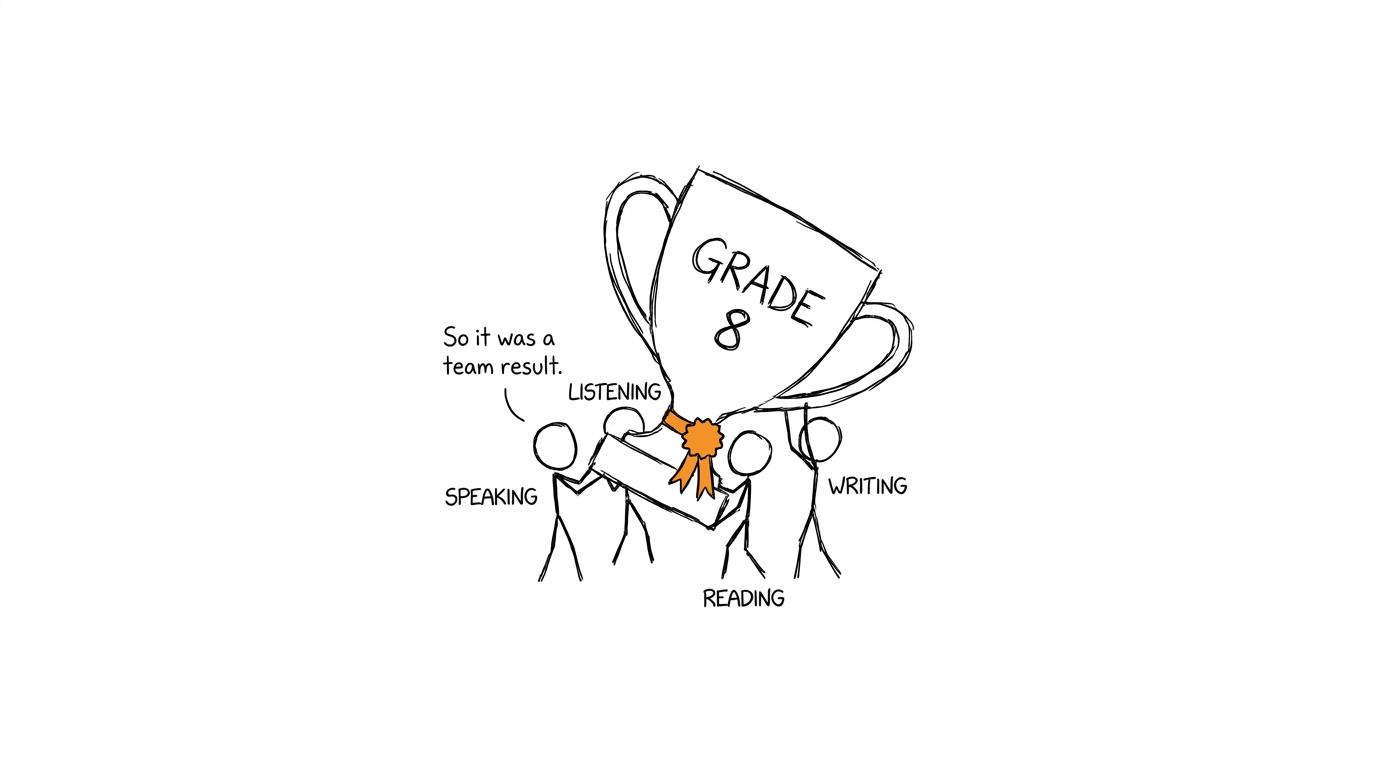 Four revision characters carry one Grade 8 trophy together
How GCSE Arabic is assessed
The current Pearson Edexcel GCSE Arabic qualification contains four externally assessed components based on the core language skills.
| Assessment area | Weighting | What it tests |
|---|---|---|
| Listening | 25%25\%25% | Understanding and responding to spoken Arabic |
| Speaking | 25%25\%25% | Communicating and interacting effectively in Arabic |
| Reading | 25%25\%25% | Understanding written Arabic and translating into English |
| Writing | 25%25\%25% | Communicating in writing and translating into Arabic |
Students enter one tier across the qualification. Foundation tier targets grades 111 to 555, while Higher tier targets grades 444 to 999, with a possible grade 333 for a candidate who narrowly misses the grade 444 boundary. A student aiming for grade 888 must therefore take Higher tier papers.
Because all four assessment objectives contribute equally, grade 888 is an overall qualification result. It does not necessarily mean that every individual skill was performed at precisely the same level. A particularly strong reading performance, for instance, may offset a weaker section elsewhere.
That is why one total grade should be treated as a summary rather than four separate judgements hidden inside a single number.
Is grade 8 equivalent to an A or an A*?
The safest answer is that grade 888 sits within the old A and A* range, but it is not officially identical to either letter.
Ofqual established several firm comparison points when numbered grades replaced letters in England:
- the bottom of grade 777 is comparable with the bottom of the old grade A;
- the bottom of grade 444 is comparable with the bottom of the old grade C;
- the bottom of grade 111 is comparable with the bottom of the old grade G.
There is no official exact conversion for every grade between these anchors. Grades 777, 888 and 999 together occupy the broad area covered by the former A and A* grades, with greater differentiation among the strongest performances.
| Current grade | Sensible interpretation against old grades |
|---|---|
| 999 | Highest performance within and beyond the old A* region |
| 888 | Between the grade 777 and grade 999 standards; roughly high A to A* territory |
| 777 | Lower boundary comparable with the lower boundary of old grade A |
Calling an 888 “an A*” may be convenient in conversation, but it hides how the system was designed. Calling it simply “an A” understates its position. The more accurate description is an excellent result in the upper A/A region of the former scale*.
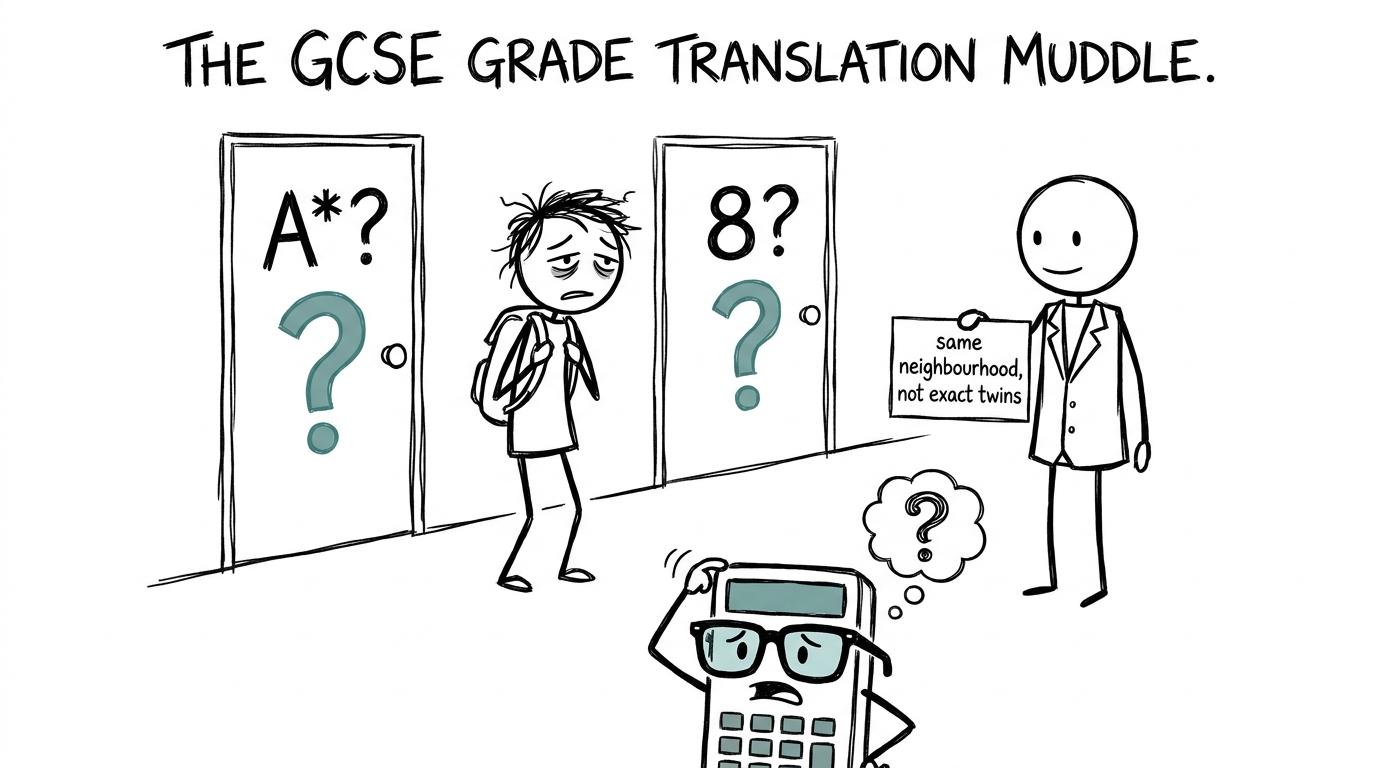 A student chooses between old and new grade labels
What mark is needed for a grade 8 in GCSE Arabic?
There is no permanent grade 888 mark. Boundaries can change after each examination series to reflect the demand of the papers and maintain standards over time.
For context, Pearson's June 202520252025 Edexcel GCSE Arabic Higher-tier boundary report placed grade 888 at 208208208 out of a scaled qualification total of 280280280. Grade 777 began at 179179179, while grade 999 began at 237237237.
These figures describe that particular series. They are not a prediction for a future examination and should not become a revision target to the nearest mark. Students can check the Edexcel GCSE Arabic grade boundaries for historical context, but should always use the boundary published for the series they actually sat.
A boundary tells you where a grade began after marking. It does not tell you which topics to ignore beforehand.
What a grade 8 does not mean
A high GCSE language grade is significant, but it has limits.
It does not certify native proficiency. Arabic is used across many countries and communities, with substantial variation in spoken forms. The GCSE assesses performance against a defined specification, principally through standard Arabic and prescribed examination tasks.
It also does not mean that the student never makes mistakes. The grade descriptor itself allows for language that is mostly accurate. Strong communication can coexist with occasional grammatical, spelling or pronunciation errors.
Finally, it does not measure every valuable language skill. Informal conversation, cultural knowledge, dialect comprehension and confidence in unfamiliar real-life situations may not align perfectly with an examination grade.
The result is best understood as strong evidence that the student performed at an excellent standard in the assessed GCSE curriculum.
Why this matters when you are revising maths
Students rarely prepare for one subject in isolation. The same week may contain an Arabic speaking assessment, a science test and a Higher maths paper. Understanding what a grade means helps you allocate revision time without turning every result into a judgement about intelligence.
The most transferable lesson is that a final grade combines several assessed skills. Maths works similarly: algebraic fluency, numerical accuracy, geometrical reasoning, problem-solving and exam technique all contribute to the result.
Start by choosing the correct exam board and tier through the GCSE maths revision hub. Edexcel, AQA, OCR and Eduqas cover the national mathematical content, but organise and assess it differently. The GCSE maths topics by exam board and tier guide can help you map the specification before deciding what needs attention.
Then use evidence rather than mood:
- diagnose a narrow weakness with GCSE maths mini tests;
- rebuild the method through revision lessons and practice questions;
- test mixed performance using GCSE past papers;
- check every lost mark against the official mark scheme;
- use video solutions where seeing the complete method would help;
- return to the weakness after a gap.
If the amount of content feels overwhelming, the best order for learning GCSE maths topics provides a calmer route through number, algebra, graphs, geometry, statistics and Higher-tier material.
Common mistakes when interpreting a grade 8
Treating grade conversions as exact
A grade 888 cannot be converted mechanically into one old letter grade. The official scales align at selected boundary points, not at every possible grade.
Assuming the boundary never changes
A mark that achieved grade 888 in one series may produce a different result in another. Use historical boundaries to understand context, not to forecast a guaranteed outcome.
Confusing examination performance with complete fluency
GCSE Arabic measures specified language skills under assessment conditions. It does not capture every dialect, cultural context or real-life interaction.
Revising only the strongest component
Because listening, speaking, reading and writing each contribute 25%25\%25%, repeatedly practising the most comfortable skill can leave avoidable gaps elsewhere. The same trap appears in maths when students practise familiar topics but avoid the questions that actually cost them marks.
Completing papers without reviewing them
A paper produces evidence only if you inspect it. The useful part begins after marking: identify the topic, understand the error and attempt a similar question later. The guide to using GCSE past papers properly explains how to turn a score into a revision plan.
The result behind the number
A grade 888 in GCSE Arabic represents excellent, advanced GCSE performance. It shows that a student can understand demanding spoken and written Arabic, communicate detailed ideas, justify opinions and use vocabulary and grammar with mostly accurate control. Against the old letter system, it belongs in the upper A/A* region, but it is not an exact replacement for either grade.
The number matters. What you do with the information matters more.
Bring that same clear thinking to your maths revision. Open the MathsGenie GCSE maths revision area, choose your board and tier, and use free revision lessons, practice questions, mini tests, past papers, predicted papers, mark schemes and video solutions to find the next mark you can realistically gain.