

GCSE Arabic Grade 7 Meaning: A Clear Guide
GCSE Arabic grade 7 meaning explained: understand the ability it represents, its old grade A comparison, tier rules and changing grade boundaries.
Results slips are remarkably small documents for something that can feel so important. A single number may leave you wondering whether you should celebrate, reconsider your plans or compare yourself with everyone else. The GCSE Arabic grade 7 meaning is reassuringly clear: it is a strong GCSE result, broadly comparable at its lower boundary to the old grade A, and it indicates secure performance across demanding language tasks.
It does not mean perfect Arabic, native-level fluency or a fixed percentage in every exam series. It means your total mark reached the grade 7 boundary set for that year's qualification. For Pearson Edexcel GCSE Arabic, that result must be achieved through Higher tier assessments.
The short answer: what does a grade 7 represent?
A grade 7 in GCSE Arabic shows that you can use and understand Arabic successfully across listening, speaking, reading and writing. You are likely to cope with extended material, communicate ideas and opinions, use a reasonably broad range of vocabulary and handle some complex language.
The essential facts are:
- Grade 7 is one of the upper GCSE grades on the scale from 9 to 1.
- Its lower boundary is officially comparable to the lower boundary of the old grade A.
- It is available through Higher tier, not Foundation tier, in Pearson Edexcel GCSE Arabic.
- It reflects a combined result rather than a separate grade in each language skill.
- The number of marks required changes between exam series.
- It represents strong assessed performance, but it is not a certificate of complete fluency.
That distinction matters. An exam grade measures performance against a specification under assessment conditions. Real-world language ability is broader and continues developing long after GCSE.
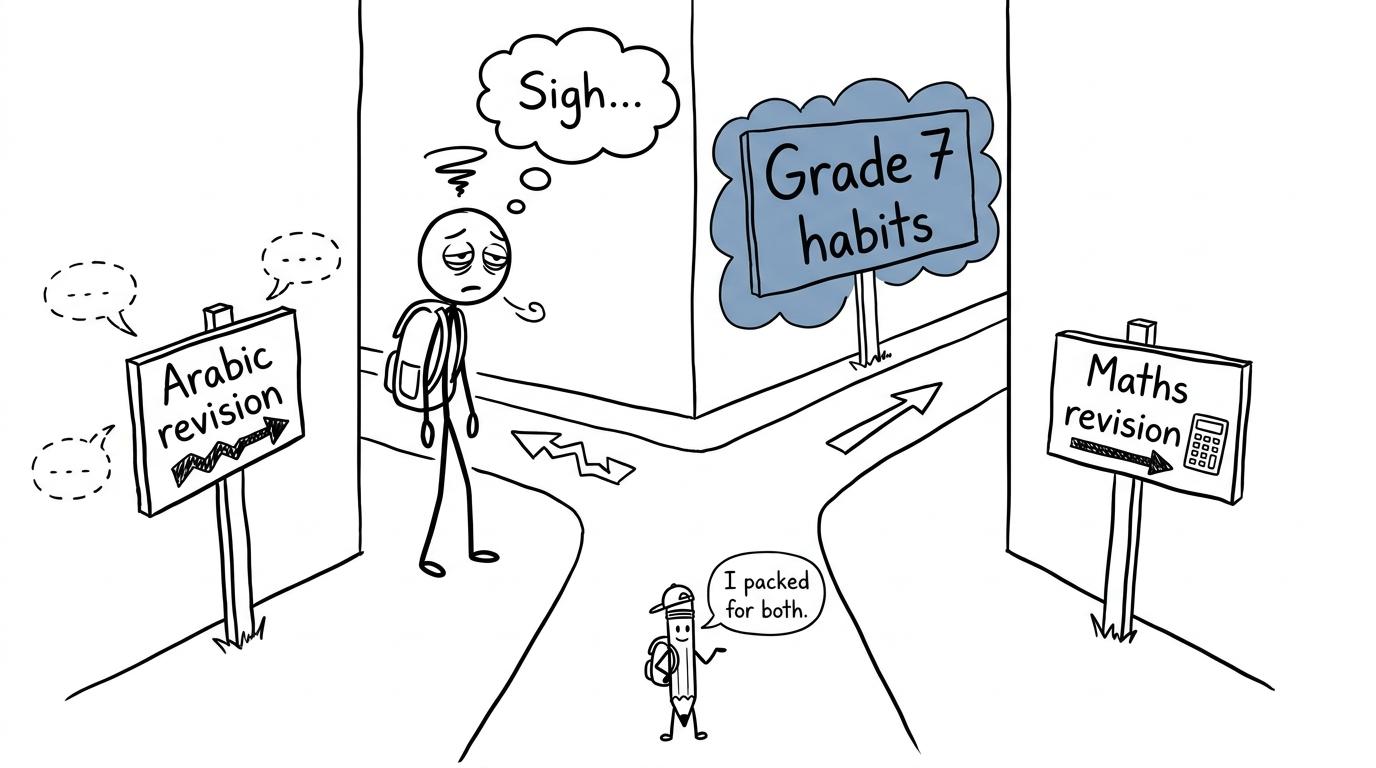 A student discovers that steady revision habits lead towards a grade 7
How grade 7 compares with the old letter grades
The safest comparison is the official one: the bottom of grade 7 is comparable to the bottom of the old grade A.
This is more precise than saying every grade 7 is exactly the same as every old A. England's reformed GCSE scale contains nine numbered grades, while the former scale ran from A* to G. The qualifications and assessments also changed, so there is no exact one-to-one conversion at every point.
Grades 7, 8 and 9 collectively occupy the part of the scale previously associated with grades A and A*. Grade 9 provides greater differentiation among the very strongest performances. A grade 7 should therefore be understood as an A-level standard of GCSE achievement in the broad historical sense, rather than as a renamed letter grade.
If you are also interpreting a maths result, the same national grading comparison applies. The MathsGenie guide to what a grade 7 in GCSE Maths means explains what that grade suggests within the maths specification.
What ability does a grade 7 in GCSE Arabic show?
Grade descriptors describe typical performance across a qualification. They are not a checklist that every student must satisfy identically, but they offer a useful picture of the standard.
Official modern foreign language descriptors place grade 7 above secure grade 6 performance but below the minimum requirements of most grade 8 statements. In practical terms, the result points towards a student who can do more than recognise rehearsed phrases.
Listening
A grade 7 student should generally be able to follow spoken Arabic across familiar and some less familiar contexts. This includes identifying overall messages, details, opinions and reasons in material that may contain extended passages, less familiar vocabulary and some complex language.
That does not mean understanding every word. Strong listening often depends on recovering meaning when one phrase is missed, recognising paraphrasing and distinguishing the main message from a distracting detail.
Speaking
In speaking, the grade suggests an ability to communicate relevant ideas, respond to questions and develop answers rather than relying entirely on isolated sentences. A strong response may include justified opinions, references to different time frames and language adapted to the task.
Communication remains central. Minor errors can occur, particularly when a student attempts ambitious structures, without destroying the overall quality of the response.
Reading
At this level, students can normally extract information and viewpoints from a range of written material. They should be increasingly capable of drawing conclusions, dealing with some unfamiliar language through context and translating meaning with reasonable accuracy.
Reading success is therefore not simply a large vocabulary test. It also requires attention to negatives, connectives, time references and the exact information requested by the question.
Writing
A grade 7 indicates that a student can communicate ideas in connected Arabic for different purposes. Writing should usually go beyond a list of basic statements, using relevant detail, opinions, reasons and a range of vocabulary and structures.
Accuracy matters, but ambitious writing need not be flawless. The important question is whether errors obscure meaning and whether the response addresses the task clearly.
How the GCSE Arabic assessment produces the grade
For Pearson Edexcel GCSE Arabic, the qualification assesses four skills:
- listening
- speaking
- reading
- writing
Each contributes 25%25\%25% of the qualification. The final grade comes from the total subject mark across all four papers; individual papers do not receive formal qualification grades.
This creates an important nuance. Two students can earn the same grade 7 with different profiles. One may be particularly strong in reading and writing, while another gains more marks through listening and speaking. The final number summarises their combined assessment performance.
Students must enter one tier across all four papers. Foundation tier offers grades 1 to 5. Higher tier normally offers grades 4 to 9, with a possible grade 3 for a mark narrowly below the grade 4 boundary. Consequently, a grade 7 requires Higher tier entry.
Do not confuse GCSE Arabic with International GCSE Arabic or other Arabic qualifications. Their paper structures, maximum marks and grading arrangements may differ. Check the qualification title and code on your school documents before interpreting a boundary.
How many marks are needed for grade 7?
There is no permanent grade 7 mark. Awarding organisations set grade boundaries for each exam series after reviewing the assessments and evidence about their demand. A harder paper can have a lower boundary; a more accessible paper can have a higher one.
Recent Pearson Edexcel Higher tier boundaries illustrate this variation:
| Exam series | Grade 7 boundary | Maximum mark |
|---|---|---|
| June 2025 | 179179179 | 280280280 |
| June 2024 | 168168168 | 280280280 |
| June 2023 | 166166166 | 280280280 |
These figures are historical facts, not predictions for a future paper. The MathsGenie GCSE Arabic grade boundaries page lets you compare exam series without assuming that one year's boundary will repeat.
This is familiar territory for maths students. Boundaries move in GCSE Maths too, as the Edexcel GCSE Maths grade boundary archive demonstrates. A sensible revision target therefore includes a buffer rather than aiming for the exact mark used in a previous year.
What a grade 7 does not tell you
A result becomes less confusing when you know its limits.
A grade 7 does not prove that you will understand every Arabic dialect. Pearson's assessment is based primarily on standard Arabic within the specification's contexts. Everyday spoken varieties can differ considerably.
It also does not reveal an individual mark for each skill on the certificate. Because marks are combined, the grade alone cannot identify whether listening, speaking, reading or writing was your strongest area.
Finally, it does not guarantee admission to a particular sixth form, course or future programme. Entry requirements are set by individual institutions. Check the published requirements and ask the relevant department if anything is unclear.
Lessons maths students can take from a grade 7
Arabic and maths test different knowledge, but effective revision has a shared structure: retrieve, attempt, check and correct.
A student preparing for several GCSEs cannot afford to revise every subject through passive rereading. For Arabic, that means listening practice, active vocabulary retrieval, spoken responses and timed writing. For maths, it means solving questions and examining where the working failed.
The GCSE Maths revision hub brings together free revision lessons, practice questions, past papers, mini tests and solutions for Edexcel, AQA, OCR and Eduqas. Use it alongside your Arabic revision rather than allowing one subject to consume every available session.
A calm weekly pattern might include:
- one short retrieval session for older material
- one focused session on a weaker skill or topic
- one timed set completed without notes
- careful marking followed by correction
- a later reattempt to check that the improvement lasted
If your timetable currently feels improvised, the GCSE one-month maths revision plan offers a practical framework that can sit beside your language preparation.
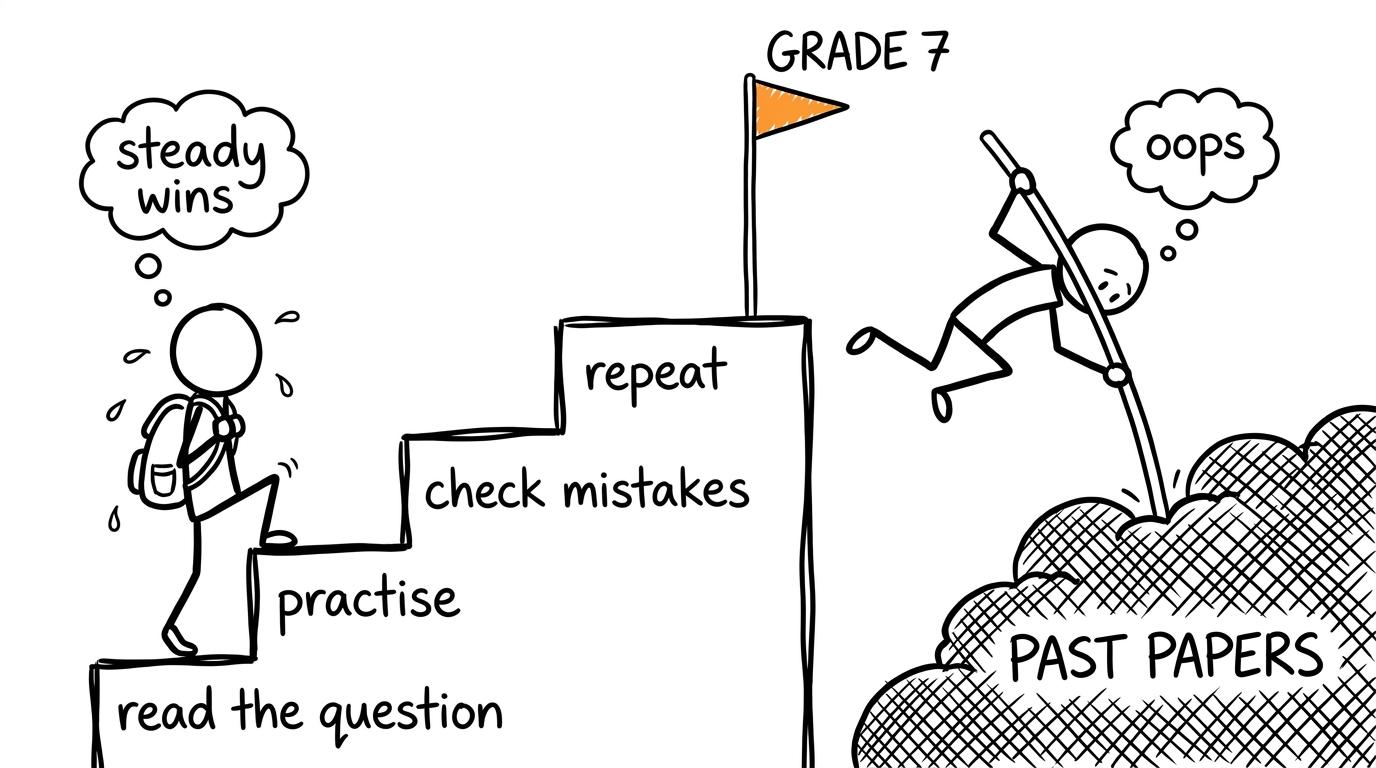 A revision staircase beats trying to jump directly to grade 7
Common mistakes when interpreting a GCSE Arabic grade 7
Calling it an exact old A
The bottom of grade 7 is comparable to the bottom of the former grade A. That is an official anchor point, not proof that the two grading systems match perfectly throughout.
Treating last year's boundary as a target
Historical marks provide context, but boundaries change. Build reliable performance across all four skills instead of gambling on a repeated number.
Assuming Foundation tier can award grade 7
For Pearson Edexcel GCSE Arabic, Foundation tier is capped at grade 5. Grade 7 is reached through Higher tier.
Believing one weak paper makes grade 7 impossible
The qualification uses a total subject mark. A weaker performance in one skill can sometimes be balanced by stronger marks elsewhere, although neglecting an entire paper is risky because each skill carries 25%25\%25%.
Equating a high grade with effortless fluency
Grade 7 is a significant academic achievement, but language development does not finish on results day. Conversation, wider reading and exposure to different speakers continue to build ability beyond the specification.
Comparing raw marks across unrelated subjects
A mark proportion in Arabic cannot be interpreted using a maths boundary. Each subject has different content, assessment demands and boundary-setting evidence.
Turn the meaning into a useful next step
The most helpful interpretation is also the simplest: grade 7 in GCSE Arabic is a strong result showing secure, increasingly independent use and understanding of the language across four assessed skills. It broadly aligns with the lower edge of the old grade A, but it is not a claim of perfection and it is not tied to one permanent mark.
Once you understand the result, return your attention to what you can control. Keep practising Arabic through active use. For your maths exams, make MathsGenie your free revision base: begin with GCSE Maths revision lessons and practice, test yourself with Edexcel predicted papers, and learn how to extract more value from GCSE Maths past papers and mark schemes.
A grade is the summary of work already completed. Good revision is what turns the next result from a hope into something increasingly familiar.










