

GCSE Arabic Grade 4 Meaning: What It Represents
GCSE Arabic grade 4 meaning explained: discover the ability it represents, how it compares with an old grade C and what the result means next.
A result can be only one digit long and still raise a dozen questions. Is it a pass? Is it the same as a C? Does it show fluency? Was it close to a grade 555?
The GCSE Arabic grade 4 meaning is straightforward at its core: in England, grade 444 is a standard pass. Its lower boundary is comparable with the lower boundary of the old grade C. In Arabic, it shows that you achieved the required overall standard across listening, speaking, reading and writing, but it does not mean that every skill is equally strong or that you are fluent in every situation.
That is the short answer. The more useful answer is what the grade represents, what it does not tell you and how to respond to it.
GCSE Arabic grade 4 meaning at a glance
- Grade 444 is officially described as a standard pass.
- Grade 555 is described as a strong pass.
- The bottom of grade 444 is comparable with the bottom of the old grade C.
- It is not accurate to convert every numerical grade directly into one old letter grade.
- In Pearson Edexcel GCSE Arabic, the overall result combines listening, speaking, reading and writing.
- Each of those four skills contributes 25%25\%25% of the qualification.
- A grade 444 is based on the total subject mark, not a separate grade for every paper.
- Grade boundaries change between exam series, so there is no permanent percentage for a grade 444.
- Unlike GCSE maths and English, a grade below 444 in Arabic does not trigger England's post-161616 continuing-study requirement.
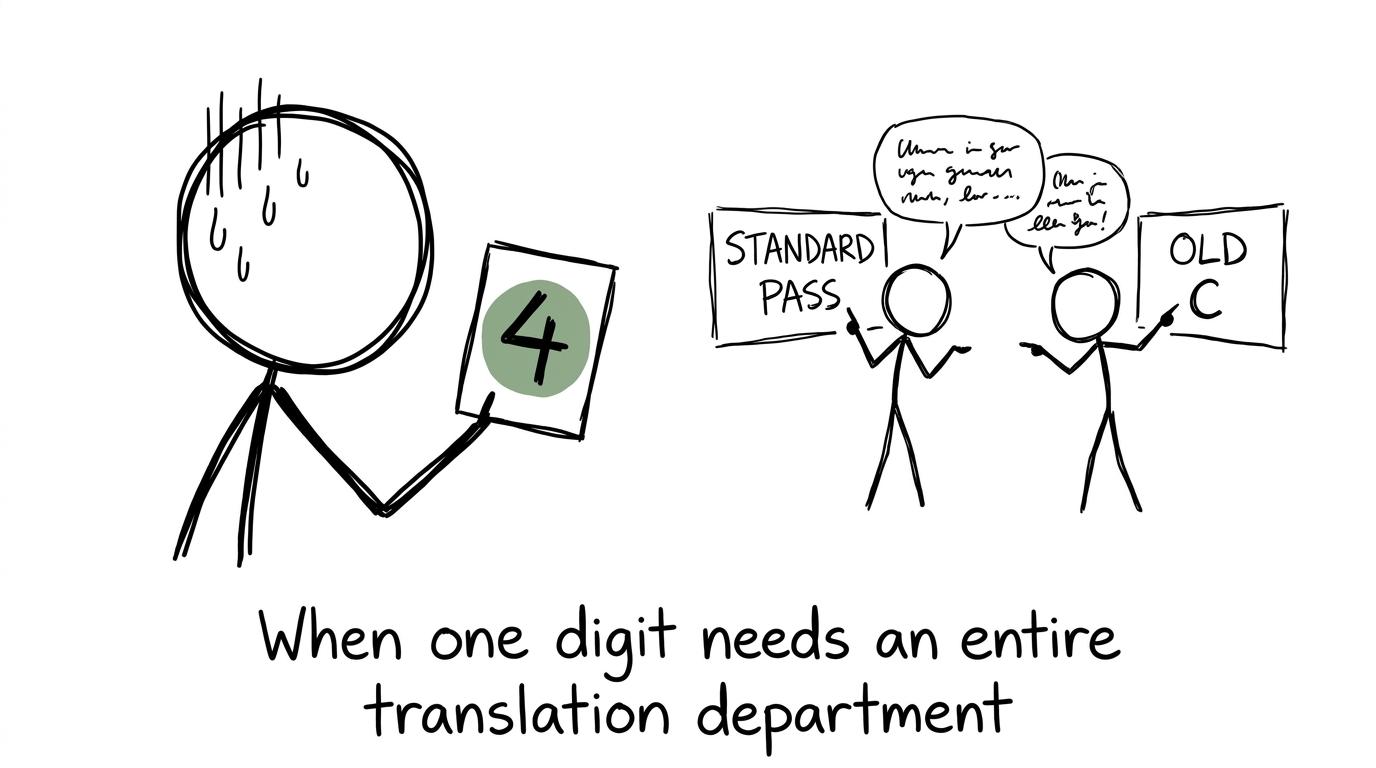 A student discovers that one GCSE grade needs a translation department
Is a grade 4 in GCSE Arabic a pass?
Yes. A grade 444 is a standard pass in England's numerical GCSE grading system, where grade 999 is the highest grade and grade 111 is the lowest.
The word “standard” matters. It does not mean the result is incomplete or unofficial. It distinguishes grade 444 from grade 555, which the Department for Education calls a strong pass for reporting purposes.
A school, sixth form, college or employer may still set its own entry requirements. One course might accept grade 444 while another asks for grade 555 or above. The sensible approach is to check the published requirement rather than assuming that “pass” guarantees entry to every course.
This distinction is also explained in MathsGenie's guide to whether grade 4 is a pass at GCSE.
How does grade 4 compare with the old letter grades?
The safest comparison is this:
The bottom of grade 444 is comparable with the bottom of the old grade C.
Ofqual did not create a complete one-to-one conversion table between the numerical and letter systems. Instead, several points were aligned:
| Numerical grading point | Comparable old grading point |
|---|---|
| Bottom of grade 777 | Bottom of grade A |
| Bottom of grade 444 | Bottom of grade C |
| Bottom of grade 111 | Bottom of grade G |
This is why grade 444 is often described informally as “equivalent to a C”. That phrase is useful shorthand, but “broadly comparable with the old C threshold” is more precise.
Grades 444, 555 and 666 create more differentiation across the region previously occupied broadly by grades B and C. Therefore, it would be misleading to label grade 555 as exactly one old letter and grade 666 as exactly another.
For a student holding grade 444 in Arabic, the practical message is simple: you crossed the modern standard-pass threshold corresponding to the old grade-C benchmark.
What ability does a grade 4 in Arabic represent?
A GCSE grade is evidence from an assessment, not a complete portrait of someone’s language ability. Pearson Edexcel GCSE Arabic assesses four compulsory skills:
| Skill | Qualification weighting | What it examines |
|---|---|---|
| Listening | 25%25\%25% | Understanding spoken Arabic, including messages, details and opinions |
| Speaking | 25%25\%25% | Communicating and interacting for different purposes |
| Reading | 25%25\%25% | Understanding written Arabic and identifying relevant information |
| Writing | 25%25\%25% | Communicating ideas and information in written Arabic |
At grade 444, a student has demonstrated sufficient performance across the qualification to meet the standard-pass threshold. In practical terms, that is likely to include communicating about familiar topics, identifying key information, responding to questions and using Arabic to convey relevant meaning.
However, the final grade does not prove that all four abilities are at the same level. A confident speaker might find extended writing harder. Another student may read accurately but need more time to process recorded speech. Because the marks are combined, stronger performance in one area can compensate to some extent for weaker performance elsewhere.
Nor is grade 444 a certificate of complete fluency. Fluency depends on context: everyday conversation, academic reading and formal writing are different demands. The result says that the candidate met a defined GCSE assessment standard under exam conditions. That is valuable evidence, but it should not be stretched into a claim the qualification was not designed to make.
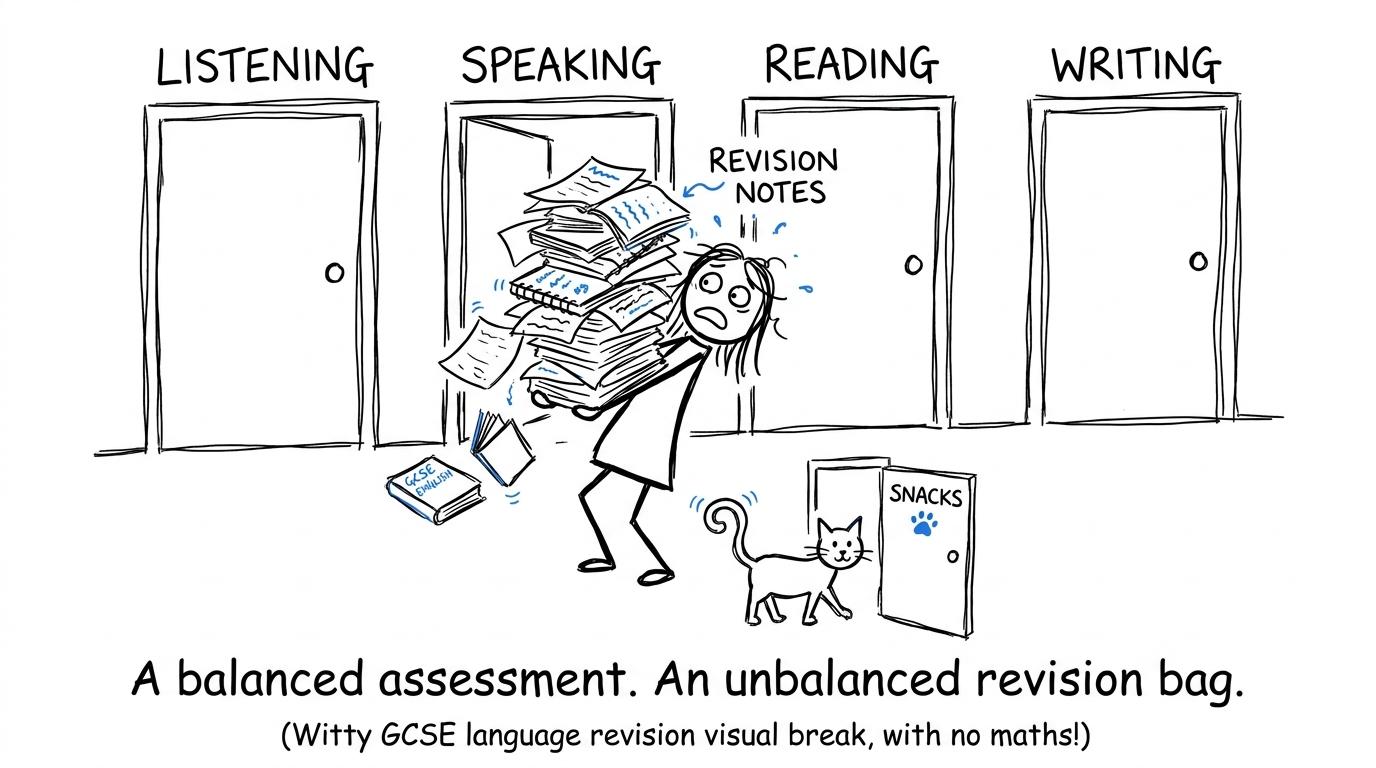 Four language skills create a balanced assessment and a very unbalanced revision bag
How the tier affects a grade 4
In the current Pearson Edexcel GCSE Arabic specification, students take either Foundation or Higher tier across all four papers.
Foundation tier makes grades 111 to 555 available. Higher tier makes grades 444 to 999 available, although a grade 333 can be awarded in a limited range immediately below the Higher grade-444 boundary.
A grade 444 is the same qualification grade whichever tier produced it. The papers, available grades and raw grade boundaries differ, but the certificate does not turn a Foundation grade 444 into a lesser version of a Higher grade 444.
Tier choice still matters before the assessment. Foundation gives access to a maximum grade 555, while Higher provides access to grades above 555 but includes more demanding material. Students should discuss the decision with their teacher and use evidence from timed papers rather than treating Higher as automatically “better”.
The same principle will be familiar to maths students. The GCSE Maths revision hub organises resources by exam board and tier, including Edexcel, AQA, OCR and Eduqas. Matching practice to the paper you will actually sit is more useful than choosing material because its label sounds ambitious.
Why a grade 4 is not a fixed number of marks
Grade boundaries are set for each exam series after the papers have been taken and marked. They account for the demands of that particular assessment, so the raw mark needed for grade 444 can move.
For context, Pearson's June 2025 boundaries for GCSE Arabic were:
- Foundation tier: grade 444 began at 144144144 marks out of 280280280.
- Higher tier: grade 444 began at 112112112 marks out of 280280280.
These figures are historical boundaries, not promises about a future examination. They also should not be compared as if the two tiers used identical papers. The Higher assessment is designed for a different grade range.
You can review recent figures on MathsGenie's Edexcel GCSE Arabic grade boundaries page. Use them to interpret a completed paper from the same series, not to predict exactly where a future boundary will fall.
There is another important detail: Pearson awards the qualification from the total subject mark. Individual papers do not receive formal certificate grades. Saying “I got a grade 444 in speaking” may therefore confuse a teacher's estimate or notional boundary with the official overall result.
What a grade 4 means for your next step
If grade 444 meets the requirement for your intended course, it has done an important job. It records a recognised GCSE pass and gives you evidence of achievement across several language skills.
If you want to continue to A Level Arabic or another advanced language course, check the provider's exact entry criteria. A course can require more than the national standard-pass threshold, particularly where future study depends on secure writing, grammar and comprehension.
If you hoped for a higher result, avoid turning one number into a judgement about your potential. A grade is better treated as information. Ask for your component marks where available, compare them carefully and identify whether listening, speaking, reading or writing limited the total.
That mindset transfers directly to maths revision. A full paper is most useful when it reveals the next weakness to fix. MathsGenie's guide to using GCSE past papers properly explains the cycle: attempt, mark, diagnose, relearn and retest.
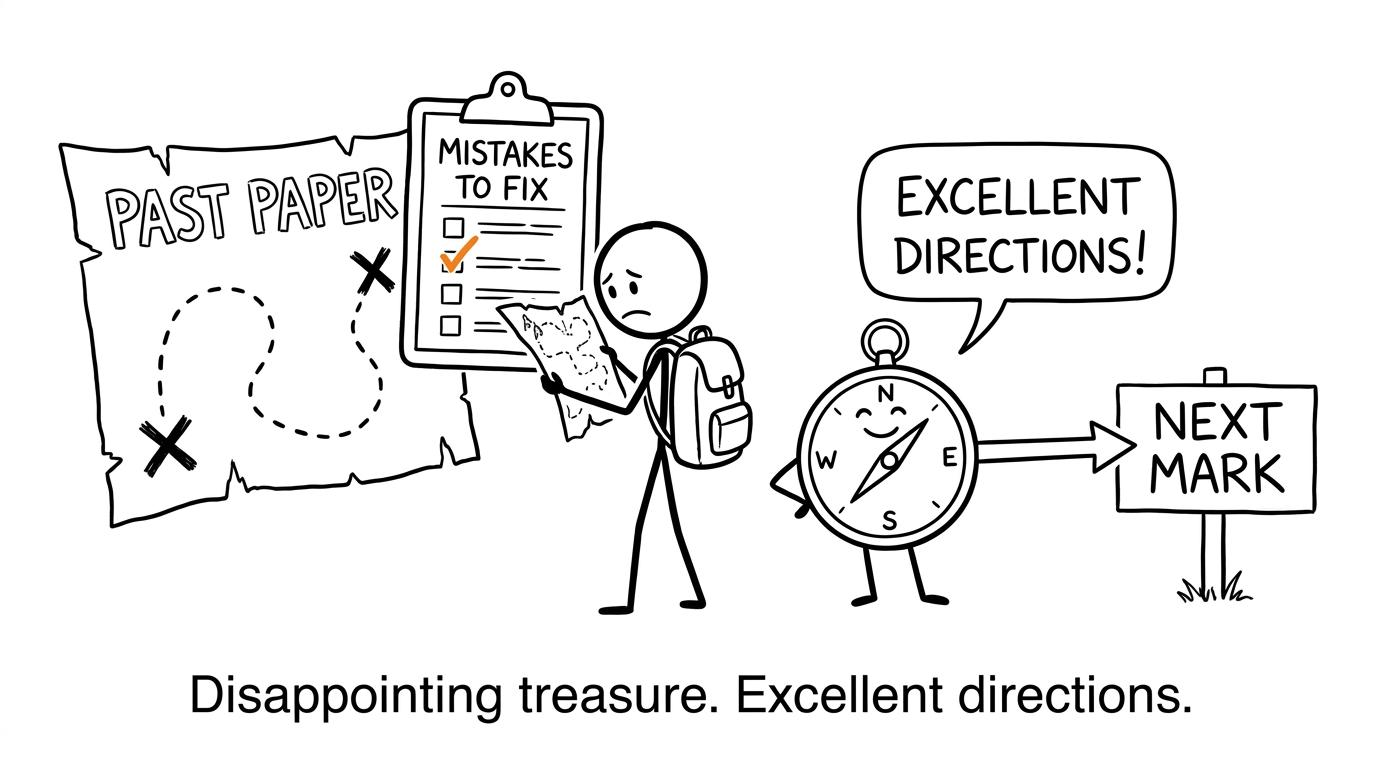 A past paper reveals disappointing treasure but excellent directions
What Arabic students can borrow from maths revision
Arabic and maths assess different knowledge, but effective revision has the same architecture: practise the exact skill, inspect errors and return later to test whether the improvement lasted.
A useful routine is:
- separate revision into the four assessed language skills;
- use timed tasks rather than relying only on notes;
- mark against the official mark scheme or teacher guidance;
- record whether each lost mark came from understanding, vocabulary, accuracy or exam technique;
- revisit the weakest category before attempting another complete paper.
For maths, MathsGenie's recommended order for learning GCSE topics applies this same idea to number, algebra, geometry, statistics and probability. Students aiming to strengthen a pass can also use the practical routine in how to move beyond a pass grade, even if they sit a different maths board.
Common mistakes when interpreting the result
Calling grade 4 a fail because grade 5 is a strong pass
Grade 555 being called a strong pass does not make grade 444 a fail. Grade 444 remains the recognised standard pass.
Treating grade 4 as exactly identical to every old C
Only defined points on the two scales were aligned. The accurate statement is that the bottom of grade 444 is comparable with the bottom of the old grade C.
Assuming grade 4 proves complete fluency
The result shows performance against GCSE assessment objectives. It does not guarantee effortless communication in every social, professional or academic context.
Using one year's boundary as a future target
Boundaries change. Use past boundaries to interpret past papers, while aiming to build a sensible margin above the historical threshold.
Applying the maths and English resit rule to Arabic
England's post-161616 continuing-study condition concerns eligible students without grade 444 or above in GCSE maths or English, or an accepted equivalent. It does not create the same statutory study requirement for GCSE Arabic.
A grade is a threshold, not a finish line
A grade 444 in GCSE Arabic means you achieved a standard pass, broadly comparable at its lower boundary with the old grade C. It reflects combined performance across listening, speaking, reading and writing. It is a credible achievement: neither proof of total fluency nor a result that needs to be dismissed because grade 555 has a different label.
And if maths is the next exam demanding your attention, turn the result into a better revision habit. Start at the MathsGenie GCSE Maths revision hub, choose your board and tier, then work through free revision lessons, practice questions, mark schemes and video solutions. Use mini tests to check weak areas, past papers to measure progress and predicted papers as a final rehearsal.
The number on the page matters. What you do with the information behind it matters more.










