GCSE Eduqas Maths: How to Move Beyond a Pass Grade
GCSE Eduqas Maths revision when you’re stuck at a pass grade: a simple plan, key topics, worked examples, mistakes to avoid and YesGenie links.
If you’re an Eduqas student stuck at a pass grade in GCSE Maths, it can feel like you’ve done “loads of revision” but your marks refuse to move. You know the basics. You can do some questions. Then a paper lands on a topic you half-remember, and your confidence quietly drops a notch.
The truth is that most pass-grade plateaus aren’t about ability. They’re about where your revision time goes. You don’t need more effort. You need fewer gaps, better habits, and a repeatable method that survives exam pressure.
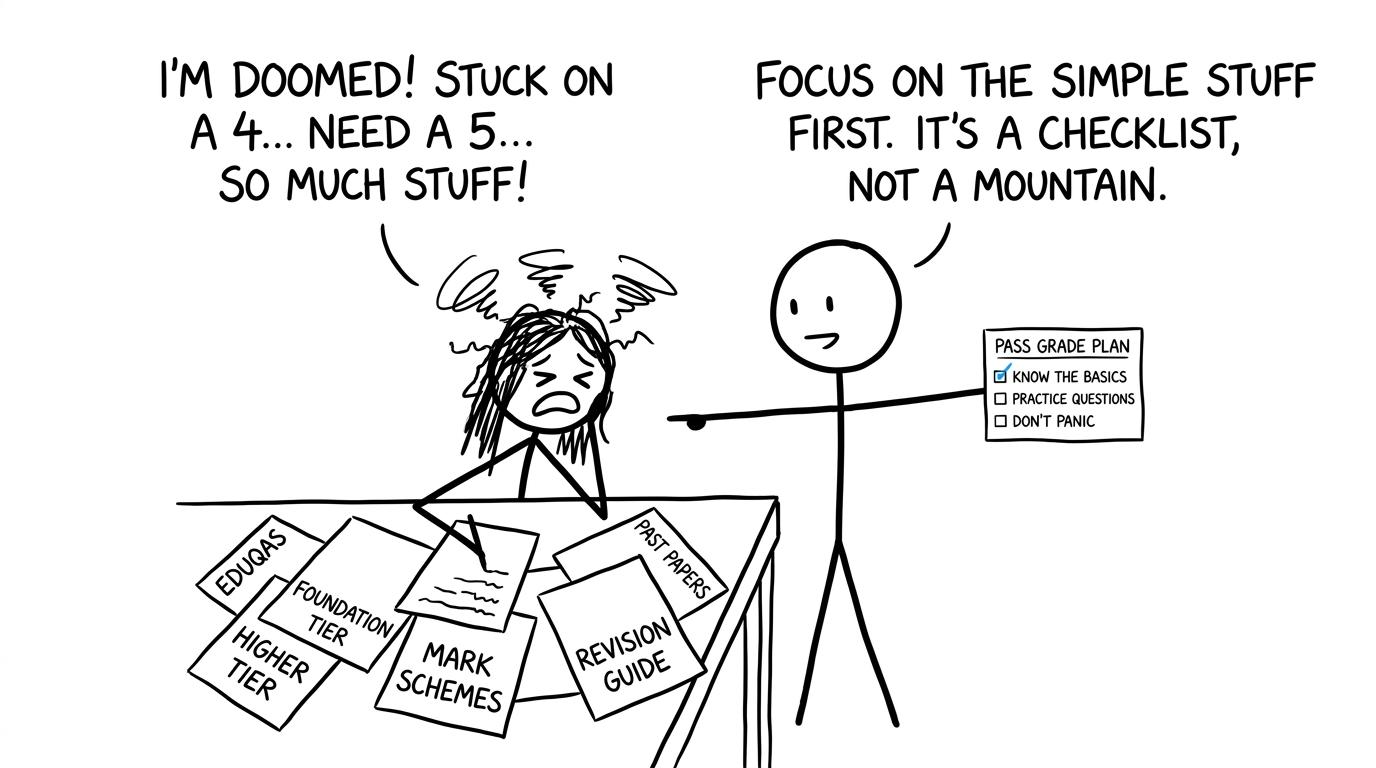 A GCSE pass-grade plan checklist comic
The pass-grade plateau (and why it’s common in GCSE Maths)
In GCSE Maths, a pass grade (usually grade 4, sometimes grade 5 depending on your goals and sixth form requirements) often comes from being solid on straightforward skills: basic percentages, simple algebra, and core number work. But Eduqas papers, like AQA, Edexcel and OCR, are designed to test fluency (can you do it?) and reasoning (can you recognise it?).
Plateaus happen when revision becomes:
- Watching solutions without practising.
- Practising the same comfortable topics.
- Doing whole papers without fixing the underlying mistakes.
You move beyond a pass grade when you treat GCSE revision like a feedback loop: attempt, mark, diagnose, target, repeat.
A simple Eduqas GCSE revision checklist (use this every week)
Here’s a realistic checklist for moving up from a pass grade.
- Choose your tier wisely: foundation or higher. If you’re on the border, talk to your teacher and use your paper scores to guide the decision.
- Build your core topics list (the pass-grade engine): fractions, percentages, ratio, equations, graphs, angle facts.
- Do short, targeted practice: 20-30 minutes on one topic beats 2 hours of random questions.
- Use mark schemes actively: not to “see the answer”, but to copy the method and the layout.
- Interleave: mix topics so your brain learns the difference between question types.
- Finish with exam-style papers under timed conditions.
On YesGenie you can keep this tight by moving between:
What Eduqas students should prioritise to move past a pass grade
Eduqas GCSE Maths assesses the same core maths as other boards, but your job is still to revise by specification skill: the topics that reliably appear and the mistakes that reliably cost marks.
Number: fractions, percentages, and the calculator habits
If you’re stuck at a pass grade, number is usually the quickest win because it appears everywhere.
Targets to secure:
- Fractions of an amount
- Percentage change
- Reverse percentages
- Standard form (often higher tier)
- Estimation and rounding (especially “show that” reasoning)
If you don’t trust your number skills, build them from topic pages, then switch to exam questions. Start with the revision notes and video support on YesGenie, then practise.
Algebra: the “two marks at a time” topic
Algebra is where students lose marks in small chunks: one incorrect rearrangement, one sign error, one line missing.
Targets to secure:
- Substitution
- Expanding and factorising
- Solving linear equations
- Forming equations from word problems
- Drawing and interpreting straight-line graphs
Ratio and proportion: the silent grade lifter
Ratio questions are often simple in structure but brutal if you don’t set them up calmly. Good ratio work also helps with probability, finance, and real-life contexts.
Geometry: angle facts and measures
A pass-grade student often knows angle rules but doesn’t spot which rule to use.
Targets to secure:
- Angles on a straight line, around a point
- Parallel lines
- Triangles and polygons
- Perimeter, area, and circle measures
Worked examples (the kind that push you beyond a pass in GCSE)
These examples are chosen because they reflect the kinds of method marks Eduqas papers reward. In GCSE Maths, method marks are your ladder out of the plateau.
Worked example: reverse percentage (common higher/foundation crossover)
A jacket is reduced by 20%20\%20% and now costs £48. Find the original price.
A 20%20\%20% reduction means the new price is 80%80\%80% of the original.
Let the original price be xxx.
0.8x=48 0.8x = 48 0.8x=48 x=480.8=60 x = \frac{48}{0.8} = 60 x=0.848=60So the original price is £60.
Why this helps your GCSE grade: you’re not guessing. You’re using a clear equation that earns method marks even if arithmetic slips later.
Worked example: ratio sharing (foundation staple, higher still appears)
Share £84 in the ratio 5:25:25:2.
Total parts =5+2=7= 5 + 2 = 7=5+2=7.
Each part is:
847=12 \frac{84}{7} = 12 784=12So the shares are:
- 555 parts: 5×12=605 \times 12 = 605×12=60
- 222 parts: 2×12=242 \times 12 = 242×12=24
Check: 60+24=8460 + 24 = 8460+24=84.
Worked example: forming and solving an equation (the pass-grade separator)
A number is multiplied by 333, then 555 is subtracted. The answer is 343434. Find the number.
Let the number be nnn.
3n−5=34 3n - 5 = 34 3n−5=34Add 555 to both sides:
3n=39 3n = 39 3n=39Divide by 333:
n=13 n = 13 n=13Exam habit: write the equation first. It keeps you calm when the wording gets longer.
Worked example: area of a triangle from base and height
A triangle has base 10 cm10\text{ cm}10 cm and perpendicular height 7 cm7\text{ cm}7 cm. Find the area.
Area=12×base×height \text{Area} = \frac{1}{2} \times \text{base} \times \text{height} Area=21×base×height Area=12×10×7=35 cm2 \text{Area} = \frac{1}{2} \times 10 \times 7 = 35\text{ cm}^2 Area=21×10×7=35 cm2GCSE mark tip: always include units for area, and don’t use the slanted side as “height” unless it is perpendicular.
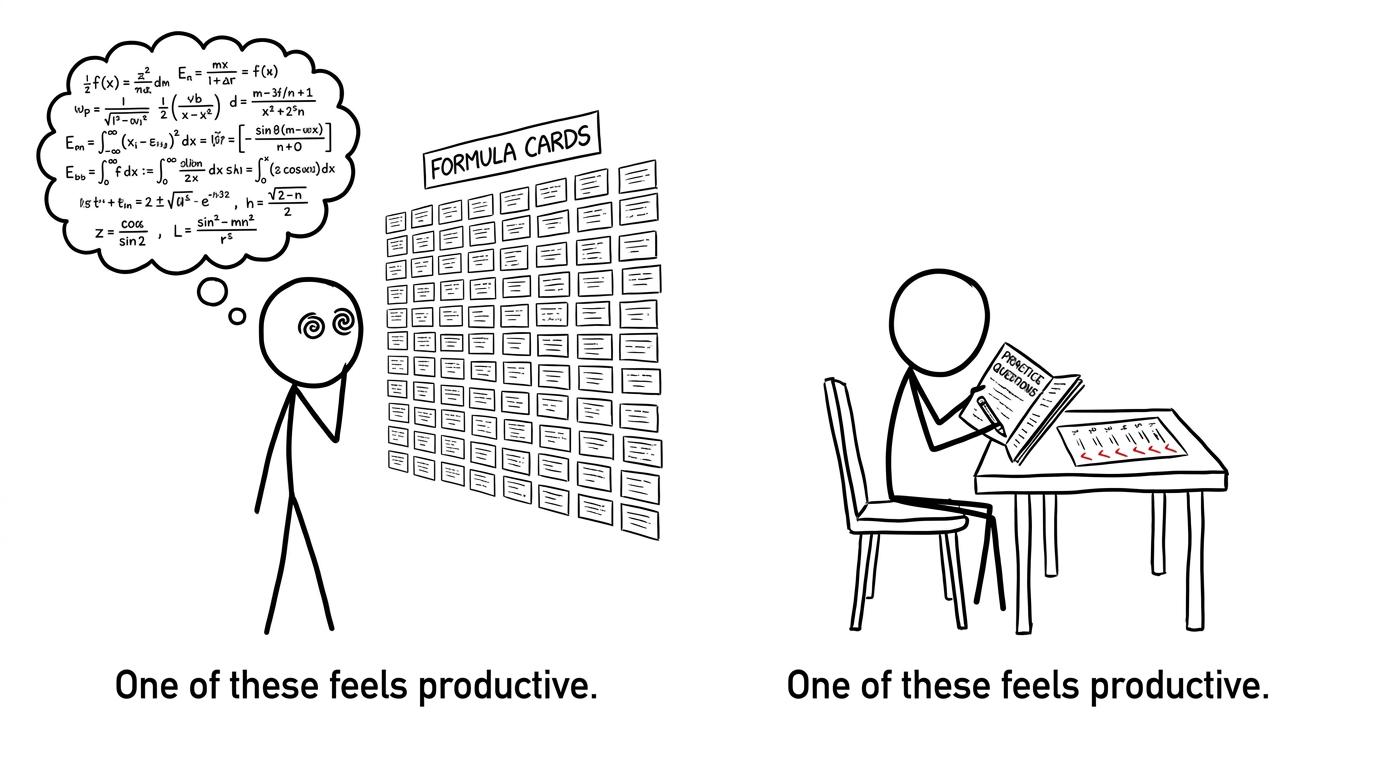 Practice questions vs memorising comic
How to use YesGenie for Eduqas GCSE Maths (without revising everything)
If you are stuck at a pass grade, the temptation is to restart the whole course. It feels responsible, but it’s usually inefficient.
Instead, use YesGenie like a sat-nav:
Start with Eduqas-aligned revision guides
Go topic-by-topic using Eduqas GCSE Maths Revision Guides. For each topic, you’re aiming for two outcomes:
- You can explain the method in a sentence.
- You can get a small set of exam-style questions right consistently.
Then switch to exam-style practice and mark schemes
When your understanding is “good enough”, move quickly to past papers and mark schemes. You can find papers organised on GCSE Past papers.
If you’re doing timed practice, a strong routine is:
- Attempt a section.
- Mark it.
- Rewrite the correct method for any missed question.
- Do two similar questions later that week.
Use short tests to build confidence under time pressure
Pass-grade students often know the content but freeze when the clock is loud. Short tests help you practise staying calm.
Use the Resources (including Mini Tests) area to create shorter, focused sessions. Even if the mini tests are listed under another board, the core GCSE skills overlap heavily, so they still work as practice.
Common mistakes that keep Eduqas students stuck at a GCSE pass grade
These are painfully normal, and fixing them is often worth more than learning new topics.
- Not writing an equation in worded problems. If you jump straight to arithmetic, you usually lose the method marks.
- Mixing up percentage multipliers. A 20%20\%20% increase is multiplying by 1.21.21.2, but a 20%20\%20% decrease is multiplying by 0.80.80.8.
- Using the wrong “height” in triangle area questions. The height must be perpendicular to the base.
- Rounding too early in multi-step calculator questions. Keep full calculator values until the end.
- Ignoring what the question asked (value, units, degrees, “show that”). In GCSE maths, a correct method can still lose marks if the final statement is unclear.
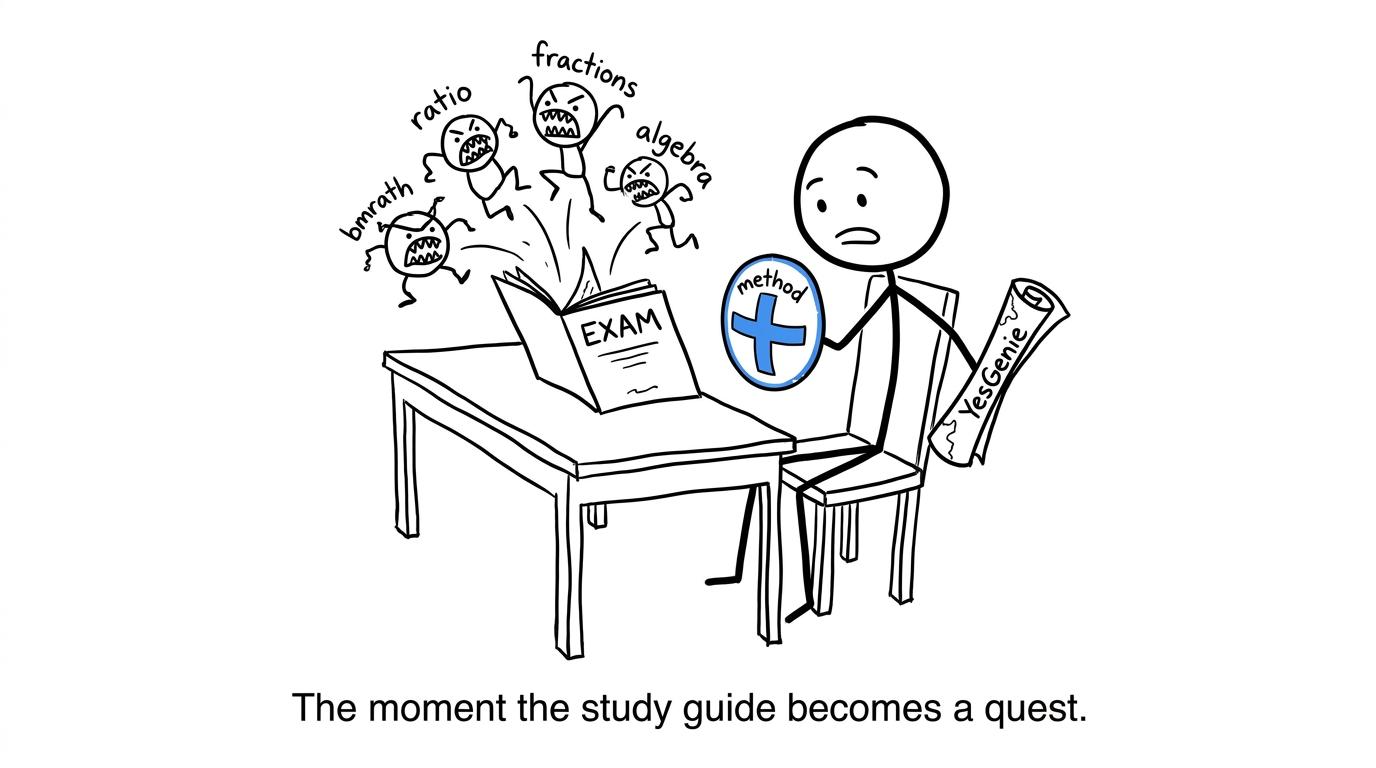 Method shield vs topic monsters comic
A final plan: your next 14 days to escape the GCSE pass grade
If you’re an Eduqas student stuck at a pass grade, aim for a two-week sprint that’s more precise than it is intense:
- Pick 6 core topics you keep losing marks on.
- Spend 20-30 minutes per day using the relevant revision guide and doing exam-style questions.
- Every three days, do a short timed set to practise calm problem-solving.
- At the end of week 2, do a full GCSE paper under exam conditions, then mark it carefully and repeat the loop.
That’s the quiet advantage of YesGenie: you don’t have to guess what to do next. Use revision lessons and revision guides to rebuild understanding, then practise with past papers, predicted-style practice, and topic questions until the method becomes automatic.
If you want your next paper to feel different, make your next revision session different. Start now with the Eduqas GCSE Maths Revision Guides, then prove it to yourself with GCSE Past papers. Your GCSE grade moves when your habits move first.