

GCSE Arabic Early Entry: Is It a Good Idea?
GCSE Arabic early entry can free Year 11 time, but only if all four skills are secure. Weigh grades, workload, tier choice and maths revision carefully.
A qualification taken early can feel like a door closing behind you: one less GCSE to worry about in Year 11. Yet GCSE Arabic early entry is only a good idea when your listening, speaking, reading and writing are already secure at the grade you want. Speaking Arabic confidently at home is valuable, but it does not automatically mean you are ready for every part of the examination.
The short answer is simple. Consider early entry if your teacher has strong evidence that you are exam-ready, you understand the specification and the preparation will not weaken your maths, English or science revision. Wait if your literacy, formal vocabulary, translation or exam technique still needs substantial development.
A quick early-entry checklist
Before agreeing, ask whether all of these statements are true:
- I have completed timed assessments in all four language skills.
- My results are consistently near or above my target grade.
- I can read and write formal Arabic, not only communicate conversationally.
- My school has confirmed the exam board, tier and entry arrangements.
- I understand what happens if I later resit the qualification.
- Arabic preparation will not displace essential GCSE maths revision.
- I want to enter early for a clear academic reason, not simply because I can.
If several answers are uncertain, waiting another year is not failure. Extra time has value when it is used deliberately.
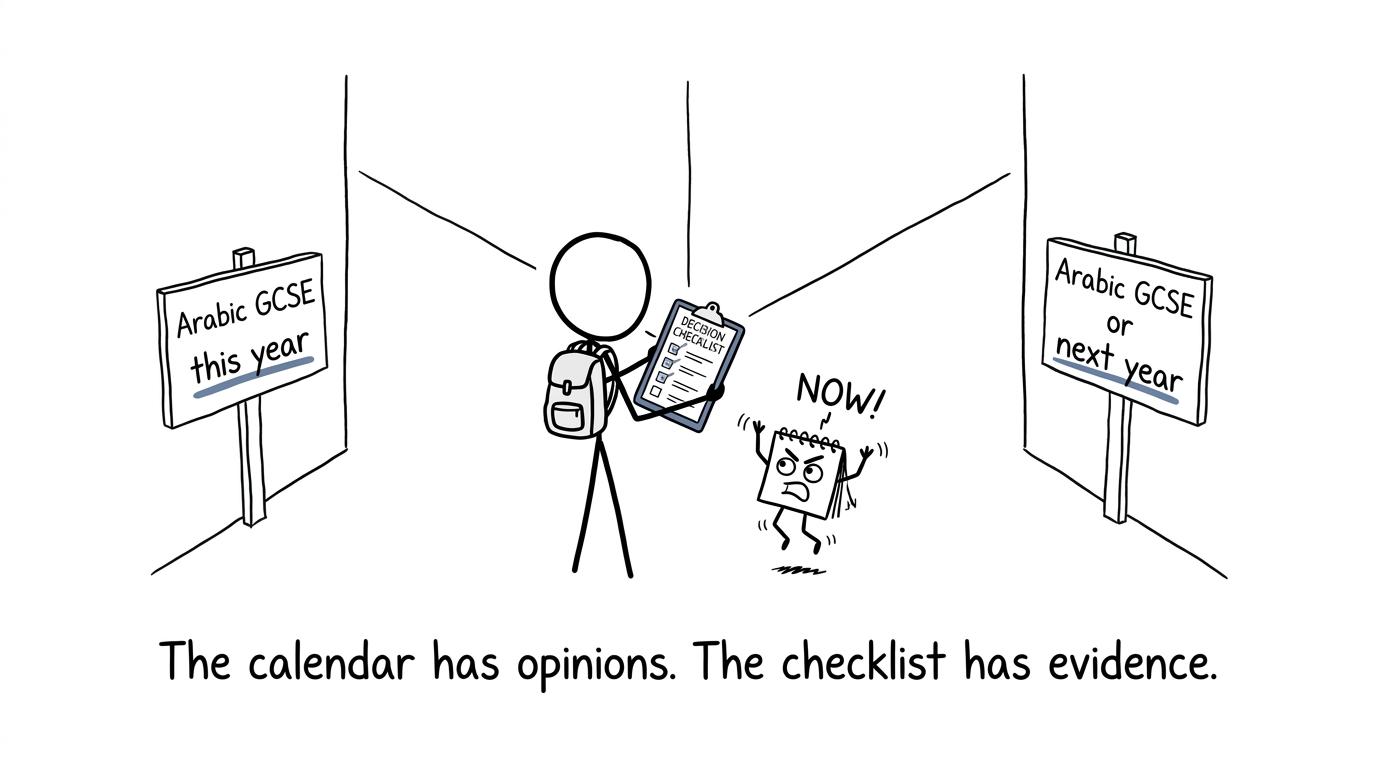 A student choosing between taking Arabic GCSE this year or next year while a calendar looks intimidating
What GCSE Arabic actually assesses
The current Pearson Edexcel GCSE Arabic qualification is a grades 999 to 111 GCSE. It assesses four skills through separate papers:
- listening and understanding;
- speaking;
- reading and understanding;
- writing.
Each paper contributes 25%25\%25% of the qualification. Students take either foundation or higher tier across the whole qualification; mixed-tier entry is not allowed. Foundation tier covers grades 111 to 555, while higher tier covers grades 444 to 999.
All assessments must be completed in the same examination series. The speaking assessment takes place before the main written papers, so readiness has to arrive earlier than students sometimes expect. Dictionaries are not permitted in the assessments.
This matters because early entry cannot sensibly be based on one strength. A student might understand rapid family conversations but be less confident with formal reading. Another might write accurately but struggle to respond spontaneously in a speaking task. The final grade combines all four areas equally.
GCSE Arabic is also different from International GCSE Arabic (First Language). They have different specifications and assessment structures. Confirm the exact qualification code with your school or examination centre rather than assuming that any Arabic course leads to the same papers.
When taking GCSE Arabic early can make sense
Your performance is already stable
One successful mock is encouraging. It is not enough evidence on its own.
A stronger case comes from repeated, timed performance across different topics and all four skills. Ask your teacher for a breakdown rather than only an overall estimated grade. If reading is consistently strong but writing varies significantly, the average may hide a genuine risk.
The important question is not, “Could I pass now?” It is, “Am I likely to achieve the grade that reflects my ability now?” Early entry makes more sense when another year is unlikely to produce a meaningful improvement.
It creates useful space in Year 11
Completing Arabic in Year 10 may reduce the number of subjects competing for attention during the main GCSE season. That can create more room for maths, English, science and other option subjects.
But the space only appears later. Early entry usually requires preparation now. Count the lessons, speaking practice, writing feedback and past-paper sessions needed before deciding that the qualification will save time overall.
A realistic timetable is more useful than a hopeful one. The GCSE maths revision timetable guide can help you map your existing commitments before adding Arabic preparation.
You have access to appropriate teaching and assessment
Being a fluent or heritage speaker can provide a strong foundation, but the examination also rewards familiarity with its themes, task types and mark scheme. Formal written Arabic, grammatical accuracy and translation may require targeted teaching.
Your school must also be able to organise the speaking assessment correctly and enter you for the appropriate tier. If you are entering through an external centre, confirm its arrangements, deadlines and support before building your revision plan around an assumed place.
When waiting is probably the better decision
Your spoken Arabic is much stronger than your literacy
Everyday fluency and examination readiness overlap, but they are not identical. Dialect, formal written Arabic, spelling, grammar and unfamiliar reading passages can expose gaps that ordinary conversation does not reveal.
Waiting may give you time to turn intuitive knowledge into dependable examination performance. That is particularly important if you are aiming for one of the highest grades rather than simply seeking a pass.
The early exam would crowd out core revision
Time has an opportunity cost. An extra Arabic session may replace the maths session in which you finally secure simultaneous equations, probability trees or circle theorems.
Start with evidence. Use the GCSE maths revision hub to identify your board and tier, then complete a short diagnostic. The guide to finding your weakest GCSE topics explains how to turn lost marks into a focused revision list.
If your maths foundations are already fragile, compressing another GCSE into the year may be the wrong trade. A qualification gained early is not automatically beneficial if it lowers performance elsewhere.
You are being entered because early always sounds better
Earlier is not the same as stronger. Examinations reward what you can demonstrate on the day, not how young you were when you attempted them.
In England, first-entry rules can also affect which result counts in a school’s key stage 444 performance measures when a pupil takes more than one qualification in the same subject. These rules do not prevent early entry, but they give schools a reason to make sure students are sufficiently prepared. Accountability arrangements differ across the UK, so ask your school how an early result and any later resit would be treated in your circumstances.
Protecting maths revision while preparing for Arabic
The safest plan gives each subject a different job. Arabic needs regular contact with listening, vocabulary, speaking and writing. Maths needs active problem-solving, marking and correction.
A balanced week might include:
- short Arabic vocabulary and listening sessions;
- one longer Arabic writing or speaking session;
- several focused maths topic sessions;
- one timed maths mini test or paper section;
- protected time for reviewing mistakes in both subjects.
Avoid measuring revision only in hours. Measure what was completed and corrected. Twenty focused minutes can be more useful than an unfocused evening, which is why the 20-minute maths revision routine works well on busy school days.
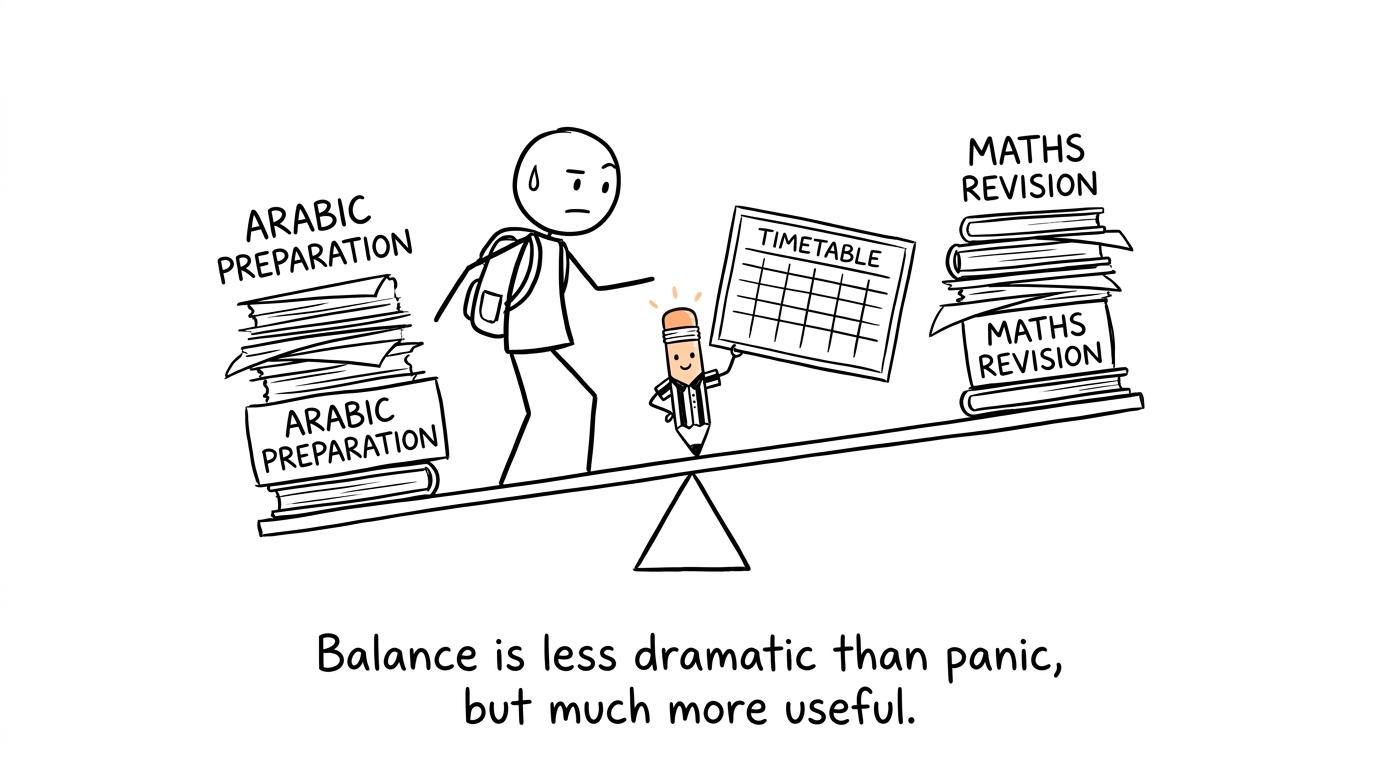 A student balancing Arabic preparation and maths revision on a seesaw while a pencil referees
When maths paper practice begins, choose resources matching your actual exam board and tier. The AQA GCSE maths revision area is available for AQA students, while the main hub covers Edexcel, OCR, Eduqas, WJEC and CCEA as well.
Do not make predicted papers your entire plan. First build topic knowledge, then use past papers for authentic examination practice. Near the exams, Edexcel GCSE maths predicted papers can provide fresh timed questions alongside mark schemes and worked solutions.
Questions to ask before agreeing to early entry
Arrange a conversation with your Arabic teacher, head of languages or examinations officer. Ask:
- Which qualification and specification will I take?
- Will I enter foundation or higher tier, and why?
- What evidence shows that I am ready in every skill?
- What grade range have my timed assessments indicated?
- Who will prepare and conduct the speaking assessment?
- What support will I receive before the examination?
- How would a resit work if I am unhappy with the result?
- How will preparation fit around my other GCSE subjects?
Parents and students should hear specific answers. “You speak Arabic well” is positive, but it is not a complete assessment plan.
Common mistakes with GCSE Arabic early entry
Confusing fluency with specification coverage
A student may communicate naturally while lacking the formal vocabulary, grammatical control or writing accuracy required by the papers. Check every assessment objective rather than relying on general confidence.
Choosing a tier without enough evidence
The same tier must be taken across all four papers. Tier decisions should come from timed assessments and teacher judgement, not pride or fear.
Revising only favourite skills
Reading familiar texts can feel productive, while timed writing or spontaneous speaking feels uncomfortable. The uncomfortable skill is often where the most useful improvement remains.
Ignoring the speaking timetable
The speaking assessment occurs before the main written papers. Planning backwards from the written examination dates may therefore leave preparation too late.
Letting Arabic absorb all available revision time
An early qualification should reduce future pressure, not create a crisis in another subject. Continue checking maths with mini tests and timed questions. When you start full papers, follow a disciplined cycle of attempt, mark, fix and retest. The guide to using GCSE past papers properly explains that process clearly.
Make the decision from evidence, not urgency
GCSE Arabic early entry can be sensible for a student whose four skills are already secure, whose target grade is supported by repeated timed assessments and whose wider GCSE workload remains manageable. It is less convincing when the decision rests mainly on conversational fluency, one strong mock or the belief that earlier must be better.
Ask for the evidence. Check the specification. Protect your core subjects. Then choose the sitting that gives you the best chance to demonstrate your real ability.
For maths, make MathsGenie’s free GCSE revision resources your starting point. Use revision lessons and practice questions to repair individual topics, mini tests to check recall, and past papers with mark schemes and video solutions to build exam readiness. Add predicted papers only after the foundations are secure. A calm plan does not remove every difficult week, but it ensures that each hour of revision has a purpose.










