

Gap Year After A-Level Results: Should You Defer?
Gap year after A-level results? Learn how university deferral works, weigh the benefits and risks, and plan calm, useful next steps after results day.
Opening an results envelope can make several years of work feel compressed into one moment. Yet results day is not a command to rush. If you are considering a gap year after A-level results, you can ask your university to delay your start, release your place and reapply, or reconsider your options through Clearing.
The crucial fact is simple: deferral is not automatic. Your university decides whether to approve it, and some courses do not accept late deferrals. Contact admissions before declining anything in your UCAS application.
For younger students preparing for GCSEs, this may feel distant. But understanding the route ahead can make choices about sixth form, A-level subjects and university feel less mysterious.
Your results-day checklist
Before making a final decision:
- Check your grades and UCAS application status.
- Read the deferral policy for your university and course.
- Contact admissions directly and explain your reasons.
- Ask whether your offer, accommodation or scholarship will be affected.
- Compare deferral with reapplying next year or using Clearing now.
- Write a realistic plan and budget for the year.
- Speak to a teacher, careers adviser or trusted adult.
- Get any approved change confirmed in writing.
A-level results day in 2026 is Thursday 13 August. There is no advantage in making a permanent decision during the most emotional ten minutes of that morning.
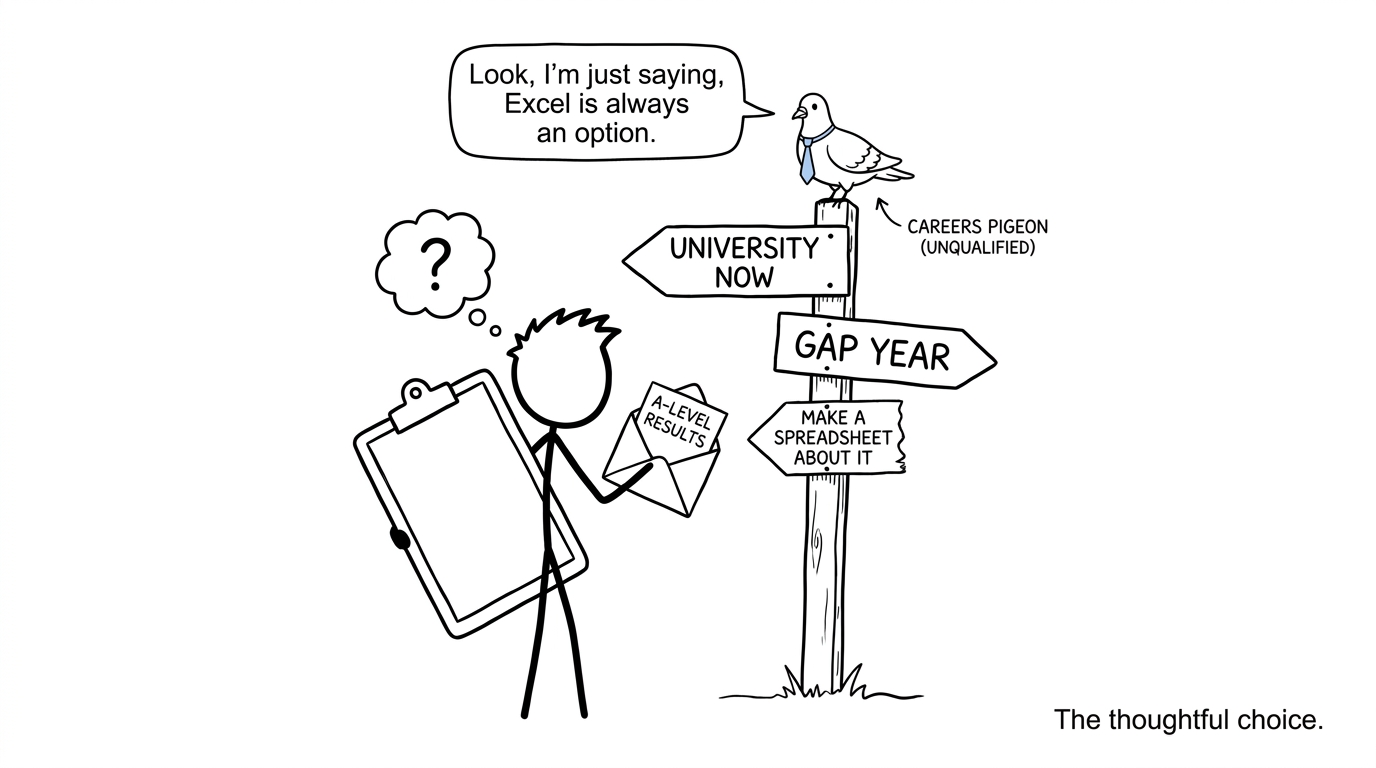 A student choosing between university and a gap year while an unqualified pigeon offers careers advice
What does deferring a university place mean?
Deferring means keeping an accepted university place but starting the course later, usually by one year. It is different from declining your place and submitting a new application in the next UCAS cycle.
Students can initially apply for deferred entry or request a deferral after applying. If you request one after results, approval remains entirely at the university's discretion. You may be asked why you want to defer and what you intend to do during the year. Certain courses may refuse deferral or require you to reapply.
The academic conditions of a deferred offer do not normally become easier. If your offer required particular grades, you must still achieve them in the year stated. You should also check arrangements for accommodation, bursaries and student finance rather than assuming they will transfer automatically.
If you accept a deferred place, UCAS advises that you cannot make another application in the following cycle while continuing to hold it. You would first need to withdraw from that place. Clearing vacancies are also offered for entry in the current year, so Clearing should not be treated as a guaranteed way to reserve a course for next year.
Deferring university place for a gap year: your options
Ask to keep your confirmed place
Call or email admissions as soon as you are reasonably sure. Give your UCAS ID, course details and a concise explanation of your plans. Ask directly whether the place can be moved to the following year and when you will receive written confirmation.
Do not use the UCAS option to decline your place merely because you assume the university will restore it later. Once released, the original offer may be difficult or impossible to recover.
Decline and reapply next year
Reapplying provides the freedom to reconsider your course or university with achieved grades rather than predicted grades. The trade-off is uncertainty: your original place is gone, entry requirements may change, and a future offer is not guaranteed.
This route may suit someone whose results have changed their ambitions or whose original course no longer feels right. It should be an active choice, not the accidental result of missing a deferral deadline.
Start university this year
A gap year is an option, not an obligation. If you still want the course and feel ready, beginning now may provide structure, new friendships and academic momentum. Nervousness alone does not necessarily mean the decision is wrong.
The benefits and risks of a gap year
A thoughtful gap year can provide time to work, save, travel, volunteer, improve relevant skills or recover after an intense exam period. It can also test whether a career idea survives contact with everyday reality.
The risks are equally real. Travel and unpaid opportunities can be expensive. A vague year may drift, while returning to formal revision after a long break can feel harder. Fees, course details and student-finance rules may also differ in the year you actually begin, so check current information with the relevant university and funding body.
The useful question is not, “Will a gap year look impressive?” It is, “What will this year make possible that starting now would not?”
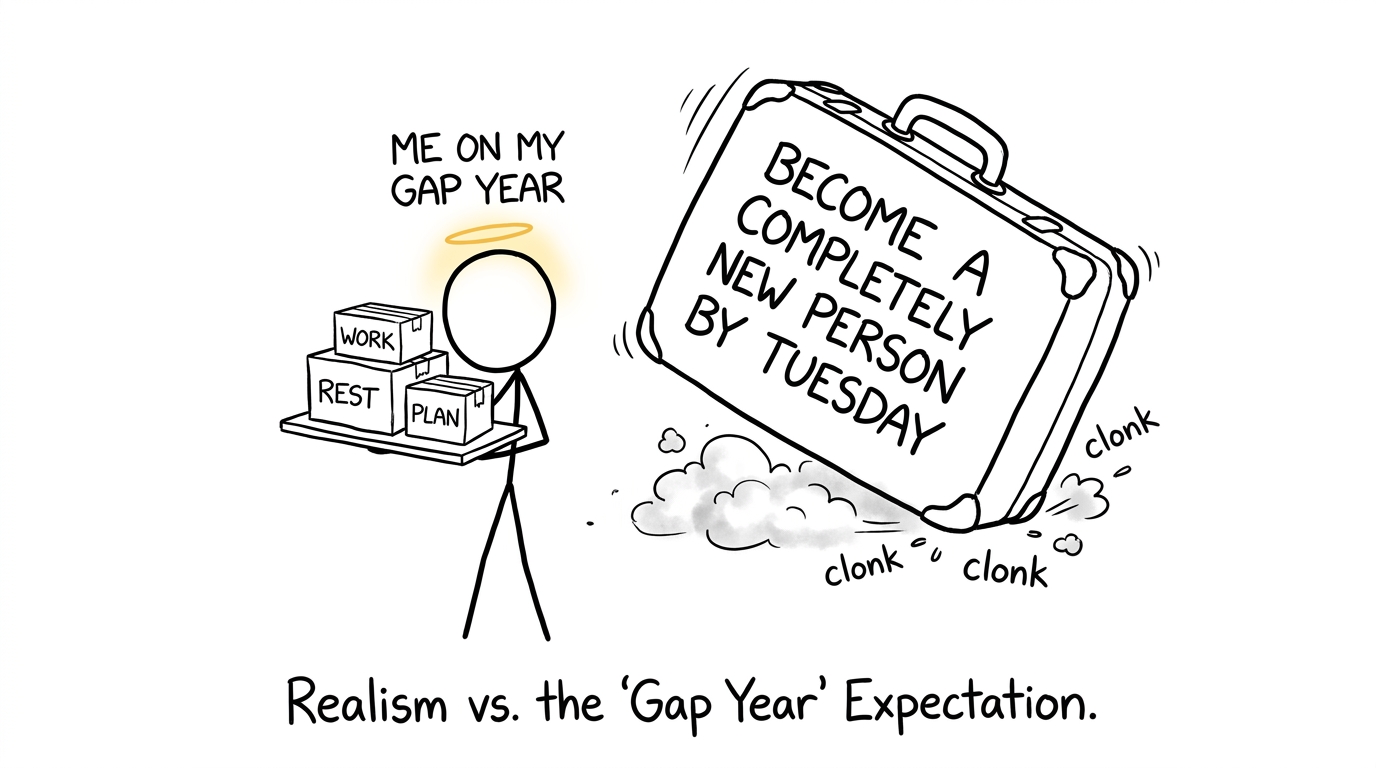 A gap-year student balancing work, rest and planning while an unrealistic suitcase falls over
How to plan a gap year that has direction
A good plan need not be dramatic. Divide the year into three purposes: something that supports you financially, something that develops you, and something that keeps you connected with your future course.
Set approximate dates, expected costs and a backup plan. If you intend to work, research realistic vacancies before relying on imagined earnings. If travelling, account for insurance, transport, accommodation and emergencies. If a course expects continuing subject knowledge, schedule light but regular revision.
For students progressing towards a maths-related degree, the free A Level Maths revision hub can keep techniques familiar. You can use board-specific resources through Edexcel A Level Maths revision or AQA A Level Maths revision, including revision guides, questions, mini tests, papers and video support.
Common mistakes when choosing a gap year
Acting before contacting admissions. Ask about deferral before surrendering a confirmed place.
Assuming approval is guaranteed. Universities can reject late requests or exclude particular courses.
Planning only the exciting months. Include ordinary weeks, costs, work applications and contingencies.
Ignoring academic skills completely. A short weekly refresher is easier than rebuilding fluency at the end of the year.
Choosing from panic or comparison. Another student's immediate plan does not determine the right timetable for you.
Looking ahead from GCSEs
If you are currently preparing for GCSE maths, the best contribution you can make to future choices is to keep your options open now. Start with the GCSE Maths revision hub, then use resources matched to your board and tier, such as Edexcel GCSE Maths revision or AQA GCSE Maths revision.
Build confidence through AQA GCSE Maths past papers, mark your work carefully, and use GCSE predicted papers alongside real past papers rather than instead of them.
A gap year after results can be sensible, but its value comes from intention rather than the label. Pause, gather the rules for your particular offer and choose the route that gives you the strongest next step. Meanwhile, MathsGenie is here whenever you need a calm revision base, with free lessons, practice questions, mark schemes, past papers, predicted papers, mini tests and video solutions.











